
Picking a game engine isn’t really about which one is “best” — it’s about which one fits your project’s genre, your team’s budget, and a licensing model you can actually live with once the game starts making money. That last part gets skipped constantly in framework comparisons, which is a real problem, because licensing terms have changed dramatically in the last few years and can matter more to a project’s bottom line than any technical feature. Here’s an accurate, current comparison of the major options.
The Big Three: Unity, Unreal Engine, and Godot
These three dominate the conversation for good reason, but they differ sharply in cost structure, not just capability:
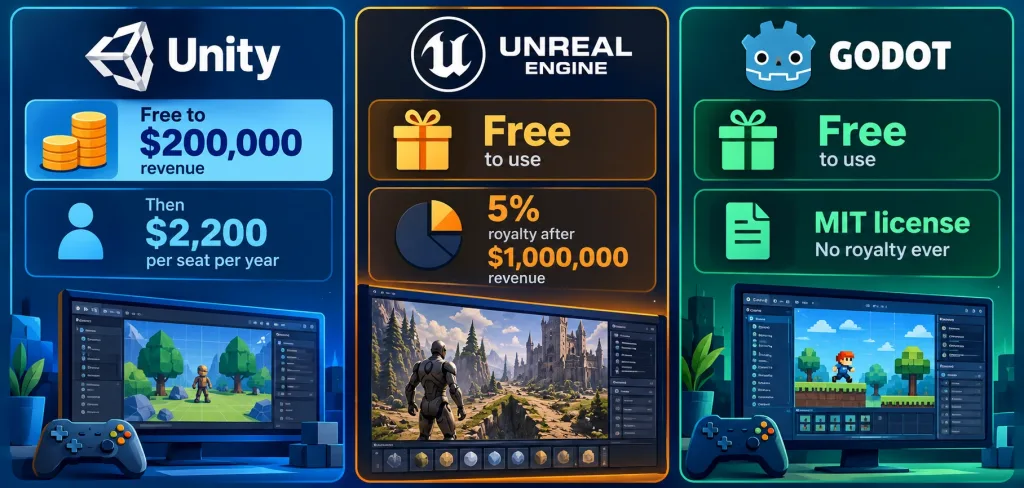
- Unity is a cross-platform engine widely used across mobile, indie, and some AAA titles (Cuphead and Temple Run both originated on Unity). After a 2023 “Runtime Fee” announcement triggered a major developer backlash, Unity reversed course in September 2024. As of January 1, 2025, Unity Personal is free with a revenue ceiling raised to $200,000; above that, Unity Pro costs $2,200 per seat annually; studios above $25 million in revenue and funding need Unity Enterprise, whose pricing rose roughly 25% in the same update. Worth noting: Unity has said it will only change pricing once a year going forward, though that’s a stated policy, not a contractual guarantee — worth confirming on Unity’s own site before committing a long-term project to it.
- Unreal Engine (now on version 5, not 4 — UE5 has been the current release since 2022) is known for high-end, out-of-the-box graphics and physics, and has shipped AAA titles like the Gears of War and Mass Effect series. Epic’s licensing model: Unreal Engine itself is free to download and use, with a 5% royalty on gross revenue after the first $1 million in lifetime gross revenue per product (reduced to 3.5% for games launched simultaneously on the Epic Games Store and elsewhere; Epic Games Store revenue doesn’t count toward that $1 million threshold at all). There’s no seat license — the royalty only applies once a game is actually earning.
- Godot is free and open source under the MIT license, with no royalties, no subscription, and no revenue threshold of any kind — genuinely free regardless of how successful the resulting game becomes, not just free to start. It supports both 2D and 3D development and has built a large, active community, making it a legitimate option rather than a lesser alternative to the two commercial engines above.
2D-Focused Tools: GameMaker and Construct
For projects that are specifically 2D and don’t need Unity or Godot’s full 3D capability:
- GameMaker offers strong flexibility for 2D game design but has a steeper learning curve for anyone without programming experience, and fewer built-in features than Construct out of the box.
- Construct is more approachable for beginners and non-programmers, with more features built in by default, trading away some of GameMaker’s flexibility in the process. For a first-time solo developer with no coding background specifically, Construct’s lower barrier to entry is the more practical starting point; GameMaker is the better fit once you’re comfortable with at least some scripting and want more control.
What Happened to CryEngine and Lumberyard
This is where accuracy really matters, because one of these engines no longer exists in the form it’s usually described in:
- CryEngine remains a real, actively maintained engine known for strong visual fidelity and a built-in visual scripting system, historically used in several AAA titles.
- Lumberyard is not a current option. Amazon discontinued Lumberyard in 2021, donating its codebase to the Linux Foundation, where it was relaunched as the Open 3D Engine (O3DE) — a community-governed, open-source project rather than an Amazon product. Any current guide recommending “Lumberyard” by that name is describing a discontinued product; developers interested in that lineage should look at O3DE directly.
Open-Source and Mobile-Focused Frameworks
- libGDX is a genuinely popular open-source Java-based framework, known for a relatively approachable learning curve and a large, active community — Machinarium and Ridiculous Fishing both used it.
- Cocos2d-x has real production credibility at scale: Supercell’s Clash of Clans and Tencent’s Arena of Valor were both built on it. It has a steeper learning curve than libGDX, but is a genuinely strong choice specifically for mobile-first projects given that track record.
- Phaser is a free, open-source JavaScript/HTML5 framework worth naming directly for anyone building browser-based 2D games — a genuinely different use case from the engines above, and a common choice for web game jams and lightweight browser titles specifically because it runs natively in a browser with no download required.
- MonoGame is a free, open-source C#-based framework (a spiritual successor to Microsoft’s discontinued XNA framework), aimed at developers who want low-level control in C# without Unity’s editor and licensing overhead.
Choosing the Right Framework for Your Actual Project
- For 2D specifically: Construct if you have no programming background and want to start immediately; GameMaker if you’re comfortable scripting and want more control; Godot if you want genuinely free, no-strings-attached 2D development with room to grow into 3D later.
- For 3D with high-end visual requirements: Unreal Engine 5, given its strong out-of-the-box graphics and physics — budget for the 5% post-$1M royalty once the project is actually earning, not before.
- For cross-platform 2D and 3D on a strict budget: Godot’s MIT license removes licensing cost from the decision entirely, which matters a great deal for a solo developer or small team where margins are already thin.
- For mobile specifically, at scale: Cocos2d-x has the strongest track record of any option here for mobile titles that need to perform well at high player volume.
- For browser-based games: Phaser is the practical default given how much of the JavaScript game-dev ecosystem is already built around it.
The Bottom Line
The technical capability gap between these frameworks has narrowed considerably — Unity, Unreal, and Godot can all realistically build a polished 2D or 3D game today. What actually differentiates them now is licensing cost at scale (Godot’s genuinely free MIT license vs. Unreal’s post-$1M royalty vs. Unity’s per-seat Pro pricing above its revenue ceiling), platform/genre fit (Cocos2d-x for mobile at scale, Phaser for browser games), and how much hand-holding your team actually needs (Construct over GameMaker for a true beginner).
Checking a framework’s current licensing terms directly before committing a long-term project to it is worth doing regardless of which one you’re leaning toward, since — as Unity’s 2023 reversal and Lumberyard’s 2021 discontinuation both demonstrate — these terms and even the products themselves can change.
Frequently Asked Questions
What’s the difference between a game engine and a game development framework?
In practice the terms are used loosely and overlap significantly. A game engine (Unity, Unreal, Godot) typically provides a full visual editor, rendering pipeline, and integrated tools out of the box. A framework (libGDX, MonoGame, Phaser) is usually more code-first, giving a developer lower-level building blocks without a full visual editor — more control, with a steeper setup.
Is Unity still free to use?
Yes, for most individual developers and small studios — Unity Personal is free up to $200,000 in revenue as of the January 2025 pricing update. Studios earning more than that need a paid Unity Pro seat ($2,200/year), and very large studios (over $25 million in revenue and funding) require Unity Enterprise.
Does Unreal Engine actually cost money to use?
Not upfront — it’s free to download and develop with. Epic takes a 5% royalty on gross revenue only after a game has earned its first $1 million lifetime (reduced to 3.5% for Epic Games Store-simultaneous releases, and Epic Games Store revenue itself doesn’t count toward that threshold).
Why shouldn’t I use Lumberyard for a new project?
Amazon discontinued Lumberyard in 2021 and handed its codebase to the Linux Foundation, where it continues as the community-governed Open 3D Engine (O3DE). Lumberyard itself is no longer maintained or available as an Amazon product, so any current project should look at O3DE instead if that engine lineage is of interest.
Which framework should a complete beginner with no coding experience start with?
Construct is generally the most approachable starting point for 2D games with zero programming background, given its built-in features and lower learning curve. Godot is a reasonable second option if you’re willing to pick up some basic scripting fairly quickly, with the advantage of a genuinely free license with no revenue ceiling as your project grows.