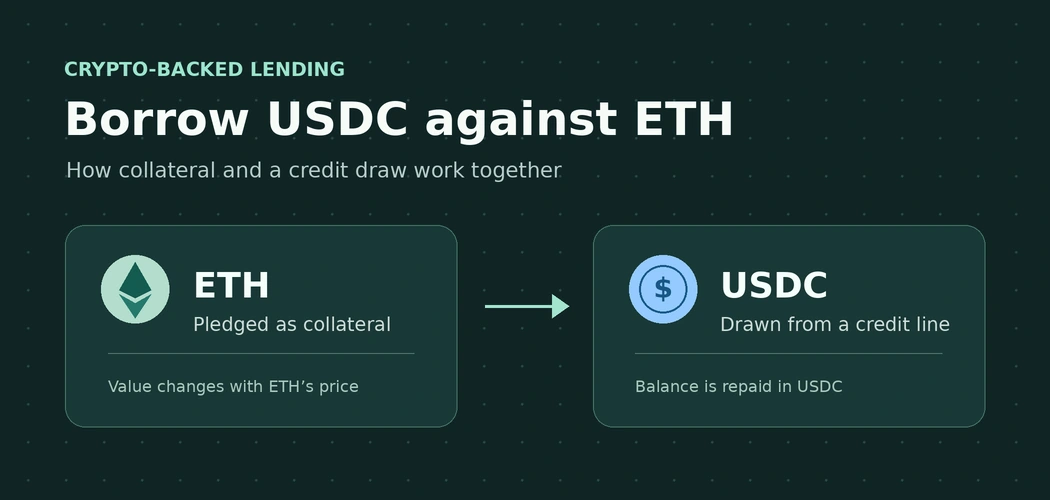
Crypto-backed lending lets you borrow against the value of your ETH without selling it upfront. You pledge ETH as collateral and receive USDC, a stablecoin designed to track the U.S. dollar. You owe the borrowed USDC back, along with any applicable interest and fees. Your ETH remains exposed to price changes while it secures the debt, and the lender or protocol can liquidate some or all of it if the position breaches its rules.
The decision comes down to more than the rate. Before you draw, work out how you’ll repay in USDC, how much ETH can fall before liquidation becomes possible, and what it will cost to move funds between the networks involved.
What a USDC credit line gives you
A term loan typically disburses a fixed amount and sets a repayment schedule. A credit line establishes a limit you can draw from as needed. If your approved limit is 5,000 USDC and you draw 2,000, the amount you used is 2,000 USDC. Check whether the provider charges interest on the used amount, whether fees apply to each draw, and whether repaying principal restores the credit you can use. A displayed limit can change with collateral value, liquidity, or the provider’s risk rules.
In a wallet-based process, you connect a compatible wallet, review the terms, and sign a transaction that puts collateral under the platform’s rules. A wallet connection gives you a way to manage the position. The collateral can still be locked in a smart contract and unavailable for transfer while it backs a balance. Check how much you can withdraw, when you can withdraw it, and what happens if you try to close the line with fees outstanding.
Collateral requirements and loan-to-value
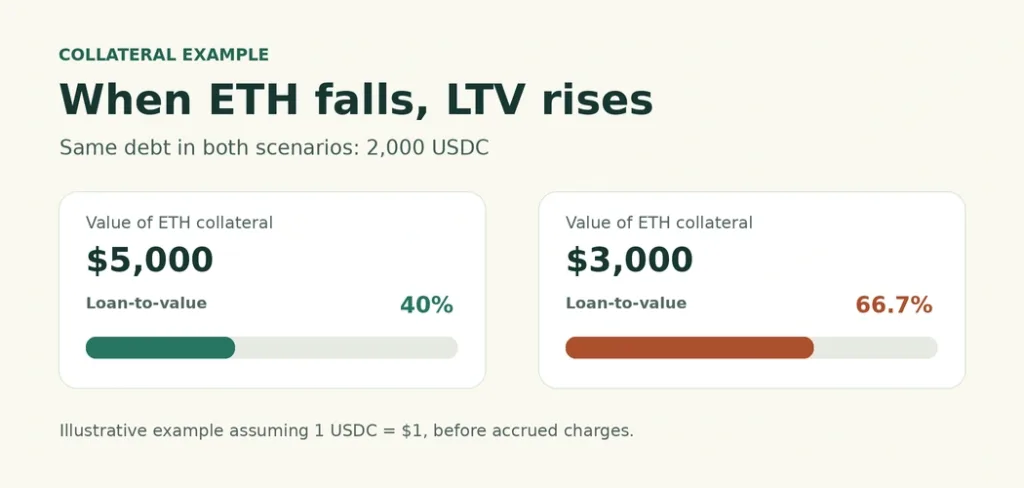
Lenders usually require collateral worth more than the amount borrowed. They quote the relationship as loan-to-value, or LTV. Divide the debt by the current value of the collateral in the same currency. In a simplified example, 2,000 USDC of debt against ETH valued at $5,000 gives an LTV of 40%, assuming USDC is worth $1 and excluding accrued charges. If the same ETH falls to $3,000 and the debt stays fixed, LTV rises to 66.7%.
Check the platform’s valuation method and its thresholds for opening a position, restricting further draws, and liquidating collateral. Each threshold can serve a different purpose. Some protocols include accrued interest or other charges in the debt used to calculate LTV, so the ratio can increase even if ETH’s price stays flat. Collateral may need to be a specific form of ETH on a supported network. The label on a wallet balance is only the starting point. Confirm the asset and network before depositing.
How interest and repayment work
APR is an annualized rate. To illustrate the arithmetic, suppose you borrow 2,000 USDC at a hypothetical 12% APR and simple interest applies for 30 interest-bearing days. With a 365-day convention, the estimate is 2,000 × 0.12 × 30 ÷ 365 = 19.73 USDC. That example assumes the principal and rate stay constant. The actual charge depends on the contract’s accrual method, rate changes, repayment timing, and any grace period. Origination fees, network fees, and penalties can add to the total.
XQ Finance is an example of a wallet-based platform developing ETH-backed USDC credit lines on Base. Its explainer on crypto line of credit vs loan describes a reusable limit and a 14-day grace period on the used balance. Under its published terms, the borrower pays 0% interest on that used amount for the grace period if they fully repay the required outstanding balance within 14 days. The clock starts when the line first has a positive debt. Origination fees and other applicable charges still apply, and the collateral can still be liquidated during the grace period. XQ describes the product as under development, so confirm availability and final terms before relying on the offer.
Before drawing, check the due date, the amount required to clear the balance, and the schedule if you carry debt beyond the grace period. XQ’s published repayment flow describes minimum payments every 14 days after grace. A partial payment may lower the amount you owe while leaving a balance that begins to accrue interest when grace ends. Also check how payments are allocated. If a payment goes to fees and interest first, only the remainder reduces principal. Use the displayed payoff amount and allow enough time for the repayment to confirm.
Blockchain fees on Base
A typical Base transaction pays gas in ETH. The fee includes execution on Base and a component tied to publishing transaction data to Ethereum. The cost can vary with network conditions and the action you sign. A draw, a repayment, or an approval to spend USDC can each require its own transaction, depending on the platform. Keep enough ETH on the appropriate network to complete the steps your wallet requires.
If your collateral starts on Ethereum mainnet or your repayment USDC sits on another chain, account for any transfer or bridge costs and delays. Confirm that the platform accepts the exact USDC token on Base. Circle issues native USDC on Base, and a bridged token with a similar name can have a different contract address. Check the network and token in the platform’s documentation before sending funds. Build enough time into your repayment plan to handle a delayed transfer or confirmation.
What can go wrong
- Liquidation. ETH can fall quickly. Depending on the contract, the protocol can sell collateral and charge a liquidation fee. A grace period changes interest treatment while the liquidation rules continue to apply.
- Stablecoin and liquidity risk. USDC is designed to track the dollar, but it can trade above or below $1. You may need to acquire USDC to repay, and your cost can change if it trades at a premium or liquidity is thin.
- Smart-contract and infrastructure risk. A contract bug, pricing-oracle problem, pause, or network interruption can affect the position. Check what the platform says users can do if a draw, repayment, or collateral withdrawal fails.
- Wallet and approval risk. Verify the site address, network, and transaction details before signing. Check which contract you are authorizing and what it is allowed to spend.
Before borrowing, compare the amount you would receive with the total you would need to repay, including fees. Then calculate what happens to LTV after a material ETH price drop and identify where the repayment USDC will come from. If repayment depends on selling the same ETH after a price decline, the position may leave you with fewer options precisely when you need them.
Financial information. This article is educational. The examples are illustrative, and platform terms, fees, and availability can change. Review the terms shown for your position before signing a transaction.