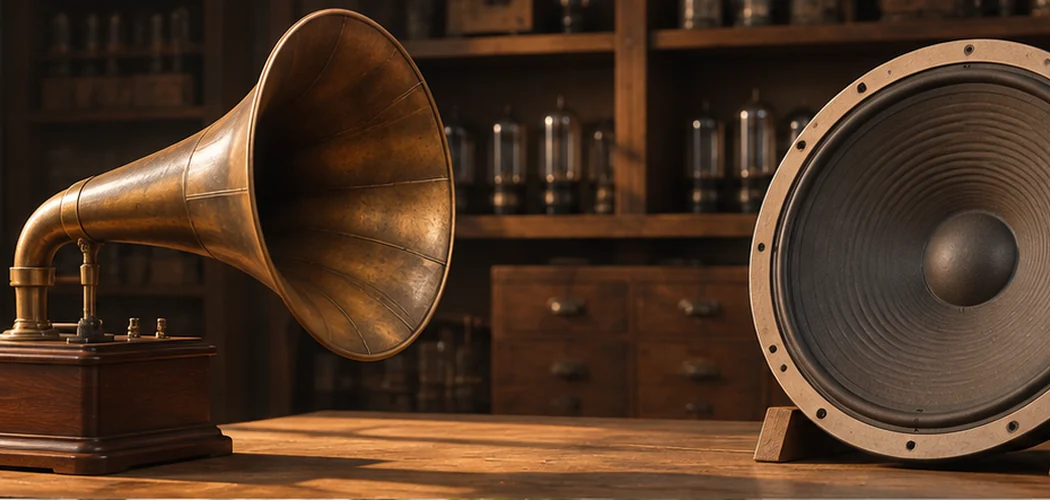
A vintage JBL loudspeaker and a portable JBL speaker can share a logo without sharing much else. One might have a large paper cone mounted in a wooden cabinet and need a separate amplifier. The other has its own amplifier, a battery, wireless connectivity, and enough signal processing to fit its sound into a case you can carry in one hand. Between those two designs sits much of the history of recorded and amplified sound.
JBL began in 1946 with James Bullough Lansing, a loudspeaker engineer whose work predated the company that bears his initials. Its early output included individual drivers and systems for home listening. The company later became associated with recording studios, large sound systems, and the idea that a loudspeaker developed for professional use could find an audience at home. Its modern catalog reaches into cars, headphones, gaming, and portable audio.
The thread connecting those products is a series of practical questions. How far does the sound need to travel? Who is listening, and from where? How much room is available for the speaker? The answers change with each setting. Following those changes makes JBL’s history easier to understand than a list of products or famous customers.
JBL History at a Glance
| Period | Milestone | Why it matters |
|---|---|---|
| 1946 | James B. Lansing establishes the company | Loudspeaker engineering becomes the basis of a new business. |
| Late 1940s | The D130 appears in JBL’s early product history | The driver shows how much attention early JBL designs paid to individual components. |
| 1950s | Hartsfield and Paragon home systems | JBL develops distinctive loudspeakers for domestic hi-fi. |
| 1960s and 1970s | Studio monitors and the consumer L100 | A professional monitor design finds a second life in the home market. |
| 1969 | Woodstock and JBL’s acquisition by Harman | The same year marks a public example of large-event sound and a change in ownership. |
| 1980s | Automotive audio becomes part of the brand’s story | JBL loudspeakers move into a listening space shaped by glass, road noise, and close seating. |
| 2020 | JBL Quantum debuts | Gaming joins the company’s consumer audio categories. |
JBL’s brand timeline highlights events such as its founding, Woodstock, and Quantum. The company’s 60-year historical retrospective provides a longer account of its early products and studio work. The dates above group related developments where a model family evolved over several years.
James B. Lansing and the Early Loudspeaker Business
To understand JBL’s beginnings, imagine buying sound equipment before a speaker became something you could pick up, pair with a phone, and carry out the door. A loudspeaker might be sold as a component for a cabinet, a replacement for an existing installation, or part of a complete system. The installer had to know the amplifier, the dimensions of the cabinet, and the room. The component itself could become the best-known part of an otherwise custom setup.
James B. Lansing came to the new company with a background in loudspeaker engineering and cinema sound. Movie theaters had helped make sound reproduction an industrial problem. An audience spread across a room needed to understand dialogue and hear music from seats at different angles and distances. A speaker that sounded clear in a demonstration could produce uneven results once installed behind a screen or used in a larger auditorium. Equipment had to work as part of a system.
Lansing’s surname can cause confusion when reading old labels. Altec Lansing and JBL have a shared historical connection to the engineer, but the two names refer to different companies. Model numbers, manufacturer plates, and original catalogs are more reliable clues than the surname alone. A seller who describes a driver simply as a “Lansing speaker” has left out information a collector would need.
The D130 gives that component era a concrete example. JBL’s retrospective describes it as a 15-inch driver and highlights its four-inch flat-wire voice coil. The voice coil carries current from the amplifier. Its interaction with the driver’s magnetic field moves the cone and sets the surrounding air in motion. That basic principle also applies to many much smaller drivers. The D130 makes the mechanics easier to see because the assembly is large and was designed to be installed in a cabinet.
A driver’s size tells you only part of what it will do. The enclosure affects how the sound from the back of the cone interacts with the sound from the front. The cone and suspension affect how the driver behaves at different frequencies. And the amplifier has to suit the load presented by the speaker. Two cabinets with the same model of driver can therefore sound different, especially at low frequencies.
That point matters when reading historical descriptions that credit one component with the sound of an entire system. A surviving D130 can tell you a great deal about what JBL was making, while the cabinet, crossover, and room determine how that particular speaker sounds now. An intact label confirms a model. Listening to a complete system tells you how the parts work together.
The Hartsfield and Paragon Bring JBL Into the Home
JBL’s domestic history began well before its best-known studio-inspired home speakers. The Hartsfield and Paragon show that the company was already thinking about how loudspeakers would look and behave in living rooms in the 1950s. These systems occupied substantial space. A customer choosing one was deciding where a piece of furniture would go as well as how records would sound.
The Hartsfield is associated with corner placement. A corner is an acoustic boundary as well as a convenient way to clear floor space. Walls change the way sound radiates into the room, especially at lower frequencies. If a loudspeaker is designed to work near those boundaries, pulling it several feet forward can alter the balance the designer expected. A modern listener looking at a corner design may see a constraint. For a household with a suitable room, that placement was part of the appeal.
The Paragon took a different approach to domestic stereo. Its left and right channels share one broad cabinet, with a curved central reflecting surface forming part of the design. The two channels still carry separate signals. The cabinet arranges how the sound from those channels enters the room. JBL’s historical account describes the reflecting system as an attempt to improve the stereo presentation.
Stereo gives a recording two channels whose relative levels and timing help establish where sounds appear. With separate speakers, a listener can change their spacing or aim them inward. Moving one speaker closer to a wall can change what reaches the chair. A cabinet such as the Paragon fixes much of that physical relationship when the cabinet is built. Its size and shape are clues to how the designers expected people to use it.
These early systems make it hard to describe JBL’s move into home audio as a single event in the 1970s. What changed later was the kind of home speaker JBL could sell and the audience it could reach. A substantial, room-defining stereo cabinet and a pair of home loudspeakers derived from compact studio monitors represent different ways to build a home audio business.
For a modern reader, there is a useful lesson in the old photographs. Before reading a review of any speaker, look at the room in which it was meant to work. A cabinet designed for a corner, a monitor placed near a console, and a portable speaker set on a table each get help from their surroundings in different ways. The room may explain a design decision more clearly than a list of specifications.
The Studio Monitor and the Move From 4310 to L100
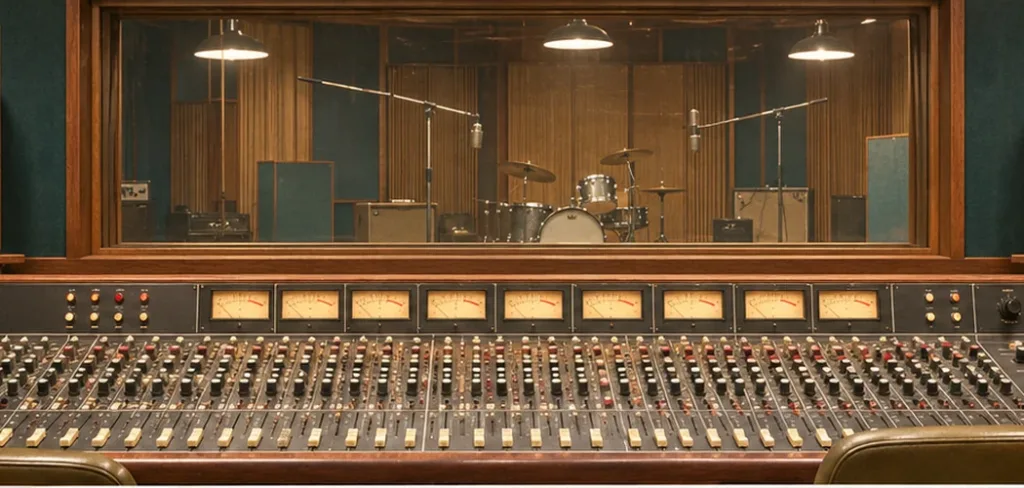
A recording studio gives the speaker a specific job. It must let engineers hear decisions while there is still time to change them. A vocal that disappears when the drums enter or a bass note that dominates one passage can send the engineer back to the controls. If a problem belongs to the listening setup, though, correcting it in the recording may create a new problem when the track is played elsewhere.
Monitor placement is part of that work. A speaker set close to a mixing desk reaches the engineer more directly than one placed farther away. It also interacts with nearby surfaces. Changing the height or angle can affect what the listener hears around the frequencies shared by two drivers. A monitor earns its place in a studio when the people using it can make dependable decisions over many sessions.
JBL’s 4310 studio monitor and the related L100 home loudspeaker are central to this chapter. The relationship matters because it runs from a practical studio design to a product intended for domestic listening. The connection also gave buyers a concrete way to understand the company’s professional reputation. They could point to a related model rather than relying on a general claim that a speaker sounded like studio equipment.
The L100’s familiar sculpted grille gives that story a visual counterpart. A studio speaker can spend its life in a room where few people care what it looks like. At home, a loudspeaker may stand beside a record shelf or become one of the first things guests see. The grille, wood finish, proportions, and controls all contribute to how owners live with it. Product design helped make the professional connection visible without requiring a customer to understand monitor placement.
A studio lineage also leaves room for differences. A cabinet intended for a particular working distance may be positioned differently in a home. A listener can sit farther back, move around the room, or choose a setup that suits several people on a couch. The home system might be used for records, radio, or television. A shared design ancestry is valuable history, while the setup tells you what to expect from the individual product.
Today, a listing for an L100 can describe an original vintage speaker, a restored example, or a much later model that draws on the same styling. A buyer comparing them should start with the full model name and photos of the label, terminals, grille, and drivers. Ask whether the cabinets are a matched pair and whether any components have been replaced. A restored pair with documented work and an untouched pair with worn components offer different things, even if both are advertised under the same familiar name.
Woodstock and the Work of Live Sound

JBL cites Woodstock in 1969 as an important moment in its public history. It is a useful example because outdoor sound poses a different problem from recording or domestic hi-fi. People in front of the stage and people near the edge of a field are trying to hear the same performance from very different positions. A system needs enough output to reach beyond the front rows, with coverage that makes the performance intelligible across the audience.
A festival sound system is a collection of parts and people. Microphones capture the instruments and voices. A mixing console combines their signals. Amplifiers drive loudspeakers, and crews choose where the equipment goes, what it points at, and how it will be powered. Even the best-known component in that chain depends on the others. A loudspeaker credit in a brand timeline establishes where the company fits into the story, while production records and accounts from the people who worked the event can explain how the system was assembled.
The outdoor setting removes many of the walls that reflect sound back into an enclosed room. That can make sound seem less full at a distance and places a premium on directing it toward listeners. A large audience also presents several listening zones. People close to one loudspeaker can receive far more sound from that cabinet than people farther away. Designers have to balance these differences while keeping voices and instruments audible over crowd noise.
Horn-loaded compression drivers are one way to think about that challenge. A compression driver feeds a horn, which helps couple the driver to the air and shape where the sound goes. The shape and size of the horn affect its coverage and the range of frequencies over which it behaves as intended. A narrow pattern can be helpful when a system needs to send sound toward distant seats. A wider pattern can suit a different location, such as a short, broad seating area.
JBL used horn-loaded designs, but horns belong to the history of loudspeaker engineering as a whole. A useful account identifies the particular design or application under discussion. It can then explain whether the goal was higher sensitivity, coverage control, easier installation, or something else. That approach gives readers more to work with than a broad claim that one manufacturer invented the techniques found in modern sound systems.
Live sound also helps explain why professional loudspeaker design has changed over time. A touring crew needs gear that can be transported, set up, connected, and serviced repeatedly. Venues differ in ceiling height, audience layout, and where equipment can be mounted. In an installed theater, those positions may be fixed for years. A system that works well on tour has a different set of practical demands from an installation behind a cinema screen, even if the two use related driver technology.
What Harman Ownership Changed
JBL’s retrospective records that Harman acquired the company in 1969. This milestone sits alongside Woodstock in the timeline, although it answers a different question. Woodstock shows where the speakers were used. The acquisition helps explain how the business expanded and distributed equipment internationally.
Distribution is an easy part of audio history to overlook. A studio wants to know whether a replacement driver can arrive before the next session. An installer needs consistent documentation and a way to order more units for another venue. A homeowner wants to hear a pair of speakers in a shop and know where to take them if one develops a fault. The ability to supply and support a product can influence where it gets used just as much as the design itself.
It also helps explain why professional and consumer catalogs can grow in parallel. The dealer who sells a portable speaker serves a different market from an integrator designing a large installation. Each buyer expects different information. A concert system proposal may include coverage predictions and rigging details. A home audio customer may need to know whether a speaker fits a shelf and connects to an existing amplifier. Those differences remain even when both products come from the same group.
When shopping secondhand, the ownership timeline is background. Product support depends on the model, its age, and the market where it was sold. A brand name on an old cabinet does not tell you whether an original part is still available. Before paying for a repair, give the technician the complete model number and ask what can be serviced with available parts.
From the Living Room to the Car
JBL places its move into automotive audio in the 1980s on its brand timeline. A car creates a peculiar listening environment. The driver sits closer to one side of the system than the other, and the speakers may fire from the doors, dashboard, or rear of the cabin. Glass and trim reflect sound. The cabin is small enough that nearby surfaces can affect what the listener hears even at modest volume.
An automotive system has to work around those constraints. Door speakers fit into spaces that also contain windows, wiring, and mechanical parts. Bass performance depends in part on how the speaker is mounted and how the surrounding panels behave. Road and tire noise add another variable. A system that seems balanced with the car parked may be harder to hear at highway speed, particularly at lower frequencies.
That is why the cabin matters when comparing a branded factory system with a home loudspeaker from the same company. A car system might use multiple drivers and tuning that were chosen for that specific vehicle. Its parts are meant to work together in that interior. A home speaker normally has to accommodate a wider variety of rooms and placements. The brand identifies a connection between the products, while the installations explain why they sound different.
Anyone comparing factory systems should check the exact vehicle trim, year, and market. A brochure for one version of a car may show equipment that another trim never received. A used vehicle can also have replacement speakers or an aftermarket head unit. Listen to both sides, try the balance and fade controls, and check whether the system behaves consistently with the source you expect to use.
How Portable Speakers Changed the Design Brief
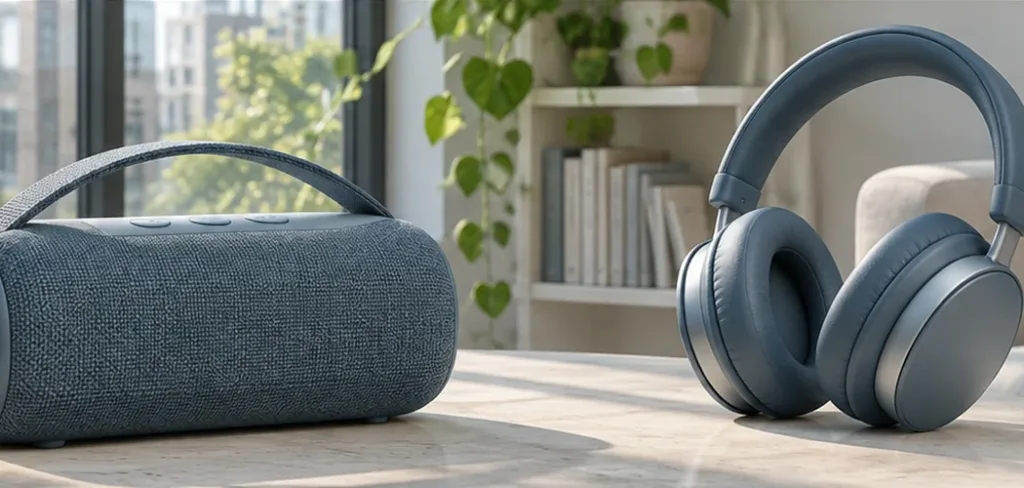
The portable Bluetooth speaker changes the job again. A home hi-fi system can place its amplifier in another cabinet and draw power from the wall. A portable speaker needs room for the driver, amplifier, battery, controls, and wireless electronics inside one case. It also has to survive being picked up, set down, and moved between rooms or taken outside.
Bass is an especially visible trade-off. A large enclosure gives the designer more room to work with. In a small cabinet, a passive radiator can contribute to output around the frequencies it is tuned for. It moves in response to air pressure inside the enclosure. Its presence alone does not tell you how deep the speaker will play. Cabinet volume, driver travel, tuning, and the maximum output the amplifier can supply all affect the result.
Signal processing gives designers another set of tools. They can shape the frequency balance and limit output when a small driver approaches its operating limits. As a result, a portable speaker may sound fuller at moderate volume than it does near maximum output. The battery has to supply the amplifier and electronics throughout that process, so volume level and the material being played can affect runtime. Compare published test conditions when a battery figure matters to your purchase.
Stereo is another point worth checking. Some portable products combine channels in one unit. Others support pairing with a second speaker, and the pairing modes may differ by product family. If you already own one unit and want to add another, check that the specific models support the connection you intend to use. A shared brand name and Bluetooth support do not establish compatibility for linking speakers together.
Portability also depends on where the speaker will go. A compact speaker can be convenient on a bedside table, while a larger model may make sense for a backyard gathering where people are spread out. A design for occasional splashes and a model rated for other conditions have different documented limits. Read the model’s instructions before deciding where to use it or how to clean it.
The shift to portable sound makes a contrast with JBL’s early driver business especially clear. The owner of a separate driver needed to consider the enclosure and amplifier. The portable speaker arrives as an integrated system. That makes setup simpler. It also means the owner has fewer ways to replace or upgrade components independently. The trade-off becomes important when a battery or charging port wears out.
Headphones, Earbuds, and Gaming
Headphones solve the room problem by putting the drivers next to the listener’s ears. A recording studio can change its sound by moving a pair of speakers. A headphone can change its sound when a pad wears out, glasses interrupt the seal, or an earbud tip does not fit. With the driver so close to the ear, small differences in fit can affect what a listener hears.
Over-ear models, earbuds, and headsets have separate design priorities. A commuter may care about comfort, isolation, and whether voices remain clear on a phone call. A listener working at a desk may prefer a wired connection and a headband they can wear for several hours. Someone using earbuds for exercise might place greater weight on fit and controls. These are different questions from how loudly a speaker can play in a room.
JBL’s brand history dates the launch of Quantum, its gaming line, to 2020. Gaming headsets add voice chat and platform compatibility to the usual headphone concerns. A microphone can be a deciding feature even if the owner spends much of the time listening. A wired analog connection, USB connection, and wireless connection can behave differently across a console, computer, or mobile device.
The way a game presents direction is also worth understanding. The source can carry positional information, and software can use cues such as timing and level to simulate sound arriving from different directions through headphones. How well that works depends on the game, the audio settings, and the listener. Two headsets can produce different results from the same game, and the same headset can behave differently when the connection or processing mode changes.
JBL’s move into gaming is part of a broader pattern in the history. A new listening context brings a new problem. In a concert venue, the problem is coverage across a crowd. In gaming, it may be hearing a directional cue while keeping teammates’ voices understandable. The equipment grows out of that job. Comparing products by the job they perform is more informative than assuming an acoustic trait carries from one category to another.
For another example of how room size and existing equipment shape a home audio purchase, see our guide to choosing a TV soundbar.
How to Read the Specifications Behind JBL’s History
Product descriptions can make a speaker sound self-explanatory. A power figure, a driver diameter, or a frequency range looks precise. Each figure measures something specific, and useful comparisons depend on knowing what the manufacturer measured. That is true whether the description comes from a paper catalog or a modern product page.
Power and sensitivity. A passive loudspeaker’s power handling gives information about the signal it can accept under the manufacturer’s stated conditions. Sensitivity describes how much sound it produces for a given input at a specified distance. A higher power handling number alone does not establish which speaker will be louder from the same amplifier. Check whether measurements use comparable methods before making that judgment.
Frequency response. A range is easier to interpret if the manufacturer explains how much variation is allowed across it. A speaker can produce some output at a low frequency without reaching the same level there as it does in the midrange. Placement and listening distance can change the bass you hear, especially with a large cabinet in a small room. Look at the conditions of the measurement as well as its endpoints.
Coverage. A loudspeaker aimed at a seating area needs to send useful sound toward the people sitting there. A coverage figure describes how widely the speaker radiates under stated conditions. That can inform placement decisions in an auditorium, while a home listener may hear the same issue as a change in tone when moving from the center of a sofa to an end seat. Understanding the relationship makes professional design terminology less abstract.
Battery and charging. On portable models, check what the battery life estimate assumes, which charger or cable the speaker requires, and whether the battery can be replaced. Two models advertised with similar runtimes may have been measured at different settings. Check the manual if you need the speaker to cover a full workday or several hours outdoors.
Specifications help most when you have a use in mind. A large vintage loudspeaker and a portable model can both suit their intended owners. The useful comparison begins with the room, equipment, and listening habits that each will have to accommodate.
What to Check When Buying Older JBL Equipment
Start by identifying the product before comparing prices. JBL has reused familiar names and styling cues. A grille color or cabinet shape can narrow the search, but the rear label and model number are better starting points. If you are looking at a pair, ask for photos of both cabinets. One speaker may have a different driver or replacement grille even when the front views look alike.
Ask how the seller tested the system. A claim that it powers on tells you little about whether all drivers work. If you can listen in person, play familiar music at a moderate level and compare the two channels. A missing treble driver, an intermittent control, or a loose cabinet panel can be easier to hear when you switch between speakers. Condition can matter more than a short list of original specifications.
For a passive loudspeaker, confirm the amplifier and available connections before buying. For a portable model, check battery runtime, the charging port, the controls, and whether it pairs with your device. If the model depends on an app for a feature you need, verify app support for your phone. A product can still perform its basic function even when a particular feature is unavailable on a newer device.
Repairs are part of the history of older equipment. Replacing a worn part can make a speaker usable for years, and collectors may still want to know what changed. Ask for invoices or part numbers when a seller describes a restoration. That gives you a basis for evaluating the work and will help the next technician if the equipment needs attention again.
Why the JBL Name Appears in So Many Listening Spaces
JBL’s history makes the most sense when the products are placed where people used them. The D130 belongs to an era in which a driver and the cabinet around it could be separate purchasing decisions. The Hartsfield and Paragon show different approaches to bringing substantial loudspeakers into a home. The 4310 and L100 show how a studio monitor could influence a domestic design. Woodstock belongs to the history of getting amplified sound to a crowd.
Automotive, portable, and personal audio extended that history into places with a different set of constraints. The car cabin dictates where drivers can fit. The portable case has to contain a power supply. The headset has to work with the listener’s ears, microphone, and source. These are distinct listening problems, and each helps explain the design of the equipment.
That is what connects a vintage JBL cabinet with products that look nothing like it. Start with who needs to hear the sound, then look at the room, the distance, and the equipment. Across eight decades, those questions stayed familiar even as the answers changed.