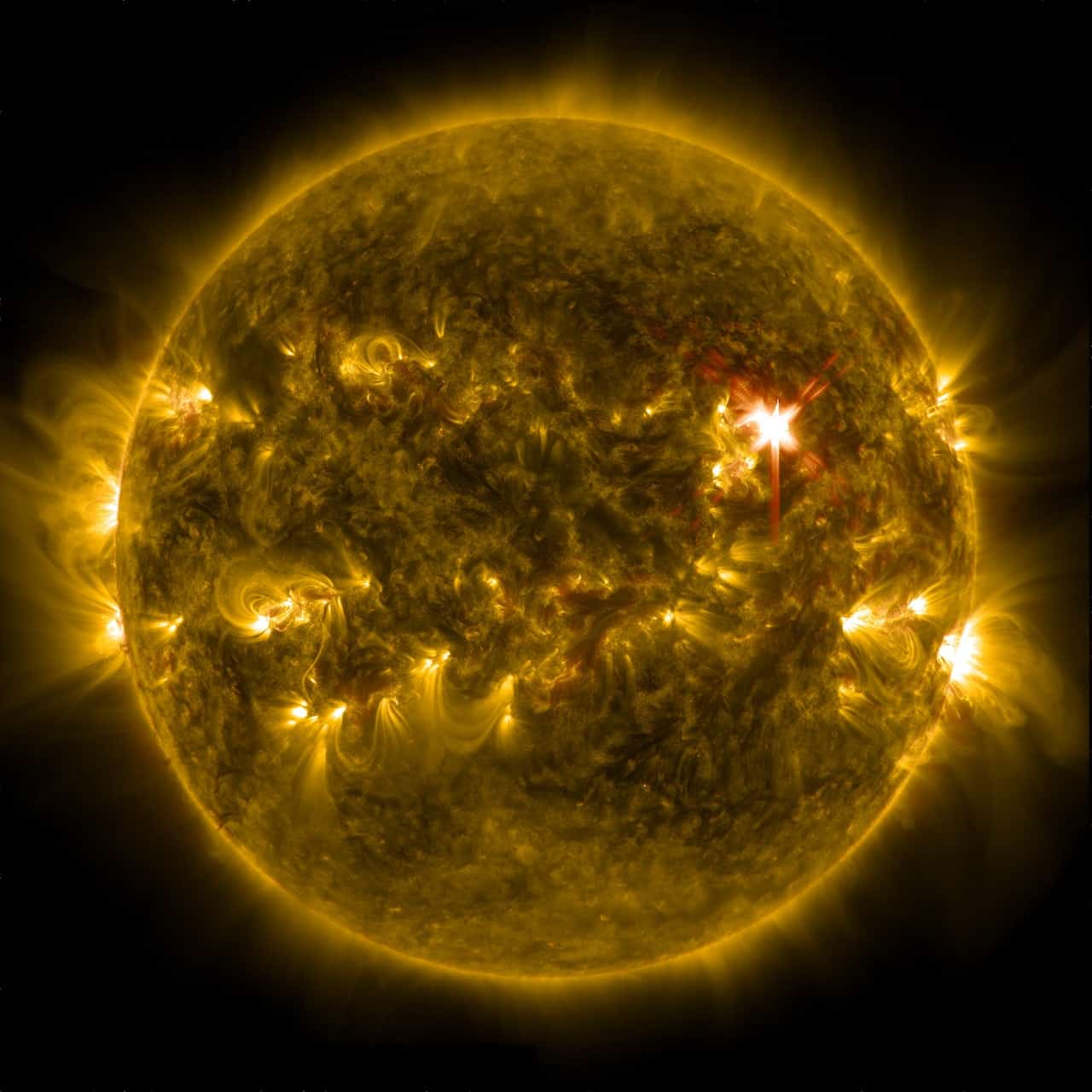
Solar storms are a space weather phenomenon when the sun releases a burst of charged particles and electromagnetic energy into space. These storms can be triggered by changes in the sun’s magnetic field, such as a solar flare eruption or a coronal mass ejection (CME), which can send billions of tons of charged particles hurtling toward Earth at speeds of up to several million miles per hour.
Solar storms can affect Earth, disrupting power grids, damaging satellites, and interfering with communications systems. They can also create beautiful auroras visible at high latitudes.
Causes of Solar Storms: The Sun’s Magnetic Field
Solar storms are caused by the complex interactions between the sun’s magnetic field and its hot, ionized plasma (a gas composed of charged particles). The sun’s magnetic field is generated by the motion of charged particles within its interior. It can become twisted and contorted over time due to the sun’s rotation and other factors.
When the magnetic field lines become twisted and tangled, they can store large amounts of energy. Eventually, this energy is released as a solar flare or coronal mass ejection (CME). Solar flares are sudden, intense bursts of radiation and energy near the sun’s surface, while CMEs are massive clouds of charged particles ejected from the sun’s outer atmosphere.
The Impacts of Solar Storms on Earth: Power Grids, Satellites, and Communications
Solar storms can significantly impact various systems on Earth, including power grids, satellites, and communications.
Power grids can be particularly vulnerable to the effects of solar storms. When the charged particles from a solar storm reach Earth’s magnetic field, they can cause fluctuations in the field that induce electric currents in power lines. These currents can overload transformers and other power grid components, leading to blackouts and other disruptions.
Satellites in orbit around Earth can also be affected by solar storms. The charged particles can cause a buildup of electrical charge on the satellite’s surface, leading to malfunctions or even permanent damage. Satellites are particularly important for communication, navigation, and weather forecasting, so disruptions to satellite systems can have widespread impacts.
How to Prepare for a Solar Storm: Predicting and Mitigating the Effects
Preparing for a solar storm involves predicting when a storm might occur and mitigating the potential effects on various systems. Here are some steps that can be taken:
- Monitoring and prediction: Scientists use a variety of instruments and models to monitor the sun’s magnetic activity and predict when solar storms are likely to occur. This information can be used to issue alerts and warnings to stakeholders who may be affected.
- Preparedness planning: Power grid operators, satellite operators, and other stakeholders can develop preparedness plans to respond to a solar storm. These plans may include procedures for reducing power transmission, putting satellites into safe modes, and other measures to mitigate the storm’s effects.
- Hardening critical infrastructure: Particularly critical Infrastructure, such as power grid components and communications systems, can be hardened to reduce the risk of damage from solar storms. This might involve installing surge protectors, shielding, or other protective measures.
- Backup systems: Stakeholders can also use backup systems to maintain critical functions during a solar storm. For example, power grids can have backup generators, and communications systems can use satellite phones or other backup technologies.
Solar Storms and Space Weather Forecasting: Advancements and Limitations
Advancements in space weather forecasting have improved our ability to predict solar storms and their potential impacts. Here are some of the advancements:
- Increased observations: More satellites, ground-based observatories, and other instruments are now available for monitoring the sun and the space environment around Earth. This increased observational data allows for more accurate and detailed forecasting.
- Improved modelling: Scientists have developed more sophisticated computer models that simulate the behaviour of the sun and the space environment around Earth. These models can predict the behaviour of solar storms and their potential impacts with greater accuracy.
- Real-time monitoring: Data from monitoring instruments can now be analyzed and processed in real time, allowing for more timely and accurate alerts and warnings to be issued to stakeholders.
Exploring the Mysteries of the Sun: Current Research and Future Directions
The sun remains one of the most mysterious objects in our solar system, and ongoing research is shedding new light on its behaviour and properties. Here are some of the current research areas and future directions for exploring the mysteries of the sun:
- Solar dynamics: Scientists are studying the dynamics of the sun’s interior, magnetic fields, and atmosphere to better understand the processes that drive solar activity and the behaviour of solar storms.
- Solar wind: The solar wind is the stream of charged particles that flows from the sun and affects the space environment around Earth. Researchers are studying the composition and behaviour of the solar wind to improve our understanding of space weather.
- Solar telescopes: Advances in telescope technology have allowed for more detailed and high-resolution sun observations. Researchers use these telescopes to study the sun’s surface features, magnetic fields, and other properties.
- Spacecraft missions: Several missions have been sent to study the sun up close. For example, NASA’s Parker Solar Probe is orbiting the sun and gathering data on its behaviour and environment.
Conclusion
Solar storms remain one of our solar system’s most fascinating and potentially disruptive phenomena. These storms can impact power grids, satellites, and communications systems, highlighting the importance of space weather forecasting and preparedness planning. Advancements in technology and research have allowed us to better understand the causes and impacts of solar storms. However, there are still many mysteries surrounding the behaviour of the sun and the space environment around Earth. Continued research and exploration will be crucial for improving our understanding of the sun and its potential impacts on our planet. By working together to predict and mitigate the effects of solar storms; we can ensure a more resilient and secure future for our world.
Related Posts:
Solar Panels Cleaning Near Me: Choosing a Solar Installation Firm
Best RV Solar Panels & Kits
Some useful tips to use solar energy correctly
The 3 Best Backup Power Sources for Your Solar System.