Korean webtoons — often called manhwa — have become one of the most significant forces in global entertainment over the past two decades, reshaping how comics are made, distributed, and adapted for screen. This guide covers where the format came from, how it differs from Japanese manga, the major subgenres worth knowing, and — importantly — the legitimate platforms that actually support the creators behind these stories.
What Makes Manhwa Different From Manga
Korean webtoons share storytelling DNA with Japanese manga but diverge in format and presentation in ways that matter:
| Aspect | Manhwa (Korean Webtoons) | Japanese Manga |
|---|---|---|
| Format | Vertical scroll, built for mobile reading | Horizontal panels, originally print-focused |
| Art style | Full color, expressive digital art | Traditionally black-and-white linework |
| Distribution | Digital-first platforms | Magazines and print volumes (tankōbon) |
| Reading experience | Continuous scroll, no page-turns | Page-by-page panel layout |
The vertical-scroll format isn’t incidental — it was specifically designed around how people actually read on a phone, scrolling rather than tapping through pages, which is a meaningful part of why the format took off as smartphone adoption grew.
A Brief History
Korean comics have roots stretching back to the early 20th century, but the industry’s defining shift happened in the 2000s, when Naver and Daum began publishing digital comics online in a vertical-scroll format designed specifically for screens rather than print. That digital-first approach — plus a willingness to experiment with full color and serialized, mobile-friendly storytelling — set the format apart from established print manga from the start.
The 2010s saw explosive international growth as official platforms began offering English translations, expanding the audience far beyond Korea. That growth has continued: Korea’s domestic webtoon industry generated approximately 2.286 trillion won (roughly $1.4 billion USD) in 2024, according to the government-run Korea Creative Content Agency’s official industry survey — up from about 2.189 trillion won the year before, marking the second consecutive year the industry topped the 2 trillion won mark.
Popular Subgenres
Like manga, webtoons are often categorized by target audience and theme:
- Shonen — action and adventure-focused, traditionally aimed at a younger male audience. Tower of God and The God of High School are well-known examples.
- Shojo — romance and coming-of-age stories, traditionally aimed at a younger female audience. True Beauty is one of the format’s biggest crossover hits.
- Seinen — more mature themes, aimed at adult readers, often darker in tone. Sweet Home (which became a Netflix series) is a prominent example.
- Josei — realistic relationships, career struggles, and adult emotional life, aimed at adult women. This category has grown significantly as the format has matured beyond its younger-skewing origins.
These categories aren’t rigid — plenty of popular titles blend elements across them — but they’re a useful starting point for finding what you’re likely to enjoy.
Cultural Impact
Webtoons have become a genuine pipeline for screen adaptations, not just a side medium. Sweet Home and All of Us Are Dead both became significant Netflix hits adapted directly from webtoon source material, and Solo Leveling made a similar jump to anime, drawing a substantial global audience in the process. This cross-media success has made webtoon IP genuinely valuable to streaming platforms and studios looking for pre-tested stories with built-in audiences.
The format has also meaningfully diversified comics storytelling — webtoons have been notably willing to center female protagonists, explore LGBTQ+ characters, and tackle social themes (identity, mental health, class) in ways that broadened who the medium speaks to and about.
Why Reading Through Official Platforms Actually Matters
This is worth being direct about: Korea’s own government survey data shows the illegal, unauthorized webtoon market is substantial — estimated at roughly 446.5 billion won, or about 20% the size of the entire legitimate industry. That’s not an abstract problem. Every reader who moves from an unauthorized aggregator to an official platform is a real, measurable difference to creator income in an industry where it already isn’t easy: KOCCA’s own 2024 survey found the median annual income for webtoon artists actively serializing work was about ₩38 million (roughly $28,000) — a modest living for people producing work read by millions.
Unauthorized aggregator sites also carry practical downsides beyond the ethical question: translations are often lower quality, updates are frequently incomplete or delayed compared to official releases, and — as with any unofficial site hosting copyrighted material — there’s inherent risk in the ads and infrastructure these sites rely on to stay running, since legitimate ad networks generally won’t work with sites built on unlicensed content.
Where to Actually Read Webtoons
WEBTOON (webtoons.com, also available as an app) is Naver’s flagship platform and the largest English-language webtoon service, offering a large free catalog alongside its “Canvas” section for independent and amateur creators. Naver’s WEBTOON Entertainment listed on Nasdaq in 2024, reflecting the platform’s scale.
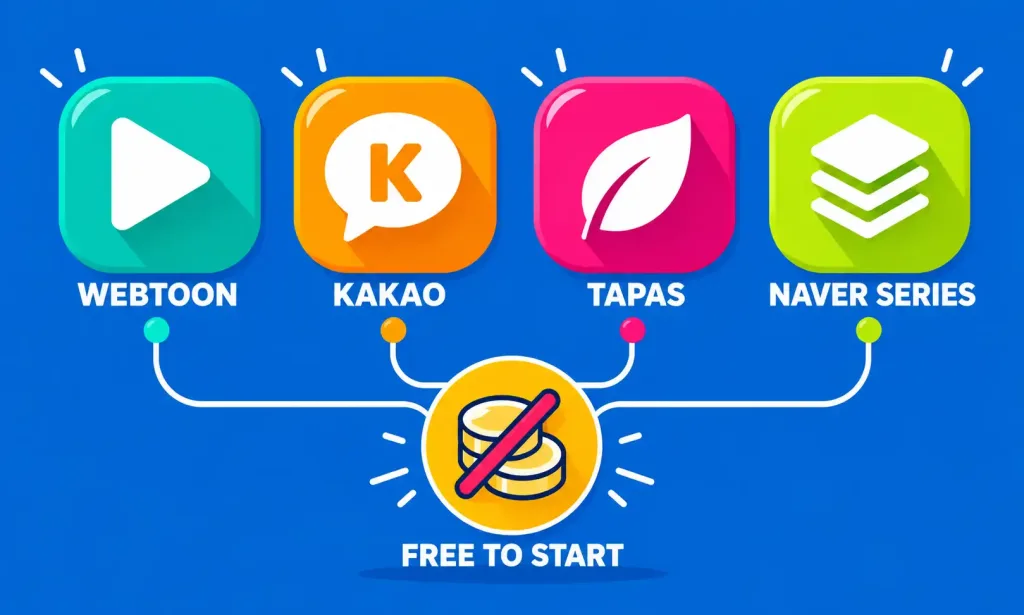
Kakao Webtoon and Piccoma are Kakao Entertainment’s platforms, offering a substantial catalog with a mix of free and premium content, strong in both the Korean and Japanese markets.
Tapas focuses on English-language webtoons and original graphic novels, including a meaningful library of creator-owned and indie work alongside licensed Korean titles.
Naver Series is Naver’s platform for Korean-language readers, offering the broadest selection for anyone comfortable reading in Korean or using translation tools.
All of these platforms offer substantial free content, with premium or “fast-pass” options for reading ahead on ongoing series — a reasonable trade-off that keeps the lights on for creators while still giving new readers a genuinely large free entry point.
Frequently Asked Questions
What’s the difference between manga and manhwa? Manga is Japanese, traditionally printed in black-and-white horizontal panels. Manhwa (Korean webtoons) is digital-first, typically full color, and formatted for vertical scrolling on mobile devices.
Are webtoons free to read? Official platforms like WEBTOON, Kakao Webtoon, and Tapas offer substantial free content, often with an option to pay for early access to new chapters (“fast-pass” systems) while older chapters remain free.
How big is the Korean webtoon industry? Approximately 2.286 trillion won (around $1.4 billion USD) in 2024, according to Korea’s government-run Korea Creative Content Agency, continuing steady growth since the agency began tracking the industry in 2018.
Why shouldn’t I use unofficial scanlation or aggregator sites? Beyond the copyright issue, unofficial sites directly reduce income for the artists creating the work — Korea’s own government data estimates the illegal webtoon market at roughly 20% the size of the legitimate industry — and often have lower translation quality, incomplete updates, and less accountability around the ads they run.
What webtoons became popular TV or streaming adaptations? Sweet Home and All of Us Are Dead both became Netflix hits, and Solo Leveling became a widely-watched anime adaptation — all originally published as webtoons.
The Bottom Line
Korean webtoons have grown from a 2000s digital experiment into a genuine global entertainment force, generating well over a billion dollars annually and feeding directly into some of the biggest streaming hits of the past few years. Reading through official platforms — WEBTOON, Kakao Webtoon, Tapas, or Naver Series — costs nothing for the vast majority of available content, actually supports the artists behind the work, and gets you better translations and more reliable updates than any unauthorized aggregator ever will.