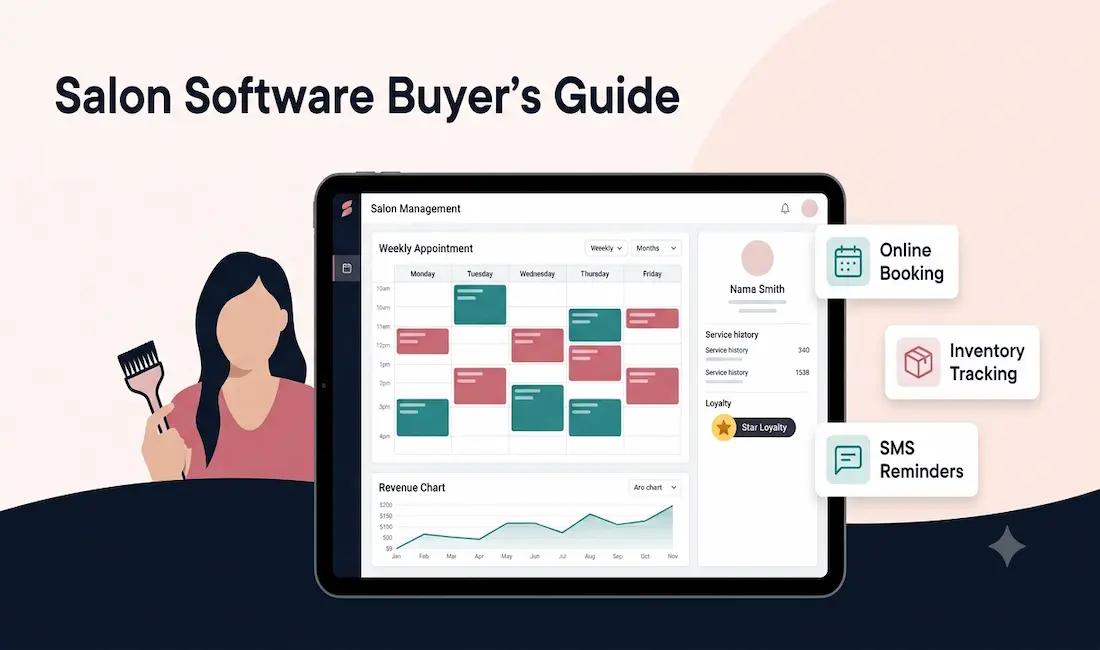
Salons are an important part of the beauty industry, but managing them can be a challenging task. From scheduling appointments to managing inventory, there are a lot of moving parts that need to be organized and managed efficiently. This is where salon software comes in.
The right salon software does more than just book appointments. It tracks client history, automates reminders, processes payments, manages retail inventory, runs marketing campaigns, and produces the reports that tell you whether the business is actually growing. The wrong choice means paying for features you don’t use, fighting a clunky interface during busy Saturdays, or getting locked into a platform that can’t scale with you.
This guide covers what salon software is, the key features to look for, the seven best platforms in 2026 with current pricing, and a practical buyer’s guide matched to salon size and type.
What Is Salon Software?
Salon software is a suite of digital tools designed to streamline the management of beauty salons, spas, barbershops, and wellness businesses. It is an all-in-one solution that handles scheduling, booking, customer management, inventory management, point of sale, and marketing — replacing the combination of spreadsheets, paper appointment books, and separate payment terminals that many salons still rely on.
Modern salon software is cloud-based and mobile-accessible, meaning owners and stylists can check schedules, update client records, and process payments from a phone or tablet without being tied to a desktop computer.
Benefits of Salon Software
Streamlined scheduling: Clients can book appointments online 24/7 through a branded booking widget or marketplace listing. The software automatically updates the schedule, sends confirmation emails, and delivers reminder texts that reduce no-show rates — one of the biggest revenue leaks in salon businesses.
Efficient record keeping: All client information — contact details, service history, product preferences, allergy notes, and before-and-after photos — is stored in one place and accessible to any staff member instantly.
Improved inventory management: Salon software tracks backbar usage and retail stock levels in real time, triggers reorder alerts when products fall below a set threshold, and generates reports that show which products are selling and which are collecting dust.
Simplified payment processing: Integrated POS accepts credit cards, contactless payments, digital wallets, and gift cards. Tips, deposits, and split payments are handled in the same flow, with receipts sent automatically.
Marketing capabilities: Many salon software systems include built-in email and SMS marketing tools, automated rebooking reminders, loyalty point programs, and review request flows — all running without manual effort from the team.
Reporting and business intelligence: Real-time dashboards show revenue by service, stylist, and time period, along with client retention rates, average ticket size, and booking utilization — the metrics that matter for growing a salon.
Types of Salon Software
Salon software platforms vary in scope. Understanding the categories helps you identify what you actually need.
All-in-one salon management platforms — combine scheduling, POS, CRM, inventory, and marketing in a single subscription. Examples: Vagaro, Boulevard, Mindbody, Phorest.
Booking-focused platforms — prioritize the client booking experience, with POS and CRM as secondary features. Examples: Fresha, Booksy.
Solo-operator tools — designed for independent stylists and booth renters who need simple, affordable booking and payment without team management complexity. Examples: GlossGenius, Square Appointments.
Enterprise platforms — multi-location architecture, centralized reporting, and enterprise CRM for salon chains and franchises. Examples: Zenoti, Phorest (growth tier).
Key Features to Look for in Salon Software
Online booking widget — a customizable booking page or embeddable widget that lets clients book directly from your website, Instagram, or Google Business Profile without calling in.
Automated reminders — SMS and email confirmations and reminders sent automatically before appointments. These alone typically reduce no-show rates by 30–50%.
Point of sale and payment processing — integrated card reader, contactless payment support, tip management, and digital receipts. Look for transparent processing fees rather than platforms that hide costs in the base price.
Client profiles and history — detailed records per client including service notes, product preferences, visit frequency, and lifetime spend. Essential for personalized service and retention.
Inventory management — tracks both retail and backbar (professional use) product stock separately. Alerts when products need reordering. Generates consumption reports.
Marketing tools — email campaigns, SMS blasts, automated rebooking flows, loyalty programs, and review request automation. The strongest platforms run these on autopilot.
Reporting and analytics — revenue by service, stylist, and time period; client retention and rebooking rate; booking utilization per chair; retail sales performance.
Ease of use — if it takes more than a day to train a new staff member, it will create friction. Look for intuitive interfaces on both desktop and mobile.
Scalability — the software should handle a single location comfortably and add locations, staff, and services without requiring a platform change.
Integration with other systems — accounting software (QuickBooks, Xero), Google Calendar, social media booking links, and payment processors. The fewer manual data transfers required, the better.
The 7 Best Salon Software Platforms in 2026
1. Vagaro
Vagaro is one of the most comprehensive all-in-one platforms for small-to-mid-sized salons and spas. It covers booking, POS, client CRM, inventory management, payroll, marketing, and a marketplace listing that helps new clients discover the salon. Its pricing scales with staff count, making it a natural fit for growing teams.
Key features:
- Online booking via Vagaro marketplace and custom website widget
- POS with integrated card reader and contactless payments
- Client CRM with detailed history and rebooking automation
- Inventory management for retail and backbar
- Email and SMS marketing with automation
- Payroll and commission tracking
- Branded app (add-on)
2026 pricing: starts at approximately $30/month (1 staff) scaling to $90/month (10+ staff). Add-ons including branded app ($50/month) and advanced marketing tools are priced separately.
Best for: small to mid-sized salons and spas with 2–10 staff who want a full-featured platform without enterprise pricing.
2. Fresha
Fresha built its market position on a “free forever” model and attracted a large user base. Its pricing model has since changed: Fresha now charges a monthly subscription fee plus a 20% commission on new clients acquired through its marketplace. For salons that rely heavily on marketplace discovery, this commission can add up significantly at scale. For salons with an established client base that rarely uses marketplace acquisition, the subscription cost remains competitive.
Key features:
- Clean online booking interface and marketplace listing
- POS and integrated payment processing
- Client management and appointment history
- Inventory tracking
- Automated reminders and client communications
- No long-term contracts
2026 pricing: approximately $19.95/month for individual operators; $14.95/member/month for teams. Plus 20% commission on new clients booked through the Fresha marketplace. No commission on existing clients.
Best for: salons starting out who want low fixed costs and marketplace discovery, and who are willing to manage the commission model as client volume grows.
3. GlossGenius
GlossGenius is built specifically for independent stylists, nail technicians, estheticians, and solo beauty professionals. Its defining strength is design — it produces booking pages and client communications that look polished and branded without requiring any design skill. It is not built for multi-staff team management, but for solo operators it covers everything needed.
Key features:
- Beautifully designed booking pages and client notifications
- Smart scheduling with buffer time management
- Integrated payment processing with flat-rate fees
- Client profiles and service history
- Basic marketing tools and automated reminders
- Instagram and social media booking integration
2026 pricing:
- Standard — $24/month: core booking, payments, client management
- Gold — $48/month: adds client waitlist, advanced analytics, priority support
- Platinum — $148/month: for larger teams, adds team management and advanced features
Best for: independent stylists and solo beauty professionals who want a beautiful, easy-to-use booking and payment tool without team management complexity.
4. Boulevard
Boulevard is a premium salon and spa management platform designed for businesses that prioritize client experience and staff efficiency. Its interface is visually polished, its booking flow is among the smoothest available, and its client messaging and retention tools are more sophisticated than most platforms at its price point. It is more expensive than Vagaro or Fresha, but delivers meaningfully better UX and client-facing features.
Key features:
- Precision scheduling with smart resource management
- Automated client journey messaging (confirmations, reminders, follow-ups, reviews)
- Integrated POS with client self-checkout and pay-from-phone
- Advanced client profiles and retention analytics
- Marketing automation and loyalty programs
- Multi-location support
2026 pricing: Essentials plan from $176/month (billed monthly) or $158/month (billed annually). Higher tiers add advanced reporting, enterprise features, and dedicated support.
Best for: established single-location salons and small groups that want a premium client experience and are willing to pay for better design, UX, and retention automation.
5. Mindbody
Mindbody is one of the oldest and most widely used platforms in the wellness space, covering salons, spas, yoga studios, gyms, and fitness centers. Its primary advantage is the Mindbody marketplace — a discovery platform used by millions of consumers to find and book wellness appointments, which can be a meaningful client acquisition channel for salons in competitive markets.
Key features:
- Mindbody marketplace for new client discovery
- Scheduling and booking management
- POS and integrated payment processing
- Staff management and payroll
- Marketing automation including email, SMS, and push notifications
- Branded app (higher tiers)
- Reporting and business analytics
2026 pricing: starts at approximately $129/month, escalating with features and location count. Marketplace commissions apply on new client bookings. Verify current pricing on Mindbody’s official site as tiers change periodically.
Best for: salons and spas in busy markets where marketplace discovery is a meaningful client acquisition channel, or multi-service wellness businesses that need one platform for salon, spa, and fitness.
6. Phorest
Phorest is a salon management platform with a strong focus on client retention marketing. Where most platforms treat marketing as an add-on, Phorest builds it into the core product — automated rebooking campaigns, targeted client segments, online reputation management, and a suite of retention analytics that show exactly which clients are at risk of lapsing. It is used by independent salons and growing salon groups across the UK, Ireland, US, and Australia.
Key features:
- Advanced retention marketing automation (rebooking, win-back campaigns)
- Client segmentation and targeted SMS/email campaigns
- Online booking and reputation management (Google review automation)
- POS with detailed financial reporting
- Staff performance tracking and commission management
- Multi-location support with centralized CRM
2026 pricing: custom pricing based on location count and feature tier. Contact Phorest for a quote. Generally positioned above Vagaro and below enterprise platforms like Zenoti.
Best for: established salons and small groups where client retention is the primary growth lever, and where marketing automation justifies a higher platform investment.
7. Square Appointments
Square Appointments is the salon-specific module of Square’s broader business platform. Its free plan for solo operators makes it the most accessible starting point for a new independent stylist who needs basic booking and payment without any monthly cost. Square’s hardware ecosystem — card readers, terminals, and POS displays — integrates cleanly with the software, and the broader Square platform covers invoicing, payroll, and team management as the business grows.
Key features:
- Free plan for solo operators (one location, one provider)
- Online booking with Google and social integration
- Integrated card reader and contactless payment
- Client profiles and appointment history
- Automated reminders
- Inventory tracking
- Team management and payroll (paid plans)
2026 pricing:
- Free: solo operators, one location, core booking and payments
- Plus: $49/month per location — team scheduling, waitlist, advanced reports
- Premium: $69/month per location — custom pricing for card processing
Best for: solo stylists just starting out who need a free, reliable booking and payment solution, or salons already in the Square ecosystem who want to add appointment scheduling.
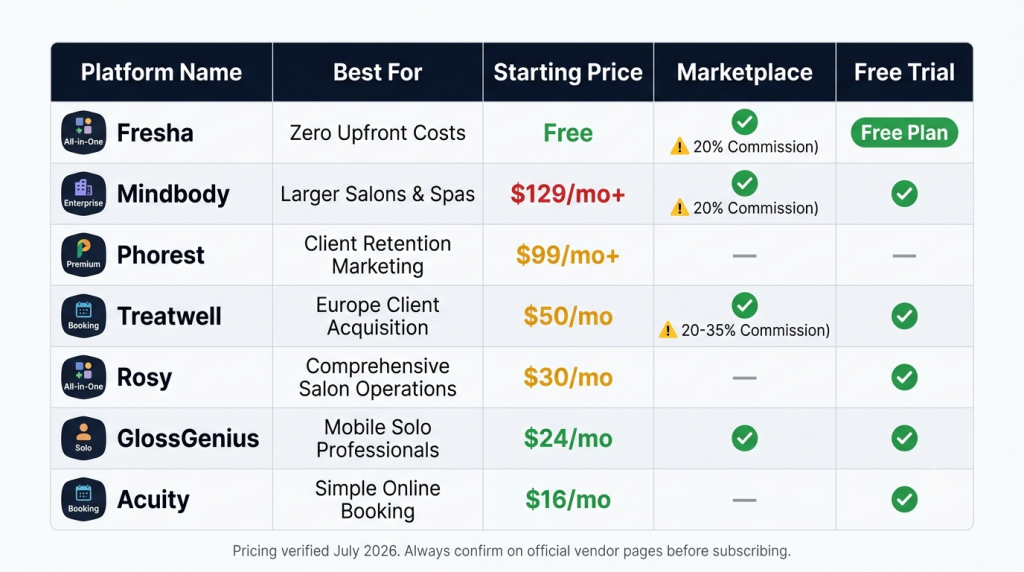
Salon Software Comparison Table
| Platform | Best For | Starting Price | Marketplace | Free Trial |
|---|---|---|---|---|
| Vagaro | Small-mid teams, all-in-one | ~$30/month | Yes | Yes |
| Fresha | Budget-conscious, new salons | ~$14.95/member/month + 20% marketplace commission | Yes | Yes |
| GlossGenius | Solo operators, design-first | $24/month | No | Yes |
| Boulevard | Premium UX, client retention | $158/month (annual) | No | Yes |
| Mindbody | Marketplace discovery, wellness | ~$129/month | Yes (20% commission) | Yes |
| Phorest | Retention marketing, groups | Custom | No | Yes |
| Square Appointments | Beginners, Square ecosystem | Free (solo) / $49/month (teams) | No | Free plan |
Choosing the Right Salon Software by Business Type
Solo stylist or booth renter: Start with GlossGenius or Square Appointments. Both are low-cost, easy to set up, and cover booking, payments, and client history without team-management overhead. GlossGenius wins on design; Square wins on ecosystem breadth and the free tier.
Independent single-location salon (2–10 staff): Vagaro offers the best balance of features and price for this segment. If client experience and retention marketing are the priority and budget allows, Boulevard is worth the premium.
New salon with limited budget: Fresha’s subscription cost is competitive, and its marketplace can help build an initial client base. Model the 20% marketplace commission into your growth projections — at high new-client volume it can become the dominant cost.
Established salon focused on client retention: Phorest’s retention marketing automation and client segmentation tools are the strongest available at its price point. If your primary challenge is keeping existing clients coming back, Phorest’s toolset justifies the investment.
Growing salon group (2–5 locations): Vagaro or Boulevard handle multi-location management at a reasonable cost. Phorest and Zenoti are the stronger choices when location count exceeds five and centralized reporting becomes critical.
Enterprise or franchise: Zenoti is the most complete platform for multi-location chains, with native multi-location architecture, enterprise CRM, and integrated payroll. Custom pricing applies.
What to Do Before Signing Up
- Map your current pain points — identify the two or three processes costing your team the most time or the business the most money (no-shows, inventory waste, rebooking gaps). Choose the platform that addresses those first.
- Run the total cost calculation — base subscription + per-user fees + add-ons + payment processing rates + marketplace commissions. The advertised starting price is rarely the real monthly cost.
- Use the free trial — every platform on this list offers a trial period. Run it during a normal working week with real appointments to see how it performs under actual conditions.
- Check data portability — before committing, confirm how you would export your client list, appointment history, and financial data if you decide to switch. Some platforms make this easy; others make it difficult by design.
Conclusion
Salon software is an essential tool for managing a salon efficiently. It streamlines scheduling, inventory management, payment processing, and marketing — and when chosen correctly, it reduces the administrative burden on staff so they can focus on delivering exceptional client experiences.
The right platform depends on your business size, growth stage, and where you are losing the most time and revenue. Solo operators get the most from GlossGenius or Square Appointments. Small teams benefit most from Vagaro’s all-in-one depth. Established salons focused on retention should evaluate Boulevard and Phorest seriously. New salons on a budget should model Fresha’s commission structure carefully before committing.
Every platform on this list offers a free trial. Start there, test it under real conditions, and let the actual experience guide the decision rather than the feature list.
Frequently Asked Questions
What is salon software and what does it do?
Salon software is a digital management platform that replaces the combination of paper appointment books, spreadsheets, and separate payment terminals that many salons rely on. It manages appointment scheduling, client records, inventory, point-of-sale transactions, staff scheduling, and marketing campaigns in one system. Modern salon software is cloud-based, meaning it can be accessed from any device, and most platforms offer client-facing online booking widgets that let customers schedule appointments 24 hours a day without calling in.
Which salon software is best for beginners and solo stylists?
GlossGenius and Square Appointments are the strongest choices for solo stylists and independent beauty professionals starting out. GlossGenius starts at $24/month and produces beautifully branded booking pages and client communications with no design skill required. Square Appointments offers a free plan for single-provider operations, covering online booking and integrated payment processing with no monthly fee. Both are quick to set up and require minimal training.
How much does salon software cost?
Salon software pricing in 2026 ranges from free (Square Appointments for solo operators) to $14.95–$30/month for budget platforms (Fresha, GlossGenius, Vagaro) to $129–$176/month for premium mid-market platforms (Mindbody, Boulevard) to custom enterprise pricing for multi-location chains (Phorest, Zenoti). The advertised base price often excludes per-user fees, add-ons, payment processing rates, and marketplace commissions. Budget 20–40% above the headline monthly price when calculating realistic total cost. Always verify current pricing on the official platform page before committing.
What is the difference between a booking platform and an all-in-one salon management system?
A booking platform (Fresha, Booksy) focuses primarily on the appointment booking experience for clients, with POS and CRM as secondary features. An all-in-one salon management system (Vagaro, Boulevard, Mindbody) covers booking alongside inventory management, detailed client CRM, marketing automation, staff payroll, and business reporting in a single subscription. The right choice depends on whether you need a simple, focused tool or a comprehensive platform that replaces multiple separate systems.
Do salon software platforms take a commission on bookings?
Some do, some don’t. Fresha charges 20% commission on new clients booked through its marketplace. Mindbody charges 20% on marketplace-sourced new client bookings (capped at $30 per booking). Booksy Boost charges 30% on first visits from boosted clients. Platforms including Vagaro, Boulevard, GlossGenius, Phorest, Zenoti, and Square Appointments do not charge marketplace commissions — you pay only the monthly subscription and standard card processing fees. If a significant portion of your new client acquisition comes through a marketplace, the commission structure can become the dominant cost — model it carefully before choosing a commission-based platform.
Can salon software help reduce no-shows?
Yes — automated appointment reminders are one of the most effective features in any salon software platform. Sending an SMS and email confirmation at the time of booking, followed by a reminder 24–48 hours before the appointment, consistently reduces no-show rates by 30–50% in real-world deployments. Most platforms also support deposit collection at the time of booking, which further reduces cancellations. This alone often justifies the monthly cost of salon software for any business with a meaningful no-show rate.