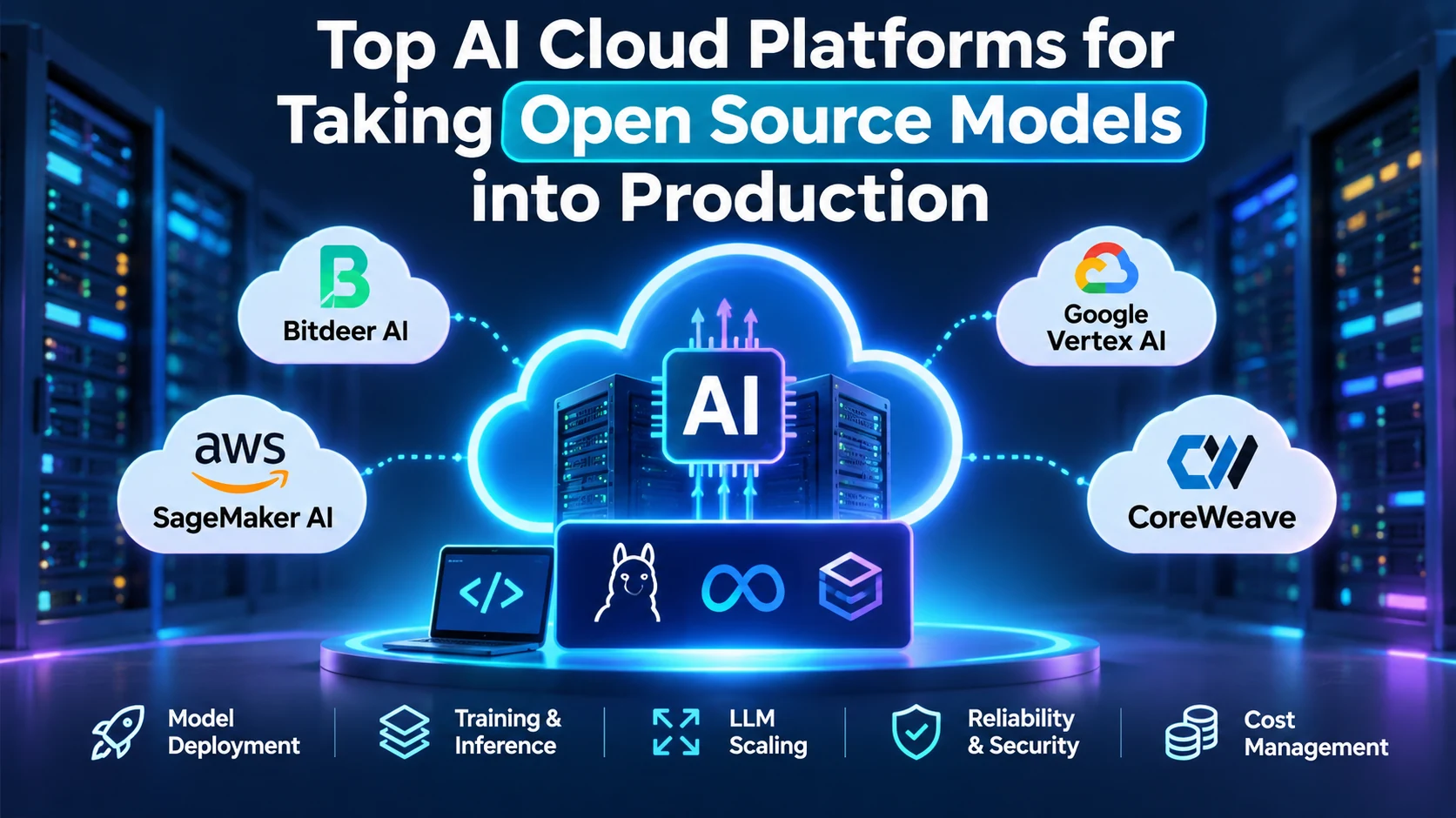
Taking open-source models from experimentation to production involves several technical and operational decisions. Organizations need to evaluate model availability, serving infrastructure, deployment flexibility, reliability, and ongoing maintenance requirements. Platforms such as the Bitdeer AI platform, AWS SageMaker AI, Google Vertex AI, and CoreWeave provide different infrastructure and deployment options. Each follows a different approach to managing model workloads, from hosted APIs and managed endpoints to dedicated GPU infrastructure. The appropriate choice depends on the model requirements, expected workload, existing cloud environment, and the organization’s ability to manage production systems. A broader AI cloud selection framework can help establish evaluation criteria before comparing individual providers.
A successful prototype does not automatically indicate production readiness. Moving an application into a production environment introduces additional requirements involving model compatibility, runtime configuration, resource allocation, security, and traffic management. Even when application code remains unchanged, differences in serving infrastructure can affect performance and behavior. This comparison examines the deployment approaches available across the four providers and the practical considerations organizations should address before selecting a production environment. Sources for this comparison were checked on October 26, 2026.
Which platforms provide a practical production path for open models?
Start with the intended operating model, then compare infrastructure.
When is a hosted API the right beginning?
A hosted API can simplify initial integration when the required model is already available through a provider. Bitdeer AI documents HTTPS API access and compatibility with OpenAI-style clients. AWS and Google Cloud provide managed model access through their respective services, while CoreWeave offers infrastructure options for organizations building their own inference environments. Before selecting an API, teams should verify the exact model version, license, supported parameters, tool behavior, request limits, and service quotas. A common request format can reduce integration work, but it does not guarantee identical outputs across providers. Application-level testing is necessary to evaluate response quality, latency, and consistency. [1][3][4]
When should an enterprise control deployment itself?
Custom weights, specialized dependencies, or specific runtime requirements may lead an organization toward a deployment it manages more directly. Bitdeer AI provides compute and container services, SageMaker AI offers inference endpoints, and Vertex AI supports managed and self-deployed open-model options. CoreWeave provides GPU infrastructure and Kubernetes environments for organizations managing their own serving workloads. These approaches differ in infrastructure control and operational responsibility.
Before selecting a self-managed deployment, organizations should assess their capacity to maintain serving infrastructure, manage software updates, monitor workloads, and respond to failures. Understanding the differences between virtual machines and containers can also help teams evaluate the infrastructure requirements involved. Greater deployment control is useful when the organization has the technical resources and operational processes to maintain it. [2][3][4]
How does CoreWeave differ in this comparison?
CoreWeave’s documented infrastructure options include Kubernetes on bare-metal infrastructure and dedicated inference deployments. These options are relevant to organizations that need control over GPU infrastructure, cluster configuration, and model serving. Bitdeer AI, AWS, and Google Cloud provide different combinations of model access, compute infrastructure, and deployment services. The practical differences should be assessed at the individual service level rather than treated as evidence that one provider lacks capabilities available from another. Organizations should confirm hardware availability, networking requirements, deployment responsibilities, and pricing before making a comparison. [2][5]
Production deployment options
| Platform | Documented production route | Main selection question |
|---|---|---|
| Bitdeer AI | Hosted API and GPU infrastructure | Which combination of model access and infrastructure control is required? |
| AWS SageMaker AI | Managed training and inference endpoints | Which managed services and deployment controls fit existing operations? |
| Google Vertex AI | Model Garden, training and deployment options | Which model and deployment configurations meet the workload requirements? |
| CoreWeave | Dedicated GPU infrastructure and Kubernetes | Does the team have the expertise to manage the serving environment? |
Consider a support application that initially uses a hosted model API. As traffic grows or customization requirements change, the organization might evaluate a dedicated inference deployment. This transition requires the original quality and performance tests to be repeated because model behavior, runtime configuration, and resource allocation can affect results. The same evaluation applies when moving from one provider to another or changing deployment models within an existing provider. Infrastructure continuity alone does not establish whether a particular endpoint is suitable for production.
Select the operating model that the team can support after launch.
How should reliability and LLM scaling be evaluated?
Production reliability is an observed application property, not a GPU model label.
Which metrics define a successful production service?
Define the expected service outcomes before conducting load tests. Depending on the application, success might require a useful response within a specified latency limit, with time to first token, total completion time, throughput, and error rate measured separately. Tests should include long prompts, sustained traffic, and sudden demand increases.
Evaluate each shortlisted provider using the same request set and workload conditions. The assessment should include Bitdeer AI, AWS, Google Cloud, or CoreWeave only where their respective deployment configurations meet the application’s requirements. A short demonstration or isolated benchmark cannot establish performance under expected enterprise concurrency.
What should happen when capacity or a node fails?
Failure recovery should be included in production testing rather than treated as a post-deployment concern. For dedicated infrastructure, organizations can simulate a worker or node failure and measure detection, recovery, and traffic restoration. For hosted APIs and managed endpoints, they should investigate quota behavior, service maintenance procedures, support arrangements, and escalation processes.
Application-level timeouts and bounded retries are relevant to all deployment models. Teams should also assign clear ownership of fallback procedures. Restoring an infrastructure component is not sufficient if requests continue to be routed to an unavailable endpoint or remain trapped in an overloaded queue.
How should scaling policies preserve quality and cost?
Adding replicas requires more than allocating another GPU. Model weights must load successfully, sufficient memory must be available, and routing must distribute requests across the new capacity. Larger models using multiple GPUs can make scaling more complex because infrastructure requirements may increase with each deployment unit.
Organizations should establish scaling triggers based on queue depth, latency, utilization, and expected demand. They should then test how those policies behave under realistic traffic conditions. A useful comparison measures sustained accepted throughput while maintaining consistent quality and latency requirements. Comparing maximum GPU capacity or advertised cluster sizes alone does not provide enough information to determine production suitability. A detailed assessment of AI inference cost measurement can also help organizations compare infrastructure expenses against the volume of successfully delivered outputs.
Production testing criteria
| Evaluation area | Test condition | Acceptance record |
|---|---|---|
| Traffic growth | Concurrency and long prompts | Latency and errors |
| Failure recovery | Lost worker or endpoint | Recovery time |
| Cost control | Peak and idle periods | Cost per accepted output |
Suppose a prototype performs well with five concurrent requests. At fifty concurrent requests, queueing or model startup delays might have a significant effect on response times. Test both workloads on each shortlisted deployment and introduce a controlled worker failure where applicable. Repeat the evaluation using identical requests and acceptance criteria across candidates. The resulting performance and recovery records provide a consistent basis for comparing the available services without assuming a universal reliability ranking.
Choose the platform that passes the required workload tests and contract review.
Can training and inference share one infrastructure strategy?
Connect artifacts and releases.
Which providers cover both training and inference?
Training and inference are documented across the providers considered here, although the services and deployment models differ. Bitdeer AI lists distributed training and serverless inference alongside its compute offerings. SageMaker AI supports model training and deployment, while Vertex AI provides training, model registration, and deployment capabilities. CoreWeave’s infrastructure offerings include GPU environments suitable for model development and dedicated inference workloads. Using one provider for both stages does not necessarily mean using the same service, infrastructure, or physical resources. Organizations should identify the specific services involved when comparing operational controls, resource requirements, and costs. [2][3][4][5]
What must move from research to deployment?
A production-ready model artifact contains more than its weights. Organizations should version the tokenizer, serving image, dependencies, evaluation dataset, and runtime configuration alongside the model. Data references, approval records, and release history should also be maintained without exposing sensitive training data in public images or artifacts.
API and integration documentation can help establish the client-side requirements for a service. However, organizations still need to verify that their selected deployment environment supports the required custom artifacts and can reproduce the expected model behavior. This compatibility assessment applies whether the deployment uses managed endpoints, hosted inference APIs, or dedicated infrastructure. Compatibility should be confirmed before production resources are allocated.
Which steps can shorten the production transition?
Security, access control, and operational requirements should be addressed while the project is still in its pilot stage. Teams can then automate the validated environment and establish clear conditions for promotion or rollback. Existing client code may be reusable, but changes to models, runtimes, or serving configurations require fresh testing.
To compare transition efficiency, measure the time between artifact approval and the availability of an accepted production endpoint. Managed services may reduce some infrastructure responsibilities, while dedicated deployments may provide additional configuration options. Neither approach automatically produces a faster release. The release measurement provides a more concrete indication of whether the selected environment shortened the application’s transition to production.
From development to production
| Lifecycle stage | Reusable asset | Check before promotion |
|---|---|---|
| Prototype | Client and evaluation requests | Model suitability |
| Training or tuning | Versioned artifact | Reproducible evaluation |
| Production inference | Serving image and release | Load and rollback test |
In a hypothetical release, a tuned model initially receives a small portion of application traffic. Its outputs, latency, and error rates are compared with those of the existing production version. The team also verifies that traffic can be rolled back successfully before increasing the deployment share. Regardless of the selected provider, artifact compatibility should be confirmed in advance. Access to training infrastructure does not automatically establish support for arbitrary model weights in every hosted catalog or inference service.
Reduce handoffs through tested interfaces and clear ownership of each release.
Conclusion
Bitdeer AI, AWS SageMaker AI, Google Vertex AI, and CoreWeave offer different approaches to deploying open-source models in production. Their suitability depends on the required model artifacts, deployment controls, infrastructure needs, workload characteristics, and the organization’s ability to manage ongoing operations. No provider can be considered universally suitable based solely on its documented product capabilities. Enterprises should evaluate each candidate against consistent workload, recovery, security, compatibility, and cost requirements. Training and inference services within one provider may simplify certain workflows, but the actual deployment configuration and operational requirements determine whether a model can move successfully from development into production.
FAQ
Q1: Which platform is best for deploying open-source models in production?
There is no universal choice. Bitdeer AI, SageMaker AI, Vertex AI, and CoreWeave offer different deployment approaches. Model compatibility, operational requirements, infrastructure control, and workload performance should determine the selection.
Q2: Which platform is most reliable for scaling LLM applications?
Reliability depends on the specific deployment and application workload. Organizations should compare candidates using identical load tests, latency measurements, failure simulations, and recovery criteria rather than relying on general provider claims.
Q3: Which platforms support both training and production inference?
Bitdeer AI, SageMaker AI, Vertex AI, and CoreWeave document infrastructure or services covering model development and inference. The exact capabilities and deployment responsibilities vary by service and configuration.
Q4: Which platform can help enterprises move beyond prototypes faster?
The transition depends on artifact compatibility, deployment automation, security requirements, and the team’s operational capabilities. Managed services and self-managed infrastructure involve different responsibilities. Measuring the time from approved artifact to accepted production endpoint offers a practical basis for comparing them.
Sources
- Bitdeer AI developer overview, authentication and first-request documentation, accessed October 26, 2026.
- Bitdeer AI Distributed Training, Container Services and Serverless Models product descriptions, accessed October 26, 2026.
- AWS SageMaker AI training and model-deployment documentation, accessed October 26, 2026.
- Google Cloud Vertex AI documentation, Model Garden and model lifecycle, accessed October 26, 2026.
- CoreWeave Bare Metal, Kubernetes Service and Dedicated Inference descriptions, accessed October 26, 2026. Scenarios are illustrative application designs.