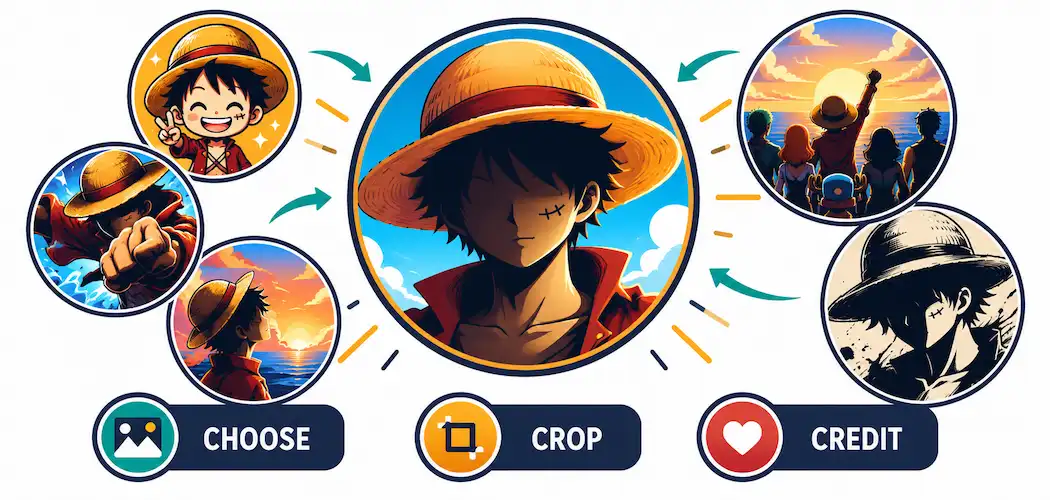
Scroll through anime Twitter, Discord servers, or any One Piece fan community and you’ll spot the same face again and again: a straw hat, a wide grin, and a scar under one eye. Monkey D. Luffy has become one of the most-used profile pictures in anime fandom, and it’s worth understanding why a cartoon pirate captain resonates so strongly as a stand-in for how people want to present themselves online.
What a PFP Actually Signals
A profile picture is more than decoration — on Discord, X, forums, and gaming platforms, it’s often the first thing anyone sees about you, before your name or your words. Choosing a character as your PFP is a quiet statement: it tells people what you’re into, and often what traits you admire or identify with. That’s a big part of why character PFPs outperform generic photos or abstract icons in anime-adjacent communities — they signal belonging instantly.
Why Luffy Specifically
Luffy’s appeal as a PFP choice isn’t random. A few traits explain the staying power:
- Unshakeable optimism. Even in One Piece’s darkest arcs, Luffy’s grin rarely disappears. For a lot of fans, that’s the whole point of picking him — a visual reminder to stay determined regardless of circumstances.
- A clear, simple visual identity. The straw hat, the red vest, the scar — Luffy is instantly recognizable even as a small, low-resolution avatar thumbnail, which matters a lot for a format that often gets shrunk to 40 pixels wide.
- A character who keeps evolving. Unlike static iconography, Luffy’s design has genuinely changed over nearly three decades of the series — Gear Second, Gear Third, Gear Fourth (with its Boundman, Tankman, and Snakeman variations), and the Gear Fifth “Nika” awakening introduced later in the story all give fans dramatically different looks to choose from depending on which version resonates with them.
- The Straw Hat crew as a found-family symbol. For fans who want to signal community rather than a single character, group-shot PFPs featuring Luffy with Zoro, Nami, Sanji, and the rest of the crew are just as common as solo portraits.
Choosing or Making a Luffy PFP
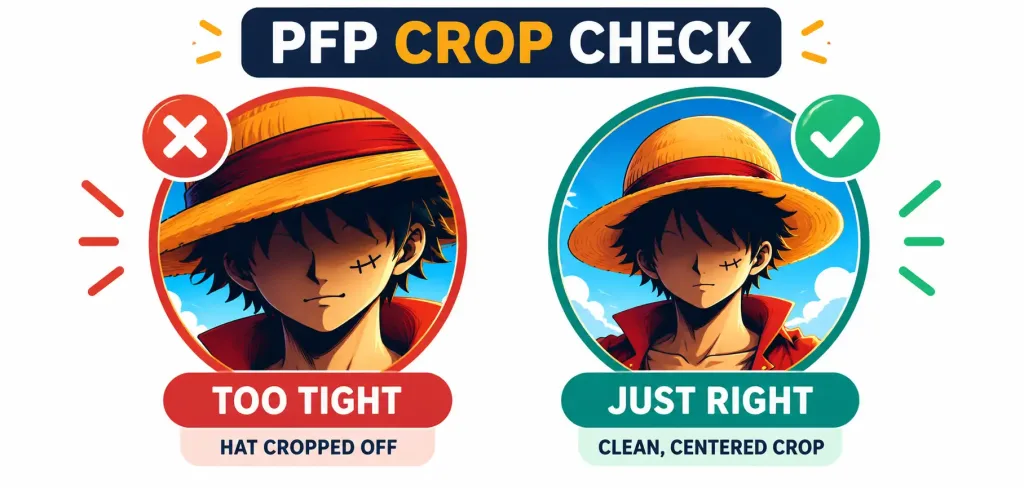
A few practical things matter more than people expect when picking or cropping a Luffy PFP:
- Resolution over style. Most platforms display PFPs as small circles or squares. A detailed, busy illustration that looks great full-size often turns to mush at avatar size — a tighter crop on the face, with clear contrast, reads better than an ambitious full-body shot.
- Platform aspect ratio. Discord, X, and most forums crop avatars to a square or circle automatically, so check how an image crops before committing — a straw hat or sword hilt getting cut off at the edge is a common and avoidable mistake.
- Matching the version to the moment. A classic East Blue-era Luffy reads as nostalgic and lighthearted; a Gear Fifth portrait signals you’re caught up with the most current arcs; a chibi or fan-art style signals a more casual, community-oriented presence rather than a “serious” fan identity.
If you want something more personal than a direct screenshot or official art, editing tools like Photoshop, GIMP (a free, genuinely capable alternative), or even simpler mobile apps like PicsArt let you crop, recolor, or stylize a base image. Keep in mind that any edit you make is still a derivative of someone else’s copyrighted art — see the note on usage rights below before posting edited fan art anywhere that isn’t purely personal use.
A Starting List of PFP Styles Fans Actually Use
- Classic straw hat close-up — the simplest, most universally recognizable option.
- Gear Fourth Boundman — for fans who want a more intense, powered-up visual.
- Gear Fifth “Nika” — the current, most talked-about transformation, popular with fans following the latest story arcs.
- Chibi/SD style — a softer, more playful take, common in casual Discord servers.
- Full crew ensemble — signals fandom of the whole show, not just the protagonist.
- Young Luffy (pre-timeskip) — a nostalgic choice for longtime readers/viewers.
- Post-timeskip Luffy — the more mature design fans associate with the series’ middle arcs.
- Luffy and Ace together — a popular choice among fans drawn to the brothers’ relationship and its emotional weight in the story.
- Action-pose fan art — dynamic, mid-battle illustrations, often from fan artists rather than official art.
- Minimalist/line-art style — a trend among fans who prefer understated, aesthetic-forward avatars over detailed illustration.
Using Fan Art and Official Art Responsibly
This is worth being direct about: One Piece, its characters, and Luffy’s design are the copyrighted property of Eiichiro Oda, Shueisha, and Toei Animation. Official art is licensed content, and fan art belongs to the artist who made it, not to whoever reposts it.
- For personal use (a Discord or X avatar, nothing monetized), using official art or crediting a fan artist’s work is standard, low-risk practice within fan communities, though it’s still technically using someone else’s copyrighted or original work.
- For anything commercial or redistributed at scale — merchandise, paid Discord bot icons, printed goods — you need actual permission from the rights holder or the original fan artist, not just a courtesy credit.
- If you’re using fan art specifically, crediting the artist directly (a username, a link to their original post) is the baseline expectation in these communities, and many artists explicitly state their own usage terms on platforms like DeviantArt, Pixiv, and X — worth checking before assuming an image is free to use however you like.
Where to Find Legitimate Options
Official One Piece art is available through Shueisha’s and Toei’s own promotional materials and licensed merchandise. For fan-made options, DeviantArt and Pixiv remain the two largest hubs with searchable tags for “Luffy” and specific Gear forms, and many artists there post with clear usage notes. Treat any image pulled from a generic image search with more caution — attribution is much harder to trace, and you have no way to confirm you’re not using someone’s paid commission work without credit.
The Bottom Line
A Luffy PFP endures as a fandom staple because the character himself is built for it — a simple, instantly recognizable design paired with a personality (relentless optimism, loyalty, refusal to give up) that a lot of fans genuinely want associated with them online. Whether you’re going with a classic straw-hat close-up or the latest Gear Fifth form, the practical choices that matter are resolution, platform cropping, and giving credit where fan art is involved — not just picking whatever image looks coolest at full size.
Frequently Asked Questions
Can I use a Luffy PFP for a business or monetized account?
Be cautious. Personal, non-commercial use (a regular social account or Discord avatar) is standard low-risk practice in fan communities, but commercial use of copyrighted character art without permission from the rights holder (or the original fan artist, for fan-made pieces) is a real legal and ethical line, not just a formality.
Where can I find high-quality Luffy PFPs?
DeviantArt and Pixiv are the two largest fan-art hubs with searchable tags, and many artists post clear usage terms alongside their work. Official art comes through Shueisha’s and Toei’s own channels and licensed merchandise.
What are the different Luffy Gear forms I might see in PFPs?
Gear Second (speed-focused), Gear Third (size-focused), Gear Fourth (with Boundman, Tankman, and Snakeman variations), and Gear Fifth — the “Nika” transformation introduced later in the series and currently the most talked-about version among active fans.
Should I credit the artist if I use fan art as my PFP?
Yes. Crediting the original artist (username or a link back to their post) is the baseline expectation in fan communities, and it matters even more if the art isn’t your own edit of official material.