BNB Chain basics start with a distinction that many short reviews miss: a blockchain ecosystem, a native asset, a trading platform and an application are different things. Understanding one does not automatically explain the others. A low network fee does not establish that a token is a good investment, and a familiar brand does not guarantee that every application using the network is safe.
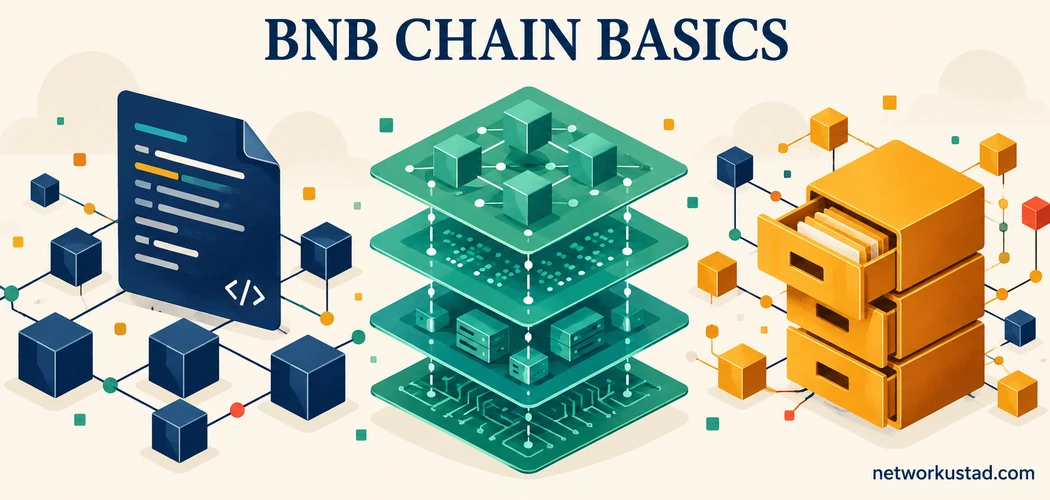
BNB Chain includes networks designed for different tasks. BNB Smart Chain supports smart contracts, opBNB provides a layer-2 environment, and Greenfield focuses on decentralised storage. Older descriptions can be misleading because Beacon Chain was retired and the ecosystem’s technical parameters have continued to change.
This guide explains the components without recommending an exchange, predicting a token price or promising a particular performance level. It also separates published protocol information from the practical questions someone should ask before interacting with an application.
BNB Chain basics: separate the names first
BNB Chain is the ecosystem name. BNB Smart Chain, commonly shortened to BSC, is a specific network within it. BNB is the native asset used for functions including transaction gas on BSC. Binance is a business operating services such as a centralised exchange. These names are connected historically, but they should not be treated as synonyms.
That distinction matters when reading a fee schedule. A percentage quoted by an exchange may describe that service’s trading charge. It does not define the gas cost of sending a transaction through BSC. Similarly, an application’s availability on a network does not mean the network operator has guaranteed the application’s assets or business model.
A beginner should identify the exact subject of each claim. Is the claim about a protocol, a wallet, an exchange account, an asset or an application? If a review moves between those subjects without explanation, its conclusions may not apply to the activity you are considering.
BNB Chain basics become clearer once the terminology stays consistent. The rest of this guide uses the ecosystem name for the broader collection and BSC when discussing the smart-contract network specifically.
BNB Smart Chain provides a smart-contract environment
BSC supports applications that use smart contracts and is compatible with the Ethereum Virtual Machine, or EVM. Compatibility can make familiar development tools and software patterns useful, but it does not mean BSC and Ethereum are the same network.
They have separate network histories, operating arrangements and transaction environments. A transaction submitted to one does not automatically become a transaction on the other. The fact that a wallet can connect to multiple EVM networks should not be mistaken for a guarantee that every asset is interchangeable between them.
The official BSC documentation describes a Proof of Staked Authority consensus arrangement involving validators. This differs from Bitcoin-style proof-of-work mining. Validator participation, incentives and penalties are part of how the network is operated, rather than evidence that every application has been reviewed for safety.
For readers learning BNB Chain basics, the practical distinction is between network operation and application behaviour. A network may process a transaction as instructed even when the instruction is a poor choice for the person signing it.
What changed when Beacon Chain retired?
Older articles often describe Beacon Chain as the active governance and staking component of a two-chain structure. That description should not be presented as current guidance. BNB Chain’s Fusion initiative moved functionality toward BSC and retired Beacon Chain.
The final sunset was scheduled for November 2024. Official post-fusion documentation states that the retired chain no longer accepts new transactions or proposes new blocks, and that its previous cross-chain communication with BSC stopped. A historical article can explain the old structure, but it needs a clear historical label.
Do not interpret this short summary as an asset-recovery procedure. Legacy assets have specific conditions, and a general beginner guide cannot establish whether an individual holding is recoverable. People encountering old network references should consult the current official documentation rather than follow an outdated transfer tutorial or an unsolicited recovery message.
This is one reason BNB Chain basics need periodic review. Network names and historical token standards can remain visible in old articles long after the workflow they describe has ceased to operate.
opBNB and Greenfield have different jobs
The official BNB Chain introduction identifies BSC, opBNB and Greenfield as the ecosystem’s networks. They should not be combined into a vague claim that every component performs the same function.
opBNB is a layer-2 environment built using the OP Stack and connected with BSC. Its fee model includes execution-related costs and costs associated with submitting data to the underlying network. That is different from saying that all activity has one permanent advertised fee.
Greenfield is storage-oriented. Its public mainnet launched in October 2023, so describing it only as a new testnet is outdated. Storage access, permissions and interactions with applications are a different subject from the execution of an ordinary BSC token transfer.
This guide does not promise a particular saving from using one network rather than another. The relevant choice depends on the application, asset support and intended task. A basic comparison should explain each component’s role before repeating marketing claims about speed or scale.
Gas fees are not percentage trading fees
On BSC, gas measures the computational work associated with an operation. The transaction’s gas use and applicable gas price affect its network cost, which is paid in BNB. A simple transfer and a more complex contract interaction need not consume the same amount of gas.
An exchange or decentralised application may impose its own separate trading or service fee. That fee can use a different basis, including a percentage of a trade. It is not a universal network rate. A bridge, exchange withdrawal or application may also involve charges that need their own explanation.
The previous version of this article incorrectly presented a range of 0.05% to 0.1% as though it explained BNB Chain fees generally. Those figures are removed because no identified service, current schedule or matching activity was established.
For BNB Chain basics, keep the question precise: what operation is being performed, on which network, and which party charges each cost? A single low headline percentage does not answer all three.
A cost example should remain an example
Imagine a hypothetical application interaction with a network fee and a separate service charge. Even if the network portion is small, the service charge may still matter. A quote can also involve the asset amount received, not merely the visible fee line.
This is a framework for checking a quote, not an estimate of current BSC pricing. It deliberately provides no made-up transaction total, token price or permanent dollar cost. A meaningful calculation needs the actual transaction details and the relevant conversion rate at the time.
Compare like with like. A transfer, token swap, storage action and cross-network operation are different tasks. A fee observed for one does not establish the cost of the others. If the quote changes before submission, the earlier estimate should not be presented as a guarantee.
Learning BNB Chain basics means understanding these categories before making numerical comparisons. The smallest advertised number is not necessarily the most informative measure of the complete task.
Treat performance specifications as dated measurements
A block interval, a gas limit and transactions per second describe different properties. They should not be collapsed into a single claim that a network is simply faster. The transaction mix and measurement method affect throughput figures.
A gas limit describes a computational budget rather than a fixed number of transactions. A basic transfer and a demanding contract call can consume different portions of that budget. Likewise, producing a block and meeting an application’s confirmation requirements are not identical milestones.
The previous article used undated values and compared them with an old Ethereum block-time claim. This replacement avoids retaining those numbers as current specifications. Readers needing operational values should check the relevant network documentation, upgrade status and measurement date.
For BNB Chain basics, the better habit is to ask what a number measures and when it was obtained. A test result, a design target and observed production activity are different kinds of evidence.
EVM compatibility does not remove application risk
Compatibility can make software easier to adapt, but it does not prove that a particular contract behaves as advertised. A familiar wallet prompt or application layout is not a substitute for identifying what is being authorised.
An application can involve permissions, asset custody or dependencies beyond the base network. A transaction can be recorded successfully while producing an outcome the user did not intend. Technical completion should not be described as consumer protection.
The appropriate review therefore moves beyond the chain name. Identify the application’s operator or project, the asset involved, the relevant contract and the action requested. Where those details are unclear, a broad statement that the network is secure does not resolve the uncertainty.
This article does not certify any application, token, bridge or wallet. BNB Chain basics provide context for asking better questions; they do not establish that a particular interaction is suitable for you.
Wallet permissions deserve careful attention
A self-custody wallet puts important responsibilities on the person controlling its keys. Keep recovery information private and do not give it to someone claiming to provide support. The Ethereum security guide explains general wallet-safety principles that are also relevant when using compatible tools; it is not a certification of BNB-specific services.
Read approval requests rather than treating every prompt as a routine connection. A token-spending approval can grant authority that persists beyond an initial visit. The permission and the specific contract deserve scrutiny, especially when a request appears broader than the intended task.
A useful distinction is between identifying a destination and authorising an action. Reaching a genuine-looking page does not automatically make every request appropriate. Similarly, recognising a token symbol is not sufficient to establish the identity of a contract.
For beginners, these observations should support caution rather than pressure to transact. No part of understanding BNB Chain basics requires connecting a funded wallet to an unfamiliar application.

Cross-network activity adds another layer of questions
An asset can be represented on more than one network, but the representations and transfer arrangements need to be identified. A familiar ticker alone does not establish that two balances are interchangeable or that a destination accepts a particular network.
A cross-network process can involve additional contracts, operators or technical dependencies. The exact risks depend on the mechanism. This guide does not provide a bridge recommendation or claim that every transfer method has the same protections.
Before relying on a tutorial, check whether it describes the current networks and the same asset you are considering. Legacy Beacon Chain instructions are an obvious example of why dates matter, but the principle applies more broadly.
BNB Chain basics should help distinguish an on-chain transaction from a cross-network movement. Understanding that boundary is more useful than treating every visible transfer button as the same operation.
Useful applications do not establish investment value
An ecosystem can support applications without every associated token becoming valuable. Developer activity, transaction volume and a product announcement are not guaranteed predictors of future prices. They measure or describe different things.
The earlier article moved from network features into exchange referrals and positive language about acquiring BNB. This replacement removes that promotional path. It does not recommend a purchase, a swap pair or a trading provider.
Similarly, a list of possible uses should not be presented as a verified catalogue of current integrations. Payment acceptance, game assets and service availability can change. An individual example needs direct evidence before it is used to support a consumer decision.
For anyone studying BNB Chain basics, separate the question “What does this network do?” from “Should I buy this asset?” The first can be explained technically without pretending to answer the second.
How to read future updates critically
Start with the date and the source. Official documentation is valuable for published protocol design and intended behaviour, while ecosystem announcements may also contain promotional language. Neither should be treated as an independent investment assessment.
Next, identify the scope. A development on opBNB does not automatically describe BSC, and a storage feature on Greenfield does not define an exchange’s withdrawal policy. Keep the network, application and service level separate.
Finally, look for limitations. If a review gives an exact performance figure, ask whether it identifies a test method and period. If it gives a fee, ask which activity and provider it concerns. If it labels something safe, ask which risks were actually assessed.
These questions make BNB Chain basics more durable than a list of temporary specifications. They also help explain why an updated article should correct old assumptions rather than merely change the year in its title.
Frequently asked questions
Is BNB Chain the same as Binance?
No. BNB Chain refers to a blockchain ecosystem, while Binance is a business operating services. Their related history does not make a network transaction and an exchange account the same thing.
Is BNB Smart Chain the whole ecosystem?
No. BSC is the smart-contract network. The ecosystem also includes opBNB and Greenfield, with different roles. Identify the relevant network before interpreting a feature claim.
Is Beacon Chain still the active staking layer described in old reviews?
That is an outdated description. Official post-fusion documentation describes its retirement and cessation of new transactions. Legacy asset questions require current, specific official guidance.
Are gas fees a fixed percentage of a trade?
No. Network gas and application trading charges are different categories. The operation, gas conditions and any service-specific charges need to be examined separately.
Does a fast block time mean an application is safe?
No. Network timing does not establish the quality of a contract, the identity of a token or the suitability of a wallet permission. Those require separate assessment.
Does this guide recommend buying BNB?
No. It explains network concepts and practical distinctions. It does not forecast prices, endorse an exchange or assess an investment’s suitability.