Choosing prepaid SIM cards for the USA starts with what your phone needs to do during the trip. Someone using maps and messaging apps may need a different service from someone receiving ordinary phone calls, sending SMS messages or sharing a connection with a laptop. A low advertised price is useful only when the plan covers those needs.
The next question is whether your particular phone can use the service. A device can be unlocked but still fail a carrier’s compatibility requirements. An eSIM-capable model may also differ by market, software or hardware version. Check the device before comparing offers in detail.
This guide explains a selection process rather than ranking providers or quoting prices that quickly become stale. It distinguishes cellular service from app-based virtual numbers, separates international texting from roaming, and helps you identify the complete cost of a plan before paying.
How prepaid SIM cards for the USA differ from virtual numbers
A physical SIM is a removable card used to identify a subscription to a mobile network. An eSIM uses a digital profile on a supported device. Either can be associated with different kinds of plan; the format alone does not establish what voice, messaging or data services are included.
A virtual number is a different product. It can provide a phone number through an application or online service, but it does not necessarily provide the cellular data connection that makes the app work. Do not assume a virtual US number replaces a mobile subscription for travel.
These distinctions matter because similar product descriptions can hide different capabilities. An offer labelled “USA eSIM” might be data-only. Another might include a mobile number and ordinary calling. An app-based number may depend on a separate internet connection and have its own restrictions.
When comparing prepaid SIM cards for the USA, write down the actual service category first. Then compare features within that category rather than treating every US-number product as equivalent.
Start with your phone, not a carrier advertisement
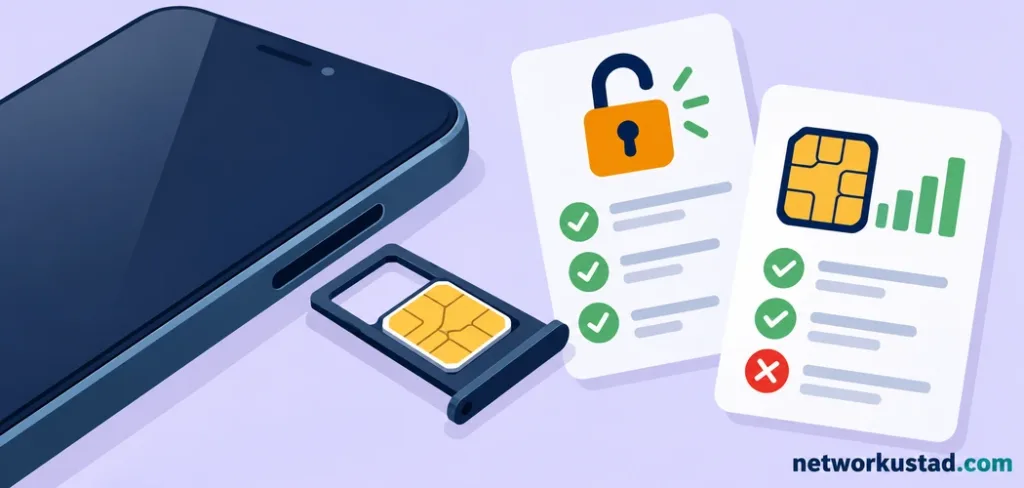
Check the device’s exact model and whether it is unlocked for another provider. Unlocking and compatibility are separate conditions. A phone released under a familiar model name in one country may not have the same supported configuration as a version sold elsewhere.
Carriers provide compatibility tools for this reason. For example, AT&T’s bring-your-own-phone information explains that a device needs to be compatible and unlocked. Use the relevant provider’s current checker for your device rather than treating this example as proof that your handset will work on every network.
Also establish whether you intend to use a physical card or an eSIM. A phone without an available physical SIM slot cannot use a loose card merely because its radio features are suitable. Likewise, digital activation requires actual support for the selected service.
The useful outcome is a confirmed device-and-plan combination. A general statement that a service supports “most phones” is not enough when choosing prepaid SIM cards for the USA.
Decide whether you need a US mobile number
Consider the people and services you expect to contact. Messaging apps use an internet connection, while an ordinary voice call or SMS depends on the service included with the selected line. A data allowance should not be interpreted as an allowance for every form of communication.
If a US number is important, confirm that one is included and identify its capabilities. Ask about incoming and outgoing calls, SMS, supported destinations and any restrictions relevant to your use. Do not assume every number will be accepted for account verification by a bank or another service.
A traveller who needs only internet access may prefer a simpler data-focused offer. Someone arranging local appointments may want ordinary calling as well. These are examples of different needs, not recommendations that one category is always better.
For prepaid SIM cards for the USA, an explicit feature list is more informative than a product name. “Connectivity” can mean different things, and the difference becomes inconvenient only after purchase if it is left unresolved.
Check coverage along your actual route
A nationwide brand name does not promise reception at every hotel, road junction or remote destination. Review the service’s stated coverage for the places you expect to visit, including stops outside major cities. A road trip and a city break can present different requirements.
Coverage maps are useful planning tools, but they should not be treated as a guarantee of an indoor signal or uninterrupted service. Terrain, buildings, network conditions and the particular device can affect the experience. Consider what you would do if the connection is unavailable at an important point.
A practical itinerary check includes accommodation, work locations and the routes between them. Downloading necessary travel information in advance can reduce reliance on a continuous connection, although it does not replace the service you need for calls or live updates.
When comparing prepaid SIM cards for the USA, prioritise relevant coverage over an unsupported claim that one carrier is excellent everywhere. The right question is whether the documented service is suitable for your route and device.
Compare data allowances and hotspot terms
Estimate the tasks you expect to perform rather than selecting an allowance by guesswork. Maps, email and short messages differ from frequent video viewing, large file transfers or sharing data with other devices. Your recent phone usage can provide a useful starting point, adjusted for the trip.
Read what happens when the included high-speed allowance is used. A plan may stop data, permit an additional purchase or continue under different conditions. The word “unlimited” does not explain every speed, prioritisation or tethering restriction.
Hotspot use deserves a separate check. Confirm that it is allowed, whether it has its own allowance and what happens after that allowance is consumed. A phone that can technically create a hotspot does not establish that the subscription includes the desired usage.
For prepaid SIM cards for the USA, compare the stated allowance with your practical work. A plan that is adequate for phone browsing may be unsuitable as the main connection for a laptop-heavy trip.
Match validity to the travel dates
Two products with similar data allowances can have different validity periods. Confirm when the clock starts: purchase, installation, activation or first qualifying network use. Do not rely on an assumption carried over from another provider’s product.
Check both the service period and any activation deadline. A plan bought well before departure may have conditions that affect when it can be used. Conversely, leaving all activation questions until arrival can create an avoidable problem when you need transport or accommodation information immediately.
Read the time unit carefully. A fixed number of days, a calendar month and an automatically renewing billing period are different arrangements. Also establish whether unused data carries forward and under which conditions, rather than assuming it remains available indefinitely.
Comparing prepaid SIM cards for the USA becomes easier when you align the validity with your itinerary. Include arrival and departure days, possible delays and any period when you need connectivity after the main part of the visit.
Calculate the full cost, including renewal
Separate the plan charge from possible activation costs, taxes, add-ons and other applicable fees. An advertised monthly equivalent may require a larger upfront payment. A discounted rate may depend on AutoPay, several lines, a promotion or another condition.
Prepaid means paying in advance; it does not necessarily mean that no further payment can occur. Providers can offer automatic renewal and recurring add-ons. AT&T’s published AutoPay information, for example, describes charges for the plan and renewing add-ons together with applicable taxes and fees.
The earlier version of this article gave carrier starting prices without identifying matching plans or conditions. Those prices have been removed. This guide does not replace them with another undated list, because a useful comparison needs current product details and a defined duration.
For prepaid SIM cards for the USA, compare the amount due now and the amount that could be charged later. Keep a record of the offer and cancellation terms so that a low headline price does not obscure the actual commitment.
International texting and roaming are different
Sending a message from the United States to another country is not the same service as using a US line while physically abroad. A plan can include one without including the other. International calling is another feature with its own destinations and conditions.
The original article bundled broad international benefits into a general prepaid recommendation. That approach is misleading. T-Mobile’s current prepaid material distinguishes texting from the US and particular cross-border benefits rather than treating every international service as universally included.
If your itinerary includes another country, examine that part of the trip separately. Identify the location, the expected usage and the applicable plan terms. Do not interpret a list of international texting destinations as proof of mobile data coverage while travelling in those destinations.
When reviewing prepaid SIM cards for the USA, use precise questions: can I call this destination from the US, can I send SMS there, and can I use the line when I leave the US? They need separate answers.

Plan how a second line will work
If your phone supports two active lines in the required configuration, decide which one will provide data and which will handle calls. Label the lines clearly where the device allows it. This reduces confusion between the travel subscription and your usual service.
Keeping the home line active may be useful for familiar contacts, but it can also leave roaming-related questions unresolved. Turning off data on one line does not automatically answer how its voice calls or messages will be handled or billed. Check the home provider’s terms as well.
Apple’s travel eSIM guidance discusses considerations for supported iPhones, including travel service and line settings. Use device-specific instructions for your own model; an iPhone example should not be treated as a universal menu path for Android devices.
The point is to configure deliberately. Buying prepaid SIM cards for the USA does not, by itself, prevent another active line from incurring charges under its separate service arrangement.
Read activation instructions before departure
Identify what the provider requires to activate the selected product. The process may involve a website, an application, a digital profile, a physical card or assistance from the provider. Do not assume a procedure from a previous trip still applies.
If internet access is needed for setup, plan where you will have it. Keep the provider’s instructions and support details accessible. Avoid sharing activation information publicly or sending it to someone who has approached you through an unsolicited message.
Confirm which information the provider requires and how payment is accepted. The previous article made blanket claims about residency, identification and credit checks. This replacement does not repeat them: eligibility and registration requirements should be established for the particular offer.
For prepaid SIM cards for the USA, preparation is more useful than claiming universal instant activation. A clear setup plan gives you a way to resolve problems before connectivity becomes urgent.
Test the services you actually bought
After activation, check that the intended line is selected and that the expected services work. If the plan includes ordinary calling and SMS, test those separately from internet access. An app message arriving over Wi-Fi does not demonstrate that the mobile line’s SMS service is working.
Check mobile data with Wi-Fi disabled temporarily so that the test uses the intended connection. If hotspot service is part of the purchase, verify it with the device you expect to connect. Restore your preferred settings afterwards.
If something fails, review the provider’s troubleshooting instructions and contact its support channel. Avoid repeatedly buying replacement plans before identifying whether the issue concerns activation, compatibility, coverage or settings.
A short check of prepaid SIM cards for the USA should focus on the promised service rather than a single signal icon. Save the confirmation and relevant account details securely for later support.
Think about number retention before leaving
A temporary travel line may be easy to stop using, but a number used for ongoing business contacts creates a longer-term obligation. Establish the conditions for keeping the number active and what happens if the plan expires or the account becomes inactive.
Avoid making a short-lived number the sole recovery method for important accounts without considering continuity. The provider’s number-retention and account-access rules matter more than an article’s general description of prepaid flexibility.
Before departure, review automatic renewal and any recurring extras. If you intend to stop service, follow the provider’s process and retain the confirmation. Do not assume that removing an eSIM profile or taking a physical card out of a phone necessarily cancels the billing arrangement.
This is another reason to compare prepaid SIM cards for the USA by the whole lifecycle: purchase, activation, use, support and ending or retaining the service.
A practical shortlist without unsupported rankings
Create a small comparison table for the actual offers you are considering. Include device compatibility, network coverage, physical SIM or eSIM format, data allowance, voice and SMS, hotspot, validity, upfront payment and renewal conditions.
Add a source and checking date for each offer. When a detail is unclear, mark it as a question for the provider rather than filling the gap with a feature offered by a different plan. Compare the same trip duration and number of lines.
This method avoids presenting a provider as universally best. A suitable option for a brief city visit may not be suitable for a long road trip or a person maintaining a business number. Your phone and communication needs determine which differences matter.
The goal is a documented choice that you can explain. That is more useful than a list of low prices without plan names, restrictions or a way to verify them.
Frequently asked questions
Does an eSIM always include a US phone number?
No. Check whether the specific plan is data-only or includes mobile voice and SMS. The digital format alone does not establish the service features.
Is an unlocked phone guaranteed to work?
No. Unlocking and network compatibility are separate checks. Confirm the exact device with the provider’s current compatibility process before buying.
Is a virtual number a replacement for cellular data?
Not necessarily. A virtual-number application can require a separate internet connection. Establish whether you are buying a number service, mobile connectivity or both.
Does prepaid mean no automatic renewal?
No. An offer can include AutoPay or recurring add-ons. Read the billing and cancellation conditions rather than assuming there will be no later charge.
Are international texts and roaming the same thing?
No. Messaging from the US to another country and using your line while abroad are different services. Check each required destination and feature separately.
Should I choose by the cheapest advertised price?
Compare the complete service and cost for your trip. Compatibility, coverage, validity and the features you need can matter more than the lowest headline figure.