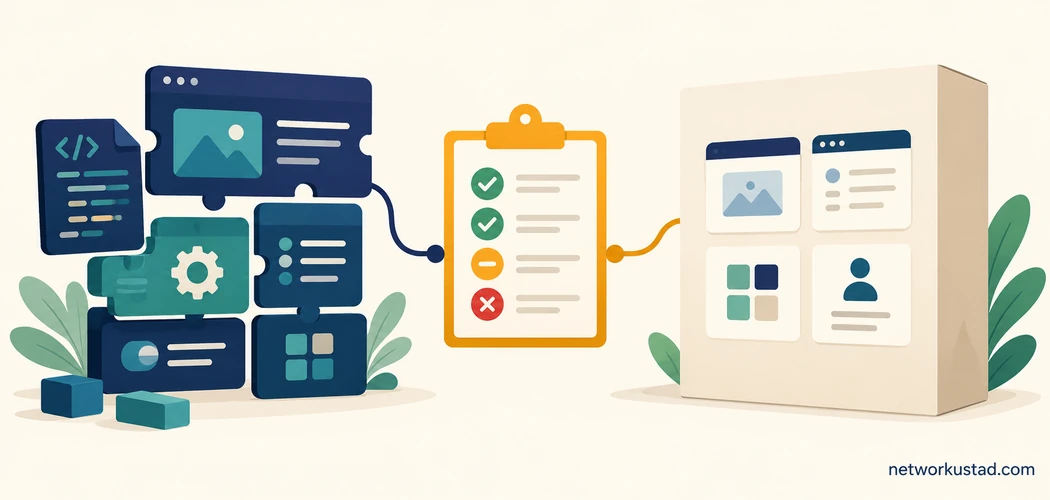
Comparing custom software vs off-the-shelf solutions is a decision about the service your organisation must operate, not just the software it will acquire. A tailored application may address a distinctive workflow, while an existing product may cover a common requirement. Either can disappoint when the implementation, maintenance and commercial arrangements are poorly understood.
Start with the problem. Which users are struggling, what are they trying to complete, and what would a better outcome look like? Without those answers, a feature-rich demonstration or an appealing development proposal can steer the decision before the requirements are clear.
This guide offers a practical comparison framework rather than a universal winner. It explains where the trade-offs arise and how to test them. It does not promise that custom development automatically creates efficiency or that packaged software can always be deployed quickly.
How to compare custom software vs off-the-shelf solutions
Custom development means commissioning or building software for defined requirements. Off-the-shelf software is a product made available to multiple customers. The distinction concerns how the capability is supplied; it does not determine where the software is hosted or how much work implementation requires.
A custom application can use cloud services and existing libraries. A commercial product can offer configuration, extensions or APIs. A software-as-a-service subscription is a delivery and commercial arrangement, rather than proof that the underlying product needs no integration.
The real decision may therefore involve several components. You might buy a standard support platform, build a specialised scheduling service and connect them through an integration. That is different from assuming the entire organisation must choose a single model.
When evaluating custom software vs off-the-shelf solutions, define the boundary of the comparison. Identify the capability being considered, the existing systems around it and the responsibilities that remain with your organisation under each option.
Document the workflow before specifying features
Describe a representative task from beginning to end. Include who starts it, the information needed, decisions made, approvals required and the final outcome. Then document exceptions: missing information, cancellations, corrections and unusual cases.
A feature list alone can hide important gaps. Two products may both advertise “approvals,” yet handle delegation, audit history or rejected requests differently. A custom proposal may promise to support the process without explaining how exceptional cases will work.
Separate essential requirements from preferences. A regulatory obligation or a necessary integration should not receive the same treatment as a preferred screen layout. Also ask whether an existing workflow is valuable or merely familiar; reproducing an inefficient process in new software can preserve the original problem.
For custom software vs off-the-shelf solutions, workflow evidence makes the comparison concrete. It gives suppliers something specific to demonstrate and development teams something specific to test, rather than asking either side to fulfil an ambiguous vision.
Identify what genuinely needs differentiation
Some activities distinguish the organisation’s service, while others are ordinary supporting functions. A highly specialised calculation or operating process may justify dedicated development. Common functions may be adequately served by an existing product.
That distinction needs evidence. Calling a business unique does not establish that every supporting tool must be built from scratch. Equally, labelling a need common does not prove that the available products meet the organisation’s requirements.
Consider a hypothetical repair company. Its standard invoicing needs might be served by an established product, while a distinctive field-allocation process could merit separate investigation. This is an illustrative scenario, not a measured customer result or a recommendation for a particular architecture.
A useful custom software vs off-the-shelf solutions discussion asks which differences create value and which differences add avoidable complexity. The answer can change the scope of the project before money is committed.
Custom development offers choices and responsibilities
A custom project can give an organisation influence over functionality, priorities and technical design. However, that influence must be exercised through capable product management, engineering and decision-making. A contract does not automatically translate requirements into a reliable service.
Changes can be difficult when the design is tightly coupled, tests are weak or the available team lacks relevant knowledge. Documentation, maintainable code and operational access matter because the original developers may not always be available.
When discussing a project with a development supplier such as ELITEX, bring a clear requirements brief. Ask about integration, security responsibilities, milestones and handover. Compare the proposed service with the same criteria you apply to other candidates.
The custom software vs off-the-shelf solutions choice should therefore include your ability to direct and sustain the work. Greater control is useful only when the organisation can support the responsibilities that accompany it.
Packaged products still require implementation
An existing product can provide a functioning starting point, but the surrounding work may still be substantial. Data must be prepared, user roles configured, integrations established and people trained. Some organisations also need to revise procedures to use the product effectively.
Configuration and customisation should be distinguished. A supported setting may survive routine upgrades differently from a bespoke extension. Ask what the supplier supports, who maintains changes and what happens when the product evolves.
A demonstration should include your workflow rather than only the supplier’s preferred scenario. Ask to see an exception handled, a failed integration diagnosed and a record exported. Those tasks can reveal more than a polished overview of standard screens.
When weighing custom software vs off-the-shelf solutions, compare the full implementation effort. “Already exists” does not mean “already works in our environment,” just as “built for us” does not mean “finished correctly.”
Estimate total ownership cost over a stated period
Use the same planning horizon and assumptions for both options. Identify initial costs, recurring costs and costs triggered by growth or change. Keep assumptions visible so that a later reader can understand why the estimates differ.
For a custom build, examine discovery, design, development, testing, hosting, monitoring, maintenance and future work. For a purchased product, examine subscriptions, implementation, configuration, integrations, training, support tiers and relevant usage charges. Both options can involve migration and internal staff time.
The GOV.UK Service Standard’s technology-choice guidance highlights total ownership cost and preserving the ability to change direction. It is written for government services; the general questions can inform a business comparison without making every government requirement applicable to private organisations.
A custom software vs off-the-shelf solutions budget should not assume that custom development pays for itself or that the lowest subscription produces the lowest overall cost. Treat expected savings as assumptions to test, rather than guaranteed returns.
Compare time to a usable service
A product can be available for purchase immediately while still needing months of organisational work. A custom team can deliver a narrow capability early while a broader replacement takes longer. The meaningful milestone is a usable service, not a licence purchase or an initial code release.
Define what must be ready for that milestone. Include data quality, permissions, support, training and a fallback if the new system fails. A date is more credible when dependencies and acceptance conditions are visible.
Consider a staged rollout where appropriate. A limited trial can expose problems before the whole organisation depends on the software. However, a pilot should not silently become a permanent workaround with no owner or support arrangement.
For custom software vs off-the-shelf solutions, ask each proposal to show the path to the same operational outcome. Otherwise, one option may appear faster simply because it excludes work included in the other.
Test integration with realistic data
List the systems the new capability must exchange information with. Identify which system owns each important record and how updates will be reconciled. “Has an API” is only a starting point, not evidence that the intended integration is straightforward.
Check the permitted operations, authentication, usage limits and error behaviour. A connection that works with a handful of sample records may reveal different problems when handling incomplete data, duplicates or interrupted updates.
Use representative test data with appropriate protection. Confirm that failed transfers are visible and that someone owns the response. An integration needs operational support, not merely a successful demonstration during procurement.
The custom software vs off-the-shelf solutions comparison should include these dependencies explicitly. Otherwise, an attractive core product or development estimate can obscure the work required to make the complete service function.
Assess security and privacy in either model
Neither sourcing model is inherently a security guarantee. A custom application needs secure design, development, deployment and maintenance. A commercial product needs suitable configuration and evidence that its supplier manages vulnerabilities and access appropriately.
Ask who can access sensitive data, how access is reviewed and what records are available for investigation. Establish the process for updates, incident communication and recovery. Avoid treating a certification or a vendor statement as an answer to every use-specific question.
Privacy requirements depend on the information, purpose and jurisdictions involved. Determine where data will be processed and which parties receive it. Obtain appropriate specialist review where the project creates legal or regulatory questions.
For custom software vs off-the-shelf solutions, record the responsibilities under each proposal. A gap between the supplier’s assumptions and your team’s assumptions can matter more than the label attached to the software.
Clarify ownership and access before contracting
Custom development does not automatically mean the customer owns all intellectual property or can freely move the system to another supplier. Contracts can distinguish new code, pre-existing components, third-party libraries and licensed services. The actual rights need to be understood.
Operational control also deserves attention. Determine who controls hosting accounts, repositories, deployment processes, documentation and credentials. A theoretical right to use code may be less helpful if the organisation cannot operate or maintain the service.
For a commercial product, establish the licence scope and permitted integrations. Ask what happens when the subscription ends, when usage grows or when a required feature moves to another tier.
This article does not interpret a particular contract. It identifies questions to resolve with procurement and legal advisers. Those questions belong in the decision before signing, rather than being discovered during a supplier dispute.
Make exit planning a practical test
Ask how your organisation would change direction. What data can be exported, in which format, with what relationships and attachments? Who performs the export, how long might it take and what charges or restrictions apply?
For a custom service, assess whether a replacement team can understand, deploy and maintain the system. For a packaged product, assess whether another system can use the exported information. In both cases, documentation and a realistic transition process matter.
Do not accept a screenshot of an export button as complete evidence. A controlled trial using representative records can reveal whether the export is usable for the intended purpose. Record any missing fields or dependencies.
A custom software vs off-the-shelf solutions assessment becomes stronger when exit is demonstrable. It does not remove all switching costs, but it makes the future dependency easier to understand.
Consider a combined approach without hiding complexity
A hybrid arrangement can use an existing product for common capabilities and custom software for specific needs. That can be sensible when the boundary is clear, but it introduces interfaces and divided responsibilities that need management.
Define which component owns the business rules and which team resolves failures. If a problem crosses two suppliers, the organisation needs a process that does not leave users waiting while each party blames the other.
Keep custom extensions proportionate. If every ordinary workflow needs an unsupported workaround, reconsider whether the underlying product is a suitable fit. Conversely, building commodity functionality repeatedly may consume effort better spent on the distinctive requirement.
The useful question is not whether a hybrid approach sounds flexible. It is whether the combination delivers the service with manageable cost, responsibility and change risk.
Use a decision record rather than a slogan
Summarise the problem, essential requirements, options considered and evidence obtained. Include the assumptions behind cost and delivery estimates. Record important uncertainties and what would cause the decision to be revisited.
A comparison table can help, provided it does not hide essential requirements inside an average score. A product that fails a mandatory need should not appear acceptable merely because it scores well on presentation or convenience.
| Decision area | Evidence to request |
|---|---|
| Workflow fit | Demonstration of ordinary and exceptional tasks |
| Ownership cost | Comparable implementation and operating estimates |
| Integration | A realistic test with documented failure handling |
| Maintenance | Named responsibilities, support scope and update process |
| Security and privacy | Controls and commitments relevant to your actual use |
| Exit | Usable data export and a credible transition process |
A custom software vs off-the-shelf solutions decision should be explainable to the people who will fund, operate and use the result. Clear evidence is more valuable than declaring one model superior in every situation.
Frequently asked questions
Is custom software always more flexible?
No. Flexibility depends on design, maintainability, available expertise and contractual access. A bespoke system can become difficult to change if those conditions are weak.
Is packaged software always cheaper?
No. Compare the complete cost for the same requirements and period, including integration, implementation, recurring charges and internal effort.
Can an organisation buy some components and build others?
Yes. A combined approach can be considered, but the boundaries and support responsibilities need to be clear. It is an option to evaluate, not an automatic improvement.
Does a custom project guarantee ownership of the code?
No. The contract and third-party licences determine the relevant rights. Obtain appropriate advice before assuming ownership or unrestricted portability.
What should a trial demonstrate?
Use your real workflow, including exceptions, integration failures and export needs. A standard sales demonstration may not reveal those requirements.
What is the main decision principle?
Compare evidence for the complete service. The better option is the one that meets the defined needs with responsibilities, costs and dependencies your organisation can sustain.