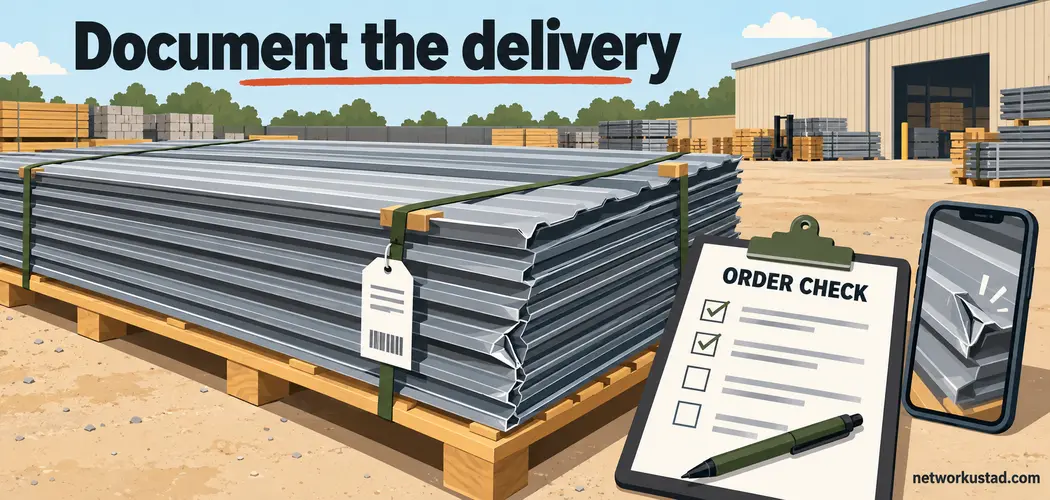
A delivery arrives with missing pieces. A panel looks different from the approved specification. An installation date passes without a clear replacement date. Problems like these are easier to discuss when the order, the evidence and the requested solution are organized.
Resolving building-supplier complaints starts with identifying exactly what was promised, what happened and which business is responsible for the next step. A general allegation that a project went badly gives the recipient little to investigate. A clear description supported by relevant records creates a more useful starting point.
This guide offers practical information for U.S. customers dealing with building-material suppliers. It does not determine whether a particular company acted improperly. Business purchases, installation contracts, custom orders and purchases elsewhere may involve different rules. Obtain local professional advice when safety, significant losses or legal deadlines are involved.
Start by identifying the issue and the responsible business
Building-supplier complaints can involve several separate relationships: the seller, manufacturer, carrier, installer and project designer. The company that supplied a product may not have agreed to install it. An installer may not control a manufacturer’s replacement process.
Look at the order confirmation, invoice and signed agreement. Identify the legal business name, the product or service purchased and the party receiving payment. Check whether delivery, unloading, storage or installation was included or arranged separately.
Then describe the issue in observable terms. For example, say that two items listed on the packing slip were absent, or that the delivered color differs from the approved order. Keep questions about cause separate from observations about condition.
You may not yet know who is legally responsible. That is a reason to ask for clarification, preserve records and seek advice where needed, rather than assume that every business on the project has the same obligations.
Step 1: Deal with immediate safety concerns
A complaint process is not a structural assessment. If components appear unstable, installation seems unsafe or a damaged item could injure someone, keep people away from the affected area and contact an appropriately qualified professional. Use emergency services for an immediate emergency.
Do not climb an unsafe structure or move heavy materials just to obtain a better photograph. Avoid attempting a repair that requires skills or equipment you do not have. Ask the relevant professional how to make the situation safe while preserving useful evidence where practical.
Document urgent work and why it was needed. Keep invoices, photographs taken safely and any written professional findings. If an emergency required action before the supplier could inspect, explain that sequence accurately.
Safety decisions and responsibility for their cost are separate questions. A supplier’s request for more information should not be treated as an engineering clearance to continue using a questionable component.
Step 2: Build a simple evidence file
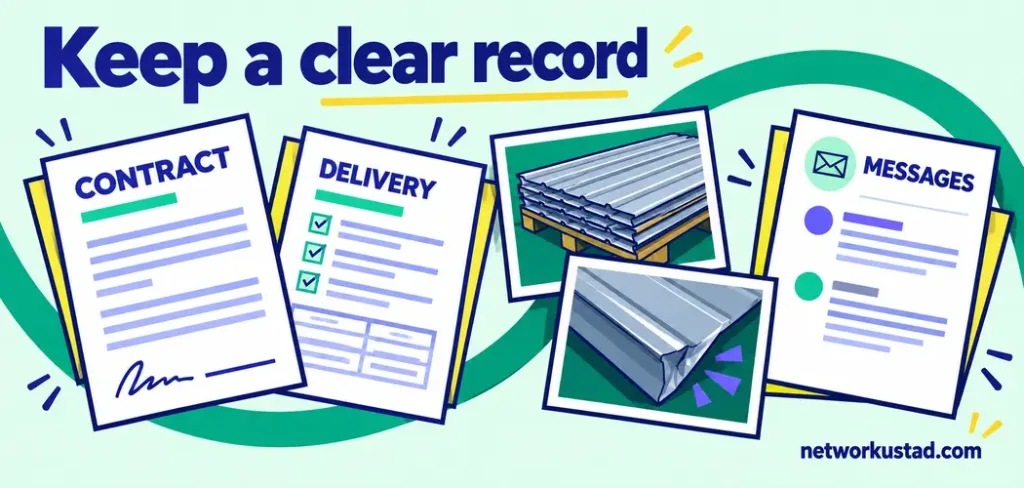
For building-supplier complaints, a small organized file is more useful than an unlabelled collection of screenshots. Start with the documents that establish the order and the events in dispute.
Keep the quotation, signed contract, approved drawings, specifications, change orders, invoices and payment records. Add delivery paperwork, product labels and relevant messages. Preserve original files and make copies for sharing.
Photographs should show both context and detail when this can be done safely. A wide image can identify the affected item; a closer image can show the condition being discussed. Record when you noticed the issue and where the item was stored or installed.
Do not alter images to make damage look more severe. If you annotate a copy, retain the original and label the annotation. A photograph may show a condition without proving when it arose or who caused it.
Make a short timeline
Record the order date, agreed milestones, delivery events, discovery of the problem and contact attempts. Separate confirmed dates from estimates. If a delivery date was described as provisional, preserve that wording rather than later describing it as an unconditional promise.
This timeline helps building-supplier complaints stay focused when different people become involved. It also makes it easier to spot missing information before repeating the same conversation.
Step 3: Read the terms relevant to the problem
Check the contract for product specifications, approved substitutions, delivery arrangements, inspection procedures, notice requirements, warranty terms and the agreed dispute process. Read later amendments and change orders too.
A sales conversation and a signed document may describe the project differently. Preserve both and ask for an explanation. Do not assume every clause is enforceable, or that an unfavorable clause can simply be ignored. Those are questions for applicable law and, where necessary, legal advice.
For building-supplier complaints about delay, establish which milestone is affected. Manufacturing completion, dispatch, arrival and installation are different events. Ask whether the date was fixed, estimated or subject to a stated condition.
For a product mismatch, compare the delivered item with the approved specification. If suitability for a site or intended use is disputed, a qualified designer or engineer may need to assess it. A customer-service response cannot replace that assessment.
Step 4: Request a specific, practical solution
Decide what response would address the immediate issue. Depending on the facts, you might request missing parts, inspection, a replacement proposal, a revised schedule or an explanation of a charge. A requested outcome is not automatically a legal entitlement.
Make the request concrete. Instead of asking the company to fix everything, identify the affected order and the action you want it to consider. Explain why that action would help move the project forward.
If you request reimbursement, attach a clear breakdown and supporting records. Distinguish amounts already paid from estimates or possible future losses. Do not describe an estimate as an invoice or assume that every resulting expense is recoverable.
For building-supplier complaints involving several issues, number them and give each a requested response. That makes it easier to see whether the company’s answer resolves the whole complaint or only one part.
Step 5: Send a clear written complaint
Use a verified contact channel from your purchase documents or the company’s established website. Check whether the agreement specifies an address or method for formal notices. A general social-media message may not satisfy that requirement.
Keep the complaint concise and attach the documents needed to understand it. Explain the order, the problem, previous contact and the response requested. The FTC’s sample customer complaint letter provides a useful general framework.
Ask for acknowledgment and a substantive response by a reasonable date. Choose that date with the circumstances in mind; it is a request, not a newly created legal deadline. Keep evidence of sending and any delivery confirmation.
Adaptable complaint-letter template
Subject: Request for resolution — order [reference]
Dear [customer-service team or named contact],
I purchased [product or service] under order [reference] on [date]. The relevant agreed specification or milestone was [brief description, referring to the attached document].
On [date], I found that [specific observable problem]. I previously contacted [person or team] on [dates], and the matter remains unresolved in the following respects: [short list].
I ask you to review the attached records and respond to this proposed solution: [specific request]. Please also explain any inspection, collection, replacement or other steps you propose, including who would arrange them.
Please acknowledge receipt and provide a substantive response by [reasonable requested date]. You can contact me at [preferred contact details].
Attached: [relevant order documents, photographs and correspondence].
Sincerely,
[name]
This is a practical starting point for building-supplier complaints, not a formal legal notice tailored to every contract. Do not include unnecessary identification, full payment-card details or unrelated personal records.

Step 6: Track responses to building-supplier complaints
Keep a communication log with the date, person contacted, summary and next action. After a telephone discussion, send a short written summary and invite corrections. Avoid treating an unanswered summary as proof that the other party agreed with everything in it.
If the company proposes an inspection, clarify access, the person attending and the information they will provide afterward. Ask how a returned item will be identified and how collection or shipping will be documented. Keep copies of relevant labels and paperwork.
Where a solution is agreed, confirm its scope, timing and practical responsibilities in writing. A replacement may leave questions about delivery, unloading, removal of the old item or installation. Resolve those details before assuming the arrangement is complete.
Read any release or settlement document carefully. If it gives up claims, changes payment duties or uses terms you do not understand, seek advice before accepting. A friendly email exchange does not remove the importance of the actual agreement.
When building-supplier complaints need escalation
If the first contact does not produce a useful answer, ask for the business’s complaint procedure or a manager responsible for the matter. Send a concise summary of the unresolved issues and the previous steps, rather than repeatedly expanding the accusation.
Escalation should have a purpose: obtaining a decision, identifying missing information or confirming whether the proposed solution is accepted. Keep the account factual even when the experience has been frustrating.
For eligible U.S. consumer issues, USA.gov lists state consumer protection offices. Ask the relevant office whether it handles the type of transaction and what assistance it can offer. Commercial purchases may fall outside a particular consumer program.
An agency complaint does not guarantee compensation or replace a court claim. Likewise, a complaint to a private review organization is not a court judgment. Identify what the process can actually do before relying on it.
Mediation, arbitration and legal advice are different options
Mediation generally involves a neutral person helping the parties explore an agreement. The mediator does not ordinarily impose a decision. Whether it is available, required or useful depends on the contract, the dispute and the applicable process.
Arbitration involves a different procedure in which an arbitrator can issue a binding award under the governing agreement and rules. Do not treat an invitation to mediation and an arbitration demand as interchangeable documents.
Before choosing either route for building-supplier complaints, ask about fees, participation requirements, evidence, representation and the effect of any resulting agreement or award. An advertised success rate does not predict your outcome.
Seek local legal advice when losses are substantial, responsibility is disputed, a formal demand arrives or a deadline may be approaching. Complaint correspondence does not necessarily pause legal or contractual time limits. Do not assume that waiting for customer service protects your position.
Keep different complaint types separate
| Issue | Useful starting records | Question to clarify |
|---|---|---|
| Missing items | Order, packing list and delivery notes | Were the items part of this shipment or scheduled separately? |
| Product mismatch | Approved specifications and product labels | What was ordered, approved and delivered? |
| Visible damage | Safe photographs and delivery records | What inspection or collection process is proposed? |
| Delay | Agreed milestones and schedule changes | Which commitment is affected and what revised plan is offered? |
| Installation concern | Installation agreement and professional findings | Which business performed and is responsible for the disputed work? |
| Billing disagreement | Quote, change orders, invoices and payments | Which charge is disputed and what supports it? |
These examples help organize building-supplier complaints. They do not decide liability. The same visible problem may have different causes, and different parties may hold the missing records.
Avoid steps that make resolution harder
Keep public reviews tied to your own experience and verifiable facts. Avoid accusing someone of fraud or inventing a pattern of complaints because one order went wrong. Redact personal information and other people’s details before posting documents publicly.
Do not secretly record calls on the assumption that recording is lawful everywhere. Written notes and a follow-up email may be a simpler way to preserve your account; obtain local advice if recording is important.
Do not withhold payments, cancel finance arrangements, discard disputed goods or arrange major alterations without understanding the consequences. Urgent safety work may be necessary, but changes to evidence or contractual performance deserve careful consideration.
Finally, do not treat a chatbot answer as a binding approval unless an authorized representative confirms the relevant arrangement. Digital tools can organize records, but they cannot determine your legal rights merely by producing confident text.
Frequently asked questions
Does a complaint prove the supplier did something wrong?
No. A complaint records an allegation or concern. Contracts, evidence and the applicable process determine what can be established. A balanced account distinguishes the customer’s observations from findings made by a qualified professional or decision-maker.
Am I automatically entitled to a refund?
No universal answer applies. The transaction, contract, applicable law and nature of the problem matter. Custom-made products, business purchases and installation work can raise different questions. Request the desired remedy and obtain advice about entitlement where necessary.
Is there one deadline for every complaint?
No. Inspection periods, contractual notices, warranty procedures and legal filing deadlines can differ. Establish which requirements apply promptly rather than relying on a general internet response period.
Should I complain to the seller or manufacturer?
Start by identifying who supplied the disputed goods or service and what the documents say. A manufacturer’s warranty process may be relevant, but it does not automatically answer every question about the seller’s obligations.
Can I use this guide for a purchase outside the United States?
The recordkeeping and communication suggestions may still help, but the legal and agency references are U.S.-focused. Use the relevant authorities and professional advice for the country and region governing your purchase.
Aim for a documented, workable outcome
The strongest practical approach to building-supplier complaints is to identify the issue, preserve accurate records, make a specific written request and track the response. Escalate through an appropriate route when needed, while checking deadlines separately.
Clear documentation cannot guarantee a refund or settlement. It can help everyone understand the disagreement and the next decision that needs to be made.