Ethernet technology has been a cornerstone of network communications since its inception at Xerox PARC in the mid-1970s. Over the years, Ethernet has evolved significantly, with data transfer rates increasing from the original 2.94 Mbit/s experimental system to 400 Gbit/s in current ratified standards, with 1.6 Tbit/s under active development by the IEEE 802.3dj task force. This evolution has been driven by the need for faster data transfer rates to support the growth of the internet and increasing network application demands.
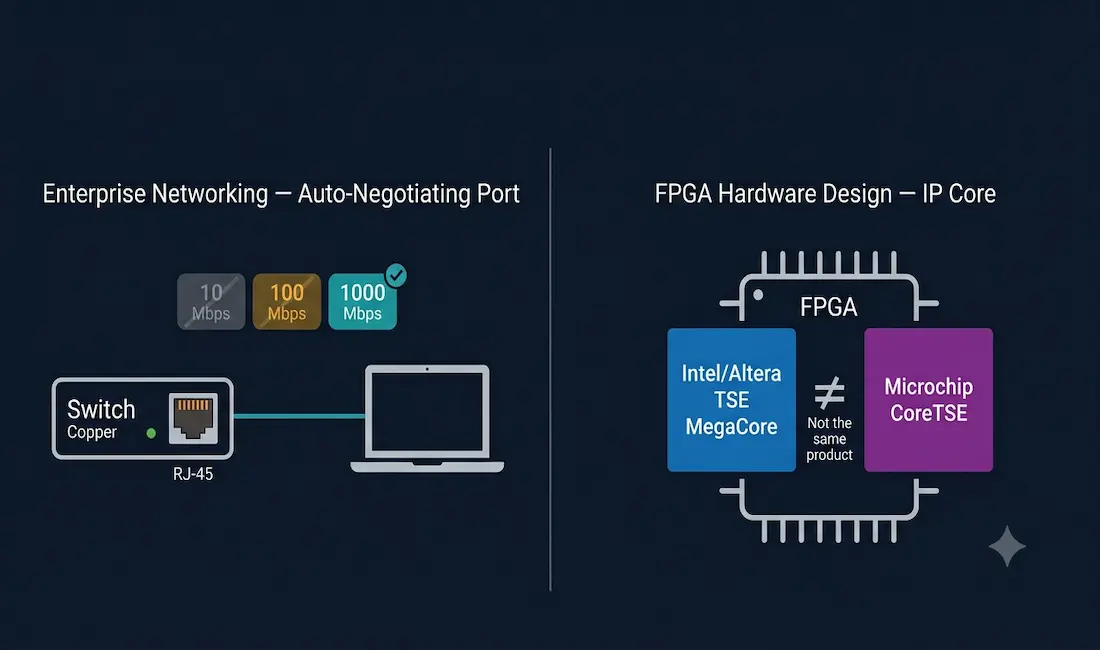
The term “Triple-Speed Ethernet” has two distinct, unrelated meanings depending on context, and this guide covers both: the common meaning used throughout enterprise networking and CCNA study material, describing an ordinary auto-negotiating copper Ethernet port, and a specialized meaning used in FPGA hardware design, referring to a specific category of soft IP core.
Triple-Speed Ethernet in Enterprise Networking
If you have seen “10/100/1000 (Triple-Speed)” listed in a Cisco switch datasheet or NIC specification, this is the meaning most relevant to CCNA study and day-to-day network administration.
A Triple-Speed Ethernet port is a copper Ethernet interface capable of operating at three distinct speeds:
- 10 Mbps (10BASE-T)
- 100 Mbps (100BASE-TX, “Fast Ethernet”)
- 1000 Mbps / 1 Gbps (1000BASE-T, “Gigabit Ethernet”)
Rather than being fixed to one speed, the port automatically determines the best speed and duplex mode it can support with whatever device is connected on the other end, using a standardized process called auto-negotiation.
How Auto-Negotiation Works
Auto-negotiation is defined in IEEE 802.3 Clause 28. When two Ethernet devices are connected, they exchange a series of Fast Link Pulses (FLPs) during link establishment. Each device advertises the full list of speeds and duplex modes it supports, and both sides then independently select the highest common denominator, the fastest speed and best duplex mode both ends can agree on.
Device A advertises: 10 Half, 10 Full, 100 Half, 100 Full, 1000 Full
Device B advertises: 10 Half, 10 Full, 100 Half, 100 Full

Result: Both negotiate down to 100 Mbps Full Duplex
        (the highest speed common to both devices)
This is why plugging a Gigabit-capable laptop into an older Fast Ethernet switch port results in a 100 Mbps link rather than a failure to connect, and why the same laptop reaches a full 1000 Mbps link when connected to a Gigabit-capable switch port instead.
Speed, Duplex, and Cabling Reference
| Speed | Standard Name | Typical Cable | Max Duplex | Common Use |
|---|---|---|---|---|
| 10 Mbps | 10BASE-T | Cat3 or better | Half or Full | Legacy devices, rare in modern networks |
| 100 Mbps | 100BASE-TX | Cat5 or better | Half or Full | Older desktops, IoT devices, VoIP phones |
| 1000 Mbps | 1000BASE-T | Cat5e or better | Full only | Standard modern desktop and access-layer connection |
A note on duplex mismatches: while auto-negotiation reliably selects the correct speed in virtually all modern equipment, duplex mismatches (one side full duplex, one side half duplex) were a historically common troubleshooting issue when one end of a link had auto-negotiation manually disabled while the other kept it enabled. This produces a working but severely degraded link, with excessive collisions and retransmissions, rather than an outright failure. The standard fix, and current best practice, is to leave auto-negotiation enabled on both ends of every link rather than manually forcing speed and duplex settings.
Triple-Speed Ethernet as an FPGA IP Core
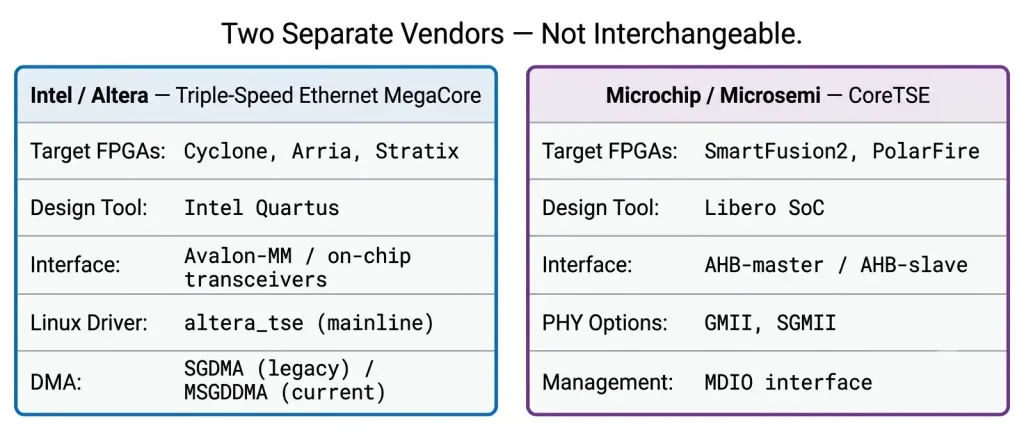
Separately from the switch-port meaning above, “Triple-Speed Ethernet” is also the name given to a category of pre-built soft IP cores used in FPGA hardware design, implementing the same 10/100/1000 Mbps capability but as a synthesizable digital logic block rather than a physical switch port. Two separate vendors offer products in this category, and they are not interchangeable or related to one another beyond both implementing the same underlying Ethernet standards.
Intel/Altera Triple-Speed Ethernet MegaCore
Intel (having acquired Altera in 2015) offers the Triple-Speed Ethernet MegaCore Function, an Ethernet MAC and Physical Coding Sublayer (PCS) IP core targeting Intel FPGAs (Cyclone, Arria, Stratix families). Key characteristics:
- Operates at 10/100/1000 Mbps
- Can be configured in MAC-only mode or combined MAC+PHY mode, with the PHY implemented using on-chip transceivers or LVDS I/O with dynamic phase alignment logic operating up to 1.25 Gbps
- A small MAC configuration option uses as few as 900 logic elements, useful for area-constrained designs
- Supports IEEE 1588v2 Precision Time Protocol (PTP) packet encapsulation for time-sensitive applications
- Is driven on Linux by the mainline
altera_tsekernel driver (CONFIG_ALTERA_TSE), which uses the platform bus and either the SGDMA or newer MSGDMA soft DMA IP components for data transfer
Note on the Linux driver: older revisions of the altera_tse driver, and certain FPGA reference designs, have historically shipped with incomplete Gigabit PHY negotiation support in specific configurations, meaning some deployments were effectively limited to 10/100 Mbps operation in practice despite the underlying MegaCore supporting Gigabit. This is a configuration- and version-specific limitation, not an inherent limitation of the IP core itself, and should be verified against your specific kernel version and board reference design rather than assumed. The core historically deprecated the older SGDMA component in favor of MSGDMA, and does not support scatter-gather DMA queuing or jumbo frames in the SGDMA path specifically.
Microchip/Microsemi CoreTSE
Separately, Microchip (through its Microsemi acquisition) offers CoreTSE, an unrelated Triple-Speed Ethernet MAC IP core targeting Microchip’s SmartFusion2 and PolarFire FPGA families. CoreTSE is built around an AHB (Advanced High-performance Bus) interface, commonly referenced as CoreTSE_AHB, providing:
- Gigabit Media Independent Interface (GMII) and Serial GMII (SGMII) options for PHY interfacing
- AHB-master and AHB-slave port interfaces for data transfer
- A management interface for MDIO-based PHY configuration
CoreTSE is developed, documented, and toolchain-supported entirely separately from Intel’s MegaCore, using Microchip’s Libero SoC design suite rather than Intel Quartus. If you are working with a Microchip/Microsemi FPGA, consult Microchip’s CoreTSE documentation directly; if you are working with an Intel FPGA, the MegaCore documentation and Linux altera_tse driver apply instead. These are not interoperable or cross-compatible product lines despite sharing the “Triple-Speed Ethernet” naming convention.
Design Examples and Reference Designs
Intel provides reference design examples for implementing its Triple-Speed Ethernet MegaCore, including a scatter-gather DMA (SGDMA) core for both transmit and receive paths, a Nios II/f soft processor core with an integrated JTAG debug module, and supporting peripherals such as a DDR3 SDRAM controller, flash memory interface, and system timers, packaged as a complete reference system for FPGA development boards.
CCNA Exam Pointers
- “Triple-Speed” or “10/100/1000” on a switch port datasheet refers to auto-negotiating copper ports, not the FPGA IP core meaning
- Auto-negotiation is defined in IEEE 802.3 Clause 28 and uses Fast Link Pulses to exchange capability information
- Both sides of a link independently select the highest common speed and duplex both ends support
- 1000BASE-T (Gigabit) requires full duplex and Cat5e or better cabling
- A duplex mismatch (one side auto, one side manually forced) produces a degraded but functional link, not a hard failure, characterized by excessive collisions/errors on the half-duplex side
- Best practice: leave auto-negotiation enabled on both ends of a link rather than manually forcing speed/duplex, except in specific documented compatibility scenarios
show interfaceson Cisco IOS reports the negotiated speed and duplex for each interface, useful for diagnosing mismatch issues
Conclusion
Triple-Speed Ethernet describes two genuinely different things depending on context: in enterprise and CCNA networking, it refers to an ordinary auto-negotiating copper port capable of 10, 100, or 1000 Mbps operation, governed by the IEEE 802.3 auto-negotiation standard that most network engineers interact with daily. In FPGA hardware design, it refers to a category of soft IP cores, with Intel’s Triple-Speed Ethernet MegaCore and Microchip’s CoreTSE being two separate, non-interchangeable vendor implementations of the same underlying 10/100/1000 Mbps Ethernet standard. Understanding which meaning applies to your specific context, and, in the FPGA case, which vendor’s core and toolchain you are actually working with, is essential to finding the correct documentation and avoiding configuration confusion.
Frequently Asked Questions
What does “Triple-Speed Ethernet” mean on a switch datasheet?
On a Cisco switch or network interface card datasheet, “Triple-Speed” or “10/100/1000” describes a copper Ethernet port capable of automatically operating at 10 Mbps, 100 Mbps, or 1000 Mbps, selecting the appropriate speed through IEEE 802.3 auto-negotiation with whatever device is connected. This is the standard type of port found on the vast majority of modern enterprise switches, replacing older fixed-speed ports. The port does not need to be manually configured for a specific speed in normal operation; it automatically detects and matches the capability of the connected device.
How does Ethernet auto-negotiation actually work?
When two Ethernet devices are connected, each side transmits Fast Link Pulses that advertise the full list of speeds and duplex modes it supports. Both devices then independently apply the same selection rule, choosing the highest speed and best duplex mode that both ends have in common, without requiring any coordination protocol beyond this pulse exchange. This is why a Gigabit-capable device connected to an older Fast Ethernet-only switch port automatically negotiates down to 100 Mbps rather than failing to connect, and why the same device reaches a full Gigabit link when connected to Gigabit-capable equipment instead.
What is a duplex mismatch and why does it matter?
A duplex mismatch occurs when one end of an Ethernet link is set to full duplex while the other end operates in half duplex, most commonly because auto-negotiation was manually disabled on one side while left enabled on the other. Unlike a speed mismatch, which typically prevents a link from forming at all, a duplex mismatch produces a link that appears to work but suffers from significant performance degradation, excessive collisions, late collisions, and retransmissions on the half-duplex side, since that side does not expect simultaneous bidirectional traffic. Current best practice is to leave auto-negotiation enabled on both ends of virtually every link rather than manually forcing speed and duplex settings, which eliminates this entire category of problem.
Is Intel’s Triple-Speed Ethernet MegaCore the same as Microchip’s CoreTSE?
No, these are two completely separate products from two different companies, despite both implementing the same underlying 10/100/1000 Mbps Ethernet capability. Intel’s Triple-Speed Ethernet MegaCore Function targets Intel FPGAs (Cyclone, Arria, Stratix families), is configured through Intel’s Quartus design software, and is driven on Linux by the mainline altera_tse kernel driver. Microchip’s CoreTSE targets Microchip’s SmartFusion2 and PolarFire FPGA families, is configured through Microchip’s Libero SoC design suite, and uses an entirely separate AHB-based interface and driver stack. If you are developing on an Intel FPGA, use Intel’s MegaCore documentation; if you are developing on a Microchip FPGA, use Microchip’s CoreTSE documentation instead, since the two are not interoperable or cross-referenced.
Does the Intel Triple-Speed Ethernet MegaCore support Gigabit speeds on Linux?
The underlying MegaCore IP itself supports full 10/100/1000 Mbps operation, including Gigabit, when properly configured with an appropriate PHY interface such as SGMII or on-chip LVDS transceivers. However, some historical revisions of the mainline altera_tse Linux driver and certain FPGA reference board designs have shipped with incomplete Gigabit PHY negotiation support in specific configurations, effectively limiting those particular deployments to 10/100 Mbps in practice. This is a driver- and configuration-specific limitation rather than a fundamental constraint of the IP core, so developers should verify actual Gigabit support against their specific kernel version, driver revision, and board reference design rather than assuming full-speed operation is automatically available.