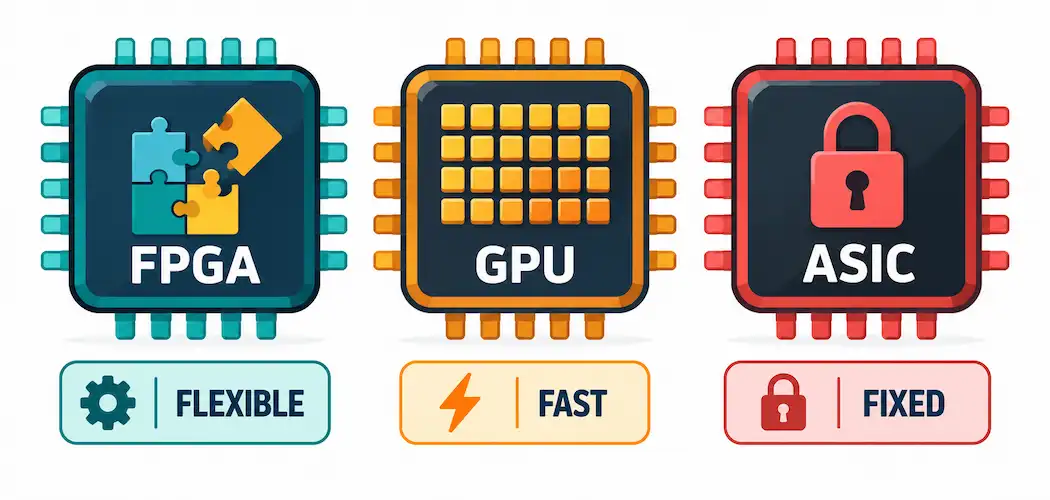
AI hardware conversations tend to collapse into “GPUs vs. everything else,” which skips over a genuinely useful third option for specific workloads: Field-Programmable Gate Arrays. FPGAs aren’t trying to replace GPUs in training massive models — they solve a different problem, and understanding that problem is more useful than any single benchmark number. Here’s an honest look at what FPGAs actually do well in AI, where the real tradeoffs sit, and what’s changed in this space recently.
What an FPGA Actually Is
A Field-Programmable Gate Array is a chip whose internal logic circuits can be reconfigured after manufacturing, unlike a CPU, GPU, or ASIC, which all have fixed internal architectures. You program an FPGA’s actual hardware logic (typically using hardware description languages like VHDL or Verilog, or increasingly higher-level tools) to implement a specific computation pipeline directly in silicon, rather than running that computation as software instructions on fixed hardware. This reconfigurability is the core trait that defines everything else about where FPGAs fit.
Why FPGAs Matter for AI Specifically
Custom hardware acceleration. Because the logic itself is reconfigurable, an FPGA can be tailored to a specific neural network architecture or inference pipeline, implementing exactly the operations that workload needs rather than running general-purpose instructions through a fixed pipeline. This can yield real efficiency gains for a well-matched workload, though the exact magnitude depends heavily on the specific model, the FPGA generation, and how well-optimized the implementation is — there’s no single universal multiplier that applies across different workloads, despite how often such figures get quoted.
Parallel processing. FPGAs can execute many operations simultaneously across their reconfigurable logic fabric, which suits the highly parallel nature of neural network inference (many independent multiply-accumulate operations happening at once).
Low power consumption relative to throughput. For edge AI specifically — inference running on a device rather than in a data center — FPGAs often offer a strong performance-per-watt profile compared to general-purpose processors, because the hardware is doing only the specific computation it was configured for, without the overhead of general-purpose instruction fetching and decoding. The exact power savings figure varies by comparison baseline and workload, so treat any single percentage figure from a vendor’s marketing material as a best-case scenario for their specific test setup, not a universal guarantee.
Reconfigurability over time. Unlike an ASIC (an application-specific chip permanently wired for one task), an FPGA can be reprogrammed as models and algorithms evolve, which matters in a field where model architectures change fast. You’re not stuck with 2024’s silicon for a 2027 model generation.
Where FPGAs Show Up in AI Today
- Edge computing and embedded AI — FPGAs are a common choice in power- and space-constrained environments where you need meaningful inference performance without a data-center power budget.
- Autonomous vehicles and robotics — real-time sensor fusion and perception workloads benefit from FPGAs’ low-latency parallel processing, particularly where deterministic timing matters.
- Medical imaging — FPGA-accelerated preprocessing and inference can meaningfully speed up image analysis pipelines, though exact speedup figures are specific to the imaging modality, model, and FPGA configuration involved — worth verifying against the specific vendor’s published benchmarks for your use case rather than a generic percentage.
- Data centers, as a complement to GPUs — some AI inference workloads at scale use FPGAs alongside GPUs, particularly where latency-sensitive inference benefits from a more specialized, lower-overhead pipeline than a general-purpose GPU provides.
FPGA vs. GPU vs. ASIC: The Honest Tradeoffs
| FPGA | GPU | ASIC | |
|---|---|---|---|
| Flexibility | Reconfigurable after deployment | Fixed architecture, flexible via software | Fixed, built for one task |
| Development time | Longer (hardware-level design) | Shorter (mature software ecosystem) | Longest (custom chip design/fabrication) |
| Peak efficiency for its target task | High, if well-matched to the workload | Good general-purpose throughput | Highest, but only for its one designed task |
| Best fit | Specialized, evolving, latency-sensitive workloads | Training and general-purpose inference at scale | Massive-volume, stable, single-purpose workloads |
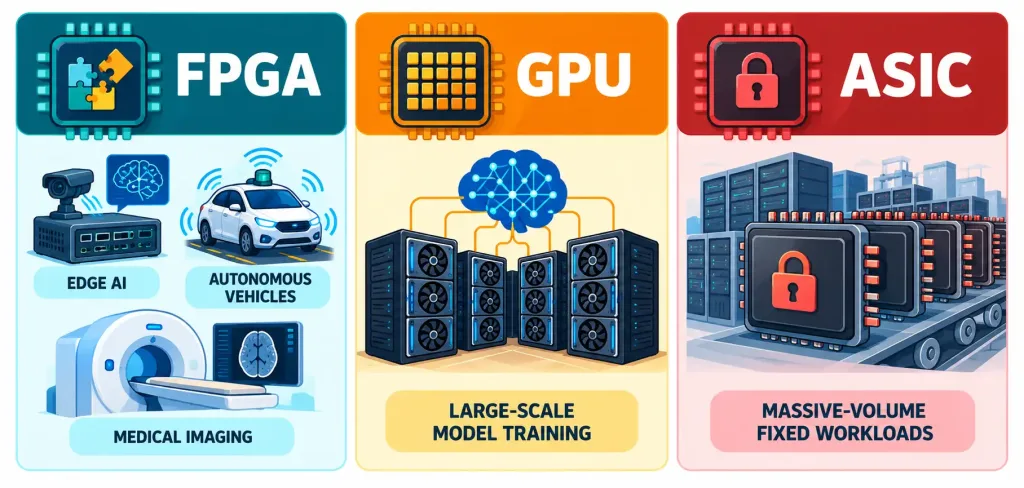
No option wins universally — GPUs dominate large-scale model training because of their mature software ecosystem (CUDA, established ML frameworks) and raw parallel throughput; ASICs win on peak efficiency for a single, unchanging task at enormous scale (think Google’s TPUs for their own specific workloads); FPGAs occupy the middle ground, trading some raw throughput and a steeper development curve for reconfigurability and strong efficiency on well-matched, evolving workloads.
Real Challenges Worth Being Honest About
- Development complexity. Programming FPGA logic directly is a meaningfully different (and often steeper) skill set than writing software for a GPU, which is part of why GPU-based AI development has broader tooling and talent availability.
- Cost at scale. For extremely high-volume, stable workloads, a custom ASIC can eventually be more cost-effective than FPGAs despite the FPGA’s lower upfront development cost, simply because of manufacturing economics at scale.
- Ecosystem maturity. While vendor toolkits (Xilinx/AMD’s Vitis AI, Intel/Altera’s toolchains, Lattice’s sensAI) have improved significantly, the AI development ecosystem around FPGAs is still less mature than the GPU/CUDA ecosystem that most ML frameworks are built around first.
What’s Changed Recently in the FPGA Landscape
One genuinely notable shift: in 2025, Intel sold a majority (51%) stake in its Altera FPGA business to the private equity firm Silver Lake, making Altera an independent company again rather than an Intel division — a reversal of Intel’s 2015 acquisition of the original Altera. This matters for anyone tracking the FPGA vendor landscape, since it changes Altera’s competitive positioning relative to AMD (which owns Xilinx, a major FPGA competitor) and other players like Lattice Semiconductor and Microchip.
Current-generation FPGA products worth knowing: AMD’s Versal series (including AI Engine tiles specifically designed for AI workloads, programmed via the Vitis AI toolkit), Altera’s Agilex line, Lattice’s low-power FPGAs aimed at edge and TinyML applications via its sensAI toolkit, and Microchip’s PolarFire FPGAs, which emphasize low power consumption for embedded applications.
The Bottom Line
FPGAs aren’t a GPU replacement, and framing them that way misses the point — they’re a specialized tool for workloads where reconfigurable, low-latency, power-efficient hardware acceleration matters more than the broad software ecosystem and raw training throughput GPUs offer. Edge AI, real-time autonomous systems, and specialized inference pipelines are where FPGAs genuinely earn their place. Any specific performance or efficiency number you see quoted for FPGAs in AI (including figures that circulate widely) should be checked against the vendor’s own published benchmarks for your specific workload, since the real-world gain depends heavily on how well-matched the implementation is to the task.
Frequently Asked Questions
Are FPGAs better than GPUs for AI? Not universally — they’re better suited to different things. GPUs generally win for large-scale model training and general-purpose inference, thanks to a mature software ecosystem. FPGAs tend to win for latency-sensitive, power-constrained, or evolving specialized workloads where their reconfigurability and efficiency-per-watt matter more than raw throughput.
What’s the difference between an FPGA and an ASIC for AI? An ASIC is custom-built in silicon for one specific task and can’t be changed after manufacturing, which gives it the highest peak efficiency for that one task but zero flexibility. An FPGA can be reprogrammed after deployment, trading some peak efficiency for the ability to adapt as models and algorithms evolve.
Is Altera still owned by Intel? No — in 2025, Intel sold a 51% majority stake in Altera to the private equity firm Silver Lake, making Altera an independent company again rather than an Intel division.
Why would someone choose an FPGA over a GPU for edge AI? Primarily for power efficiency and low latency in a power- and space-constrained environment, where an FPGA configured specifically for the target workload can outperform a general-purpose GPU on efficiency, even if the GPU would win on raw throughput in a data center setting.