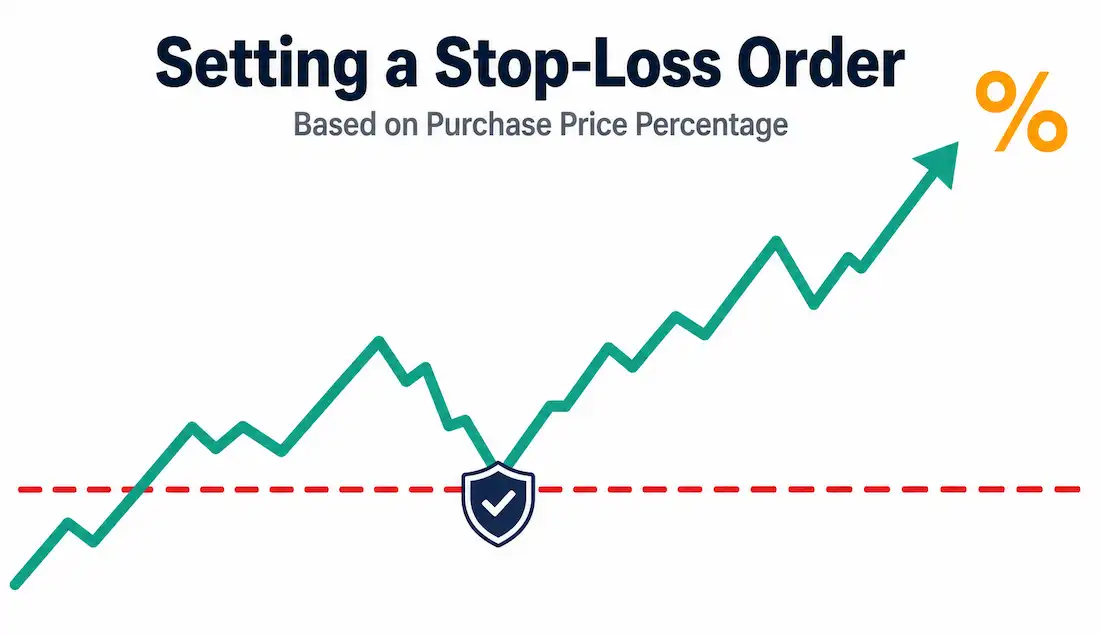
A stop-loss order is one of the most widely used risk management tools in trading — a standing instruction to your broker to sell a security automatically once its price falls to a specified level, limiting how much of a position’s value you’re exposed to losing. Setting that level as a percentage of your purchase price is the simplest, most common way to define it. This guide covers how the method actually works, its real advantages and limitations — including a risk that catches many newer traders off guard — and how it compares to alternative approaches.
This is general educational information about a common trading mechanism, not personalized financial advice. Consult a licensed financial advisor and your specific broker’s order-execution policies before applying any of this to real trades.
How Percentage-Based Stop-Loss Orders Work
Setting a stop-loss as a percentage of your purchase price means calculating your stop price as a fixed percentage below what you paid. If you buy a stock at $100 and set a 10% stop-loss, your stop price is $90 — if the stock falls to $90 or below, the stop-loss order triggers and the position is sold.
This gives you a simple, rule-based way to define your maximum acceptable loss on a position before you ever enter the trade, rather than needing to actively monitor and manually decide an exit point as the market moves. You set the percentage once, based on how much of the position’s value you’re willing to risk, and the order executes on its own if that threshold is reached.
Advantages of a Percentage-Based Approach
Simplicity and consistency. The math is straightforward, and applying the same percentage across different trades makes it easy to compare risk exposure between them at a glance.
Proportional risk scaling. A 10% stop-loss risks $100 on a $1,000 position and $1,000 on a $10,000 position — the dollar risk scales automatically with position size, keeping your risk management consistent regardless of how much capital you’re deploying into any individual trade.
Reduces emotional decision-making. Because the exit point is defined in advance rather than decided in the moment, a percentage-based stop removes some of the temptation to hold a losing position too long in the hope it recovers — a well-documented behavioral tendency that costs many traders more than a disciplined, predefined exit would.
The Real Limitations — Including One That Catches People Off Guard
A fixed percentage doesn’t account for volatility. A 10% stop might be reasonable for a historically stable, low-volatility stock, but far too tight for a stock that regularly swings 15-20% within normal trading activity — in the volatile case, a flat percentage stop risks triggering on routine price noise rather than a genuine trend reversal, exiting you from a position that would have recovered if you’d simply given it more room.
Different securities need different treatment. Applying the same percentage uniformly across a portfolio of securities with meaningfully different volatility profiles tends to produce a systematically worse outcome than tailoring the stop distance to each security’s actual behavior.
Gap risk — a stop-loss order isn’t a price guarantee. This is the limitation most likely to genuinely surprise someone new to this tool. A standard stop-loss order guarantees that a sell order will be triggered once your stop price is reached — it does not guarantee the sale actually executes at that exact price. If a stock gaps down sharply between one trading session and the next (common around earnings announcements, major news, or overnight events) and opens below your stop price, your order typically executes at the next available price, which could be meaningfully worse than the stop price you set.
In extreme cases — a severe overnight gap or a temporary trading halt — the actual execution price can differ from your intended stop price by a significant margin. Some brokers offer a guaranteed stop-loss order as a distinct, often fee-based product specifically to eliminate this gap risk, executing at your exact specified price regardless of how the market moves — worth asking your broker about directly if this risk matters to your specific trading approach.
Whipsaw risk in genuinely volatile or sideways markets. In choppy markets that move up and down without a clear sustained direction, a tight stop-loss can trigger repeatedly — stopping you out on a dip, only for the price to recover shortly after — a pattern traders call getting “whipsawed.” This is a direct consequence of the volatility-mismatch problem above, and it’s a real, recurring cost of setting stops too tight relative to a security’s actual price behavior.
Alternative and Complementary Approaches
Trailing stop-loss orders adjust automatically as a position’s price moves in your favor, maintaining your set percentage or dollar distance below the highest price reached rather than staying fixed at your original purchase price. If you buy at $100 with a 10% trailing stop and the price rises to $150, your stop price rises along with it to $135 — locking in a portion of the gain while still allowing room for the position to keep running, rather than exiting the moment it retraces from its peak. This addresses one of the plain percentage method’s real weaknesses: a fixed stop based purely on your original purchase price doesn’t adjust to protect gains as a position appreciates.
Volatility-adjusted stops, commonly based on a measure like the Average True Range (ATR), set the stop distance according to a security’s actual recent price volatility rather than an arbitrary flat percentage. This directly addresses the volatility-mismatch limitation above — a more volatile stock automatically gets a wider stop, and a calmer one gets a tighter one, rather than applying the same percentage uniformly regardless of how the underlying security actually behaves.
Support-level based stops place the stop price just below a technical support level (a price point where the security has historically found buying interest) rather than at an arbitrary percentage, on the reasoning that a break below genuine support is a more meaningful signal of trend reversal than an arbitrary percentage threshold.
Adjusting Your Stop-Loss Strategy Over Time
A stop-loss percentage set at trade entry isn’t necessarily meant to stay fixed for the position’s entire life. As a position gains value, many traders manually raise their stop-loss price to lock in a portion of the unrealized gain while still protecting against a full reversal — functionally recreating what a trailing stop does automatically, just through manual adjustment. Conversely, if a security’s volatility genuinely increases due to changing market conditions, widening a previously-appropriate stop to avoid unnecessary whipsaw exits is a reasonable adjustment, provided it’s a deliberate, planned response to changed conditions rather than an emotional reaction to an unrealized loss you don’t want to accept.
A Practical Starting Framework for Choosing a Stop Distance
While there’s no universal correct percentage, a few general, widely-cited reference points are worth knowing as a starting orientation, not a rule to follow blindly:
- Historically lower-volatility, large-cap stocks are sometimes managed with tighter stops (commonly cited in the 5-10% range), since large price swings are less typical for these securities, and a tight stop is less likely to trigger on routine noise.
- Higher-volatility growth stocks or smaller-cap securities often warrant meaningfully wider stops (sometimes 15-25% or more), specifically to avoid the whipsaw problem covered above, since routine volatility for these securities can easily exceed a tight percentage.
- A security’s own recent trading history — specifically, the size of its typical day-to-day price swings over a recent period — is a better individualized reference point than any generic percentage range, which is exactly what ATR-based volatility-adjusted stops are designed to calculate systematically rather than estimating by eye.
These are general starting orientations from common trading practice, not personalized recommendations — the appropriate distance for any specific position depends on your own risk tolerance, position sizing, and overall strategy, which is why this is worth working through with a financial advisor rather than applying a generic range from an article.
A Worked Example: Comparing the Approaches on the Same Trade
It’s easier to see the practical difference between these methods with a concrete comparison. Suppose you buy a stock at $100, and over the following weeks it rises to $130 before pulling back.
Fixed percentage stop-loss (10%, set at entry and never adjusted): your stop remains at $90 for the life of the trade, regardless of the price rising to $130. If the stock pulls back from $130 down toward $90, you’d give back the entire unrealized gain before the stop ever triggers — the fixed method offers no built-in protection for profits already earned.
Trailing stop-loss (10%, adjusting with the price peak): as the price rises to $130, your stop rises along with it to $117 (10% below the new peak). A pullback from $130 would trigger a sale around $117, locking in a meaningful portion of the gain rather than giving it all back — the core advantage a trailing stop offers over a static one.
Volatility-adjusted (ATR-based) stop: if this particular stock has historically moved in a tight, low-volatility range, the ATR-based stop distance might actually be narrower than a flat 10% — tightening your risk relative to the stock’s real behavior instead of applying a generic percentage that doesn’t reflect how this specific security actually trades.
This comparison illustrates why professional and experienced traders rarely rely on a single fixed percentage set once and left untouched — each method solves a different problem, and combining an understanding of all three tends to produce a more deliberate risk management approach than defaulting to the simplest option by habit.
Frequently Asked Questions
What percentage should I use for my stop-loss?
There’s no universal correct answer — it depends on the specific security’s volatility, your individual risk tolerance, and your broader trading or investment strategy. This is exactly the kind of decision worth discussing with a licensed financial advisor familiar with your specific situation, rather than applying a generic percentage you’ve seen recommended elsewhere.
Can a stop-loss order actually make my losses worse in some situations?
In a specific scenario, yes — during a sharp, brief price spike that reverses quickly (sometimes called a “flash crash” at the extreme end), a stop-loss can trigger and sell your position right before the price recovers, converting a temporary paper loss into a realized one. This is part of why understanding your specific security’s typical volatility pattern matters before setting a stop distance.
Is a stop-loss order free to place?
Placing a standard stop-loss order typically doesn’t carry an extra fee beyond normal trading commissions at most brokers, though guaranteed stop-loss orders (which eliminate gap risk) often do carry an additional fee — check your specific broker’s fee schedule, since this varies.
Does a stop-loss order work the same way for all asset types?
The core mechanism is similar for stocks, ETFs, and many other exchange-traded securities, but execution behavior, available order types, and gap risk can vary meaningfully for less liquid securities, after-hours trading, and other asset classes like options or certain cryptocurrencies — confirm the specific mechanics with your broker for whatever you’re actually trading.
Conclusion
Setting a stop-loss as a percentage of purchase price is a genuinely useful, simple starting framework for risk management — but treating a flat percentage as a one-size-fits-all solution across every security and market condition is where the method’s real limitations show up, particularly the gap-risk issue that means a stop-loss order caps your intent to exit, not necessarily your exact exit price. Understanding trailing stops, volatility-adjusted approaches, and the guaranteed-stop-loss option available through some brokers gives you a fuller toolkit than the basic percentage method alone, and matching the tool to the specific security and market condition — rather than applying one fixed percentage everywhere — is where more experienced application of this method genuinely improves outcomes over the basic version.