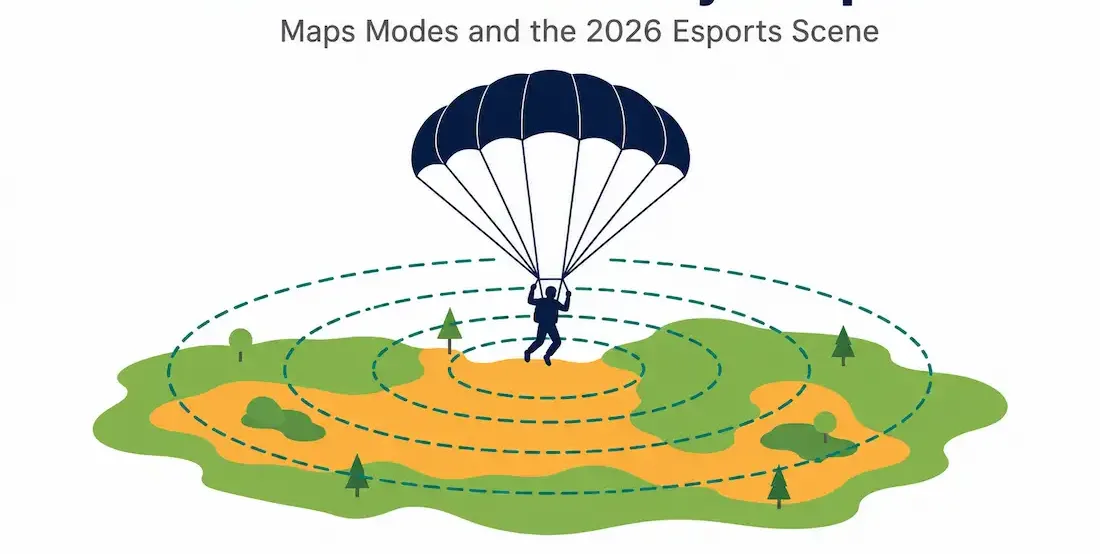
PUBG Mobile has grown from a mobile port of a PC phenomenon into one of the biggest esports and entertainment properties in mobile gaming, developed by Tencent Games’ Lightspeed & Quantum Studio and published globally by Level Infinite. Nearly a decade after its 2018 launch, PUBG Mobile remains one of the most-played battle royale titles on mobile, with an active competitive esports scene backed by multi-million-dollar tournament prize pools. This guide covers the actual current state of the game: its maps, modes, and the real competitive scene behind it — not just generic battle royale platitudes.
Core Gameplay: What Actually Matters
The fundamental format hasn’t changed since launch: up to 100 players parachute onto a map with nothing but their fists, scavenge for weapons, armor, and supplies, and fight to be the last player or team standing as a shrinking “blue zone” forces the remaining players into an increasingly small area.
Looting and resource management is the foundation everything else builds on — deciding when to fight for contested high-tier loot versus grabbing what’s available and repositioning is a constant risk calculation throughout a match. Positioning relative to the shrinking zone matters as much as gunfights themselves; players caught outside the safe zone take escalating damage over time, and predicting where the zone will end up next is a genuine skill that separates consistent top finishers from players who rely on gunfighting alone. In squad and duo modes, coordinated communication — calling out enemy positions, coordinating pushes, and sharing loot — is what separates organized teams from randomly grouped players, which is exactly why voice communication tools are built directly into the game.
The Maps: All 8 Current Battle Royale Maps
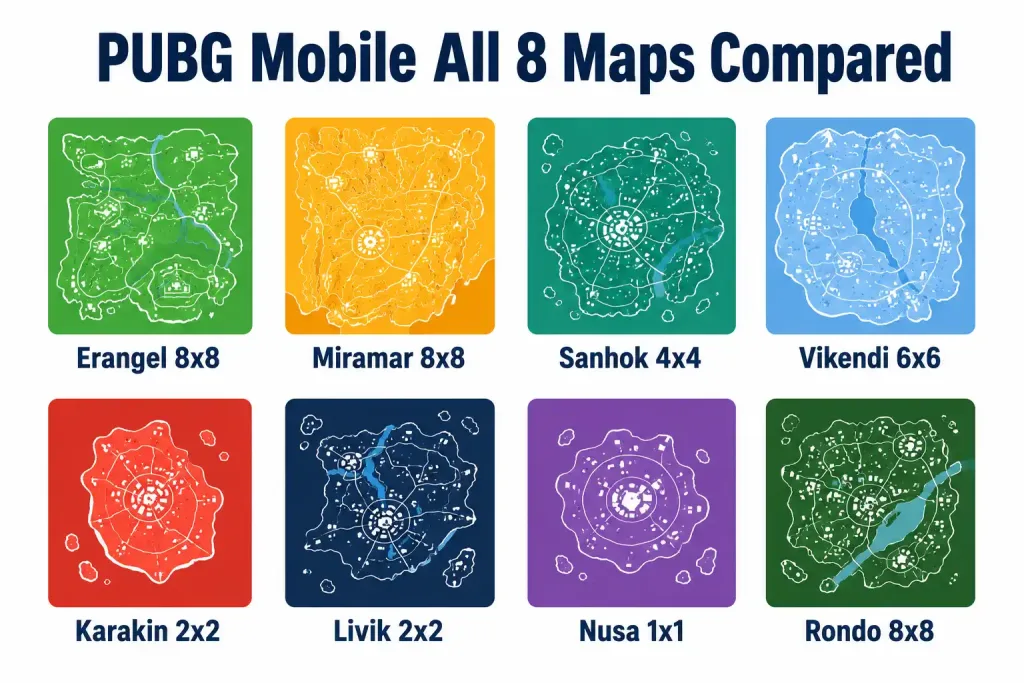
PUBG Mobile currently features eight classic battle royale maps, each with a genuinely distinct size, terrain, and playstyle:
- Erangel (8×8 km) — the original, most-played map, and the standard choice for competitive ranked play. Open grassland, forests, and small towns give it the most balanced mix of long-range and close-quarters engagements.
- Miramar (8×8 km) — a desert map with wide-open terrain and sparse cover, generally considered the least forgiving map for positioning mistakes, since open sightlines punish careless movement. Los Leones and El Pozo are among its most contested drop locations.
- Sanhok (4×4 km) — a smaller, dense tropical map spread across three islands connected by bridges, built for fast, aggressive close-quarters fights rather than long, drawn-out survival play.
- Vikendi (6×6 km) — a snow-covered map with a unique feature: a functioning in-map train system on a fixed schedule, usable for fast cross-map rotation.
- Karakin (2×2 km) — the smallest classic map, defined by destructible walls that mean no building offers guaranteed cover, forcing constant, aggressive engagement in a compressed space.
- Livik (2×2 km) — designed specifically for mobile, built for fast matches with unique mechanics like ziplines and hidden treasure-map loot routes.
- Nusa (1×1 km) — the newest small-format map, a tropical resort island where matches run as short as 8 minutes, with unique interactive elements like elevators, pools, and destructible objects.
- Rondo (8×8 km) — the most recently added large map, blending dense urban cityscapes with natural terrain, offering both close-range building fights and long-range sniping positions.
For competitive ranked progression, Erangel remains the standard choice due to its balanced size and scoring potential; smaller maps like Livik, Karakin, and Nusa suit players who prefer fast, combat-heavy sessions over longer survival-focused play.
Game Modes
PUBG Mobile’s core modes are Solo, Duo, and Squad (up to four players) — the foundational battle royale formats. Beyond these, the game maintains a rotating and permanent selection of Arcade modes, which run on shorter timers and smaller player counts, including Team Deathmatch-style modes and objective-based formats like Payload, which introduces heavy weaponry and vehicles not available in classic battle royale matches. Ranked play uses a tiered system, with competitive placement typically restricted to specific maps (Erangel and, in some ranked formats, Miramar) to keep the competitive experience standardized.
The Esports Scene: Real Numbers, Real Tournaments
This is where a lot of casual coverage of PUBG Mobile falls flat by staying vague — the competitive scene is large, well-funded, and has a defined annual structure worth actually naming.
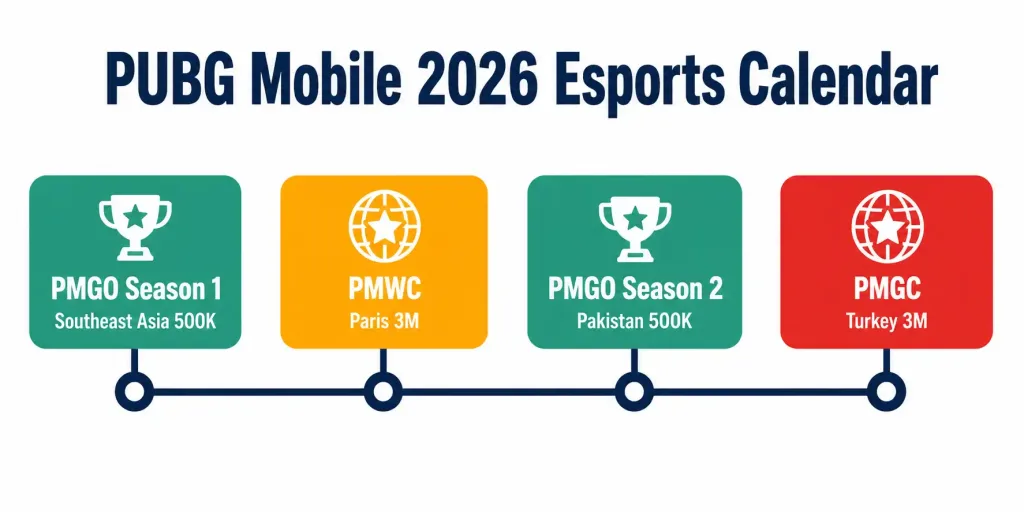
PUBG Mobile Global Championship (PMGC) is the season-ending world championship. The 2026 edition is set to take place in Turkey, carrying the same $3 million prize pool as its previous three editions.
PUBG Mobile World Cup (PMWC) is the mid-season global tournament, run in partnership with the Esports World Cup Foundation. PMWC 2026 takes place in Paris (August 6–16), featuring 32 of the world’s top teams competing for a $3 million prize pool and qualification points toward PMGC.
PUBG Mobile Global Open (PMGO) is new for the 2026 season, replacing the previous PUBG Mobile Super League (PMSL) regional format. PMGO runs two seasons in 2026, each with a $500,000 prize pool — Season 1 in Southeast Asia, and Season 2 in Pakistan, marking Pakistan’s first-ever international PUBG Mobile esports tournament.
Beneath these global events sits a full structure of National Championships (PMNC) across more than 30 regions, feeding qualified teams up through the tournament pyramid toward the global stage. For context on scale: the 2025 PMWC alone crowned Yangon Galacticos as champions after a field of 24 international teams, and the game’s competitive scene now spans nearly every major esports region globally, from Central and South Asia to the Middle East, Europe, and Southeast Asia.
Cultural Impact Beyond the Game
PUBG Mobile’s reach extends into areas most mobile games never touch: a large, active fan content community producing fan art, cosplay, and community-run events; visible influence on streaming and content creator culture across multiple regions; and a competitive scene substantial enough to serve as a genuine career path for professional players, coaches, and analysts, not just a hobby.
Real Considerations Worth Taking Seriously
Screen time and youth engagement. The game’s format — matches that reset every 15-30 minutes, constant progression systems, and social/squad play — is specifically engaging in ways that warrant the same general moderation conversation that applies to any highly engaging mobile game, particularly for younger players. Built-in playtime management tools exist in many regions specifically to address this.
In-game purchases. Like most free-to-play mobile games, PUBG Mobile generates revenue through cosmetic items, battle passes, and loot-crate-style mechanics. This business model draws legitimate scrutiny, particularly regarding how it’s marketed to younger players — worth being an informed, deliberate consumer of rather than an unconsidered one, regardless of age.
Competitive market pressure. PUBG Mobile competes in a crowded battle royale field alongside titles like Free Fire, Call of Duty: Mobile, and Fortnite’s mobile presence, among others. Its continued relevance depends on regular content updates (new maps, modes, and seasonal content) and sustained esports investment — both of which, based on the confirmed 2026 tournament roadmap, appear to still be a genuine priority for its publishers rather than a franchise coasting on past momentum. For players looking to take mobile gaming more seriously, having the right technology and setup can make a meaningful difference in competitive performance.
Weapon and Vehicle Systems
Beyond map knowledge, weapon and vehicle mastery form the game’s other core skill pillar. The weapon roster spans assault rifles, sniper rifles, submachine guns, shotguns, and throwables, each with distinct recoil patterns and attachment slots — scopes, suppressors, extended magazines, and grips all meaningfully change how a weapon handles, and learning specific weapon-attachment combinations is a genuine skill investment separate from just aiming accuracy. Vehicles range from motorcycles (fast but exposed) to armored options on certain maps, and vehicle choice interacts directly with map type: large maps reward vehicle-based rotation strategy in a way small maps like Karakin and Nusa, where distances are short enough that vehicles matter far less, simply don’t.
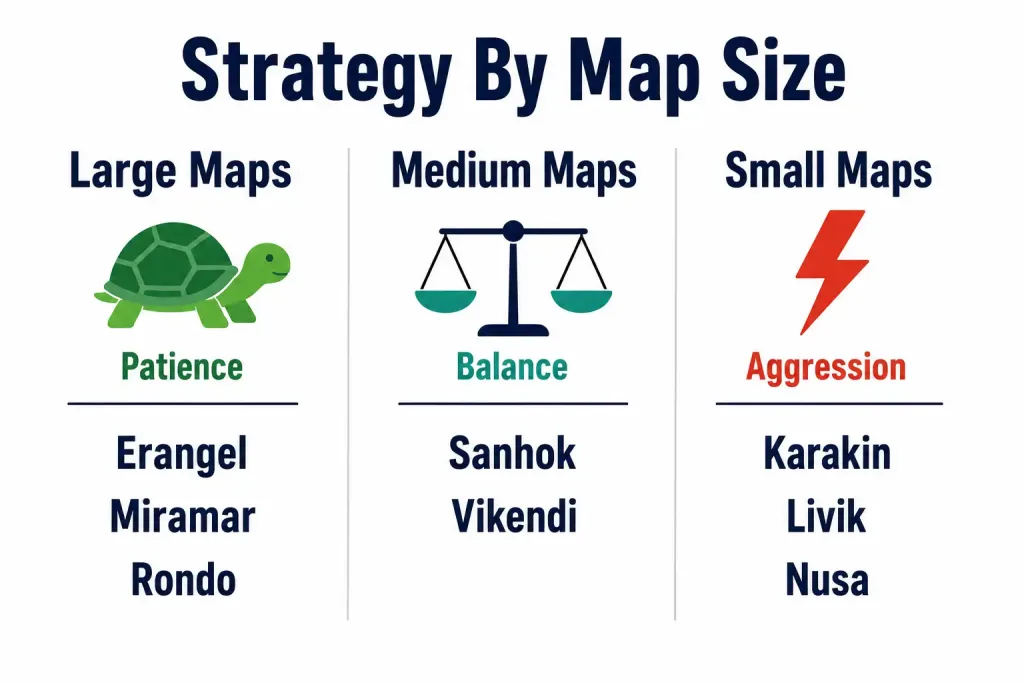
Different map sizes genuinely reward different approaches, and treating every map the same is a common mistake among newer players:
On large maps (Erangel, Miramar, Rondo): early-game patience pays off. Landing away from the most contested drop points, looting efficiently, and rotating toward the zone center rather than sprinting into it gives more time to gear up before serious engagements start. Vehicle usage matters more here than on smaller maps, simply because of the distances involved.
On medium maps (Sanhok, Vikendi): expect earlier fights and plan accordingly — looting fast and being ready to engage within the first few minutes is more often necessary than optional, since the smaller footprint compresses player density faster than on the 8×8 km maps.
On small maps (Karakin, Livik, Nusa): aggression is generally rewarded over patience. These maps are specifically designed around fast, high-frequency engagements, and playing overly cautiously often just means arriving at a smaller and smaller safe zone with less accumulated gear than more aggressive players.
General positioning discipline: regardless of map, tracking the zone’s shrinking pattern and pre-positioning ahead of the next phase — rather than reacting to the current one — consistently separates higher-placing players from those who scramble reactively each time the zone shrinks.
How the Competitive Pathway Actually Works
For anyone curious how a player goes from casual ranked matches to the PMGC stage, the structure is genuinely tiered rather than a single open bracket:
- National Championships (PMNC) run in more than 30 individual regions, giving local teams a path to qualify without needing to compete directly against international powerhouses from the outset.
- Regional and national league play (previously PMSL, replaced by PMGO’s two-season structure starting in 2026) sits above the national tier, with the best-performing teams from PMNC events earning slots.
- PMWC, the mid-season global tournament, draws top teams from across all regions to compete head-to-head, both for the title itself and for qualification points toward the season finale.
- PMGC, the season-ending world championship, is the top of the pyramid — the culmination of a full year’s regional and international competition, determining the sport’s ultimate season champion.
This structure means a strong regional team genuinely has a defined, visible path to the world stage, rather than needing an invitation or wildcard — a meaningful part of why the scene has sustained multi-million-dollar investment across so many different countries and regions simultaneously.
FAQs
What are the current game modes in PUBG Mobile? Solo, Duo, and Squad are the core battle royale formats, supplemented by rotating Arcade modes (including Team Deathmatch-style and objective-based formats like Payload) and a tiered ranked system typically played on Erangel.
How does the blue zone work? The playable area shrinks continuously throughout a match according to a set schedule, dealing escalating damage to any player caught outside it, forcing all surviving players into an increasingly small final area.
What are the current maps in PUBG Mobile? Eight classic maps: Erangel, Miramar, Sanhok, Vikendi, Karakin, Livik, Nusa, and Rondo — each with distinct size and terrain, ranging from Nusa’s compact 1×1 km footprint to Erangel and Rondo’s full 8×8 km scale.
Is PUBG Mobile suitable for all ages? The game contains cartoon-style violence and gunplay; most regional age ratings place it in the teen category rather than for young children, and parental guidance and playtime awareness are reasonable regardless of the specific rating in your region.
Conclusion
PUBG Mobile’s staying power comes down to a genuinely active content and competitive pipeline rather than nostalgia alone — eight maps with real design variety, a confirmed 2026 esports calendar spanning three major global tournaments and over 30 national championships, and a business model and cultural footprint substantial enough to warrant the same informed-consumer mindset as any major entertainment platform. Whether you’re picking it up casually or following its esports scene, the game in 2026 looks meaningfully different from its 2018 launch version — and that ongoing evolution is a large part of why it’s still relevant nearly a decade later.