Most mid-sized companies reach a point where HR stops being something one person handles out of a shared spreadsheet and a filing cabinet. Onboarding paperwork multiplies, performance reviews pile up at the same time every year, and compliance deadlines start arriving faster than anyone can comfortably track by hand. That’s usually the moment HR software — or more precisely, an HRIS or HCM platform — moves from “nice to have” to something worth actually evaluating.
The question worth asking isn’t whether HR software helps. It’s which problems it actually solves, and whether the benefits are real enough to justify the switch.
What HRIS and HCM Actually Mean
The acronyms get thrown around loosely, so it’s worth being precise. An HRIS (Human Resources Information System) is the core system of record — employee data, payroll integration, time tracking, benefits administration. An HCM (Human Capital Management) platform builds on that foundation with tools aimed at the employee lifecycle more broadly: recruiting, performance management, learning and development, succession planning. In practice, many modern platforms blur the line and offer both under one roof, but the distinction is useful when comparing vendors, since some tools are built primarily as HRIS with HCM features bolted on, and others the reverse.
Where the Productivity Gains Actually Come From
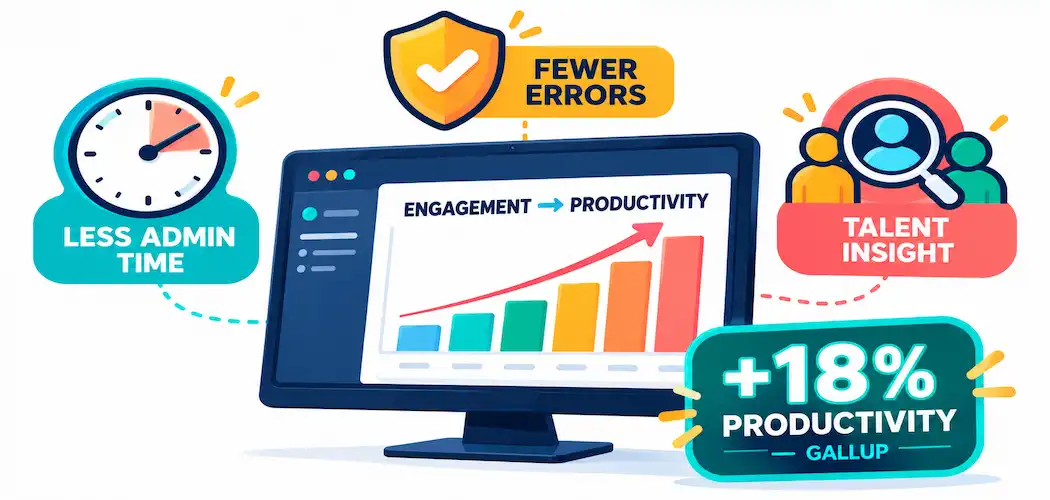
Less time spent on administrative tasks. This is the most consistent, measurable benefit across HR software adoption. Manual processes — paper onboarding forms, spreadsheet-tracked time-off requests, emailed performance review templates — consume hours that automated workflows can reclaim. The exact time saved varies by organization and how manual the previous process was, so any specific percentage should be treated skeptically unless it comes with a named source; the honest version of this claim is that the time savings are real and often substantial, not that they follow a universal formula.
Fewer errors in payroll and compliance-sensitive data. Centralizing employee records in one system, rather than scattering them across spreadsheets and email threads, reduces the chances of a payroll miscalculation or a missed compliance deadline slipping through. This is a structural benefit of centralization itself, not a feature unique to any one platform.
Better-informed talent decisions. When performance data, engagement signals, and skills records live in one system instead of several disconnected ones, managers can actually see patterns — who’s ready for more responsibility, where a team is struggling, which roles have unusually high turnover — instead of relying on memory and anecdote.
The Engagement Connection Is Real — and Worth Citing Properly
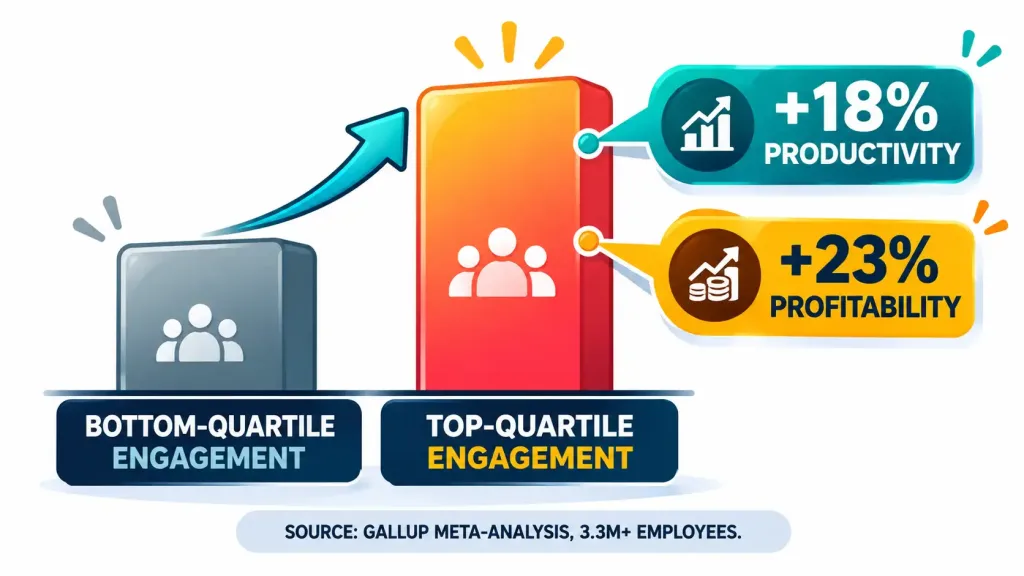
It’s genuinely true that engaged employees outperform disengaged ones by a meaningful margin, and this is one of the best-documented findings in workplace research rather than a marketing talking point. Gallup’s long-running meta-analysis — drawing on 736 studies across 347 organizations, covering more than 3.3 million employees — found that business units in the top quartile of employee engagement show 18% higher productivity and 23% higher profitability than those in the bottom quartile.
HR software doesn’t create engagement by itself, but it removes a lot of the friction that erodes it: slow onboarding, confusing benefits enrollment, performance reviews that feel arbitrary because no one tracked progress consistently throughout the year. Platforms with built-in pulse surveys, recognition tools, or development tracking give HR teams an actual window into engagement trends instead of guessing until the exit interview.
How Many Organizations Are Actually Using This
The adoption numbers are more modest than a lot of marketing content implies, and the gap between small and large employers is wide. A 2022 SHRM survey of 1,688 HR professionals found that roughly 25% of organizations use automation or AI for HR activities such as recruiting and hiring — but that figure splits sharply by company size: just 16% of employers with fewer than 100 workers use these tools, compared with 42% of employers with 5,000 or more employees.
Among organizations that have adopted automation or AI tools, the reported benefits are concrete: 85% say it saves time, increases efficiency, or both. 69% of users say time-to-fill for open positions has improved, and a similar share say the volume of applications they have to review manually has dropped. These are self-reported survey figures rather than independently audited numbers, but they come from a named, methodologically transparent source, which is more than can be said for most of the round-number claims that circulate around this topic.
The broader HR technology market itself has grown substantially: industry analysis from IMARC Group puts the global market at roughly $38.7 billion in 2025, with a projected climb to $72.5 billion by 2034 — a steady, unglamorous growth curve rather than the dramatic figures sometimes quoted elsewhere.
Applicant Tracking and Learning Management, Specifically
Two categories deserve a closer look because they’re often sold as part of a broader HCM suite rather than standalone tools:
Applicant Tracking Systems (ATS) streamline the recruiting funnel — posting, screening, interview scheduling, offer management. The real value is consistency: every candidate goes through the same structured process, which reduces the chance that a strong candidate gets lost in a crowded inbox.
Learning Management Systems (LMS) centralize training content and track completion, certification, and skill development over time. For compliance-heavy industries especially, having an auditable record of who completed required training — and when — is worth more than the training content itself in a lot of cases.
Vendor-specific performance claims for either category vary too much by implementation and company size to generalize responsibly. Anyone evaluating a specific product should ask the vendor for case studies with named customers and verifiable outcomes, rather than relying on round, unattributed percentages in buying guides.
What to Actually Evaluate Before Choosing a Platform
- Integration with existing systems — payroll, benefits providers, and any applicant-tracking tools already in use. A platform that requires rebuilding integrations from scratch costs more in implementation time than its subscription fee might suggest.
- Scalability — whether the platform’s pricing and feature tiers make sense for where the company expects to be in two or three years, not just its current headcount.
- Data security and compliance support — especially for organizations operating across multiple states or countries, where employment law varies significantly.
- Actual user experience for employees, not just HR staff — a platform that’s powerful for administrators but confusing for employees submitting a time-off request undermines a lot of the efficiency gain.
The Bottom Line
HR software’s real value isn’t in a headline statistic — it’s in removing the administrative friction that eats HR teams’ time and quietly erodes employee experience. The genuinely well-documented research (Gallup’s engagement-productivity link, SHRM’s adoption and efficiency data) supports that case clearly enough on its own, without needing invented numbers to make the point feel more dramatic than it already is.
Frequently Asked Questions
What’s the real difference between an HRIS and an HCM platform?
An HRIS is the core system of record for employee data, payroll, and benefits. An HCM platform extends that into the broader employee lifecycle — recruiting, performance, learning, succession planning. Many modern platforms combine both, but the distinction matters when comparing which features are core versus added on.
Is there solid evidence that employee engagement actually affects productivity?
Yes. Gallup’s meta-analysis of 736 studies across more than 3.3 million employees found that highly engaged business units show 18% higher productivity and 23% higher profitability than less engaged ones — one of the more rigorously documented findings in workplace research.
How common is HR automation adoption, really?
Less common than a lot of marketing suggests. A 2022 SHRM survey found about 25% of organizations use automation or AI for HR tasks, with adoption much higher among large employers (42% at 5,000+ employees) than small ones (16% under 100 employees).
Should I trust specific ROI percentages in HR software marketing?
Treat unsourced percentages with skepticism. Genuine, well-documented statistics (like Gallup’s engagement research or SHRM’s adoption survey) cite their methodology and sample size. A number with no named source — “reduces errors by 30%” or similar — should be treated as a marketing estimate, not a verified fact.