Chennai’s real estate market has been expanding for years, but “growth” as a word doesn’t tell you much without the specifics behind it — which localities, driven by what infrastructure, at what price tiers, and with what realistic timeline. Here’s what’s actually behind the growth in Chennai’s newer residential corridors, grounded in the infrastructure projects and locality-level data driving it, rather than general optimism about the city’s trajectory.
The Infrastructure Project Actually Driving Locality-Level Growth
Chennai Metro Phase 2 is the single biggest infrastructure driver behind the current wave of locality-level growth, and it’s worth understanding specifically rather than as a vague “infrastructure investment” claim:
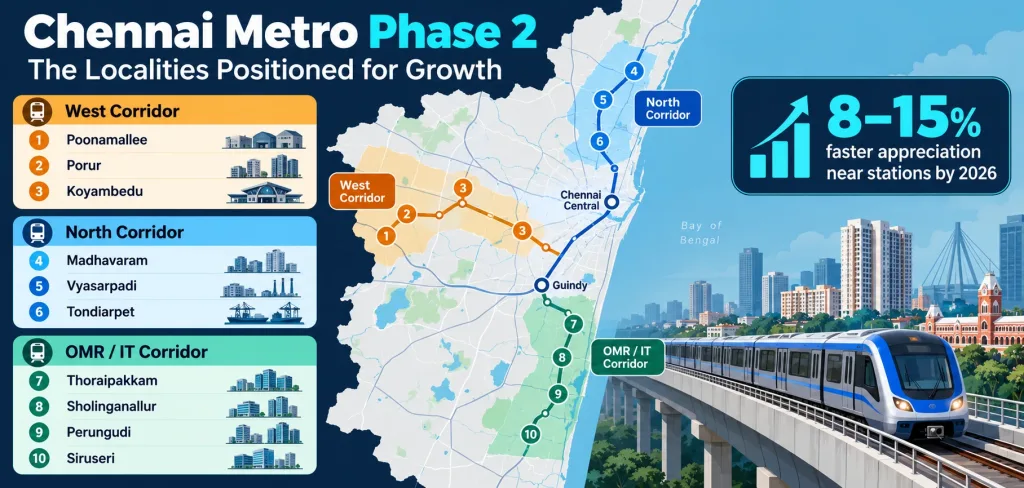
- Chennai Metro Rail Limited’s (CMRL) Phase 2 expansion adds 118.9 km across 128 stations, running through three new corridors (3, 4, and 5) covering west Chennai, north Chennai, and the OMR/IT corridor.
- Properties within roughly 500–800 meters of operational Metro stations along the OMR, Madhavaram, and Sholinganallur corridors are projected to appreciate 8–15% faster than comparable non-metro areas by 2026, according to property market analysis.
- The ten localities most directly named as beneficiaries span all three corridors: Poonamallee, Porur, Valasaravakkam, and Alwarthirunagar in the west; Madhavaram, Kolathur, and Perambur in the north; and Perungudi, Thoraipakkam, and Sholinganallur along the OMR/IT corridor.
This matters for evaluating any specific new project: a development’s proximity to an actual, named Metro Phase 2 station is a far more concrete growth indicator than general claims about “infrastructure development” in a broad area.
Where Affordable Housing Demand Is Actually Concentrated
Rather than a vague claim that “builders are responding to demand for affordable housing,” the actual locality-level pattern is specific: Guduvanchery, Tambaram, and Kelambakkam are the suburbs where affordable and early-mid-segment demand is currently strongest, driven by a combination of connectivity improvements, comparatively reasonable land prices, and more available space than the already-dense core city offers. Guduvanchery and Kelambakkam in particular are described in recent market analysis as transitioning from purely affordable to early mid-segment pricing — a sign of genuine, sustained demand rather than a temporary dip in prices. New apartments for sale in Chennai in this price tier are concentrated in exactly these growth corridors, which is a more useful signal for a buyer than the price range alone.
Why Suburban and Peripheral Growth Is Real, Not Just a Developer Talking Point
Tambaram, Kelambakkam, and Poonamallee are specifically named in current market analysis as the strongest investment-return candidates among Chennai’s growth suburbs, for reasons that go beyond lower land cost:
- Connectivity improvements (Metro Phase 2’s western and OMR corridors specifically) are reducing commute times from these suburbs into the city’s core employment centers.
- Larger available space at these peripheral locations allows for the kind of amenity-rich, lower-density development that’s increasingly difficult to build in the already-dense core city.
- Rental yield data gives suburban growth a concrete number, not just a narrative: suburban hubs near office clusters or colleges can deliver rental yields up to roughly 4.5% on compact units, compared to about 2.5–3% in central premium locations and 3–4% in the established IT corridors (OMR, Perungudi, Sholinganallur) — a meaningful yield gap that reflects genuine demand, not developer marketing.
What “Quality and Innovation” in New Builds Actually Means
Builder competition genuinely is pushing toward specific, measurable features rather than vague design language — energy-efficient construction is a real, quantifiable trend: homes built with better insulation, efficient fixtures, and solar integration can cut electricity costs by roughly 15–25% annually, according to recent market analysis. That’s a concrete number a prospective buyer can actually weigh against a project’s listed amenities, rather than taking “eco-friendly features” as a marketing phrase at face value.
What to Actually Look at When Evaluating New Projects in Chennai
- Check the project’s actual distance to the nearest Metro Phase 2 station, not just its general locality — the 8–15% projected appreciation premium applies specifically within that 500–800 meter radius, not citywide.
- Compare rental yield by corridor type, not just purchase price — a suburban location near an office or education hub may offer a meaningfully better yield than a nominally more “prestigious” central address.
- Verify specific efficiency claims (insulation standards, solar integration, fixture specifications) rather than accepting general “eco-friendly” language, since the 15–25% electricity savings figure depends on what’s actually built in, not just marketed.
- Watch for speculative pre-opening price spikes near Metro stations that haven’t opened yet — market analysis specifically flags this pattern and expects prices to level off once station access and supply both increase.
The Bottom Line
Chennai’s residential growth corridors are real, but they’re driven by specific, traceable factors — Metro Phase 2’s 118.9 km expansion through named corridors, suburban rental yields running a full percentage point or more above central locations, and genuine efficiency gains in newer construction — rather than general optimism about the city’s economic trajectory. Evaluating any specific project against these concrete factors (actual station proximity, actual yield data by corridor, actual efficiency specifications) gives a far more reliable read on its growth potential than developer messaging about location and quality in the abstract.
Frequently Asked Questions
What’s actually driving growth in Chennai’s suburban real estate right now? Chennai Metro Phase 2’s 118.9 km expansion across west Chennai, north Chennai, and the OMR/IT corridor is the single biggest driver, with properties near its stations projected to appreciate 8–15% faster than non-metro areas by 2026. Suburbs like Tambaram, Kelambakkam, and Guduvanchery are also benefiting from genuine connectivity and space advantages, not just lower prices.
Are rental yields actually better in the suburbs than in central Chennai? In several cases, yes — suburban hubs near offices or colleges can reach rental yields up to about 4.5% on compact units, compared to roughly 2.5–3% in central premium locations and 3–4% in the established IT corridors. The yield gap reflects genuine demand for well-connected, more affordable housing stock.
Do energy-efficient features in new builds actually save money, or is it just marketing language? The savings are real when the features are genuinely built in — market analysis puts electricity cost reductions from efficient construction (better insulation, efficient fixtures, solar integration) at roughly 15–25% annually. The key is verifying what’s actually specified in a given project rather than accepting “eco-friendly” as a label alone.
Should I expect property prices to keep rising near Metro Phase 2 stations? In the near term, likely yes in the stated 8–15% premium range for the most directly affected localities, but market analysis also flags a pattern worth watching: speculative price spikes often occur before a station actually opens, then level off once supply catches up with improved access. Buying based on realistic post-opening value, not pre-opening speculation, is the more reliable approach.