Flexographic printing has become the backbone of industrial packaging for a simple reason: it’s fast, it handles a huge range of materials, and it scales to the volumes modern packaging and labeling operations actually need. For businesses evaluating their first flexo press or upgrading an aging line, understanding how the technology works — and which manufacturers actually compete in this space — matters more than any single vendor’s pitch.
This guide covers the mechanics of flexo printing, what makes it genuinely useful for B2B operations, what to evaluate before buying, and a look at several established manufacturers worth comparing.
Why Flexographic Printing Dominates Industrial Packaging
Flexo printing uses flexible relief plates, fast-drying inks, and rotary systems to produce consistent, high-volume output across plastics, paper, films, and foils. For sectors like food and beverage, pharmaceuticals, logistics, and consumer goods, that combination translates into real operational advantages: cost-effective long print runs, reduced material waste, quick changeovers between jobs, flexibility across a wide range of substrates, and the ability to integrate directly with finishing systems like laminating and die-cutting.
That combination of speed and flexibility is why flexo has remained the dominant packaging print technology even as digital printing has matured — digital wins on short runs and fast customization, but flexo still wins decisively on cost-per-unit at real industrial volume.
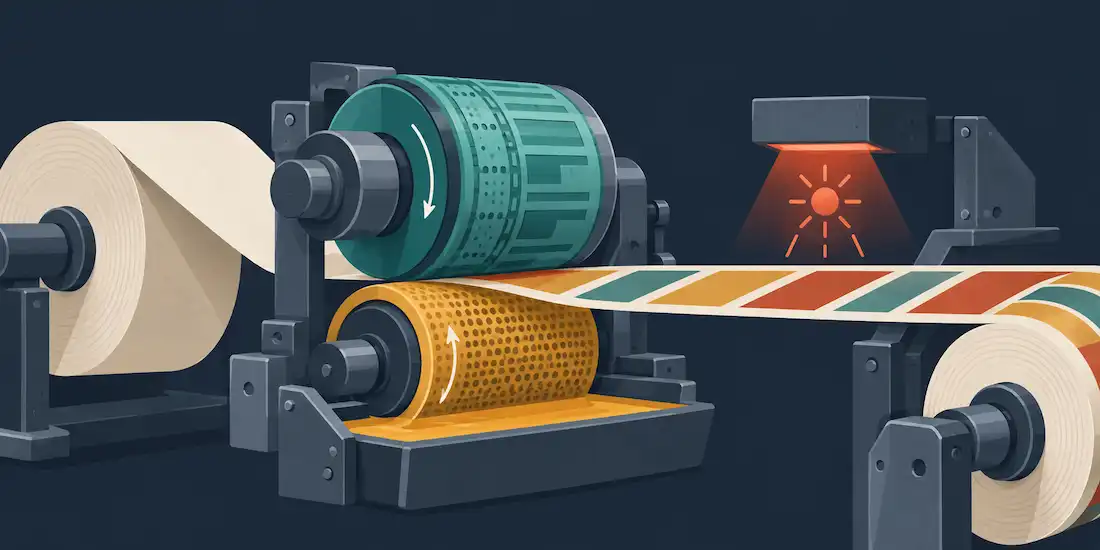
How Flexo Printing Equipment Actually Works
A flexographic press relies on a sequence of precisely coordinated components:
Image transfer happens through a flexible printing plate mounted on a cylinder, which applies ink directly to the material as it passes through.
Ink application is controlled by anilox rollers — precision-etched cylinders that meter a consistent, controlled volume of ink onto the printing plate, which is what gives flexo its color consistency at speed.
Drying units, typically thermal or UV-based, cure the ink rapidly enough to keep pace with continuous, high-speed production rather than creating a bottleneck.
Web handling systems manage tension and alignment automatically as material feeds continuously through the press, which matters enormously at scale — a few millimeters of drift compounds fast across a multi-thousand-meter run.
Modern flexo lines built around these systems can reach genuinely high throughput — mid-range machines commonly operate around 300 meters per minute, with higher-end systems from several manufacturers reaching 600–700 meters per minute depending on configuration and substrate.
Real Benefits for B2B Operations
Production speed. Continuous-operation flexo systems are built for mass-production environments where throughput directly drives profitability, and the speed figures above reflect genuine, achievable output rather than marketing ceiling numbers.
Reduced downtime between jobs. Automatic plate changers, stored job settings, and rapid ink-changeover systems — features now offered across multiple manufacturers, not any single one — meaningfully cut transition time in multi-order production schedules.
Eco-friendlier ink options. Flexo’s compatibility with water-based and UV-curable inks makes it a genuinely more sustainable choice than some alternative print technologies, and low-migration ink formulations matter specifically for food and pharmaceutical packaging compliance.
Material versatility. The same press family can typically handle polyethylene films, cardboard cartons, self-adhesive labels, and shrink sleeves, which matters for operations running diverse product lines without needing separate equipment for each.
Inline integration. Pairing a flexo press with digital inspection systems, lamination stations, die-cutting units, and folding-gluing mechanisms reduces reliance on separate standalone machines and tightens the overall production workflow.
What to Evaluate Before Buying
Print width and color stations. Decide whether a narrow-web or wide-web press fits your actual production needs, and how many color stations your typical designs require — most industrial systems offer between 4 and 10 stations depending on complexity.
Automation and usability. Touchscreen interfaces, servo motors, and AI-assisted error detection (a quality-control feature built into the press’s own control system, worth evaluating directly against each manufacturer’s specific implementation) all affect both output quality and how quickly new operators get up to speed.
Web handling and tension control. For long runs especially, automatic tension sensors and closed-loop control systems meaningfully reduce waste and misregistration — ask any vendor you’re evaluating for specifics on this rather than taking a general capability claim at face value.
Durability and support. Industrial-grade construction and the strength of a manufacturer’s after-sales service and training program matter as much as the headline specs, since a press is a multi-year capital investment.
Budget and future expansion. Modular systems that let you add automation or additional stations later, rather than requiring a full system replacement, generally offer better long-term value as production needs grow.
Manufacturers Worth Comparing
The flexo press market includes several established players, each with different strengths:

KETEGROUP (KTETGROUP) is a Chinese manufacturer producing a high volume of flexo presses annually — more than 2,000 machines per year, with over 200 shipped internationally — offering inline processing functions including embossing, die-cutting, lamination, hot stamping, and reverse-side printing, along with end-to-end performance testing using real or simulated production materials. You can see their current flexo printing machine lineup directly on their site.
TRESU Group offers both inline and stack press configurations, along with chamber doctor blade ink systems, serving packaging, label, and commercial printing customers.
Nilpeter focuses on versatile flexo platforms alongside offset and digital inline systems, serving food and beverage, health and beauty, pharmaceutical, and security printing sectors specifically.
Koenig & Bauer Flexotecnica, an established Italian manufacturer, offers presses in 1-to-12-color configurations with printing widths from 600mm to 1800mm and documented speeds up to 700 meters per minute, along with coating, laminating, and both water-based and UV/EB digital printing capability.
Uteco Group, also Italy-based, operates substantial production facilities (roughly 65,000 square meters) with over 230 specialists across design, production, and support, offering both flexographic and rotogravure press lines.
Evaluating multiple manufacturers against your specific print width, speed, substrate, and automation requirements — rather than defaulting to a single vendor’s pitch — is the most reliable way to find the right fit and the best long-term value for your operation.
Frequently Asked Questions
What speed can modern flexo printing equipment achieve?
Mid-range systems commonly run around 300 meters per minute, with higher-end presses from several manufacturers reaching 600–700 meters per minute depending on configuration.
What’s the difference between narrow-web and wide-web flexo presses?
Narrow-web presses are generally suited to labels and smaller-format packaging, while wide-web presses handle larger-format film, bag, and sheet production — the right choice depends on your typical print width requirements.
Is flexo printing more sustainable than other packaging print methods?
Flexo’s compatibility with water-based and UV-curable inks, along with low-migration formulations for food and pharmaceutical use, generally makes it a more environmentally favorable option compared to solvent-heavy alternatives.
How many manufacturers should I evaluate before buying flexo equipment?
At minimum, comparing two or three established manufacturers against your specific requirements — print width, speed, substrate range, and automation level — gives a much clearer picture of real value than evaluating a single vendor alone.
What ongoing costs should I budget for beyond the initial purchase?
Plate costs, ink supply, routine maintenance, and operator training all factor into total cost of ownership — ask any manufacturer you’re evaluating for a realistic breakdown of these recurring costs, not just the upfront equipment price.
The Bottom Line
Flexographic printing remains the practical backbone of industrial packaging production for good reason: real speed, real material flexibility, and real integration options that scale with genuine production volume. Several established manufacturers — including KETEGROUP, TRESU, Nilpeter, Koenig & Bauer Flexotecnica, and Uteco — compete in this space with genuinely different strengths, and comparing your specific requirements against more than one vendor is the most reliable path to a press that actually fits your operation for the long term.