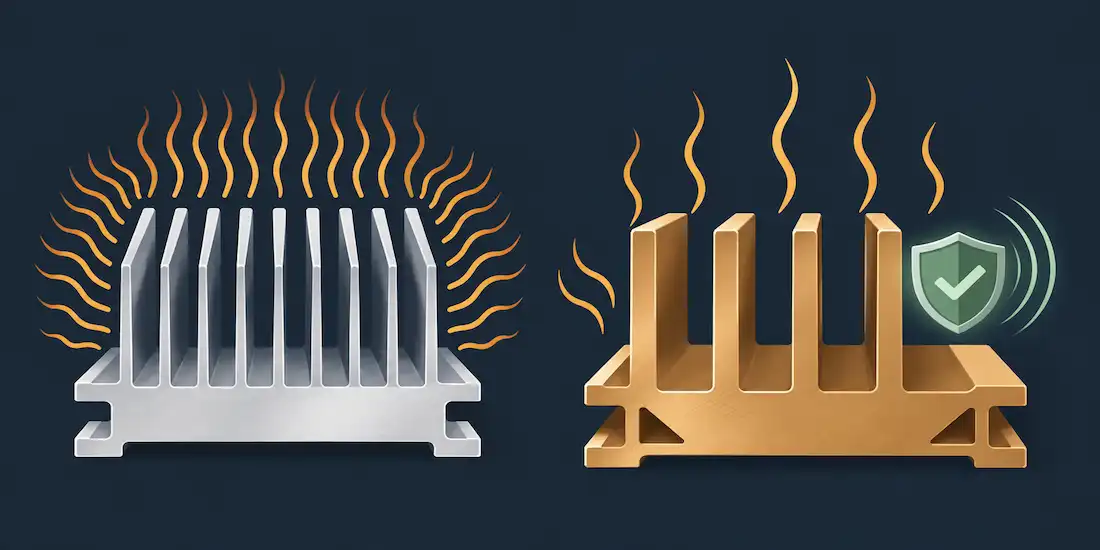
5G base stations run hotter than their predecessors, and the thermal engineering behind them matters more than most people outside the industry realize. This piece looks at why 5G heat dissipation is a genuine engineering challenge, what materials actually perform best for it, and where precision CNC-machined components — including bronze, used thoughtfully rather than as a blanket “better than aluminum” claim — genuinely add value.
Why 5G Equipment Runs Hotter Than 4G
The jump in thermal load isn’t incidental — it comes from real architectural changes. Massive MIMO technology, now standard in 5G deployments, uses many more antenna elements operating simultaneously than 4G systems did, and that increase in active radio components translates directly into higher power consumption and heat output per base station. Power amplifiers, baseband processors, and RF units are the primary heat sources, and all three run under sustained high load in a typical 5G deployment.
As a general materials science principle, electronic component failure rates do rise with sustained elevated temperature — this is well-established in reliability engineering generally, though the specific rate of increase varies significantly by component type, so broad “X% increase per degree” figures should be treated skeptically unless tied to a specific component and test methodology.
Outdoor deployment compounds the challenge. Base stations often operate across a genuinely wide temperature range depending on climate and location, and cooling systems have to handle both ends of that range reliably, in a compact outdoor enclosure, without the airflow advantages of a climate-controlled data center.
Getting the Materials Science Right: Aluminum, Bronze, and Copper
This is worth being precise about, since it’s commonly misunderstood.
Aluminum is the dominant heat-sink material in electronics for good reason — it offers a strong combination of thermal conductivity (commonly 150–220 W/m·K depending on alloy), low weight, and relatively low cost, which is exactly why it’s the default choice across consumer electronics, telecom equipment, and industrial cooling applications.
Copper has higher thermal conductivity still (around 390 W/m·K for pure copper), which is why it shows up in high-performance cooling applications — CPU heat spreaders, high-end heat pipes — where the weight and cost penalty is worth the conductivity gain.
Bronze, as a structural material, generally has lower thermal conductivity than aluminum, with common bronze alloys ranging roughly 36–170 W/m·K depending on composition. Bronze isn’t typically chosen for raw heat-dissipation performance over aluminum — it’s chosen for other properties entirely:
- Dimensional stability under thermal cycling. Bronze generally has a lower coefficient of thermal expansion than aluminum, meaning machined components hold tighter tolerances across the wide temperature swings an outdoor base station actually experiences — which matters for maintaining consistent contact pressure against a heat source over years of operation, even if bronze isn’t moving heat away as efficiently per unit of material.
- Mechanical strength. Bronze alloys typically offer meaningfully higher tensile strength than aluminum alloys, which allows thinner structural sections without sacrificing durability — useful in compact enclosures where every millimeter of space matters.
- Corrosion resistance. Bronze holds up well in humid, salt-exposed, or industrially polluted environments, which matters for outdoor telecom infrastructure deployed in coastal or industrial zones.
- Electromagnetic shielding. Bronze’s electrical properties make it effective at blocking external electromagnetic interference and reducing crosstalk between internal RF components — a genuinely relevant benefit for dense 5G equipment packed with sensitive radio circuitry.
In practice, well-engineered 5G thermal solutions often combine materials deliberately — aluminum or copper where raw conductivity matters most, bronze where structural stability, corrosion resistance, or EMI shielding are the priority, with the two working together rather than one simply “replacing” the other.
What Precision CNC Machining Actually Contributes
Regardless of which material is chosen, the precision of how it’s machined has a real, measurable effect on thermal performance.
Tight tolerances improve thermal contact. The quality of contact between a heat sink and the chip or component it’s cooling directly affects thermal resistance at that interface — a poorly machined contact surface, even in a high-conductivity material, creates a resistance bottleneck that undermines the material’s theoretical performance. High-precision CNC machining, capable of tight tolerances, reduces this interface resistance meaningfully compared to cast or extruded alternatives.
Complex geometries increase surface area. Multi-axis CNC machining can produce thin fins, internal cavities, and optimized airflow channels that are difficult or impossible to achieve with casting or extrusion, and more surface area in a given footprint generally means better heat dissipation for the same base material.
Consistency matters at scale. For equipment deployed across many base stations over years of service, machining consistency — not just peak performance in a single part — determines whether a cooling solution performs reliably across an entire deployed fleet.
Evaluating Total Cost of Ownership, Honestly
Any serious cost comparison between cooling approaches should be based on Total Cost of Ownership (TCO) rather than unit price alone. A more expensive, precisely machined component can reasonably be expected to offer value over a cheaper cast alternative through fewer field failures, reduced maintenance visits, and longer service life — but specific percentage savings depend heavily on deployment environment, duty cycle, and the specific baseline being compared against, and should be verified against a specific vendor’s documented case data rather than treated as a universal figure.
When evaluating a CNC machining partner for thermal or structural components, questions worth asking directly include: what tolerances can they consistently hold in production, not just in a best-case sample; what quality certifications do they carry (ISO 9001 is a reasonable baseline for process consistency); and can they provide real failure-rate or field-performance data from comparable deployments, rather than general industry claims.
Where This Applies Beyond 5G
The same engineering principles — matching material properties to the actual requirement, using precision machining to maximize whatever material is chosen, and evaluating on total lifecycle cost rather than unit price — apply across other high-power-density electronics: network security infrastructure, data center hardware, industrial power electronics, and automotive power systems all face comparable thermal and reliability engineering challenges.
Readers interested in the specific alloy and machining details referenced here can find a more technical breakdown in this bronze CNC machining guide, and general background on CNC machining processes more broadly.
Frequently Asked Questions
Does bronze have better thermal conductivity than aluminum?
Generally, no. Most structural bronze alloys have lower thermal conductivity than common aluminum alloys. Bronze is typically chosen for other properties — dimensional stability, mechanical strength, corrosion resistance, and EMI shielding — rather than raw heat-dissipation performance.
Why do 5G base stations generate more heat than 4G equipment?
Massive MIMO technology uses significantly more active antenna elements operating simultaneously, which increases power consumption and heat output per base station compared to earlier-generation equipment.
What does precision CNC machining actually improve for thermal components?
Tighter tolerances reduce thermal contact resistance at the interface between a heat sink and the component it’s cooling, and multi-axis machining enables complex geometries (thin fins, optimized airflow channels) that increase effective surface area within a given footprint.
Is bronze ever a good choice for 5G cooling components?
Yes, in combination with other materials or for specific structural elements — particularly where dimensional stability under thermal cycling, corrosion resistance, or electromagnetic shielding matter alongside thermal performance, rather than as a blanket replacement for aluminum.
What should I ask a CNC machining supplier before choosing them for thermal components?
Ask about tolerances they consistently achieve in actual production runs, relevant quality certifications, and whether they can provide real field-performance or failure-rate data from comparable past projects.
The Bottom Line
5G’s thermal challenges are real, driven by genuine increases in power density from Massive MIMO and sustained outdoor operation across a wide temperature range. The materials science behind solving it is more nuanced than “bronze beats aluminum” — aluminum generally wins on raw thermal conductivity, while bronze earns its place through dimensional stability, strength, corrosion resistance, and EMI shielding. Precision CNC machining improves thermal performance regardless of which material is chosen, by tightening contact tolerances and enabling complex, high-surface-area geometries that casting and extrusion can’t match.