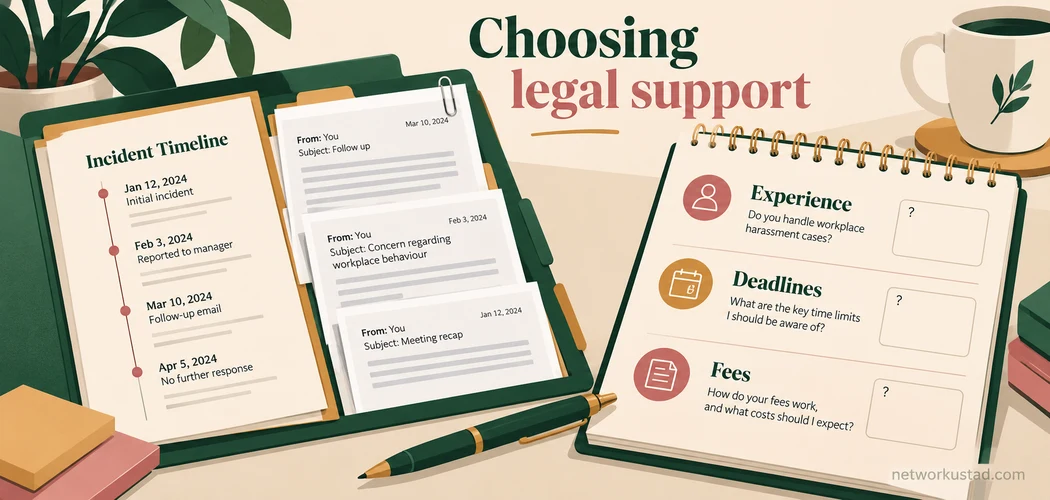
Deciding whether to seek legal help after workplace harassment can involve several concerns at once. You may want the conduct to stop, worry about your job, need to understand a deadline, or simply want someone independent to explain your options. You do not need to resolve every question before asking for information.
A workplace sexual harassment lawyer can assess the facts, identify potentially applicable laws and explain available steps. The value of that advice depends on relevant experience, a clear understanding of your circumstances and an honest discussion of uncertainty. A professional title, a confident advertisement or a large previous verdict does not guarantee the outcome of another person’s case.
This guide concerns U.S. workplace issues. Federal, state and local rules can differ, and federal employees use a different complaint process. It offers a way to prepare and compare legal help, rather than a determination that a particular incident is unlawful or that a particular lawyer is right for you.
What a workplace sexual harassment lawyer can help assess
A consultation can examine who was involved, where the conduct occurred, what happened, how the employer responded and whether any relevant deadline is approaching. The lawyer may also need to review the employment relationship, employer size, work location and documents you signed. These details can affect which rules and procedures apply.
Potential assistance includes explaining reporting routes, reviewing relevant records, advising about a proposed agreement and representing a client within an agreed scope. Representation does not prevent all future misconduct, ensure that an employer acts appropriately or promise compensation. Ask what the lawyer would actually undertake and what remains your responsibility.
The existing Sexual Harassment Lawyer link leads to Avloni Law, a private law firm whose website describes a California employment practice. Treat that as one commercial source to evaluate. Confirm the individual attorney’s licensing, jurisdiction, experience and availability before deciding whether to contact or retain them.
Understand the issue without diagnosing your own case
Unwelcome sexual advances, requests for sexual favors and other sex-based verbal or physical conduct can raise workplace discrimination concerns. Harassment need not involve a person of a different sex, and it may involve a supervisor, colleague or nonemployee such as a customer. Context matters when assessing the legal consequences.
Federal law does not make every rude interaction a harassment claim. The EEOC explains that unlawful harassment may involve conduct sufficiently frequent or severe to create a hostile environment, or an adverse employment decision connected to the conduct. One serious incident should not be dismissed merely because it happened once.
Tell an adviser what happened in ordinary language. You do not need to decide whether to call it quid pro quo, a hostile environment or retaliation before seeking an assessment. Keep your factual account separate from conclusions you have read online.
Check deadlines before waiting for a complete solution
A workplace sexual harassment lawyer should identify the relevant filing route promptly. For many private-sector and state or local government employment discrimination matters, the EEOC charge deadline is generally 180 calendar days. It can extend to 300 days where the specified state or local enforcement conditions apply. These are not interchangeable periods from which a reader can simply choose the longer one.
Federal employees and applicants generally must contact their agency’s EEO counselor within 45 days, subject to applicable exceptions. State claims and later court proceedings can have separate requirements. A short general guide cannot calculate every deadline from a few dates.
Do not assume an internal complaint, union process or negotiation pauses an EEOC deadline. The agency says these efforts generally do not extend the charge-filing period. If timing may be close, contact the relevant agency or a qualified lawyer promptly rather than waiting to collect a perfect file.
Missing a deadline can seriously affect a claim. It should not be described as temporarily losing a right that will automatically return. Obtain an individual assessment if a deadline may already have passed.
You can contact the EEOC without first hiring counsel
Hiring a workplace sexual harassment lawyer is a choice, not a prerequisite to contacting the EEOC. The agency states that its services are free and that a person does not need an attorney to file a job discrimination complaint. A lawyer may still help evaluate legal issues, organize submissions or represent you where agreed.
Distinguish starting an inquiry from completing a charge. The EEOC describes a charge as a signed statement requesting agency action. Do not assume that a website inquiry, consultation request or scheduled interview has completed every required filing step. Ask the agency or your lawyer what has been submitted and obtain confirmation.
If a deadline is approaching while you are looking for representation, tell the agency about that timing. A law firm’s decision to review a potential case is not a promise that it has accepted responsibility for filing anything.
Prepare a factual account for a workplace sexual harassment lawyer
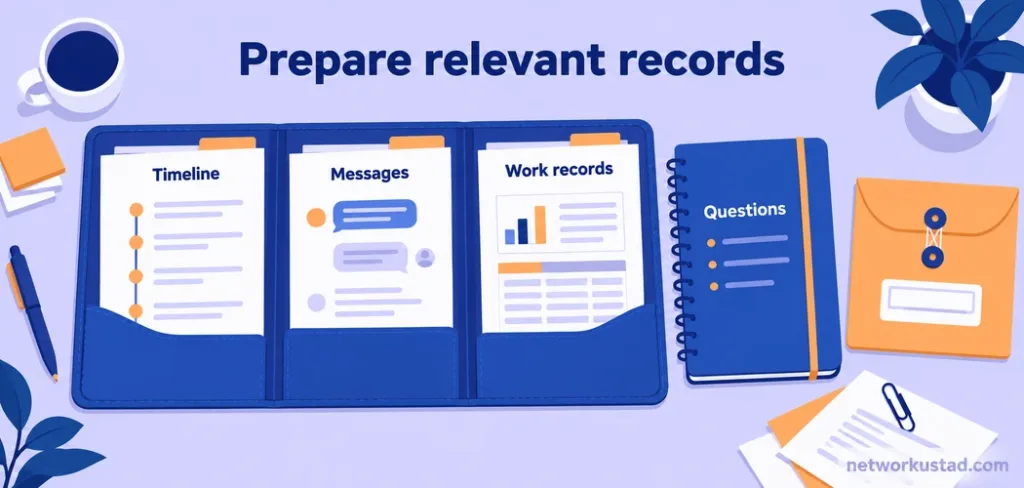
Before speaking with a workplace sexual harassment lawyer, make a manageable chronology. Record approximate dates, locations, people present, what was said or done and any response. Mark uncertain details as uncertain. An honest note about an approximate date is more useful than false precision.
Separate the events themselves from later consequences. For example, distinguish a comment during a meeting, an email reporting it and a subsequent schedule change. Include relevant context even if you think it weakens your position. An adviser needs to understand both supporting information and potential explanations the employer may offer.
You can organize available information in a simple table:
| Topic | Useful details |
|---|---|
| Conduct | What happened, when and where |
| People | Participants, witnesses and reporting contacts |
| Reporting | Who received a concern and how they responded |
| Work changes | Relevant schedule, pay, assignment or evaluation changes |
| Records | Existing messages, policies and correspondence |
| Questions | Your goals, timing concerns and practical constraints |
This is a preparation aid, not a legal evidence checklist or a requirement to investigate the matter yourself.
Preserve relevant records lawfully and carefully
Keep existing records you are entitled to possess, and ask for advice about anything uncertain. Relevant material may include messages sent to you, your own contemporaneous notes, complaint correspondence, employment policies and documents about a disputed work decision. Avoid editing originals to make an account appear clearer.
Do not enter restricted systems, use someone else’s credentials or take unrelated confidential files to strengthen a claim. Secret recording can raise jurisdiction-specific legal issues. Ask a qualified adviser before recording a conversation or copying information whose handling is unclear.
Use a contact method you can access appropriately and privately. Ask the law office how to send sensitive documents and what it needs for an initial conflict check. Avoid uploading an entire personnel or medical file to a general contact form before understanding who receives it and why.
Discuss retaliation without assuming every later decision proves it
A workplace sexual harassment lawyer can review whether a later employment action may be connected to protected activity. The EEOC identifies several potentially protected activities, including reporting discrimination and participating in relevant proceedings. The protection is important, but it does not make a person immune from every legitimate workplace decision.
Record changes objectively. Note what changed, when it happened, who made the decision and what explanation was given. A chronology can help an adviser assess a possible connection. Timing alone should not be presented in an article as a complete legal conclusion.
If new concerns arise after reporting, ask how to communicate them and whether an existing filing needs attention. Do not assume that retaining counsel stops retaliation or that every new event is automatically covered by earlier paperwork. The response depends on the facts and procedural position.
Evaluate relevant experience rather than an expert label
The phrase “expert lawyer” is not a substitute for questions. Ask whether the attorney represents employees in workplace harassment matters in the relevant jurisdiction, what kinds of proceedings they handle and who would work on your case. A broad practice is not automatically unsuitable, and a narrow marketing description is not proof of competence.
Check the licensing authority’s official attorney record. Review current status and available public disciplinary information, and confirm that the identity matches the lawyer you are considering. An advertisement, directory badge or website testimonial does not replace that check.
For broader background, NetworkUstad’s employment law article discusses the role of employment advice. Use general reading to prepare questions; jurisdiction-specific agency information and individual legal advice should guide a live deadline or claim.
When reviewing a Sexual Harassment Lawyer website, look beyond promotional language. Ask about the actual scope offered, current capacity and possible conflicts. This link identifies the existing firm destination; it is not a comparative ranking or a certification of suitability.
Ask a workplace sexual harassment lawyer about scope and communication
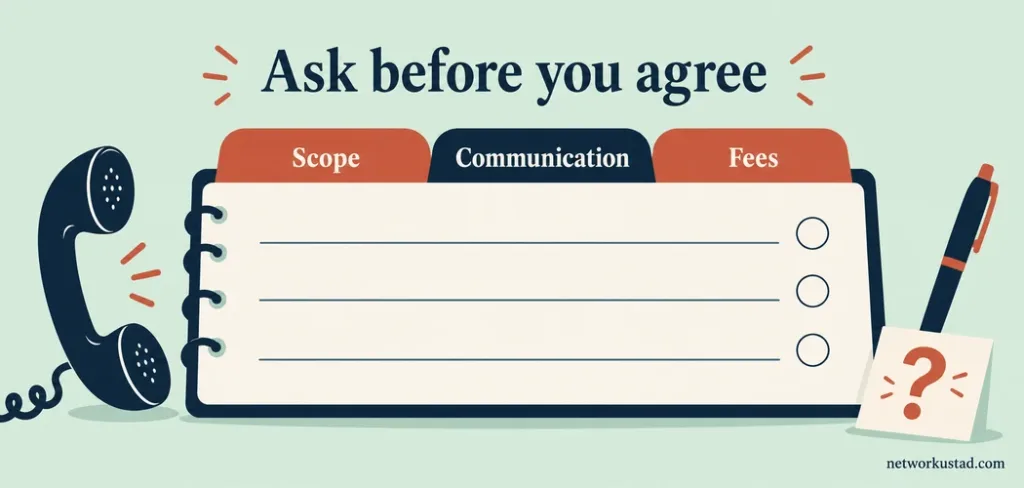
A useful initial conversation should leave you clearer about what happens next. Ask whether the meeting is only an intake assessment, whether further review costs money and whether the firm has accepted representation. Confirm who is monitoring any urgent date while the decision remains pending.
Ask how the office communicates, who answers routine questions and how you report new events. Discuss accessibility, language or scheduling needs early. You should be able to understand the explanation without being pressured to accept a promise of a quick result.
Before relying on a workplace sexual harassment lawyer to act, confirm the engagement and its scope. Representation for reviewing an agreement may not include an agency charge or court case. Ask what additional authorization or agreement would be needed if the matter changes.
Discuss fees with a workplace sexual harassment lawyer
Fee arrangements vary. A lawyer may propose hourly billing, a fixed charge for a limited service, a contingency arrangement or another permitted structure. Ask what applies to your matter instead of assuming every employment lawyer works on a no-win, no-fee basis.
A contingency fee generally ties the lawyer’s fee to a recovery, but expenses are a separate question. Ask who pays filing fees, transcripts, experts or other authorized costs, including if the matter is unsuccessful. Clarify how any percentage is calculated and what deductions come before determining the amount you receive.
Request a written explanation of services, fees and expense responsibilities. Ask about ending the engagement, transferring the matter and work outside the agreed scope. Read the actual terms rather than relying on a headline slogan. Requirements vary by jurisdiction, so a general example should not be treated as the governing rule everywhere.
Understand commercial contact services before submitting information
The existing RequestLegalHelp link leads to a commercial legal advertising platform, rather than a government agency or law firm. Its disclosures say inquiries may be forwarded to participating lawyers who pay advertising fees. It also states that submitting information does not create an attorney-client relationship and may not be protected by privilege.
Read the service’s current privacy and contact terms before sending details. Identify who may receive your information and distinguish an introduction from a lawyer accepting your case. A completed form should not be treated as filing a complaint with an agency or satisfying a legal deadline.
You can also investigate official bar referral resources and legal-aid organizations serving your location. Assess the person who would provide advice, regardless of how you found them. Do not let the appearance of a familiar case category substitute for checking jurisdiction and representation terms.
Discuss options and possible outcomes realistically
A workplace sexual harassment lawyer may explain internal reporting, agency processes, negotiation or litigation, depending on the circumstances. Some paths may operate alongside others, while particular claims require procedural steps before court action. Ask what each option would involve and which immediate decisions matter.
Discuss your goals without treating them as guaranteed remedies. You may want a change in reporting arrangements, a response to conduct, advice about leaving employment or an assessment of possible compensation. The available choices depend on law, facts and practical circumstances.
Maximizing settlements is a phrase readers may encounter in legal marketing. The linked internal article concerns personal-injury representation, a different context; it should not be used to value a workplace harassment claim. Ask for a reasoned assessment of strengths, weaknesses and costs rather than importing figures or expectations from unrelated cases.
Put the January 2026 guidance change in context
The EEOC voted on January 22, 2026 to rescind its 2024 workplace harassment enforcement guidance. In its announcement, the agency stated that federal laws against discrimination, harassment and retaliation, together with relevant Supreme Court precedent, remained in place. Rescinding a guidance document is not the same as repealing the underlying statute.
A workplace sexual harassment lawyer should explain how current law and relevant court decisions apply to your particular matter. Do not infer from a headline that a protected group has lost every legal protection or that an employer can disregard harassment complaints. Equally, do not assume that every paragraph of a withdrawn guidance document remains the agency’s current position.
State and local requirements need separate checking. This article does not combine different states’ rules into a single nationwide promise or treat an introduced bill as an enacted law.
Ask a workplace sexual harassment lawyer to clarify the next action
Consider an illustrative situation: an employee has concerning messages, has reported them internally and is waiting for an answer. The employee is also unsure whether a filing deadline is close. This example is not an author testimonial or a prediction of how a real dispute will end.
A useful consultation would identify the relevant dates and employment circumstances, examine available records and discuss possible reporting routes. It would also establish whether the lawyer is taking any action. The employee should leave knowing what remains uncertain, who is responsible for the next step and whether anything must happen promptly.
When contacting a Sexual Harassment Lawyer, apply the same checks you would use for any candidate. Explain timing concerns, ask what information is needed and confirm whether the firm can assist in the relevant jurisdiction. Contacting a firm does not guarantee acceptance, protection from misconduct or a particular recovery.
Frequently asked questions
Do I have to hire a lawyer before contacting the EEOC?
No. The EEOC says its services are free and an attorney is not required to file a job discrimination complaint. You may choose to obtain legal advice, but do not assume you must finish selecting counsel before asking the agency about an approaching deadline.
Is every consultation confidential?
Ask about the intake process and handling of information before sharing sensitive details. A law-office consultation and an advertising platform’s general contact form are different situations. Do not assume that submitting a form creates representation or attorney-client privilege.
Can someone promise that my case will succeed?
A responsible assessment should explain uncertainty. Relevant experience and careful preparation can support informed decisions, but neither establishes that you will win, settle or receive a particular amount. Ask what evidence and legal issues affect the assessment.
What should I do first if I am unsure?
Record the key dates, identify the jurisdiction and contact a qualified adviser or the relevant agency about timing. Preserve available records lawfully. Avoid waiting for complete certainty before checking a deadline that may affect your options.