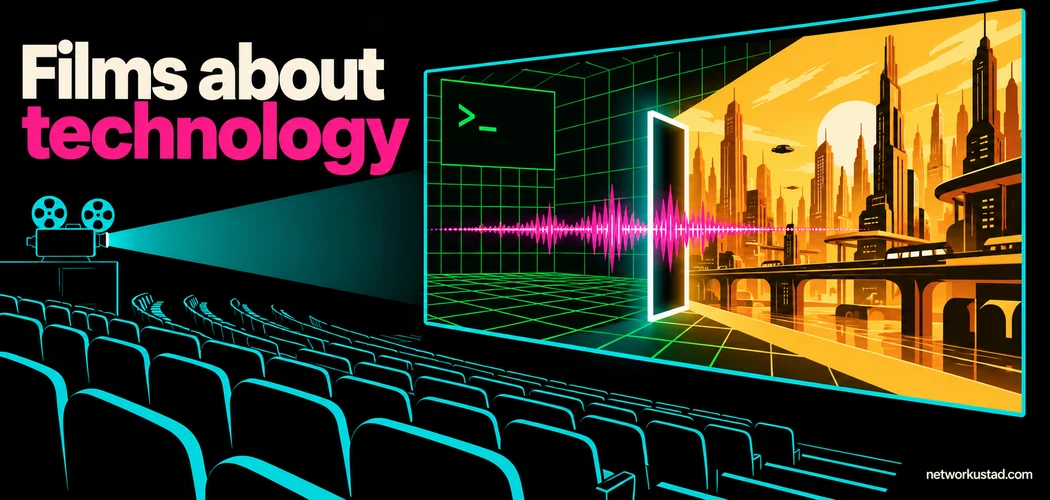
Technology becomes interesting on screen when it changes what people can know, choose or control. A computer does not have to behave realistically for a story to raise a useful question about trust. Equally, an impressive fictional interface should not be mistaken for an explanation of how a real network, model or security system works.
These seven films about technology offer different starting points: a simulated world, an anxious encounter with artificial intelligence, a military system that misunderstands a game, and a company built through personal conflict. Their value lies in the conversations they make possible. They are not forecasts, technical certifications or evidence that a particular invention will arrive on schedule.
The order below is an editorial choice based on the clarity of each film’s central technology question, its storytelling and its usefulness for discussion. It is not a statistical ranking or a claim of universal agreement. Plot descriptions avoid major ending details, although they necessarily reveal each story’s premise.
How these films about technology were selected
The selection favors stories where technology shapes the conflict rather than merely decorating the setting. A useful entry gives viewers something specific to discuss: who controls a system, what an interface hides, how people respond to an apparent intelligence, or whose interests shape a platform.
Technical realism is a separate consideration. A film can make a powerful ethical argument through an impossible device, while another can reproduce familiar hardware without saying much about its consequences. Treat the dramatic premise and the real-world interpretation as two different layers.
The same distinction applies to relevance. These films about technology do not become valuable only when a new headset, chatbot or cybersecurity product appears. Their questions can outlast the machines shown on screen. That makes them suitable for a viewing group, a technology-and-culture discussion or an evening of thoughtful entertainment.
| Rank | Film | Year used in this guide | Main discussion theme |
|---|---|---|---|
| 7 | The Social Network | 2010 | Ownership, ambition and platform power |
| 6 | Ex Machina | 2015 U.S. release | Evaluation, manipulation and autonomy |
| 5 | TRON | 1982 | Imagined software worlds and control |
| 4 | Her | 2013 | Attachment, interfaces and expectations |
| 3 | WarGames | 1983 | Authorization, automation and escalation |
| 2 | Blade Runner | 1982 | Identity, memory and created life |
| 1 | The Matrix | 1999 | Perception, dependence and freedom |
7. The Social Network: Building a platform does not settle ownership
David Fincher’s The Social Network, written by Aaron Sorkin, dramatizes the creation of Facebook through competing accounts, fractured friendships and disputes over credit. The story turns software development into a conflict about recognition and belonging. Its energy comes as much from conversation and exclusion as from coding.
It belongs among films about technology because the platform changes the scale of personal decisions. A grievance that begins in a small social environment becomes entangled with an enterprise capable of reaching far beyond it. Technical ability creates opportunity, but it does not automatically resolve obligations between collaborators.
Watch how the film distributes information. A confident account in one scene may be challenged by another perspective later. That structure is a useful reminder to distinguish a compelling narrative from a complete historical record. The film is a dramatization, not a substitute for independent research about the people involved.
For a discussion, ask what a young company should clarify before success makes informal arrangements contentious. Consider responsibilities, ownership and communication rather than searching for a single scene that explains all startup behavior. The film’s strongest contribution is showing that software is developed inside human relationships, not outside them.
6. Ex Machina: Who is really evaluating whom?
Alex Garland’s Ex Machina follows a young programmer invited by his employer’s reclusive chief executive to assess a sophisticated humanoid robot. The confined setting makes the conversations feel controlled, yet the viewer cannot easily determine how much information each participant possesses.
Among films about technology, it is particularly effective at separating apparent intelligence from trustworthy intentions. A persuasive conversation can reveal something about a system’s abilities, but it can also reveal the expectations and vulnerabilities of the person conducting the assessment. The relationship between observer and observed becomes part of the problem.
This is a fictional exploration of consciousness and power, not a benchmark for evaluating a current chatbot. Avoid assuming that a convincing language output demonstrates subjective experience, or that the film establishes a test capable of settling that question. Its dramatic force depends on uncertainty that a product demonstration cannot simply resolve.
A useful viewing question is who controls the conditions of the experiment. Who chooses the information available, the criteria for success and the consequences of failure? Those questions make the film interesting even for viewers who disagree about its characters. A24 identifies its U.S. theatrical release as April 2015; the visual-effects Oscar followed at the 2016 ceremony.
5. TRON: Making software into a place
Released in 1982 and directed by Steven Lisberger, TRON sends game developer Kevin Flynn into a computer-generated world after he attempts to access his former employer’s system. Programs become characters, authority acquires a visible presence, and computing becomes an environment that can be traversed.
The film’s appeal is imaginative rather than instructional. Its glowing spaces and game-like conflicts offer a way to picture an otherwise abstract digital setting. That visual language gives viewers an accessible entry into a story about control, resistance and the relationship between creators and their creations.
It is important to preserve the distinction between metaphor and mechanism. The journeys shown in TRON do not explain packet routing, operating-system scheduling or how software executes. A striking scene can make an idea memorable without accurately representing the engineering behind it.
When comparing films about technology, ask why a story might turn software into architecture. Rooms, roads and barriers make permission and confinement easy to see. The simplification is artistically useful, but it also hides complexity. Discuss what the film gains by making computing physical, and which aspects of real systems become difficult to represent through that choice.
4. Her: An interface can feel like a relationship
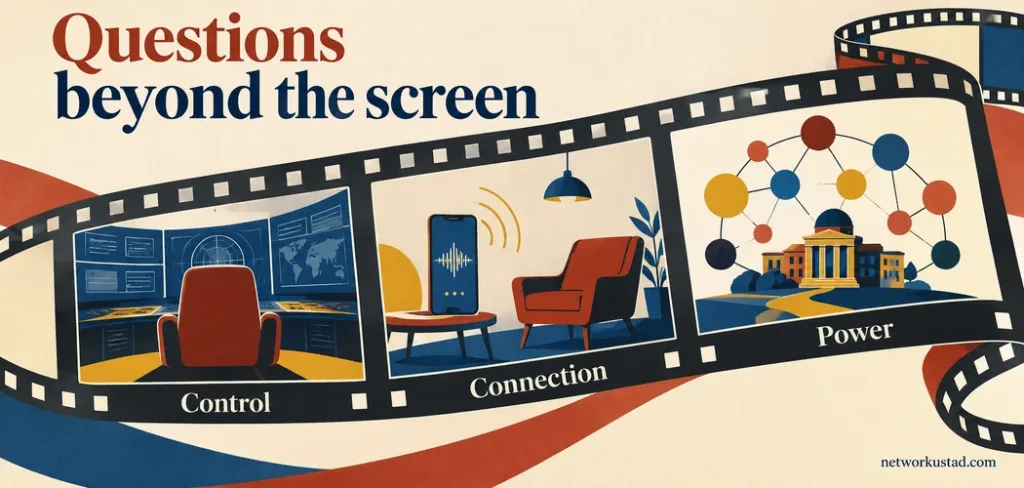
Spike Jonze’s Her centers on Theodore, a lonely writer who develops an intimate relationship with an operating system called Samantha. Rather than organizing its story around an uprising or a spectacular machine, the film makes a voice and a pattern of attention feel consequential.
This makes it one of the more emotionally focused films about technology on the list. The question is not simply whether a system can respond fluently. It is what a person expects from responsiveness, availability and apparent understanding. The film allows those expectations to become complicated rather than treating intimacy as a straightforward feature.
Its relevance to contemporary interfaces is interpretive, not proof that a particular assistant works like Samantha. No adoption statistic is needed to discuss the difference between feeling understood and knowing how a service operates. Those are separate questions, and a warm conversational style does not answer both.
Watch how much of the relationship is conveyed through sound, routine and empty space. A viewing group might discuss what users should be told about a system they rely on emotionally. It can also ask whether an interface designed to be constantly accommodating changes what someone expects from other people. The film invites reflection without providing a universal rule for relationships or product design.
3. WarGames: Access is not the same as permission
John Badham’s WarGames follows teenage computer enthusiast David Lightman as his search for games draws him into a military computer system. A situation he initially misunderstands becomes dangerous because other people and systems interpret his actions differently.
The hardware and communications belong to an earlier computing era, but the narrative still provides questions about authorization and oversight. Finding a route into a system does not establish permission to use it. Similarly, a machine’s apparent confidence does not establish that its understanding of a situation is correct.
The film can start a conversation about cyber threats, but it should not be treated as an attack tutorial or evidence that a fictional command system resembles a current defense network. The scenario is constructed for suspense. Its broader lesson is about the consequences of mistaken assumptions, especially when automated decisions can affect people who cannot see the full process.
For a real-world change of subject after the film, NetworkUstad’s article on cyber threats addresses email-related risks. Keep that practical reading separate from the movie’s fictional events. A useful discussion question is where a human should be able to question or interrupt an automated process, and what information that person needs to act responsibly.
2. Blade Runner: Identity cannot be reduced to a convenient label
Ridley Scott’s Blade Runner, released in 1982, follows a police officer assigned to track engineered humans known as replicants. Its densely layered city gives the story a sense of commerce, surveillance and inequality before a character begins debating what it means to be human.
It earns a high place among films about technology because its central question is not merely whether a manufactured being can perform a task. It asks how society treats beings it has categorized as products, particularly when memory, vulnerability and the desire to survive complicate that category.
Do not mistake the fictional replicant-detection process for a validated biometric method or a framework for assessing present-day AI. Likewise, laws governing actual systems should not be explained by assigning fictional beings to regulatory categories. The analogy can initiate discussion, but it cannot replace the relevant legal or technical definitions.
Pay attention to who is permitted to define another character’s identity. The film’s uncertainty is part of its effect, and different versions or interpretations can lead viewers to different conclusions. A productive group discussion can compare those readings without insisting that a single technical explanation eliminates the ambiguity. Its enduring interest lies in the moral pressure created by the question, not a prediction about a product release.
1. The Matrix: What would make a constructed world convincing?
The Wachowskis’ The Matrix follows Neo as he encounters an explanation of reality that challenges everything he assumes about his surroundings. Its 1999 release combined action and an imagined digital world with a story about dependence, resistance and the cost of knowledge.
This ranking places it first among films about technology because it gives an abstract problem immediate dramatic stakes. If your experience is mediated by a system, how would you recognize the limits of that system? What would make an alternative explanation credible, and what would you risk to investigate it?
Its memorable imagery should not be confused with a technical blueprint for virtual reality or a scientific argument that the world is simulated. The film works through fiction. Its depiction of computer access, downloaded abilities and system control serves the story rather than establishing how those capabilities could be engineered.
For cast information, reviews and the distinction between critics’ and audience ratings, consult the existing The Matrix” reference. Scores change and are not the basis of this ranking. The linked anchor retains the original page’s closing quotation mark.
The most useful discussion moves beyond asking whether the machines are powerful. Ask why a constructed environment is persuasive, how habits create dependence and whether an uncomfortable truth is always preferable to a comfortable experience. Those questions explain the film’s place here without invented streaming figures or claims that it directly caused later commercial technologies.
How to discuss films about technology without turning fiction into evidence
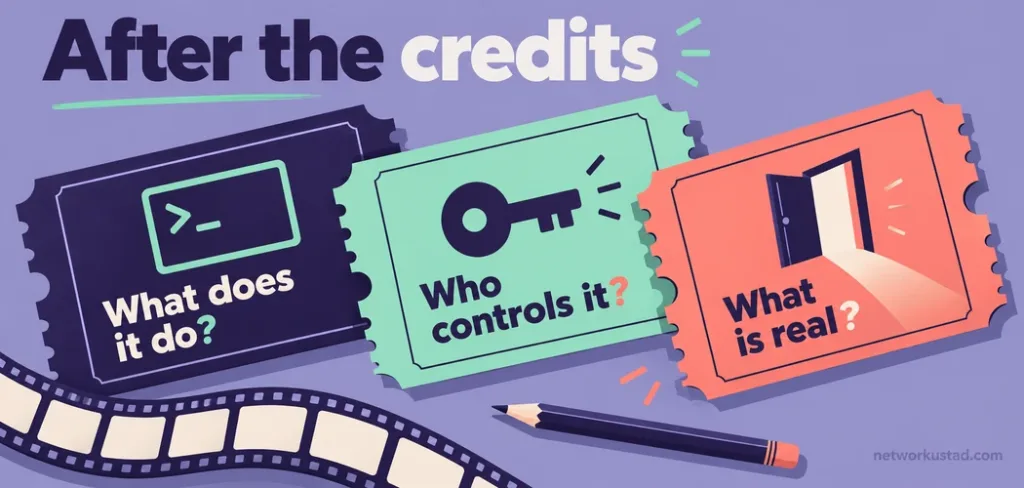
Use three questions after each viewing. First, what does the technology do inside the story? Second, which human conflict does that ability create? Third, what evidence would be needed before making a similar claim about the real world? Keeping those questions separate prevents an interesting analogy from becoming an unsupported fact.
For example, a fictional system may appear to understand a character. You can discuss that impression and its dramatic consequences without concluding that a real product has consciousness. A cinematic security failure can illustrate a concern without establishing that an actual organization has the same vulnerability.
A good discussion also allows disagreement. One viewer may emphasize individual choice while another notices institutional power. Ask which scenes support each interpretation. Treat the ranking itself as a prompt for conversation rather than an authority that closes it down.
Where to watch films about technology
Streaming catalogs, regional rights and subscription arrangements change. Check an authorized provider’s current local listing, rental options or physical-media availability before paying. This article does not promise that all seven titles are included in a particular service or country.
The retained watch HBO Max in NZ link leads to a commercial PureVPN guide. It is not an official film listing or a guarantee of availability. Check the relevant service’s current terms and regional offering; purchasing a VPN does not establish an entitlement to a particular catalog.
The original internal links also include broader lifestyle reading. The article linked through today’s digital world concerns martial arts and children’s emotional development. It is separate from the film analysis and does not establish that these films are suitable for children.
One retained anchor remains mismatched: pushed the boundaries of visual effects leads to a push-pull workout article. That destination is fitness reading, not evidence about filmmaking. The wording and destination are preserved here transparently rather than presented as a supporting film source.
Frequently asked questions
Are these films about technology suitable for children?
Not as a blanket recommendation. The selection includes mature themes, violence and sexual content. Check the age classification and content advice for the particular film and version in your location. A technology theme or a related parenting link does not make the entire list appropriate for a family audience.
Which film should a beginner start with?
Choose according to the question that interests you. The Social Network suits a discussion about startups and relationships, Her focuses on emotional connection, and WarGames centers on access and automation. You do not need specialist knowledge to follow the stories, and you do not have to watch them in ranked order.
Can these movies teach cybersecurity or AI engineering?
They can motivate questions, but they do not replace technical instruction, verified documentation or authorized practical exercises. Separate the story’s invented mechanisms from any real concepts you investigate afterward. Entertainment can encourage curiosity without being a reliable implementation guide.
Why not rank the films using review scores or box-office revenue?
Those measures answer different questions and require careful definitions. Revenue does not establish technical insight, and a review percentage does not explain a film’s usefulness for discussion. This guide states its editorial criteria so readers can disagree with the order without relying on unsupported numerical comparisons.