Why Most B2B SaaS Marketing Partnerships Fail to Generate Pipeline
When you search for a performance marketing partner, almost every agency claims to specialize in B2B SaaS. The reality is considerably more complicated. Most still optimize for vanity metrics — impressions, traffic volume, trial sign-ups, and cost-per-click — because those numbers are easy to report and hard to dispute. Meanwhile, the pipeline targets your board cares about stay flat.
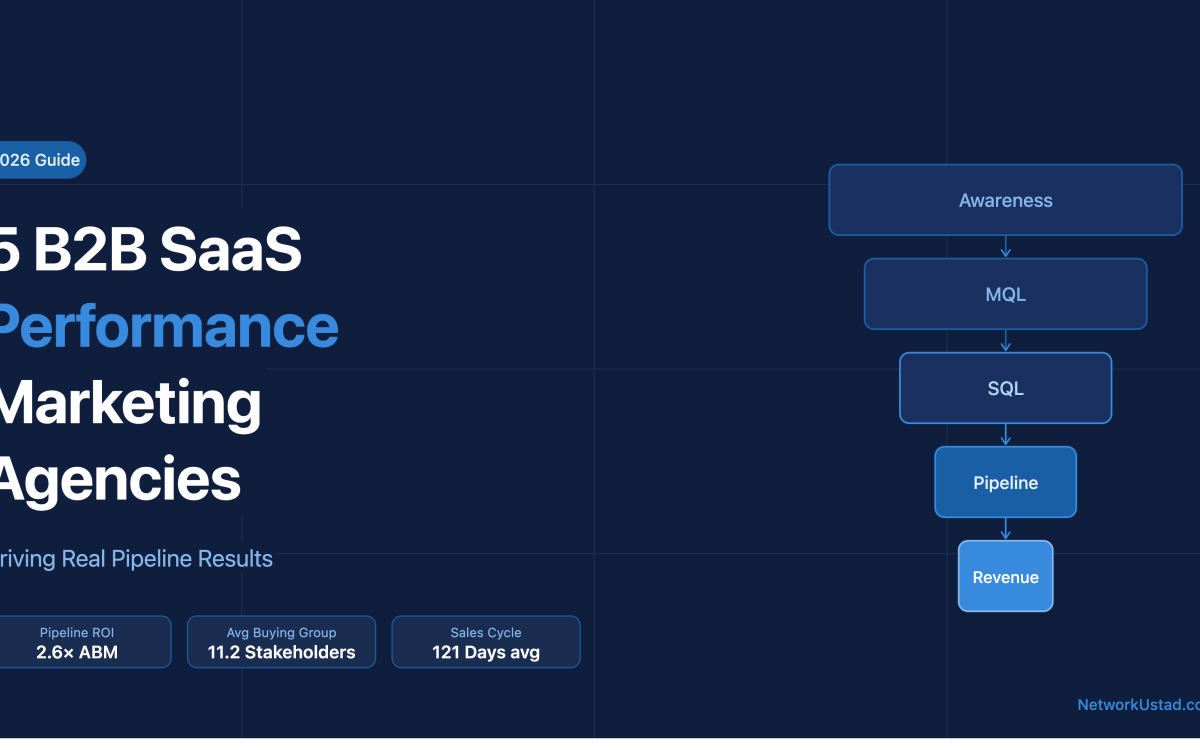
The structural problem is that B2B SaaS buying does not resemble the consumer funnels most agencies were built to manage. According to Forrester and 6sense data published in 2026, the median B2B buying group for deals over $50,000 now involves 11.2 stakeholders, up from 9.7 in 2024. Sales cycles for mid-market software stretch to 121 days on average, and enterprise deals run closer to 218 days. An agency that treats a SaaS demo request the same way it treats an e-commerce add-to-cart is optimizing for the wrong event entirely.
The economic pressure from CFOs is accelerating this reckoning. According to the 2026 State of Demand Generation Report, 73% of B2B organizations have completely restructured how they approach pipeline generation in the past 18 months. Marketing leaders are being held to one question above all others: how much qualified pipeline did your team create this quarter? MQL volume does not answer that question. Cost per lead does not answer that question. Only SQL-attributed, revenue-aligned measurement answers that question.
The five agencies featured in this article share a common orientation: they have made the deliberate decision to measure and be accountable to pipeline outcomes. They understand ICP targeting, intent signals, multi-stakeholder messaging, and the attribution complexity that comes with long B2B sales cycles. They are not interchangeable with generalist digital agencies that happen to have a few SaaS logos in their deck.
The B2B SaaS Performance Marketing Landscape in 2026
Understanding the current paid acquisition environment matters before evaluating any agency. Paid acquisition’s share of B2B SaaS pipeline has fallen from approximately 34% in 2023 to 26% in 2026, while organic search, content, and answer engine optimization have climbed from 22% to 27% of qualified pipeline, according to the FirstPageSage SaaS Demand Report 2026. This means paid-only programs are plateauing as a standalone motion, and the best-performing agencies are building multi-channel systems that combine paid acquisition with content, ABM, and intent data.
The LinkedIn advertising channel remains the clearest differentiator for B2B-specific agencies. LinkedIn’s targeting capabilities — by job title, seniority, company size, industry, and even specific company lists — make it uniquely suited to reaching buying committee members with precision that Google’s broad keyword intent cannot match. The agencies that genuinely understand B2B SaaS build LinkedIn programs around account-level intent signals rather than demographic targeting alone, which materially changes both cost efficiency and lead quality.
ABM-led programs have emerged as the dominant high-performance model. ABM Leadership Alliance and Demandbase 2026 data show that ABM-led programs generate 2.6x more pipeline per marketing dollar than broad-reach demand generation, with 41% higher win rates and 33% larger average deal sizes. This is not a niche approach for enterprise-only companies — it is the structural model that separates agencies building genuine pipeline from those padding reporting dashboards with activity metrics.
The MQL-to-SQL conversion benchmark has deteriorated across the industry. The median MQL-to-SQL conversion rate fell from 13.1% in 2024 to 9.8% in 2026, per Forrester and Demand Gen Report data. The cause is definitional drift: more unqualified contacts being pushed through as MQLs. Programs that add behavioral and intent signals to their MQL criteria report 16.4% conversion — nearly 70% above the unfiltered median. Agencies worth partnering with know this and build intent-gated qualification into their campaign architecture from day one.
1. Disruptive Advertising
Disruptive Advertising has built a credible reputation managing high-volume paid advertising programs across Google, Meta, and LinkedIn. Their B2B SaaS experience is substantial and their client roster includes established software companies at the scaling stage. They are best understood as a performance advertising agency with strong B2B capabilities rather than an exclusively SaaS-focused operation.
Their genuine strength is rapid creative and audience testing. They rotate messaging and audience combinations systematically, identifying winning combinations faster than most internal teams can manage. For companies with significant ad budgets who need velocity in creative iteration, this methodology delivers clear value. Their attribution reporting is transparent: they focus on measurable ROI rather than inflating impact through loose metric definitions.
Disruptive Advertising works best with established SaaS companies that are already generating pipeline and want to scale paid channels profitably. They operate with clear processes for reporting, optimization, and testing that reassure operations-focused marketing leaders who need agency accountability. If you are pre-product-market-fit or running below $15,000 per month in ad spend, their model is less suited to your stage. For companies ready to scale a channel that is already working, their system-driven approach delivers consistent professional execution.
2. WebFX
WebFX is a full-service digital marketing agency with deep roots in paid acquisition. Their B2B SaaS division concentrates on LinkedIn and Google Ads for software companies and they bring a structured, process-driven approach to campaign management that suits companies who value consistency and documentation over experimental approaches.
Their account-based marketing capabilities are a genuine differentiator within their offering. They understand that B2B buying involves multiple decision-makers and longer sales cycles, and they build campaigns around account lists and intent signals rather than relying purely on keyword-level demand capture. This architecture matters considerably in categories where your ICP is specific enough that broad targeting wastes meaningful budget on non-buyers.
WebFX works well for Series B and beyond companies that need professional, consistent campaign execution with structured reporting and clear SLAs. Their systems are mature, their processes are documented, and they deliver the kind of institutional reliability that matters when you are reporting marketing performance to a board. Companies that want experimental, rapid-iteration culture may find their model more conservative than they need. For those who prioritize reliability and process integrity alongside performance, WebFX represents a credible choice in the B2B paid acquisition space.

3. HubSpot Agency Partner Network
HubSpot has built a substantial network of certified agencies specializing in demand generation and paid acquisition for B2B SaaS. These partners use HubSpot as their core platform for integrating paid ads, landing pages, lead scoring, and CRM attribution — which creates a meaningful advantage if your GTM stack is already HubSpot-native.
The practical benefit of working with a HubSpot partner is built-in CRM alignment. A partner agency can track pipeline impact directly from first ad click through every sales stage to closed deal, inside the same platform your sales team uses daily. This attribution fidelity is genuinely difficult to replicate when your marketing agency is operating outside your CRM, stitching together data from disconnected platforms. For companies that have committed to HubSpot as their system of record, this native expertise removes an entire layer of integration complexity.
HubSpot Agency Partners work best with mid-market SaaS companies at Series A and B that are scaling their inbound and paid programs together within the HubSpot ecosystem. Their quality varies considerably across the partner network — HubSpot certification indicates platform proficiency, not necessarily deep B2B SaaS performance marketing expertise. When evaluating specific partners within the network, ask for case studies from companies at your exact stage and ICP, and verify that their team can speak fluently about pipeline attribution rather than just campaign management.
4. Hey Digital — B2B SaaS Exclusive Demand Generation
Hey Digital operates exclusively in the B2B SaaS space, making them one of the few agencies on this list that has made a deliberate structural choice to serve only software companies. They have worked with more than 200 B2B SaaS teams across growth stages and their stated focus is on paid acquisition systems designed to generate predictable revenue while maintaining CAC discipline — not campaign activity for its own sake.
What separates Hey Digital from generalist paid agencies is their orientation toward unit economics. They build programs around a mix of bottom-of-funnel intent capture, mid-funnel nurturing, and higher-funnel awareness — with CRM-connected attribution throughout. The goal is not to generate the most leads, but to generate leads that can be traced through to closed revenue. Their client results include documented cases such as a 94% CPA decrease on YouTube for Hotjar and a 56% signup increase for Pitch, both verified SaaS clients.
Their channel coverage spans Google Ads, LinkedIn Ads, Meta Ads, YouTube, Reddit, and Bing, with in-house creative production covering ad copy, design, and video. Critically, they also offer dedicated landing page design as part of their service stack — recognizing that paid traffic performance is fundamentally limited by conversion rate, not just audience targeting. Senior strategists lead each account with dedicated project managers providing structured communication, which addresses the accountability gap that frustrates many SaaS companies working with agencies that rotate junior account managers.
Hey Digital is most suited to growth-stage and scaling B2B SaaS companies — Series A through Series C — operating in MarTech, FinTech, data infrastructure, productivity, and adjacent verticals. Their model resonates specifically with founders and marketing leaders who are done celebrating inflated metrics and need a partner that speaks in pipeline contribution and CAC payback.
5. Blue Whale Digital
Blue Whale Digital specializes in paid advertising for B2B SaaS companies with a primary focus on LinkedIn and Google Ads. They work primarily with mid-market B2B software companies and their defining characteristic is a small, deliberate client roster that enables hands-on partnership rather than volume-driven account management.
Their approach prioritizes strategic positioning before any media buying begins. Before launching campaigns, their team works to clearly define your ICP, messaging angles, and sales process — a sequencing discipline that prevents the common failure mode of running technically correct campaigns to the wrong audience with the wrong message. In practice, this front-end investment meaningfully reduces wasted spend in the first 60 days of an engagement.
Blue Whale Digital runs structured optimization cycles — testing new audience segments, creative variations, and landing page approaches on a regular cadence — and they show genuine competence in managing longer sales cycles where last-click attribution obscures the actual pipeline contribution of top-of-funnel and mid-funnel activity. For SaaS companies that have been burned by agencies that chase easy attribution and abandon awareness-level investment, their willingness to manage complex attribution models is a material differentiator. Their small roster model suits companies that want dedicated strategic attention rather than scaled account management at volume.
What to Look for When Evaluating Any B2B SaaS Marketing Agency
The five agencies above share characteristics worth understanding clearly before you start any evaluation process.
All of them measure success in pipeline and revenue, not in activity metrics. They have working experience with B2B purchase decisions that involve multiple stakeholders and consideration periods measured in months, not days. They build campaigns around intent signals and ICP targeting rather than broad demographic assumptions. And critically, they are willing to be held accountable to business outcomes — not just campaign performance metrics that look good in a slide deck but do not show up in your CRM.
When evaluating any agency, ask for references from other SaaS companies at your stage and in your category. Ask what metrics they tracked, what they optimized for, and whether pipeline contribution was part of the conversation from day one. Request case studies with specific numbers: cost per SQL, pipeline generated per dollar of ad spend, CAC payback period. Agencies that cannot produce this kind of outcome-specific evidence are likely still operating on the vanity metrics model, regardless of what their homepage says.
Be specifically cautious of agencies that promise guaranteed results, quote extremely low management fees relative to your ad spend, or lead their proposals with traffic projections and impressions. B2B SaaS demand generation is specific enough that one-size-fits-all playbooks consistently underperform. The agencies worth partnering with will want to understand your ICP, your ACV, your sales cycle, and your existing pipeline before making any commitments about what they can deliver.
Budget reality matters as well. Most specialist B2B SaaS performance agencies recommend a minimum monthly ad spend of $10,000 to $30,000 to generate sufficient testing data for meaningful optimization. Working backward from your target CAC and expected demo-to-close conversion rate will help you determine whether your current budget is sufficient to run the kind of disciplined testing that separates genuine performance marketing from spending money on ads and hoping.
Conclusion
The B2B SaaS marketing agency landscape in 2026 is not short of options. What it is short of is agencies that have made a genuine structural commitment to being accountable for pipeline outcomes rather than activity metrics. The five agencies profiled here — Disruptive Advertising, WebFX, HubSpot Agency Partners, Hey Digital, and Blue Whale Digital — represent different models, strengths, and ideal client profiles, but they share a foundational orientation toward results that show up in revenue, not just reporting.
The right agency for your company depends on your current stage, your existing GTM stack, your budget, and whether you need specialist SaaS focus or broader digital execution capability. Hey Digital’s exclusive B2B SaaS focus makes them a strong starting point for growth-stage companies that want a partner built specifically for software. Disruptive Advertising and WebFX offer scale and process maturity for companies that are already generating pipeline and need to grow it faster. HubSpot partners offer native CRM alignment for teams committed to that ecosystem. Blue Whale Digital offers hands-on strategic partnership for companies that want dedicated attention over volume.
Whatever agency you evaluate, hold them to the same standard you hold your internal team to: pipeline generated, cost per qualified opportunity, and CAC payback. Agencies that cannot speak fluently to those numbers in your first conversation are telling you something important about how they will manage your budget.