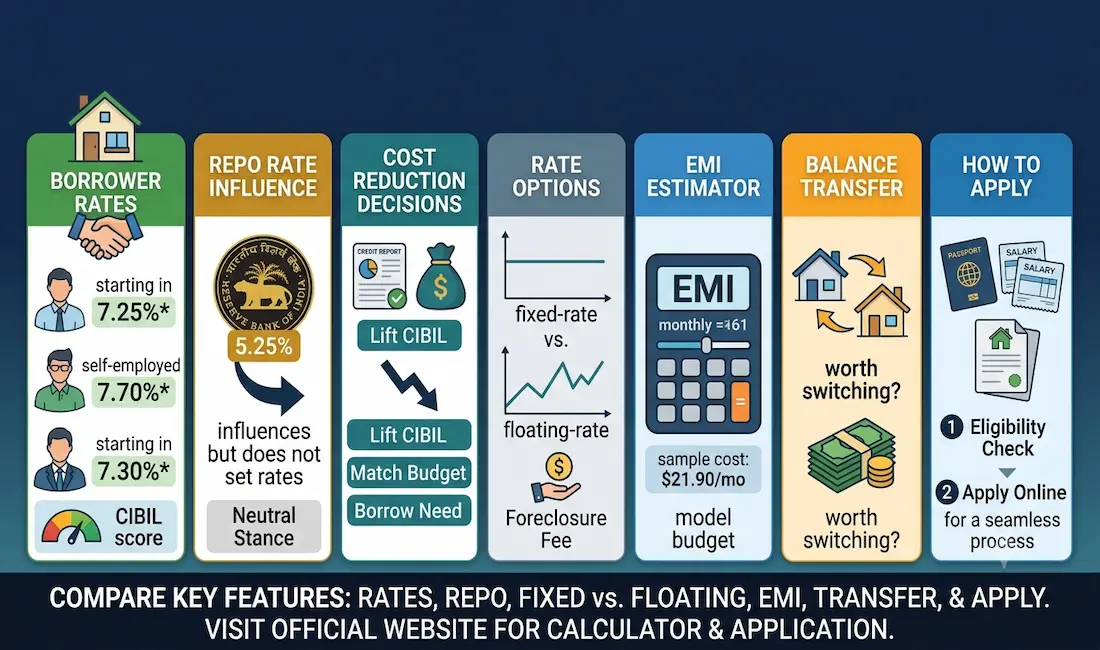
Home loan interest rates in India vary by borrower profile, lender, and loan type. In July 2026, salaried borrowers can expect rates from 7.25%* p.a., while self-employed applicants typically see rates from 7.70%* p.a. The RBI held the repo rate at 5.25% at its June 2026 meeting, which can influence floating-rate home loans over time, though lenders factor in additional costs and your individual risk profile before finalising your rate.
Bajaj Finance offers home loans up to Rs. 15 crore* with tenures up to 32 years* and EMIs from Rs. 671 per lakh*. Your credit score, income type, loan size, and repayment period all affect the rate you receive. This article covers what drives rate differences, how to compare fixed and floating options, and how to apply.
What home loan interest rate can you realistically expect in July?
There is no single home loan interest rate that applies to everyone. Lenders assess each application individually, which is why two people applying on the same day may receive different offers.
Your rate depends on your employment type, income stability, credit score, loan amount, and the tenure you choose. A salaried applicant with a strong credit profile generally receives a lower rate than a self-employed borrower with a shorter credit history.
Here is the current rate range at Bajaj Finance, by borrower type:
| Borrower type | Current rate range |
| Salaried | 7.25%* – 10.25%* p.a. |
| Self-employed | 7.70%* – 10.65%* p.a. |
| Professionals | 7.30%* – 10.30%* p.a. |
Understanding why these differences exist helps you take steps to improve the rate you are offered.
Why the repo rate today is only one part of the story
The RBI’s Monetary Policy Committee voted unanimously at its June 2026 meeting to hold the policy repo rate at 5.25%, maintaining a neutral stance. The standing deposit facility rate remains at 5.00%, and the marginal standing facility rate at 5.50%.
When the current repo rate falls, floating-rate home loans can respond over time, as lenders may pass on lower funding costs. However, this is not automatic. Lenders also weigh their own cost of funds and each borrower’s risk profile before setting a rate.
Per the RBI’s Fair Practices Code, lenders must disclose the annualised rate of interest before loan disbursal. This means the rate in your loan offer letter reflects the full cost, not a discounted headline figure. A repo rate cut creates conditions for lower lending rates, but your individual rate still depends on the lender’s assessment of your profile.
Which decisions can lower your borrowing cost?
Your home loan interest rate is not entirely outside your control. Several choices you make before applying can shift the rate in your favour.
Improve your credit profile before applying
Lenders use your CIBIL Score as a measure of repayment reliability. At Bajaj Finance, a score of 725 or above is considered suitable for a home loan. Scores below this range can result in a higher offered rate or a declined application. Checking your credit report before applying and correcting any errors is a useful first step. Paying down existing debt and avoiding multiple loan applications in quick succession can also lift your score.
Choose a repayment period that matches your budget
Tenure directly affects your monthly outflow and total borrowing cost. A longer tenure lowers your EMI but raises total interest paid. A shorter tenure does the reverse. The right tenure is the one that keeps your EMI within a range you can manage without straining other financial commitments.
Borrow only what you need
A larger loan means more interest in absolute terms, even at the same rate. Borrowing the amount you actually need, rather than the maximum you are eligible for, keeps your total repayment lower and improves your debt-to-income ratio. Borrowing a surplus you may not use adds to your repayment without a corresponding benefit.
Compare fixed and floating options before deciding
The type of interest rate you choose affects whether your EMI stays constant or adjusts over the loan tenure. This decision is worth thinking through carefully before you sign.
Fixed or floating home loan interest rate: which suits your situation?
A fixed rate keeps your EMI the same for the full tenure, regardless of market changes. A floating rate moves in line with a benchmark, typically the repo rate, and can go up or down over time.
| If your priority is… | You may consider… |
| Stable monthly payments | Fixed rate |
| Potential benefit if rates fall | Floating rate |
| No foreclosure charges (for eligible borrowers) | Floating rate |
| Payment certainty over the full tenure | Fixed rate |
For individual borrowers who choose a floating rate for non-business purposes, Bajaj Finance does not charge a fee for foreclosure or part-prepayment. This is a material benefit if you plan to repay your loan early.
Neither option suits every situation. If you want monthly certainty, a fixed rate delivers that. If you expect rates to fall and can absorb some variation, a floating rate may work in your favour. Your income stability and risk tolerance matter as much as the rate itself.
What could your monthly EMI look like?
Your EMI depends on three variables: loan amount, interest rate, and repayment tenure. Changing any one of these shifts the monthly figure and the total amount repaid.
Consider two applicants: a 31-year-old salaried employee in Pune applies for Rs. 50 lakh over 20 years. A 46-year-old self-employed business owner in Jaipur applies for the same amount over 12 years. Both borrow the same principal, but their offered rates and total interest outgo differ because lenders evaluate income stability, repayment history, tenure, and credit profile together.
At Bajaj Finance, EMIs start from Rs. 671 per lakh*. Using an EMI calculator before you apply helps you model combinations and choose a structure that fits your budget.
When is switching your existing home loan worth considering?
Is your current rate meaningfully higher than what you could get today? If yes, and if you still have several years remaining, a balance transfer may reduce your total repayment.
A balance transfer typically makes sense when:
- Your current rate is significantly higher than available market rates
- Your remaining tenure is long enough for savings to outweigh transfer costs
- Processing and administrative costs are lower than the interest saved
Bajaj Finance offers home loan balance transfers from 7.30%* p.a. Borrowers who transfer may also be eligible for a top-up loan of up to Rs. 1 crore*, usable for home renovation, education, or medical expenses, with no restriction on use. Calculate the net saving after accounting for any processing fee (up to 4% of the loan amount, plus GST) before initiating a transfer.
How do you apply for a Bajaj Finance Home Loan?
To apply, you need to meet basic eligibility conditions and have standard documents ready.
| Criterion | Details |
| Nationality | Indian citizen residing in India |
| Age | 23 to 67 years (salaried)23 to 70 years (self-employed) |
| CIBIL Score | 725 or above |
| Eligible occupations | Salaried employees, professionals, and self-employed individuals |
| Documents required | KYC documentsIncome proof (salary slips/ P&L statements)Business proof (self-employed applicants only)Bank statements for the last 6 monthsProperty documents |
Online application process
- Click on the ‘APPLY’ button on the Bajaj Finance Home Loan page.
- Enter your full name, mobile number, and employment type.
- Select the type of loan you wish to apply for.
- Generate and submit your OTP to verify your phone number.
- Enter additional details — your monthly income, required loan amount, and whether you have identified the property.
- Enter your date of birth, PAN, and other details as requested based on your occupation type.
- Submit your application. A Bajaj Finance representative will connect with you to guide you through the next steps.
The lowest advertised rate is only one part of choosing a home loan. Comparing your total borrowing cost, repayment period, foreclosure terms, and processing fees gives you a more complete view than the headline rate alone.
Visit the official website to use the home loan EMI calculator to estimate your monthly outgo, check your eligibility, and apply for the Bajaj Finance Home Loan online.