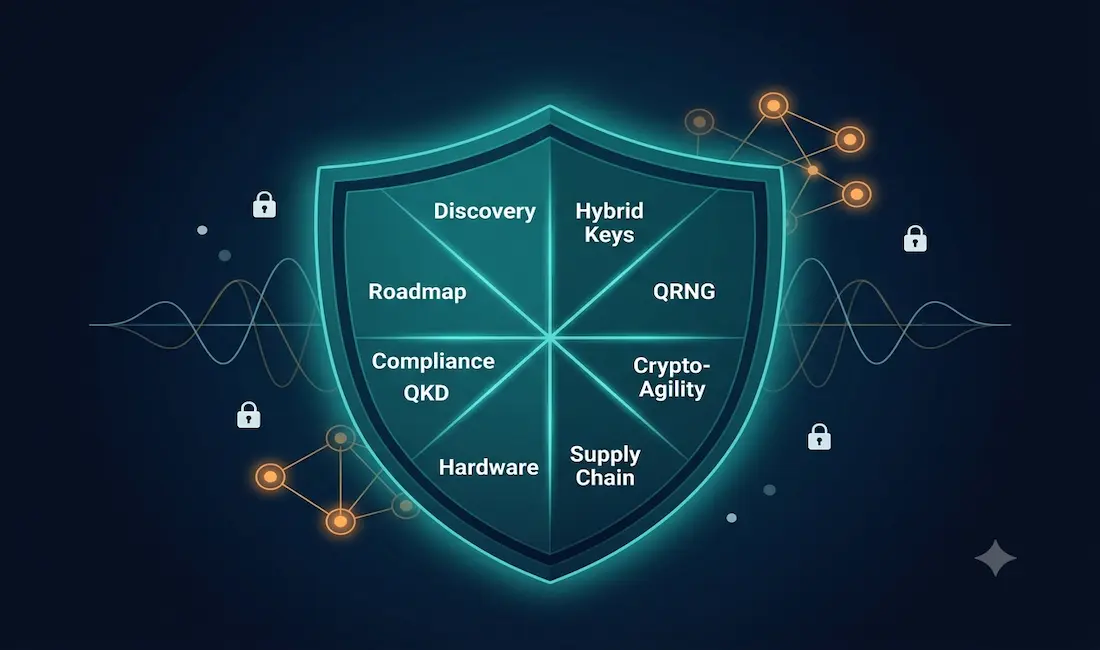
The digital landscape of 2026 is defined by a silent but accelerating race against time. While quantum computing continues to promise breakthroughs in materials science and pharmacology, it simultaneously poses a fundamental threat to the cryptographic systems that secure the global economy.
Most of the encryption currently protecting bank transfers, medical records, and state secrets relies on mathematical problems — primarily the difficulty of factoring large integers and solving discrete logarithm problems — that a sufficiently powerful quantum computer could solve in minutes using Shor’s algorithm. Symmetric encryption is also affected: Grover’s algorithm halves the effective security of symmetric keys, meaning AES-128 would offer only 64-bit security against a quantum adversary, which is why AES-256 is now the recommended minimum for long-lived data.
This vulnerability has given rise to the tactical threat known as “Harvest Now, Decrypt Later”: malicious actors intercept and store encrypted data today, intending to decrypt it once cryptographically relevant quantum computers become commercially available. Intelligence agencies and security researchers consider this an active, ongoing threat — not a future concern.
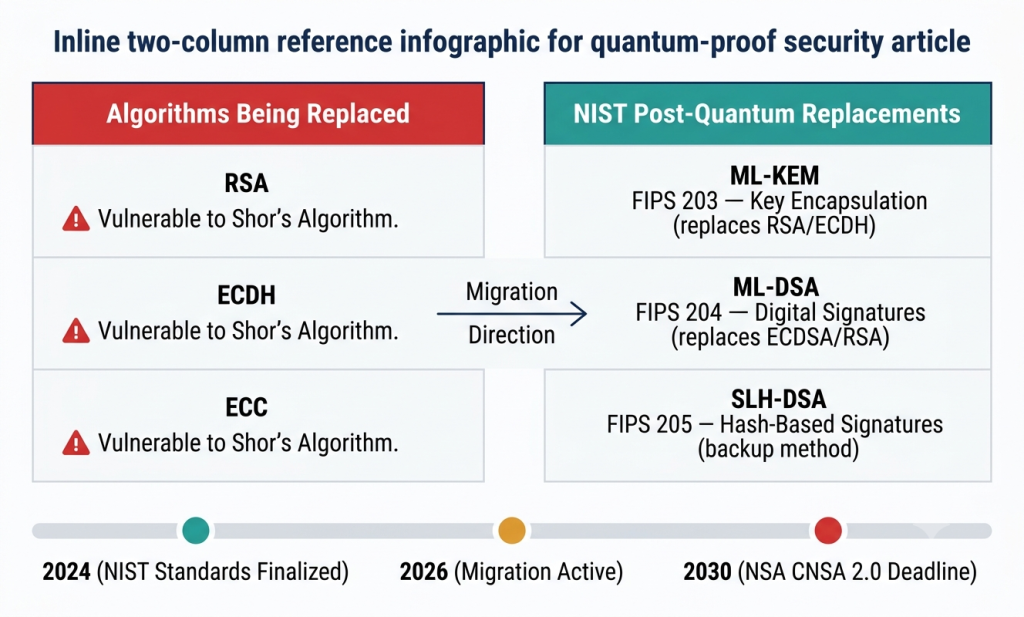
For the modern enterprise, the window for preparation is narrowing. The NSA’s Commercial National Security Algorithm Suite 2.0 (CNSA 2.0) sets 2030 as the mandatory migration deadline for National Security Systems. NIST completed its eight-year post-quantum standardization process on August 13, 2024, publishing three finalized standards: ML-KEM (FIPS 203) for key encapsulation, ML-DSA (FIPS 204) for digital signatures, and SLH-DSA (FIPS 205) as a hash-based signature backup. These are now the authoritative algorithms for quantum-resistant cryptography.
Understanding a quantum computing security strategy for future threats is no longer optional planning — it is active risk management. Below are nine essential moves that forward-thinking organizations are making now.
1. Conducting Comprehensive Cryptographic Discovery
Before an organization can protect itself, it must understand exactly where its vulnerabilities lie. Most large enterprises do not have a complete picture of which encryption algorithms are running inside their custom applications, third-party software, and legacy systems. RSA, ECDH, and ECC are embedded everywhere — in TLS handshakes, code signing certificates, VPN tunnels, SSH sessions, and database encryption — and every instance is potentially vulnerable to a future quantum attack.
Smart companies are deploying automated discovery tools to build a Cryptographic Bill of Materials (CBOM): a comprehensive inventory of every algorithm, key size, certificate, and library across the entire technology stack. Tools such as IBM’s Cryptography Bill of Materials (CBOM) generator, Microsoft’s quantum-readiness assessment, and open-source scanners like Souffle can automate much of this discovery at scale. Without this inventory, migration planning is guesswork. With it, organizations can quantify risk, prioritize the most exposed systems, and allocate migration budgets with precision.
2. Transitioning to Hybrid Key Exchange Protocols
Rather than executing a sudden, all-or-nothing replacement of existing cryptography, the industry consensus in 2026 is the hybrid model: wrapping protected data in two simultaneous layers of encryption.
- Layer 1 (classical): an established algorithm such as X25519 (Elliptic Curve Diffie-Hellman) or RSA, providing immediate protection against today’s classical threats.
- Layer 2 (post-quantum): a NIST-standardized algorithm such as ML-KEM (FIPS 203), providing protection against a future quantum adversary.
The hybrid approach is mathematically conservative: an attacker must break both layers to recover the plaintext. If a weakness is later discovered in the new post-quantum algorithm, the classical layer still provides a baseline of protection — and vice versa. Cloudflare, Google, and AWS have all deployed hybrid X25519+ML-KEM handshakes in production TLS 1.3 connections, demonstrating the approach is operationally feasible. Hybrid TLS 1.3 handshakes add approximately 2.3 KB and a median latency of 10–20 milliseconds — acceptable overhead for most enterprise environments.
3. Implementing Entropic Quantum Randomness
The security of any encryption system is fundamentally limited by the quality of the random numbers used to generate its keys. Classical computers rely on pseudo-random number generators (PRNGs), which are deterministic — given the same seed, they produce the same output. A sufficiently powerful adversary using AI-assisted modeling could, in theory, narrow the key space if the seed source is predictable.
Quantum Random Number Generation (QRNG) solves this at the physical level. QRNG devices derive entropy from the inherently unpredictable behavior of quantum phenomena — photon arrival times, vacuum fluctuations, or electron spin — that are fundamentally non-deterministic by the laws of physics. In enterprise deployments, QRNG output is fed into hardware security modules (HSMs) and key management systems to ensure that the keys generated for VPNs, databases, and cloud sessions cannot be forecast or reproduced by any classical or quantum computation.
4. Adopting Modular Crypto-Agility Frameworks
The three NIST standards finalized in August 2024 are not the end of the post-quantum story — they are the beginning. The cryptographic landscape will continue to evolve as mathematical research matures, new vulnerabilities are discovered, and additional algorithms are standardized. NIST is already evaluating additional candidates for key establishment, and HQC was selected for standardization in 2025 as an alternative to ML-KEM.
Crypto-agility is the architectural property that allows a system to swap one cryptographic algorithm for another without rebuilding the application or replacing its hardware infrastructure. Smart companies are implementing abstraction layers in their software stacks that separate the choice of algorithm from the rest of the application logic. When an algorithm needs to change — because of a discovered weakness, a new standard, or a regulatory mandate — the swap becomes a configuration update rather than an emergency re-engineering project.
The security protocols that hard-code a specific cipher suite into their implementation are the ones that will require the most expensive emergency work when that suite needs to change. Crypto-agility is insurance against that scenario.
5. Vetting the Software Supply Chain
A network is only as quantum-resistant as the weakest vendor in its supply chain. Enterprise organizations increasingly rely on hundreds of SaaS providers, open-source libraries, and hardware vendors, each of which may handle sensitive data using cryptographic methods the customer has never audited.
Smart organizations are now requiring a Software Bill of Materials (SBOM) from every vendor, including explicit disclosure of the cryptographic algorithms used. They give procurement preference to vendors that have already begun their post-quantum migration — specifically, those that have published timelines for adopting ML-KEM and ML-DSA in their products. By evaluating global cybersecurity trends for 2026, organizations can benchmark where their supply chains stand relative to industry peers and identify the highest-risk third-party dependencies before an adversary exploits them.
The supply chain dimension of quantum risk is often overlooked in migration planning. A company can harden its own infrastructure perfectly and still be exposed through a vendor that sends sensitive data using RSA-2048.
6. Utilizing Hardware-Accelerated Gateways
Post-quantum algorithms are mathematically more complex than the classical systems they replace. ML-KEM public keys are 800–1,568 bytes; ML-DSA signatures range from 2,420 to 4,595 bytes. Running these operations in software at scale — particularly in high-traffic data centers, border gateways, and branch office firewalls — produces meaningful increases in CPU load and latency.
To address this, organizations are deploying hardware-accelerated gateways equipped with dedicated security processing units (SPUs) that offload the heavy computation of post-quantum handshakes from general-purpose CPUs. These appliances handle encrypted traffic inspection, key generation, and signature verification at line rate without degrading user experience. In environments where real-time AI agents, high-frequency transactions, or latency-sensitive applications are the norm, hardware acceleration is not an optimization — it is a prerequisite for deploying post-quantum cryptography at production scale.
7. Deploying Out-of-Band Key Delivery
For the most sensitive data links — connections between corporate headquarters and primary data centers, or between financial institutions exchanging settlement data — some organizations are deploying Quantum Key Distribution (QKD).
QKD is a hardware-based key exchange mechanism that uses individual photons to transmit symmetric encryption keys. Its security derives from a fundamental principle of quantum mechanics: measuring a quantum state disturbs it. Any attempt by an adversary to intercept a photon-based key in transit alters the photon’s state in a detectable way, immediately revealing the eavesdropping attempt. This provides information-theoretic security — security that holds regardless of the attacker’s computational power, both now and in a post-quantum world.
By delivering symmetric keys out-of-band through a dedicated QKD channel, organizations ensure that the keys themselves were never transmitted across a mathematically vulnerable classical channel. This provides perfect forward secrecy at the physical layer for industries with the highest confidentiality requirements: defense, finance, critical infrastructure, and healthcare.
8. Aligning with International Compliance Mandates
Regulatory requirements are accelerating the quantum migration timeline for organizations that might otherwise defer action. Key mandates active in 2026 include:
- NSA CNSA 2.0: sets 2030 as the migration deadline for all National Security Systems to adopt post-quantum algorithms.
- NIST IR 8547: provides transition guidance for federal agencies deprecating RSA, ECDH, and ECC in favor of ML-KEM, ML-DSA, and SLH-DSA.
- EU Cyber Resilience Act and NIS2: while not quantum-specific, both mandate demonstrable cryptographic resilience for critical infrastructure operators across the European Union.
- Several financial regulators and healthcare compliance frameworks have begun issuing quantum-readiness guidance requiring documented transition roadmaps.
Smart companies treat these mandates as a competitive advantage rather than a compliance burden. An organization that can present a documented cryptographic roadmap and demonstrate active migration to post-quantum standards builds measurable trust with clients, regulators, and partners who are asking these questions. By navigating the NIST post-quantum standardization process, organizations can align their internal timelines with the internationally recognized framework that regulators are already using as their reference.
9. Developing a Comprehensive Quantum Security Roadmap
The transition to a quantum-proof environment is a multi-year program that touches every layer of an organization’s technology stack. It cannot be owned by the security team alone — it requires coordination across IT, legal, finance, procurement, and executive leadership.
A resilient quantum security roadmap defines milestones in four phases:
Phase 1 — Discover (Now to 2026): Complete the CBOM. Identify all RSA, ECDH, and ECC dependencies. Classify them by data sensitivity and how long the data needs to remain confidential.
Phase 2 — Prioritize (2026 to 2027): Pilot hybrid key exchange (X25519 + ML-KEM) on the highest-risk connections. Begin replacing long-lived certificates with ML-DSA-based alternatives.
Phase 3 — Migrate (2027 to 2029): Deploy post-quantum cryptography across production systems in order of risk priority. Require quantum-readiness from vendors as a procurement condition.
Phase 4 — Operate (2030 onward): Maintain crypto-agility as the operational standard. Monitor NIST for additional algorithm updates. Meet the NSA CNSA 2.0 deadline for any systems in scope.
A smart roadmap is a living document, reviewed quarterly as the technical and regulatory landscape shifts. The organizations that will reach 2030 in the strongest position are those building the governance structures today to execute this transition systematically — not scrambling to respond once the first cryptographically relevant quantum computer is announced.
Where to Start: A Practical Summary
For security teams that need a concrete starting point, these three actions deliver the highest immediate risk reduction:
- Disable RSA key sizes below 3072 bits and TLS 1.1/1.0 on all public-facing services. This reduces classical attack surface while migration proceeds.
- Begin CBOM discovery on your five most sensitive applications. Use an automated scanner to identify every cryptographic dependency before attempting to prioritize migration.
- Enable hybrid post-quantum key exchange on your TLS 1.3 termination points. Cloudflare, AWS, and Azure all support X25519+ML-KEM in production today. Turning it on requires configuration, not new infrastructure.
Conclusion: Securing the Digital Heritage
The arrival of 2026 has marked a turning point: quantum security has moved from theoretical planning to active organizational requirement. The nine moves described above represent a layered defense that addresses both the mathematical vulnerabilities created by Shor’s and Grover’s algorithms and the operational realities of migrating complex enterprise systems over a multi-year timeline. NIST has provided the algorithmic foundation with ML-KEM, ML-DSA, and SLH-DSA. The NSA has provided the deadline. The remaining work — discovery, hybrid deployment, supply chain vetting, and crypto-agility — belongs to every organization that has data worth protecting.
The organizations building that foundation now are the ones whose data will still be confidential in 2035.
Frequently Asked Questions
What is a quantum-proof security strategy?
A quantum-proof security strategy is a structured plan to replace or supplement cryptographic algorithms that are vulnerable to quantum computing attacks — primarily RSA, ECC, and ECDH — with post-quantum alternatives that remain secure against both classical and quantum adversaries. A complete strategy includes cryptographic discovery (CBOM), algorithm migration to NIST-standardized post-quantum algorithms such as ML-KEM and ML-DSA, hybrid deployment during the transition period, supply chain vetting, and crypto-agility architecture to handle future algorithm changes without emergency re-engineering.
What are the NIST post-quantum cryptography standards?
NIST finalized three post-quantum cryptographic standards on August 13, 2024: ML-KEM (FIPS 203, based on CRYSTALS-Kyber) for key encapsulation, replacing RSA and ECDH in key exchange; ML-DSA (FIPS 204, based on CRYSTALS-Dilithium) for digital signatures, replacing ECDSA and RSA signatures; and SLH-DSA (FIPS 205, based on SPHINCS+) as a hash-based signature backup with different security assumptions than lattice-based schemes. These are the algorithms organizations should be adopting now for quantum-resistant cryptography.
What is crypto-agility and why does it matter?
Crypto-agility is the ability of a software system or infrastructure component to replace one cryptographic algorithm with another without rebuilding the application or replacing its hardware. It matters because the post-quantum landscape is still evolving — additional algorithms will be standardized, and weaknesses may be discovered in current ones. A crypto-agile system treats the choice of algorithm as a configuration parameter, allowing a security team to pivot to a new standard in days rather than months of emergency engineering.
Is quantum risk immediate in 2026?
The risk is not immediate in the sense that no publicly known quantum computer can yet break production RSA-2048 or ECC-256. However, the Harvest Now, Decrypt Later threat makes the risk effectively present today for any data that must remain confidential for more than five to ten years. Adversaries are already collecting encrypted traffic with the intention of decrypting it when quantum hardware matures. The NSA’s CNSA 2.0 framework sets 2030 as the migration deadline for National Security Systems — organizations in regulated industries should treat that as their outer boundary for completing post-quantum migration on their most sensitive systems.
What is Quantum Key Distribution (QKD) and how is it different from post-quantum cryptography?
Post-quantum cryptography (PQC) replaces mathematically vulnerable algorithms with new mathematical problems believed to be hard for quantum computers to solve. QKD is a hardware-based approach that uses the physics of individual photons to distribute symmetric encryption keys. Its security is information-theoretic — it holds regardless of computational power — because any interception attempt physically disturbs the photons and is immediately detectable. PQC is software-deployable and scalable; QKD requires dedicated fiber infrastructure and is suited to the highest-sensitivity point-to-point links. Most organizations will use PQC as their primary migration path and QKD selectively for the most critical connections.
What is the difference between SMBv1 being disabled and disabling RSA for quantum readiness?
Disabling SMBv1 addresses a known, exploited vulnerability in a file-sharing protocol. Disabling or upgrading RSA for quantum readiness addresses a future vulnerability: RSA is not yet broken by quantum computers, but will be once a cryptographically relevant quantum computer exists. Both are mandatory hygiene steps — one is urgent because the threat is current, the other is urgent because the migration timeline is long and the data being protected may need to remain confidential for decades.