

Every day, billions of pieces of data travel across networks worldwide—from personal emails and banking transactions to corporate secrets and government intelligence. But what keeps this information safe? What prevents hackers from reading your private messages, altering your bank balance, or shutting down critical systems?
The answer lies in three fundamental principles that form the backbone of information security: the CIA Triad. No, we’re not talking about the Central Intelligence Agency. In cybersecurity, CIA stands for Confidentiality, Integrity, and Availability—three pillars that protect information from unauthorized access, tampering, and disruption.
Whether you’re a business owner, IT professional, or someone concerned about digital privacy, understanding the CIA Triad is essential. This framework guides every security decision, from designing network architectures to choosing encryption methods. By the end of this article, you’ll understand how these three principles work together to create a robust security posture.
What is the CIA Triad?
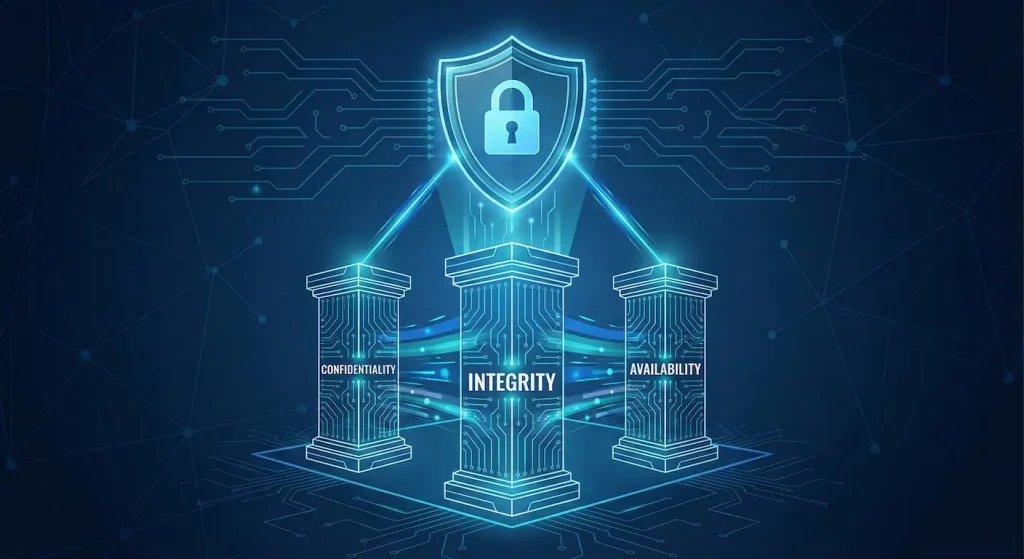
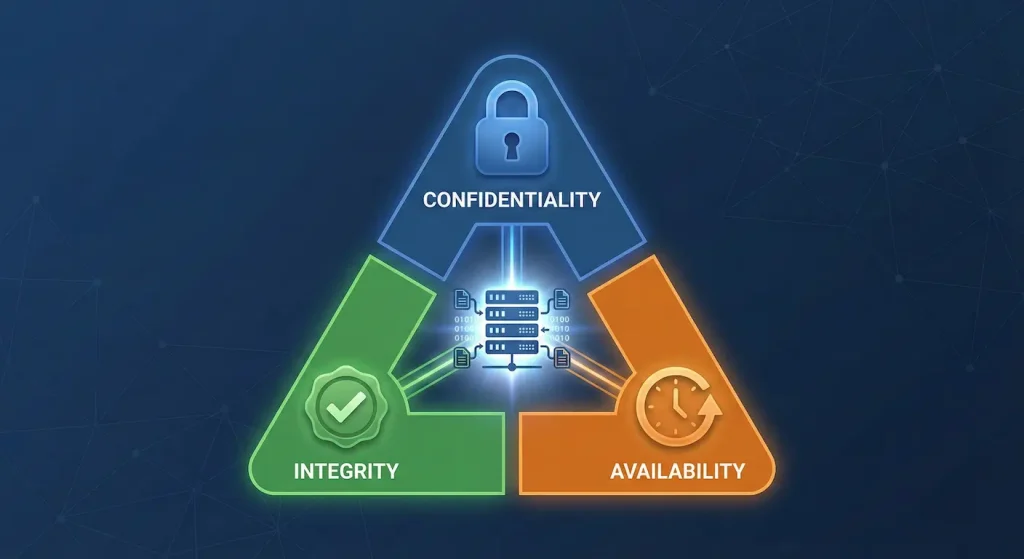
The CIA Triad is a model designed to guide policies for information security within an organization. Think of it as the three-legged stool of cybersecurity—remove any one leg, and the entire structure becomes unstable and vulnerable.
These three principles form the foundation upon which all security measures are built:
- Confidentiality ensures that information is accessible only to those authorized to view it
- Integrity maintains the accuracy and completeness of data throughout its lifecycle
- Availability ensures that authorized users have reliable access to information when needed
The beauty of the CIA Triad lies in its simplicity and universality. Whether you’re securing a small business network or designing security protocols for a global enterprise, these three principles remain constant. However, implementing them effectively requires understanding the delicate balance between security and usability.
Confidentiality: Keeping Secrets Secret
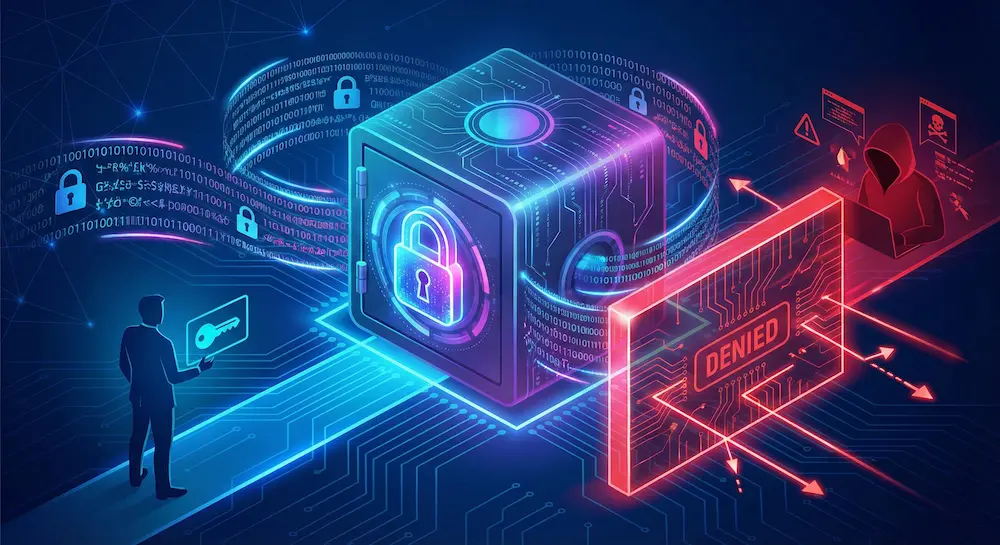
Confidentiality is perhaps the most intuitive aspect of the CIA Triad. It’s about keeping sensitive information away from unauthorized individuals, entities, or processes. When you think of “cybersecurity,” confidentiality is often what comes to mind first.
What Does Confidentiality Protect?
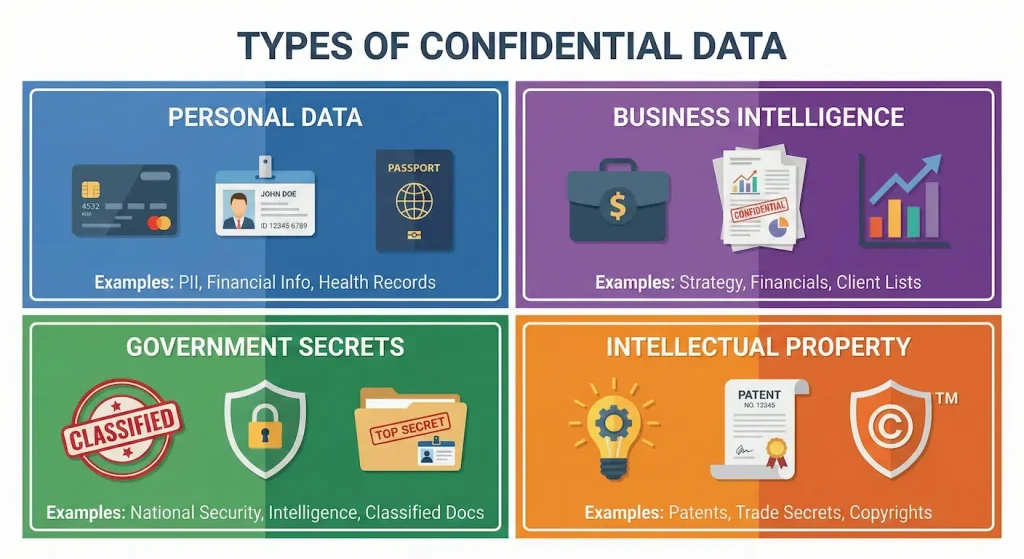
Confidentiality safeguards various types of sensitive information:
Personal Data: Social security numbers, medical records, financial information, and personal identification details must remain private to prevent identity theft and fraud.
Business Intelligence: Trade secrets, product designs, pricing strategies, customer databases, and proprietary algorithms represent competitive advantages that companies must protect from competitors and malicious actors.
Government Secrets: Classified information, defense strategies, diplomatic communications, and intelligence operations require the highest levels of confidentiality to protect national security.
Intellectual Property: Patents pending approval, research data, software source code, and creative works need protection to maintain their value and competitive edge.
Real-World Confidentiality Breaches
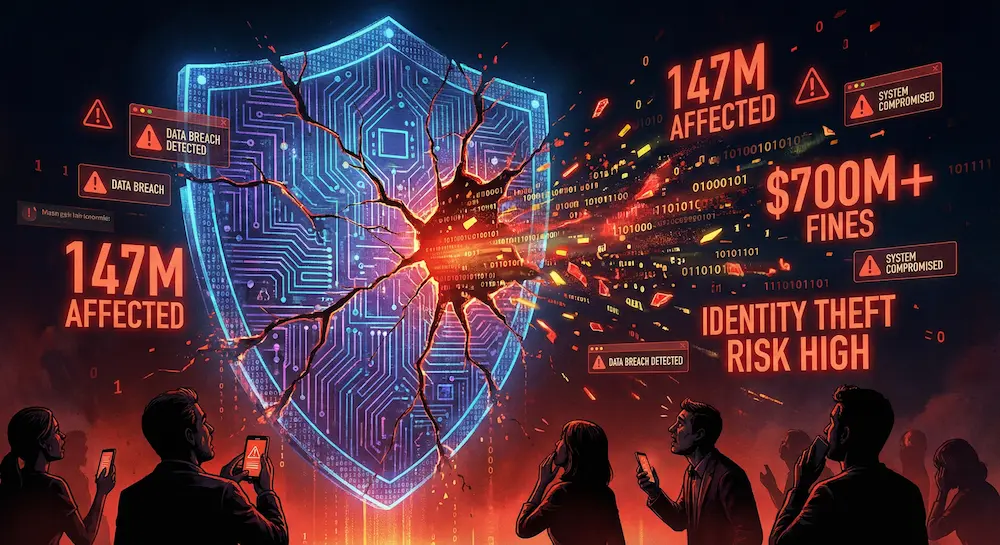
Consider the 2017 Equifax breach, where hackers accessed personal information of 147 million people, including names, birth dates, addresses, and Social Security numbers. This massive confidentiality failure resulted from unpatched vulnerabilities and inadequate security measures. The consequences were severe—identity theft risks for millions, regulatory fines exceeding $700 million, and irreparable damage to Equifax’s reputation.
Another example is the 2013 Edward Snowden leaks, which revealed extensive government surveillance programs. Whether you view Snowden as a whistleblower or traitor, the incident demonstrates how confidentiality breaches can have geopolitical ramifications and spark debates about privacy versus security.
How to Maintain Confidentiality
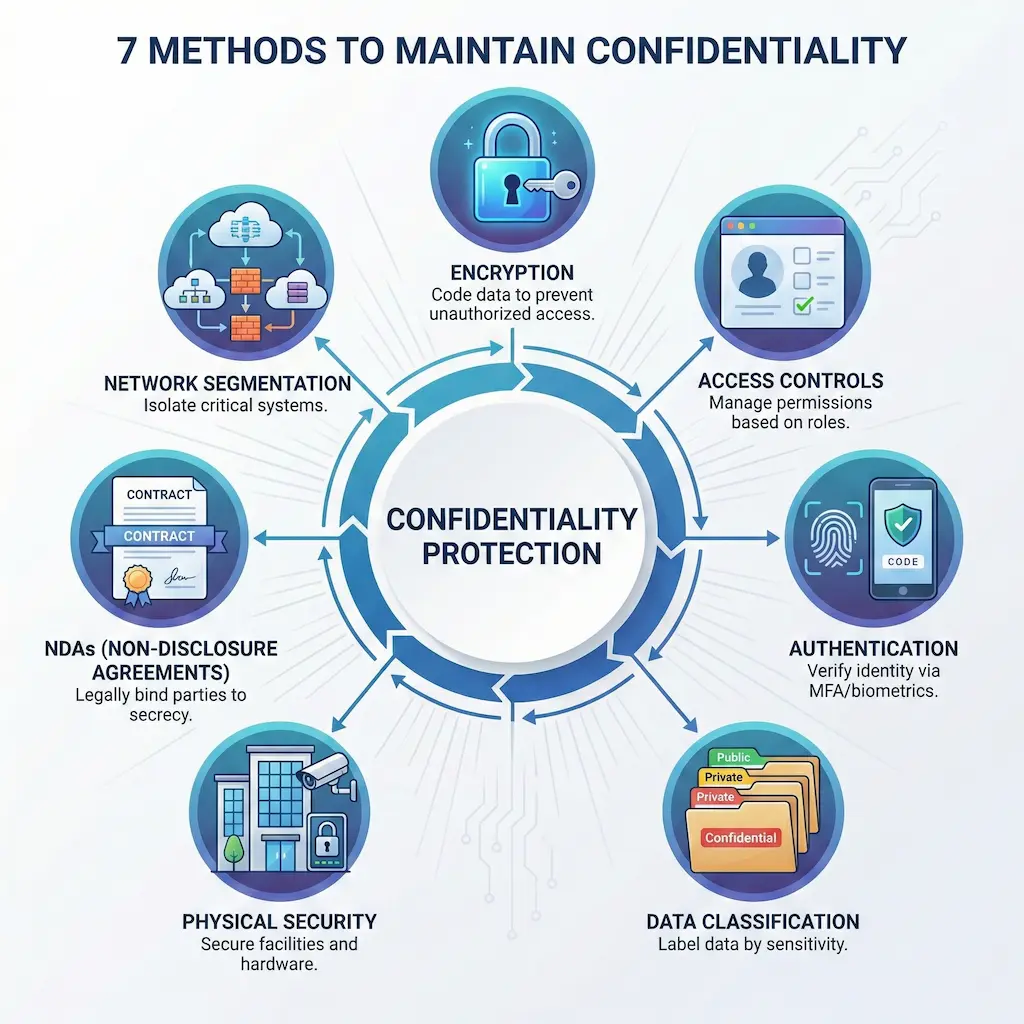
Organizations employ multiple strategies to ensure confidentiality:
Encryption: Converting data into coded format ensures that even if intercepted, information remains unreadable without the proper decryption key. Modern encryption standards like AES-256 are virtually unbreakable with current technology.
Access Controls: Implementing role-based access control (RBAC) ensures users only access information necessary for their job functions. The principle of least privilege means granting the minimum access rights needed to perform required tasks.
Authentication: Multi-factor authentication (MFA) adds layers of verification beyond simple passwords. Learn more about Password Authentication Protocol (PAP) and how combining something you know (password), something you have (phone or token), and something you are (biometrics) dramatically reduces unauthorized access risks.
Data Classification: Labeling information according to sensitivity levels (public, internal, confidential, restricted) helps organizations apply appropriate protection measures. Not all data requires the same security level—classification enables efficient resource allocation.
Physical Security: Confidentiality isn’t just digital. Locked server rooms, badge-access systems, security cameras, and secure document disposal (shredding) prevent physical information theft.
Non-Disclosure Agreements: Legal contracts binding employees, contractors, and partners to confidentiality help establish accountability and legal recourse for breaches.
Network Segmentation: Dividing networks into separate zones limits breach impact. If attackers compromise one segment, they don’t automatically gain access to everything.
Integrity: Maintaining Trust in Data
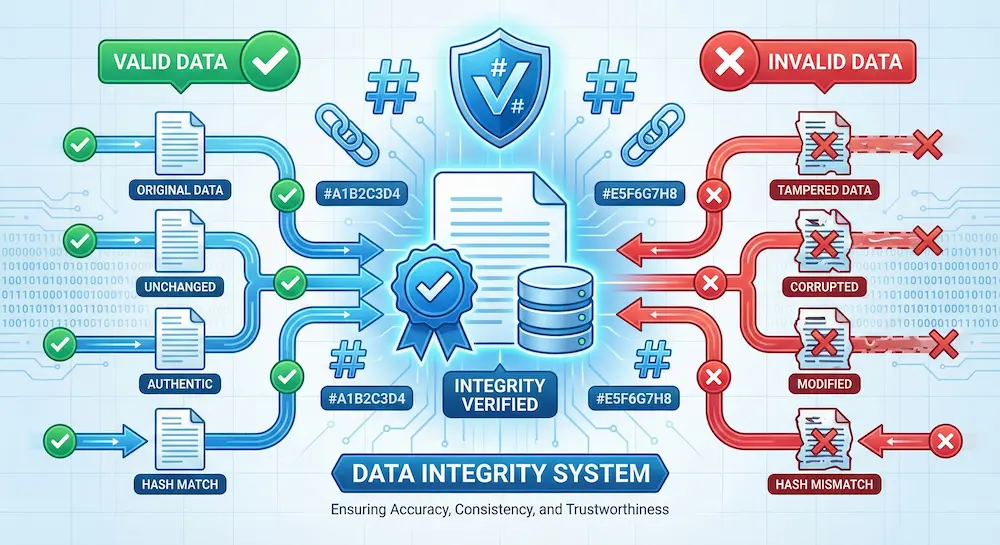
While confidentiality focuses on who can see information, integrity ensures that information remains accurate, consistent, and trustworthy throughout its entire lifecycle. Data integrity means information has not been altered, tampered with, or corrupted—whether accidentally or maliciously.
Why Integrity Matters
Imagine checking your bank account and seeing a balance of $100 instead of $10,000. Or consider a hospital’s electronic health records system where a decimal point error changes a medication dosage from 1.0mg to 10mg—potentially fatal. These scenarios illustrate why data integrity is critical.
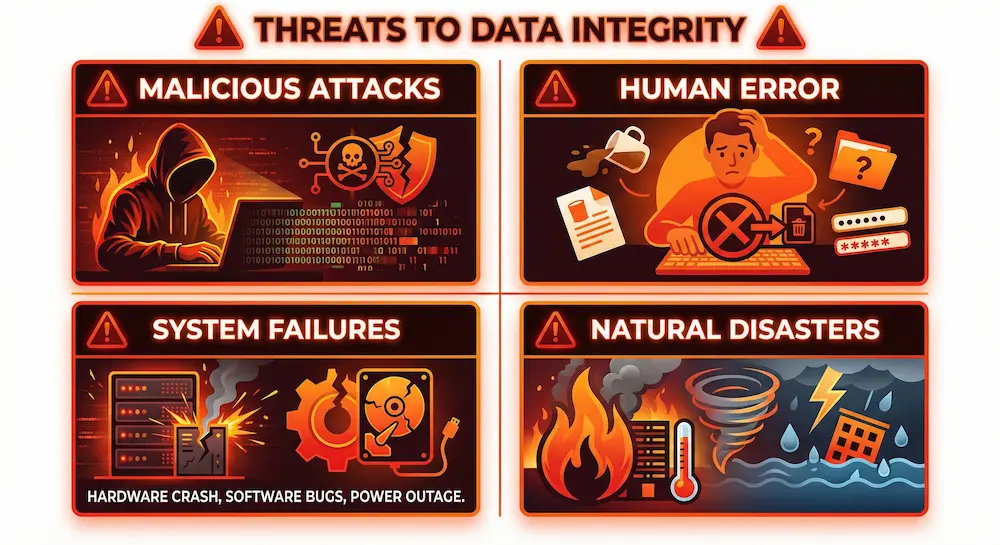
Integrity violations can occur through:
Malicious Attacks: Hackers may alter data to commit fraud, sabotage operations, or cover their tracks. For instance, changing log files to hide evidence of a breach, or modifying financial records to steal money.
Human Error: Accidental data entry mistakes, misconfigured systems, or unintentional file modifications can compromise integrity without malicious intent.
System Failures: Hardware malfunctions, software bugs, power outages, or network interruptions can corrupt data during transmission or storage.
Natural Disasters: Floods, fires, earthquakes, or other disasters can physically damage storage media, leading to data corruption.
Real-World Integrity Failures
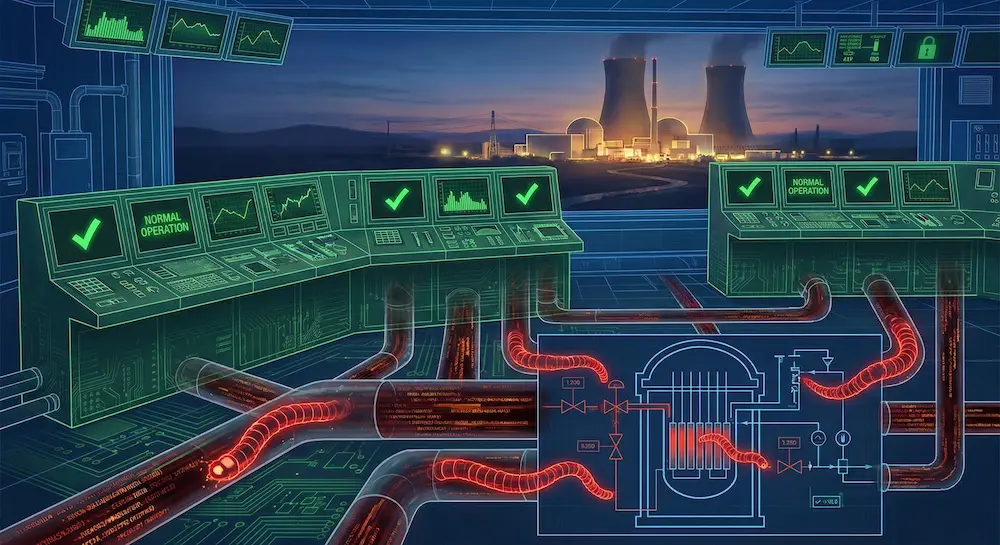
The 2010 Stuxnet worm provides a dramatic example of an integrity attack. This sophisticated malware targeted Iranian nuclear facilities by altering the control systems of uranium enrichment centrifuges while reporting that everything was functioning normally. The integrity violation caused physical damage to equipment without immediate detection.
In 2016, Russian hackers compromised the Democratic National Committee’s network and leaked emails—but concerns also emerged about potential alterations to documents before release. Even the possibility of tampering created doubt about information authenticity, demonstrating how integrity threats undermine trust.
Protecting Data Integrity
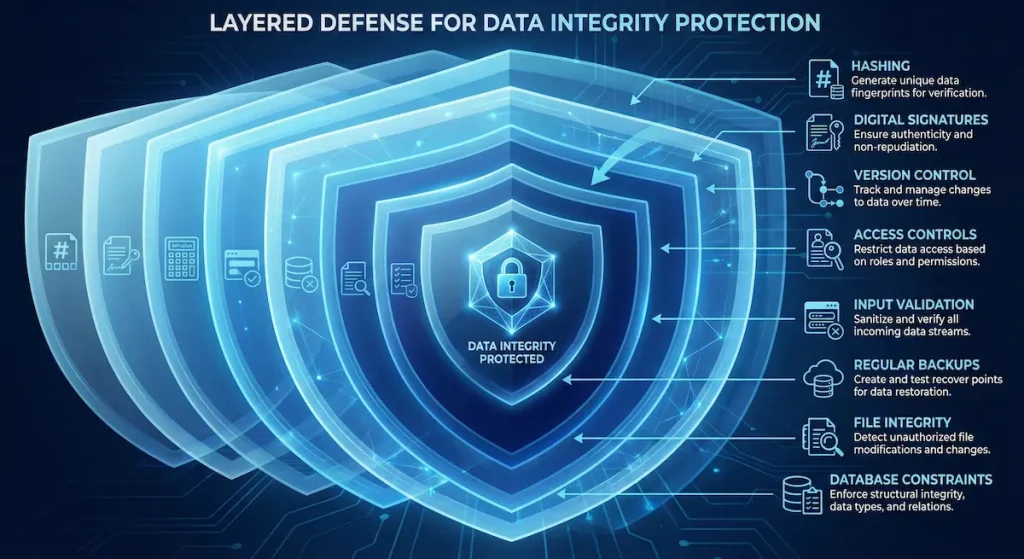
Organizations implement various mechanisms to maintain integrity:
Hashing: Cryptographic hash functions create unique “fingerprints” of data. Even tiny changes produce completely different hashes, making tampering detectable. Common algorithms include SHA-256 and MD5 (though MD5 is now considered weak for security purposes).
Digital Signatures: Combining hashing with encryption creates verifiable proof that data originated from a specific source and hasn’t been altered. Digital signatures provide both integrity and authenticity.
Version Control: Systems like Git track every change to files, maintaining complete histories. This allows rollback to previous versions if corruption or unauthorized modifications occur.
Checksums: Simple mathematical calculations verify data hasn’t been corrupted during transmission. While less secure than cryptographic hashes, checksums catch accidental errors efficiently.
Access Controls: Limiting who can modify data reduces integrity risks. Implementing separation of duties ensures no single person can alter critical information without oversight.
Input Validation: Checking that data meets expected formats, ranges, and types prevents injection attacks and accidental corruption from malformed inputs.
Regular Backups: Maintaining multiple copies of data across different locations enables recovery from integrity failures. The 3-2-1 backup rule recommends three copies on two different media types with one offsite.
File Integrity Monitoring: Tools continuously scan critical files for unauthorized changes and alert security teams immediately when modifications occur.
Database Constraints: Enforcing rules at the database level (foreign keys, data types, required fields) prevents invalid data entry that could compromise integrity.
Availability: Ensuring Access When Needed
Availability ensures that information and resources are accessible to authorized users whenever required. This might seem straightforward, but availability challenges range from hardware failures to sophisticated cyberattacks designed specifically to deny service.
The Importance of Availability
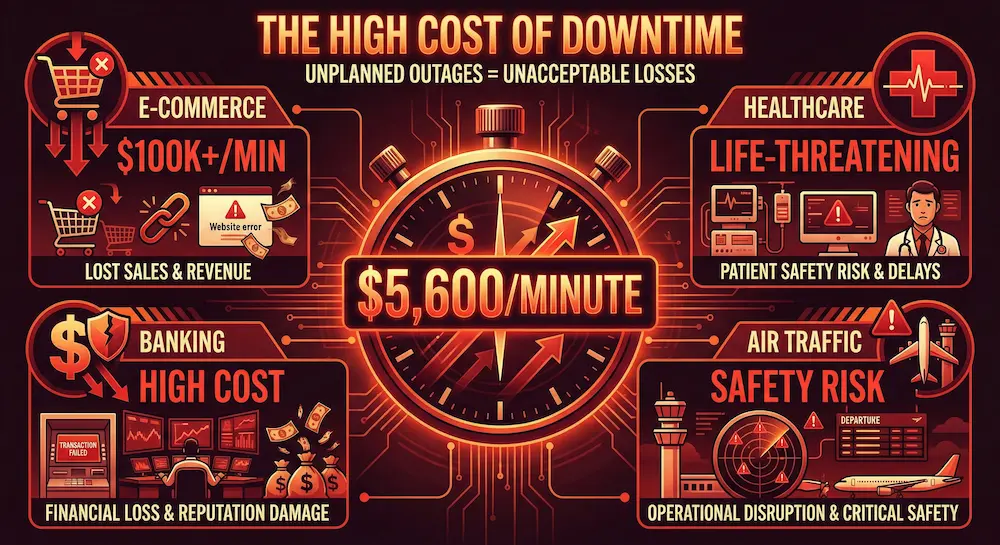
In our interconnected world, downtime costs money—lots of it. According to recent studies, the average cost of IT downtime across industries exceeds $5,600 per minute. For e-commerce giants like Amazon, estimates suggest losses could reach hundreds of thousands of dollars per minute during outages.
Beyond financial costs, availability failures can have life-threatening consequences. Consider healthcare systems where doctors need immediate access to patient records during emergencies, or air traffic control systems where even brief outages risk collisions.
Threats to Availability
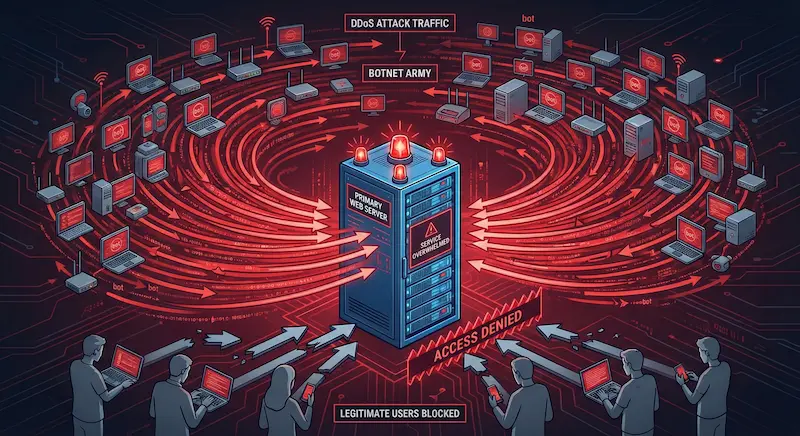
Distributed Denial of Service (DDoS) Attacks: Attackers overwhelm systems with massive traffic volumes, making them unavailable to legitimate users. Modern DDoS attacks can generate terabits of traffic, enough to bring down even well-protected targets.
Ransomware: Malicious software encrypts data and demands payment for restoration. Until paid (and sometimes even after), data remains inaccessible. The 2017 WannaCry attack affected over 200,000 computers across 150 countries, disrupting hospitals, businesses, and government agencies. Learn more about malware threats.
Hardware Failures: Servers crash, hard drives fail, network equipment malfunctions. Despite reliability improvements, all hardware eventually fails—it’s not if but when.
Natural Disasters: Hurricanes, earthquakes, fires, floods, and other disasters can destroy data centers and disrupt operations for extended periods.
Power Outages: Even brief power losses can bring down systems lacking proper backup power systems.
Insider Threats: Disgruntled employees or malicious insiders might deliberately sabotage systems or delete critical data.
Software Bugs: Coding errors can cause applications to crash, creating unplanned downtime that impacts availability.
Maintaining Availability
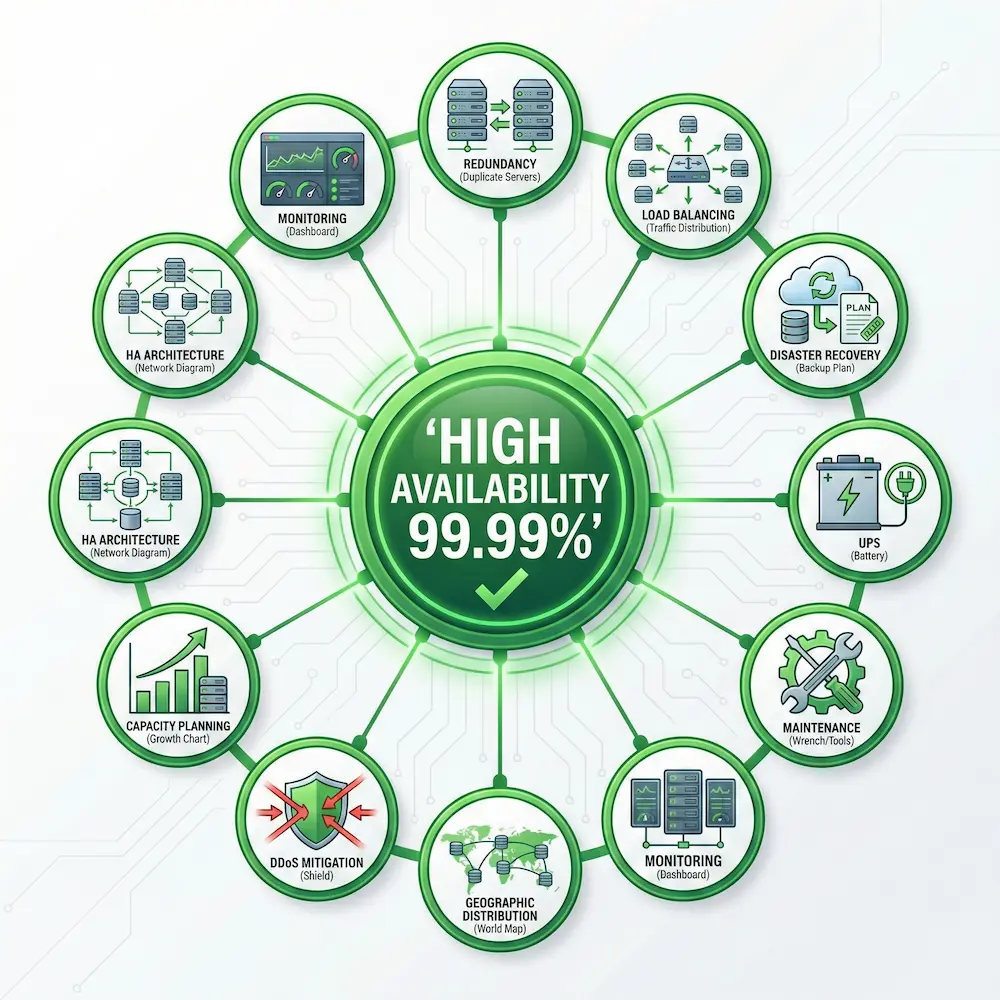
Organizations employ multiple strategies to ensure continuous availability:
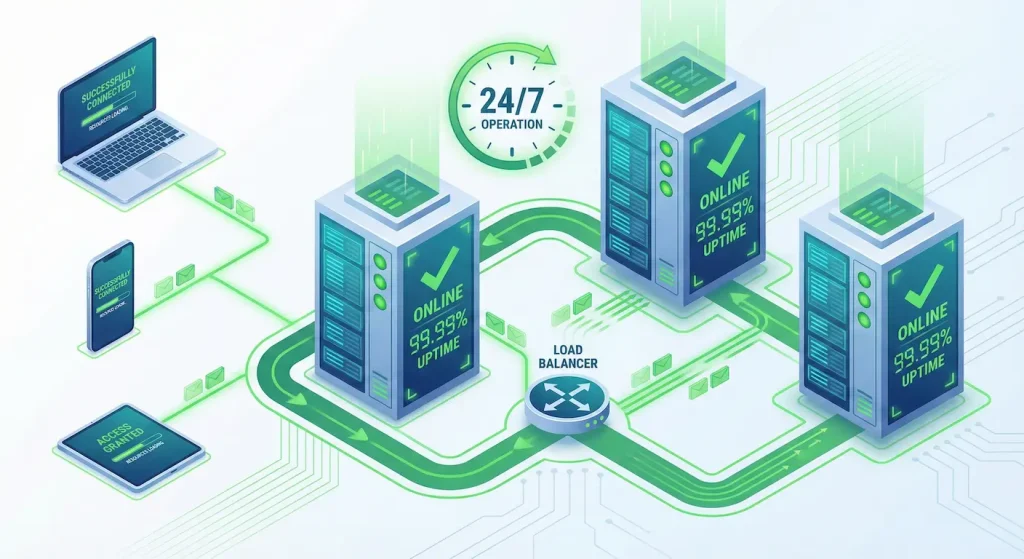
Redundancy: Implementing duplicate components means if one fails, others take over seamlessly. This includes redundant servers, storage systems, network connections, and power supplies.
Load Balancing: Distributing traffic across multiple servers prevents any single system from becoming overwhelmed and ensures continued operation if one server fails.
Disaster Recovery Planning: Comprehensive plans detail exactly how to restore operations after various disaster scenarios. Regular testing ensures plans work when needed.
Uninterruptible Power Supplies (UPS): Battery backup systems provide temporary power during outages, allowing graceful shutdowns or continued operation until generators start.
Regular Maintenance: Proactive system updates, patch management, and hardware replacement before failures occur minimizes unplanned downtime.
Geographic Distribution: Deploying systems across multiple physical locations protects against localized disasters. Cloud services often replicate data across multiple regions automatically.
DDoS Mitigation Services: Specialized services filter malicious traffic before it reaches your systems, maintaining availability during attacks.
Capacity Planning: Monitoring usage trends and scaling resources proactively prevents performance degradation and outages from insufficient capacity.
High Availability Architecture: Designing systems without single points of failure means no individual component failure can bring down entire services.
Monitoring and Alerting: Continuous system monitoring detects problems early, often before users notice, allowing rapid response to potential availability threats.
Balancing the CIA Triad: The Security Challenge
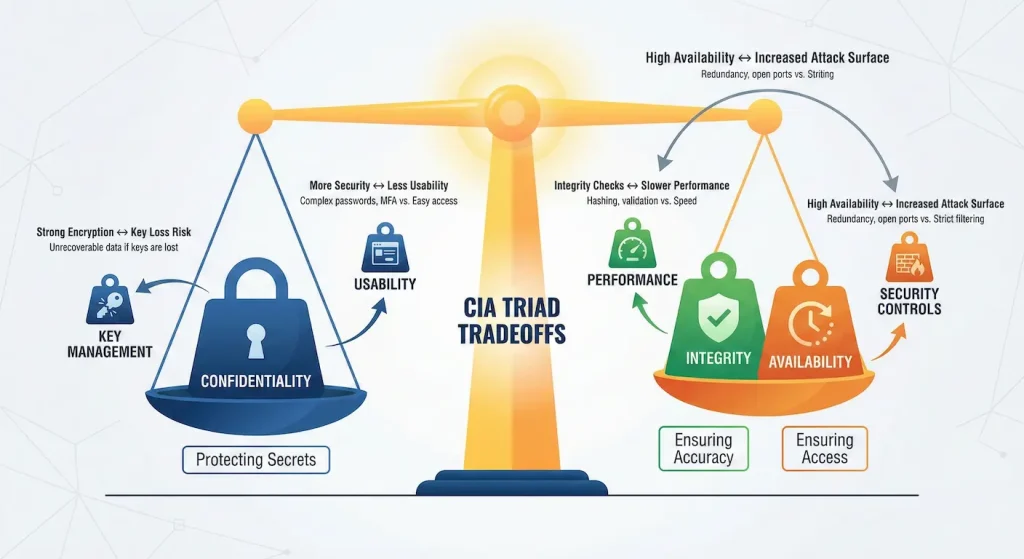
While understanding each component of the CIA Triad is important, the real challenge lies in balancing them. Often, strengthening one aspect can weaken another, creating difficult tradeoffs.
Common Tradeoffs
Security vs Usability: Implementing strict confidentiality measures like complex passwords, frequent authentication prompts, and restricted access can frustrate users and reduce productivity. Too much security creates barriers that users attempt to circumvent, potentially creating worse vulnerabilities.
Integrity vs Availability: Extensive integrity checks, validation processes, and approval workflows can slow systems and reduce availability. Finding the right balance between thorough verification and acceptable performance is crucial.
Confidentiality vs Availability: Strong encryption protects confidentiality but requires decryption keys—lose them, and data becomes unavailable even to authorized users. Disaster recovery procedures that restore systems quickly might temporarily bypass some security controls.
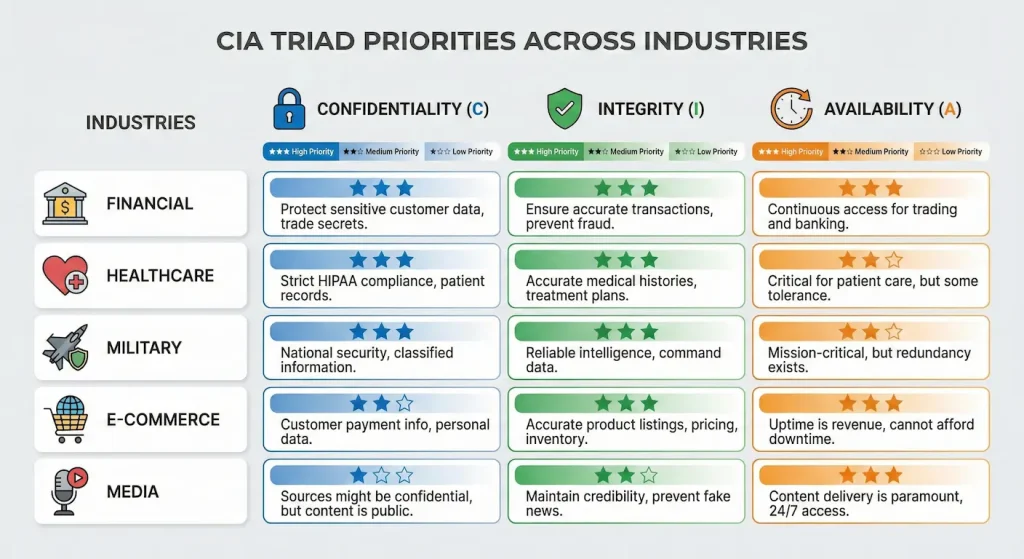
Context-Dependent Priorities
Different organizations and situations require different balances within the CIA Triad:
Financial Institutions: Banks prioritize integrity above all else. Account balances must be absolutely accurate—even brief availability issues are preferable to integrity failures that could result in incorrect transactions.
Healthcare: Medical systems balance all three carefully, but in emergencies, availability might take precedence. Doctors need immediate access to patient records, even if it means temporarily relaxed authentication requirements.
Military/Intelligence: Confidentiality typically ranks highest for classified information. These organizations accept reduced availability and additional complexity to protect sensitive data.
E-commerce: Online retailers prioritize availability—downtime directly impacts revenue. They implement strong confidentiality for payment data while accepting some risk in other areas to maintain 24/7 operations.
Media Companies: News organizations might prioritize integrity (accurate reporting) and availability (getting stories published quickly) while accepting lower confidentiality for most content.
The CIA Triad in Action: Case Studies
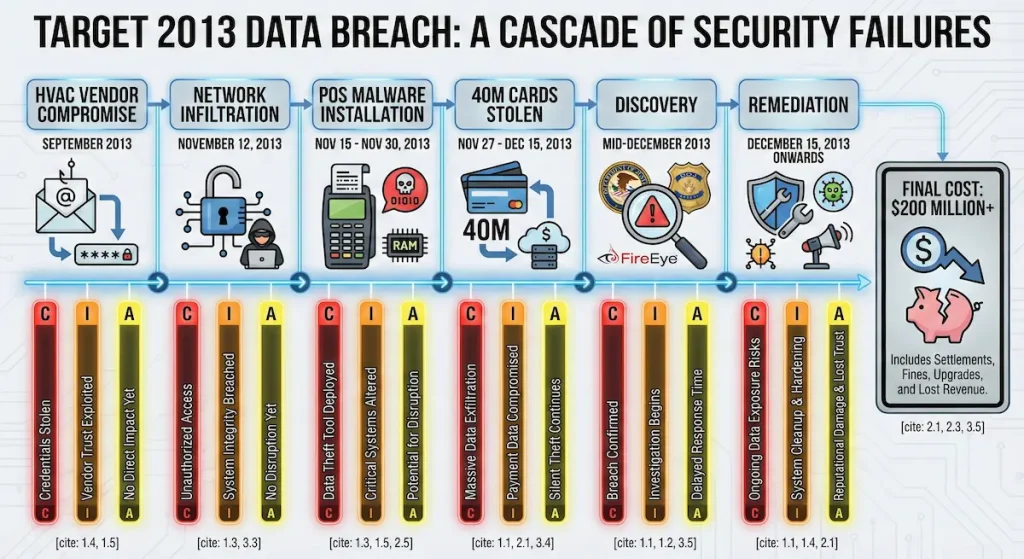
Case Study 1: Target Data Breach (2013)
The Target breach demonstrates how CIA Triad failures cascade. Hackers exploited weak access controls (confidentiality failure) through a third-party HVAC vendor, accessing Target’s network. They then installed malware on point-of-sale systems, stealing credit card information from 40 million customers.
Confidentiality: Failed when payment data was accessed by unauthorized parties.
Integrity: Compromised as malware altered normal system operations to capture data.
Availability: Ultimately affected as Target had to temporarily disable certain services during remediation.
The breach cost Target over $18 million in settlements and immeasurable reputational damage. It highlighted how interconnected the CIA Triad components are—addressing one without considering the others leaves vulnerabilities.
Case Study 2: Amazon Web Services Outage (2017)
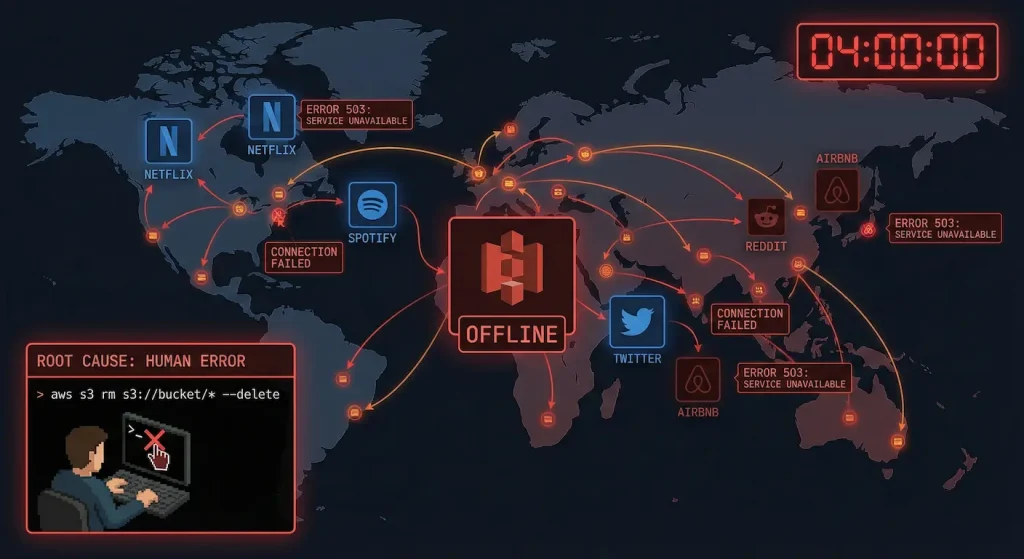
In February 2017, human error caused a massive Amazon S3 outage affecting thousands of websites and services. An engineer executing a debugging command accidentally removed too many servers, causing a four-hour disruption.
Availability: Primary failure—services became inaccessible to users.
Integrity: Maintained—no data was corrupted or lost.
Confidentiality: Maintained—no unauthorized access occurred.
This incident highlighted that availability threats aren’t always malicious attacks. Simple mistakes, inadequate procedures, or insufficient safeguards can cause significant disruptions. Amazon responded by improving procedures and implementing better safeguards against accidental mass deletions.
Case Study 3: SolarWinds Supply Chain Attack (2020)
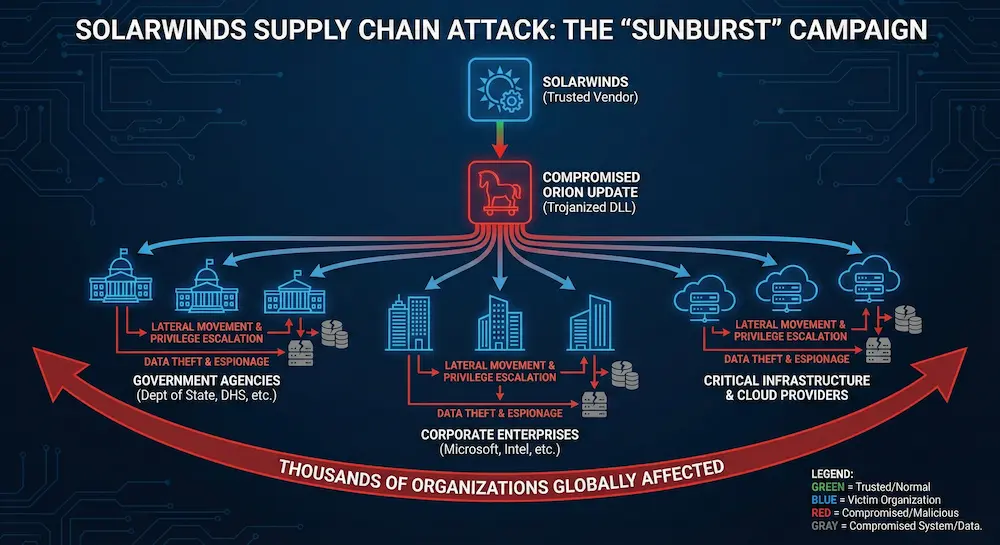
The sophisticated SolarWinds attack showed how nation-state actors compromise all three CIA Triad elements through supply chain infiltration. Hackers inserted malicious code into SolarWinds software updates, affecting approximately 18,000 customers, including government agencies and Fortune 500 companies.
Integrity: Compromised when legitimate software updates were altered to include backdoors.
Confidentiality: Breached as attackers accessed sensitive data across numerous organizations.
Availability: Potentially impacted as organizations had to disable compromised software until patches were available.
This attack demonstrated that even with strong internal security, organizations remain vulnerable through trusted third-party suppliers. It emphasized the importance of supply chain security and verifying software integrity before deployment.
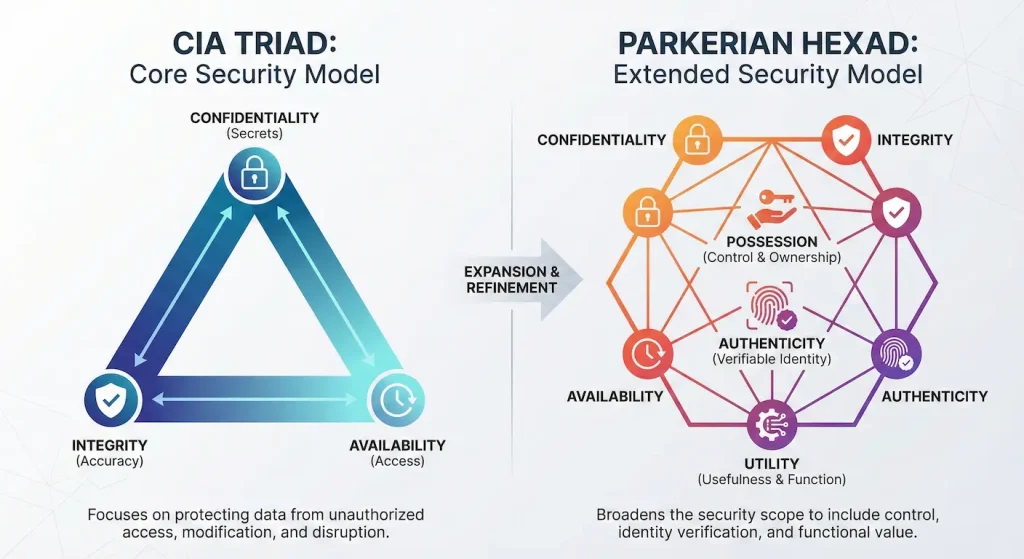
Beyond the CIA Triad: Extended Models
While the CIA Triad provides an excellent foundation, cybersecurity has evolved to include additional considerations:
The Parkerian Hexad
This expanded model adds three more elements:
Possession: Control over information, even if not accessed or viewed. For example, if someone steals your backup hard drive, they possess your data even without reading it.
Authenticity: Verification that users and data are genuine. This addresses impersonation and spoofing attacks where attackers pretend to be legitimate entities.
Utility: Data must be usable—encrypted backups without decryption keys maintain confidentiality but lose utility.
Non-Repudiation
Often discussed alongside the CIA Triad, non-repudiation ensures that actions can be traced to specific individuals who cannot deny their involvement. Digital signatures and audit logs provide non-repudiation, crucial for legal accountability.
Implementing the CIA Triad: Practical Steps
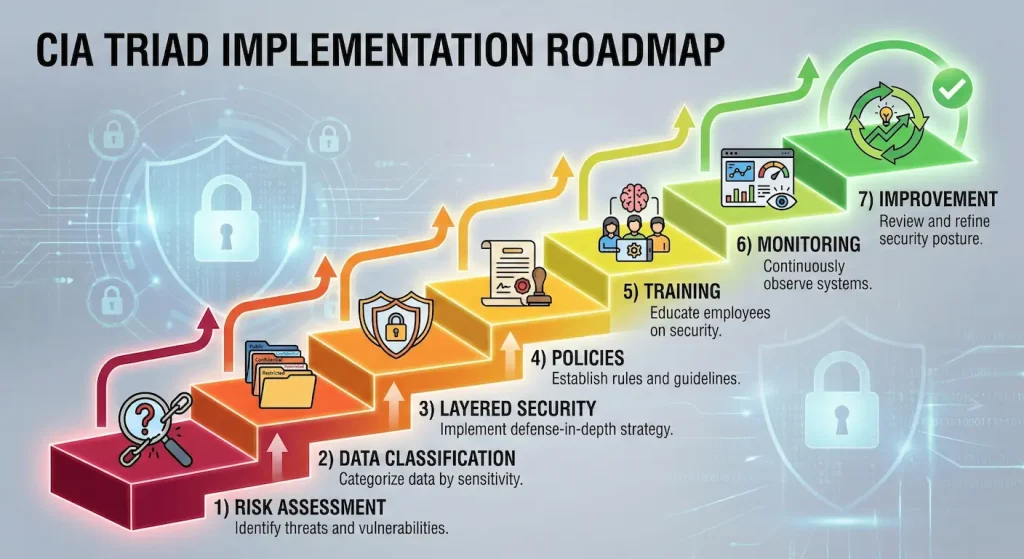
Understanding theory is important, but implementation matters most. Here’s how to apply the CIA Triad in your organization:
Step 1: Conduct a Risk Assessment
Identify your information assets, determine their value, and assess threats and vulnerabilities. This helps prioritize security efforts where they matter most.
Step 2: Classify Your Data
Not all information requires equal protection. Classify data by sensitivity level and apply appropriate CIA Triad protections accordingly.
Step 3: Implement Layered Security
Use defense-in-depth strategies that apply multiple security controls at different levels. If one layer fails, others provide backup protection. Understanding network security fundamentals is essential for this approach.
Step 4: Develop Policies and Procedures
Clear documentation guides consistent security practices across your organization. Include incident response procedures for when breaches occur.
Step 5: Train Your Users
Employees often represent the weakest link in security. Regular training helps them recognize threats and follow proper procedures. Learn about common threats like phishing to educate your team.
Step 6: Monitor and Test
Continuous monitoring detects anomalies quickly. Regular penetration testing and security audits identify vulnerabilities before attackers exploit them.
Step 7: Maintain and Improve
Security isn’t one-time—it requires ongoing attention. Regularly review and update security measures as threats evolve and your organization changes.
Common Misconceptions About the CIA Triad
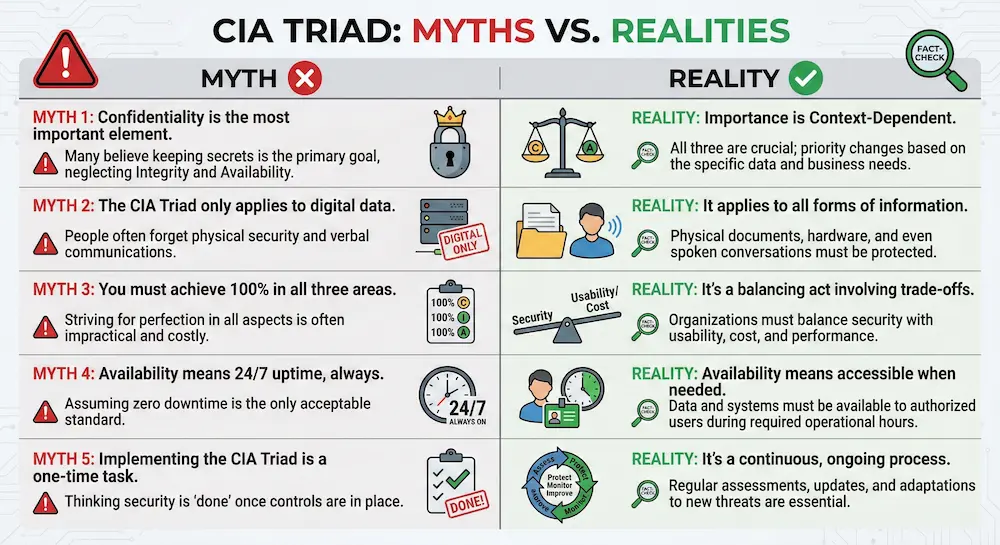
Misconception 1: “Confidentiality is most important.” While confidentiality often gets attention, priorities depend on context. For some organizations, integrity or availability matters more.
Misconception 2: “The CIA Triad is outdated.” The fundamentals remain relevant despite technological changes. New threats and technologies require new implementations, but the core principles still apply.
Misconception 3: “Achieving perfect security is possible.” Security is about risk management, not elimination. Perfect security is impossible—the goal is reducing risk to acceptable levels.
Misconception 4: “Compliance equals security.” Meeting regulatory requirements is important but insufficient. Compliance provides baselines; effective security requires going beyond minimum standards. Learn about building cybersecurity compliance.
Misconception 5: “Security is solely an IT problem.” Effective security requires organization-wide commitment. Business leaders, employees, and partners all play crucial roles.
The Future of the CIA Triad
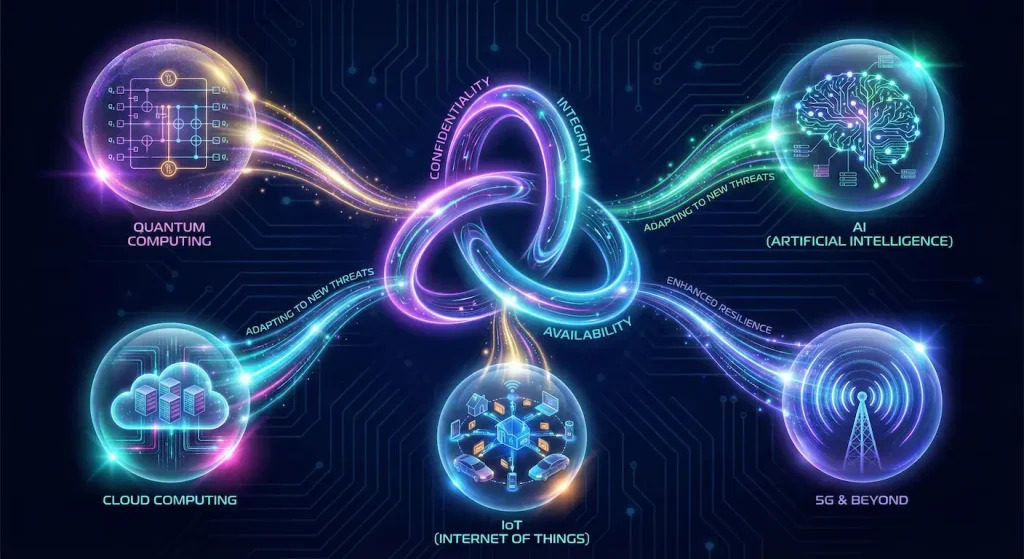
As technology evolves, so do applications of the CIA Triad:
Quantum Computing: Will break current encryption methods, requiring new approaches to confidentiality. Post-quantum cryptography research addresses this future threat.
Artificial Intelligence: AI enhances security monitoring and threat detection but also enables more sophisticated attacks that challenge all three CIA Triad components.
Internet of Things: Billions of connected devices create new attack surfaces requiring innovative approaches to confidentiality, integrity, and availability.
Cloud Computing: Shared responsibility models mean organizations must understand how cloud providers protect CIA Triad components and what remains the customer’s responsibility.
5G Networks: Increased speed and connectivity bring new security challenges requiring updated CIA Triad implementations.
Despite these changes, the fundamental principles of confidentiality, integrity, and availability will continue guiding security decisions. The methods may evolve, but the core concepts remain constant.
Conclusion
The CIA Triad—Confidentiality, Integrity, and Availability—forms the cornerstone of information security. These three principles work together to protect information from unauthorized access, tampering, and disruption. Understanding and properly balancing them enables organizations to build robust security programs that protect valuable assets while maintaining operational efficiency.
Confidentiality keeps secrets safe through encryption, access controls, and authentication. Integrity maintains data accuracy through hashing, digital signatures, and validation. Availability ensures continuous access through redundancy, disaster recovery, and proactive maintenance.
No single principle stands alone—they’re interconnected and interdependent. Strengthening one without considering the others creates imbalances and vulnerabilities. The key is understanding your organization’s unique needs and risk tolerance, then implementing appropriate measures that balance all three components.
As cyber threats continue evolving, the CIA Triad provides a timeless framework for thinking about security. Whether you’re protecting a small business, securing enterprise systems, or safeguarding national infrastructure, these three principles guide effective security decision-making.
Remember: security is a journey, not a destination. Start with the fundamentals, apply the CIA Triad consistently, and continuously adapt to emerging threats. By doing so, you’ll build a security posture that protects what matters most to your organization.
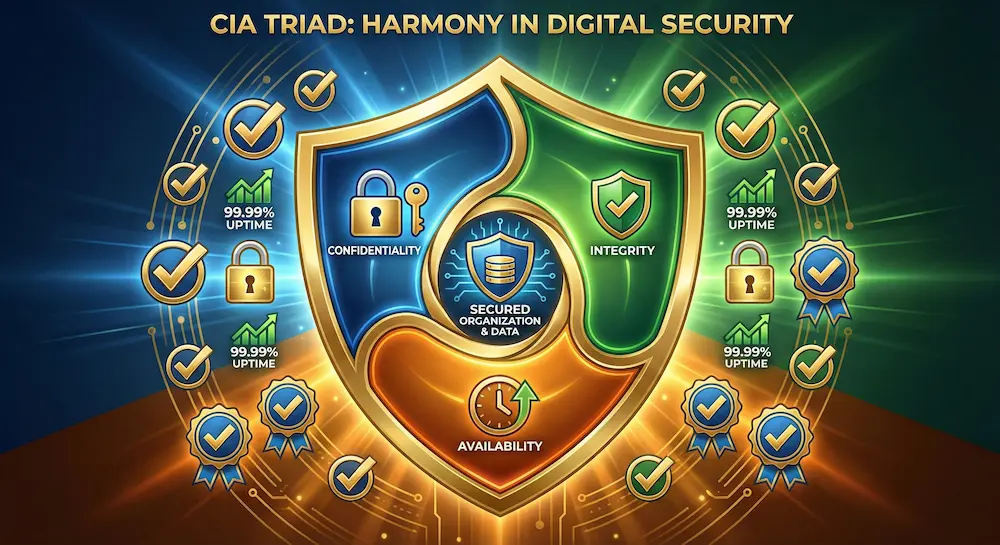
Alt Text: “Complete CIA Triad framework summary showing integrated confidentiality, integrity, and availability protecting organizational assets”
Key Takeaways:
- The CIA Triad consists of Confidentiality, Integrity, and Availability—three foundational security principles
- Confidentiality protects information from unauthorized access through encryption, access controls, and authentication
- Integrity ensures data accuracy and prevents tampering through hashing, digital signatures, and validation
- Availability guarantees authorized users can access information when needed through redundancy and disaster recovery
- Balancing the three components requires understanding organizational priorities and acceptable tradeoffs
- Security effectiveness depends on applying CIA Triad principles consistently across all systems and processes
- Regular assessment, monitoring, and improvement ensure security measures remain effective against evolving threats
Next Steps:
Now that you understand the CIA Triad fundamentals, the next article in this series will explore “Information Security vs Cybersecurity: Key Differences” to clarify these commonly confused terms and help you understand where the CIA Triad fits in the broader security landscape.