CCNA 200-301 v1.1 — Domain 1.0 — 20% of exam
Domain 01: Network Fundamentals
Device roles, topologies, OSI model, cabling, subnetting basics, wireless principles.
13
Total Lessons
13
Live Now
20% of exam
Exam Weight
Domain Progress
13 of 13 live
Lessons in This Domain
Click any live lesson to start reading. New lessons added weekly.
Live
Coming Soon
 1
✅ Live
1
✅ Live
Network Components: Routers, Switches, Security Appliances, and More
 2
✅ Live
2
✅ Live
Network Topology Architectures: Two-Tier, Three-Tier, Spine-Leaf, and Beyond
 3
✅ Live
3
✅ Live
Physical Interface and Cabling Types: Fiber, Copper, and Ethernet Fundamentals
 4
✅ Live
4
✅ Live
Identifying Interface and Cable Issues: Collisions, Errors, and Mismatches
 5
✅ Live
5
✅ Live
TCP vs UDP: The Reliability-Speed Trade-Off Every Application Makes
 6
✅ Live
6
✅ Live
Configuring and Verifying IPv4 Addressing and Subnetting
 7
✅ Live
7
✅ Live
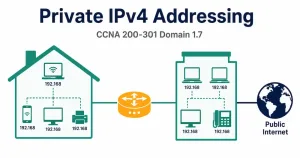
Private IPv4 Addressing: Why RFC 1918 Exists and How It Actually Works
 8
✅ Live
8
✅ Live
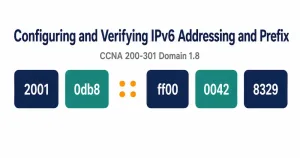
Configuring and Verifying IPv6 Addressing and Prefix
 9
✅ Live
9
✅ Live
Comparing IPv6 Address Types: Unicast, Anycast, and Multicast
 10
✅ Live
10
✅ Live
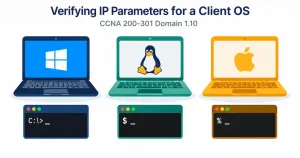
Verifying IP Parameters for a Client OS: Windows, Linux, and macOS
 11
✅ Live
11
✅ Live
Wireless Principles: Channels, SSIDs, RF Fundamentals, and Encryption
 12
✅ Live
12
✅ Live
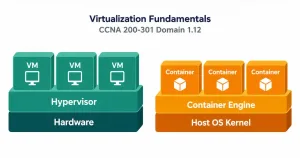
Virtualization Fundamentals: Virtual Machines vs Containers
 13
✅ Live
13
✅ Live
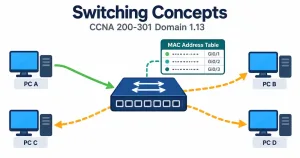
Describe Switching Concepts
Module 1 Summary & Common Pitfalls
→
Subnetting speed and accuracy is the highest-leverage skill in this entire module — it resurfaces constantly in later domains.
→
Don't confuse ULA (IPv6 private addressing) with link-local — they serve different purposes and use different address ranges.
→
Remember IPv6 has no broadcast; multicast fully replaces that function.
→
Duplex mismatch causes degraded performance on a link that's still technically up; speed mismatch usually prevents the link from coming up at all — these are different failure signatures, frequently confused.
→
Know the practical difference between a VM and a container conceptually, even without needing deep virtualization administration skills for this exam.
Ready to test yourself?
Practice 13 domain-specific questions with timer, scoring, and explanations.