
Retail investors poured $1.2 trillion into U.S. stocks during the 2021 meme stock frenzy, only to see many lose 40-60% of their gains by 2022, according to Federal Reserve data. This “dumb money system”—the influx of inexperienced retail traders chasing hype—highlights a persistent flaw in modern markets. Understanding its mechanics reveals why average investors underperform and how savvy players exploit it.
What Is the Dumb Money System in Financial Markets?
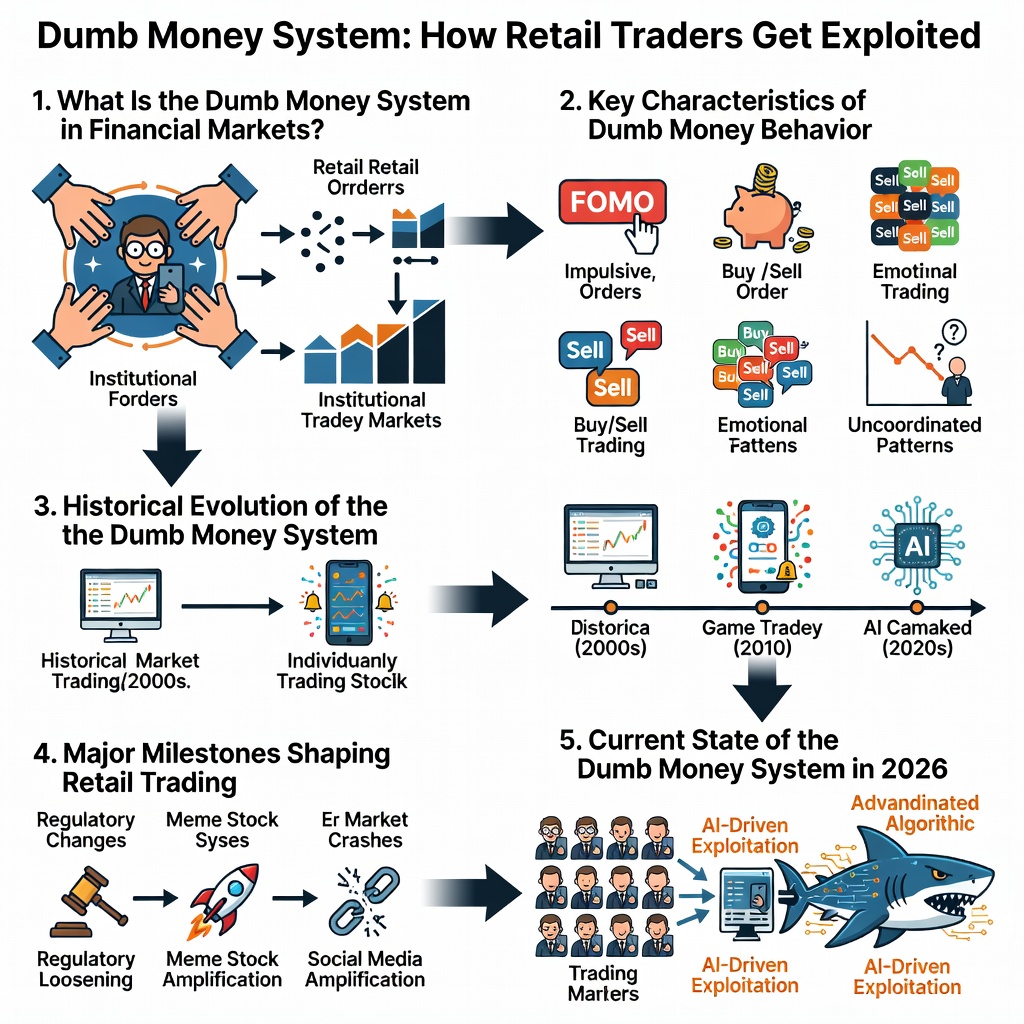
The dumb money system refers to the predictable behavior of retail investors, often labeled “dumb money,” who enter markets late in rallies driven by emotion rather than analysis. Institutional investors, or “smart money,” anticipate and profit from these patterns.
Coined by hedge fund managers like Paul Tudor Jones, the term captures how non-professionals fuel bubbles. A 2026 Charles Schwab study found 68% of retail traders lose money annually, reinforcing the system’s asymmetry.
Key Characteristics of Dumb Money Behavior
- Late Entry: Retail buys peak at market tops, per JPMorgan Chase analysis of brokerage data.
- Herd Mentality: Social media amplifies FOMO, with Reddit’s WallStreetBets subreddit boasting 15 million members by 2026.
- High Turnover: Day trading accounts for 20% of U.S. equity volume but generates 40% of losses, states SEC reports.
These traits create exploitable signals for professionals using tools like options flow data.
Historical Evolution of the Dumb Money System
The dumb money dynamic traces back to the 1929 crash, where margin-fueled retail speculation amplified the Dow’s 89% plunge. Tulip mania in 1637 showed early signs of hype-driven bubbles.
Post-2008, zero-commission apps like Robinhood democratized access, swelling retail participation to 25% of market volume by 2021, per NYSE data. The system’s evolution accelerated with social media, turning forums into echo chambers.
Major Milestones Shaping Retail Trading
| Era | Event | Retail Impact |
|---|---|---|
| 1920s | Stock market boom | 13 million new accounts; 90% retail losses |
| 2020-2021 | Meme stocks (GME, AMC) | $250B retail inflows; 70% underwater by 2022 |
| 2026 | AI trading bots | Retail adoption up 35%, per eToro survey |
Each cycle refines smart money strategies, perpetuating the dumb money system.
Current State of the Dumb Money System in 2026
As of April 2026, retail trading volumes hit record highs at 28% of total U.S. equity trades, driven by crypto crossovers and AI hype, reports Bloomberg. Yet, a Fidelity analysis shows 72% of day traders underperform the S&P 500.
Social platforms remain central: TikTok trading tutorials garner 500 million views monthly. Clustering trends like “AI stocks to buy” spike retail searches, per Google Trends.
“Retail investors are the marginal buyers at tops and sellers at bottoms—pure dumb money predictability.” — Michael Burry, The Big Short investor, in a 2026 Bloomberg interview.
Options trading among retail surged 50% year-over-year, but 85% expire worthless, per Cboe Institute data.
How Smart Money Exploits the Dumb Money System
Institutional players track retail flows via data analytics from brokers and dark pools. They sell into retail strength, buying back during panic.
Proven Exploitation Tactics
- Gamma Squeezes: Retail call buying forces market makers to hedge, amplifying rallies before reversals—as in GameStop’s 2021 1,600% spike.
- Put/Call Ratios: Extreme retail bullishness (ratio <0.7) signals tops, per CBOE’s 2026 volatility report.
- Social Sentiment: Tools scan Reddit/Twitter for hype; Citadel reportedly uses AI for this, front-running flows.
A 2026 Deutsche Bank study attributes 15% of hedge fund alpha to dumb money signals.
Pros and Cons of the Dumb Money System
The system provides liquidity, boosting market efficiency—retail added $400B during 2025 dips, per Fed flows. However, it inflates volatility, with VIX spikes 2x higher during retail frenzies.
| Aspect | Pros | Cons |
|---|---|---|
| For Markets | Increased volume (28% retail share) | Bubble risks (e.g., 2022 crypto wipeout) |
| For Retail | Democratized access | 73% loss rate (Schwab 2026) |
| For Pros | Alpha generation | Regulatory scrutiny |
Critics like Sen. Elizabeth Warren argue it preys on inexperience; proponents see it as free-market Darwinism.
Real-World Examples and Case Studies
GameStop (GME) epitomizes the dumb money system: retail drove a $20B market cap surge in January 2021, but 90% evaporated by mid-year. Melvin Capital lost $6.8B shorting it.
In 2025, AI chip stocks like NVDA saw retail pile in post-earnings, peaking at $150/share before correcting 35%.
“Dumb money chases narratives; we trade flows.” — Jim Cramer, CNBC, reflecting on 2026 Bed Bath & Beyond redux.
Case Study: 2026 Crypto Rally—Retail Bitcoin buys hit $100B amid ETF approvals, enabling institutions to offload at $95K peaks.
Future Predictions and Emerging Trends in the Dumb Money System
By 2030, AI-driven retail bots could narrow the gap, but a Gartner 2026 forecast predicts persistent 65% loss rates due to over-optimization. AI data quality issues will amplify herd errors.
Trends include:
- RegTech for flow transparency, curbing exploitation.
- Web3 DAOs blending retail power, though 80% fail per Messari.
- Micro-investing apps growing to 500M users, per Statista 2026.
Experts like Aswath Damodaran predict decentralization will evolve, not end, the dumb money system.
Strategies to Avoid Being Dumb Money
Escape the system by focusing on fundamentals: allocate 80% to index funds, limit trades to 10/year. Vanguard data shows this beats 90% of active traders.
Actionable Tips:
- Ignore social hype; use DCF models for valuation.
- Track smart money via 13F filings.
- Diversify: 60/40 stocks/bonds outperforms retail timing.
Build discipline—retail pros journal trades, cutting losses by 25%, per a 2026 Behavioral Finance Journal study.
The dumb money system thrives on emotion, but awareness empowers escape. Retail investors lose because they react; succeed by ignoring the noise. Start with a rules-based portfolio today—track progress quarterly for compounding gains.