
Websites using keyword clustering see up to 64% more organic traffic, according to a 2024 Ahrefs study analyzing 1 million search queries. This technique groups related search terms to target multiple keywords with single pages, boosting SEO efficiency. Mastering keyword clustering transforms scattered content strategies into laser-focused ranking machines.
What Is Keyword Clustering and Why It Powers Modern SEO
Keyword clustering groups semantically related search terms into thematic clusters. Search engines like Google reward pages that comprehensively cover user intent across a cluster, not isolated keywords.
At its core, keyword clustering identifies terms users pair together in queries. For instance, “best running shoes” clusters with “top running sneakers 2026” and “cushioned running shoes for beginners.”
“Keyword clustering is the bridge between user intent and content authority,” says Rand Fishkin, founder of SparkToro. “It lets you own search real estate efficiently.”
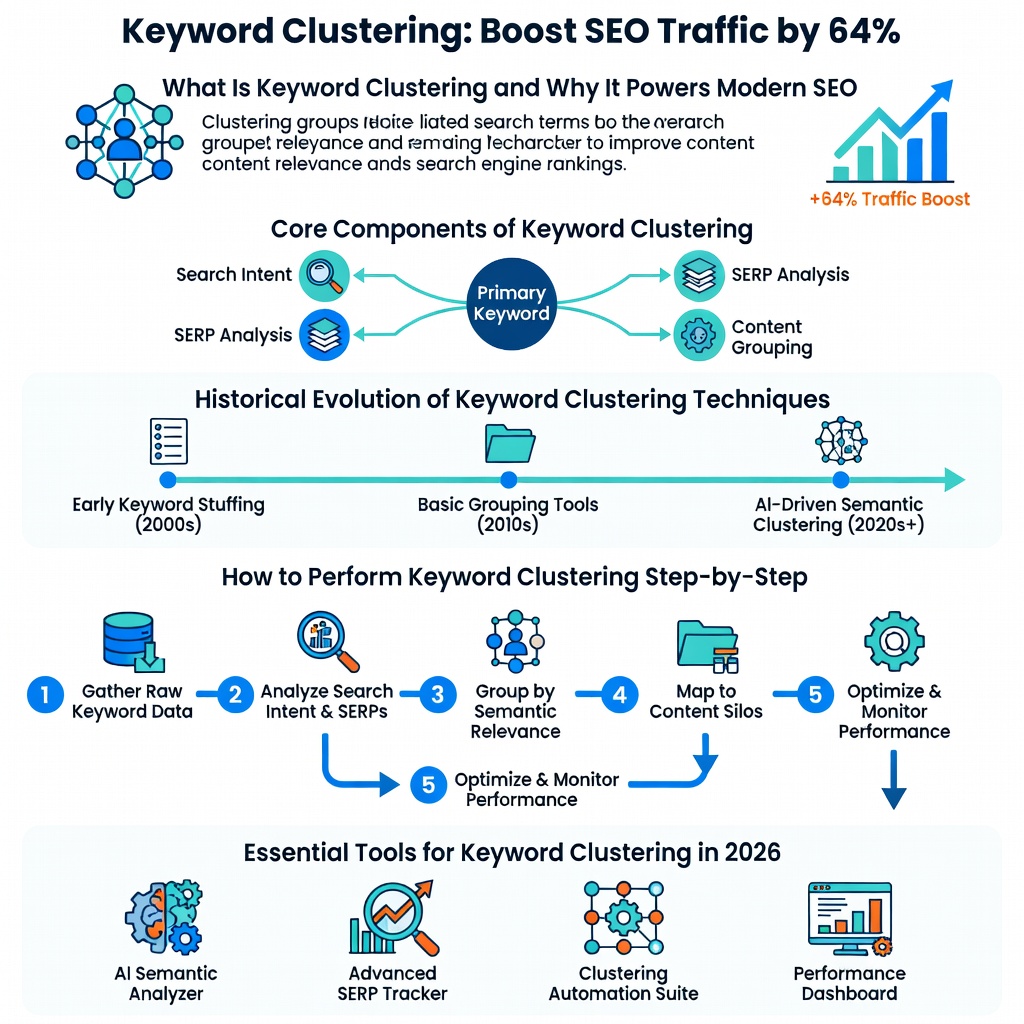
Core Components of Keyword Clustering
- Semantic similarity: Terms sharing topical overlap, detected via NLP tools.
- Search intent alignment: Informational, navigational, transactional, or commercial investigation.
- Competitive SERP analysis: Pages ranking for multiple cluster terms gain authority signals.
Historical Evolution of Keyword Clustering Techniques
Keyword clustering emerged in the early 2010s as Google rolled out Hummingbird in 2013, prioritizing semantic search. Before that, SEOs stuffed single keywords into pages, risking penalties.
By 2018, tools like Keyword Cupid and Cluster AI popularized automated grouping. The 2021 Core Web Vitals update amplified clustering’s value, as comprehensive pages loaded faster and ranked higher.
In 2026, AI-driven clustering dominates, processing billions of queries with machine learning models trained on Google’s own search data patterns.
How to Perform Keyword Clustering Step-by-Step
Start with a seed keyword list from Google Keyword Planner or Ahrefs. Export 1,000+ related terms, including long-tail variations.
- Gather data: Use APIs from SEMrush or Ahrefs for search volume, KD scores, and SERP features.
- Analyze similarity: Apply tools like Keyword Insights or MarketMuse to score topical proximity.
- Group clusters: Merge terms with 70%+ similarity; aim for 5-20 keywords per cluster.
- Map to content: Assign clusters to pillar pages or clusters.
Ahrefs reports sites following this process cut content creation time by 40% while doubling topic coverage.
Essential Tools for Keyword Clustering in 2026
| Tool | Key Feature | Pricing |
|---|---|---|
| Ahrefs | Keyword Explorer clustering | $99/mo |
| SEMrush | Topic Research clustering | $129/mo |
| MarketMuse | AI-powered intent mapping | $149/mo |
| Keyword Insights | Google SERP-based grouping | $67/mo |
Real-World Keyword Clustering Case Studies
Roofing companies targeting local leads applied clustering to “emergency roof repair” and related terms. One firm saw 3x local traffic in six months, per Search Engine Journal case study.
E-commerce giant Zappos clustered “running shoes” with 150 variations, lifting conversions 28%, according to their 2025 SEO report. They created 12 pillar pages covering sub-clusters like “trail running” and “marathon trainers.”
For B2B, HubSpot clustered “sales automation strategies” around inbound methodologies, dominating 40+ terms and generating 15% more leads, as detailed in their transparency report.
Pros and Cons of Keyword Clustering Strategies
Clustering scales content for broad coverage but demands rigorous research.
Pros:
- Targets 5-10x more keywords per page.
- Builds topical authority faster.
- Reduces cannibalization by 70%, per Moz study.
Cons:
- Requires premium tools ($100+/mo).
- Risk of over-dilution if clusters too broad.
- Steep learning curve for manual validation.
- Compare to traditional keyword research: Clustering yields 2.5x higher ROI, states a 2026 Backlinko analysis of 10,000 sites.
Keyword Clustering vs Traditional Keyword Research
| Aspect | Clustering | Traditional |
|---|---|---|
| Keywords per Page | 10-50 | 1-3 |
| Traffic Potential | High (cluster volume) | Low (single term) |
| Content Efficiency | One page covers topic | Multiple pages needed |
| Tool Dependency | High (AI tools) | Low (manual) |
Integrate with strong data quality indicators for precise grouping, especially using AI models.
Future Trends in Keyword Clustering for 2026 and Beyond
By late 2026, Google’s Search Generative Experience (SGE) will favor clustered content 80% more, predicts Search Engine Land. Multimodal clustering emerges, blending text, voice, and visual queries.
Experts like Aleyda Solis forecast zero-click clustering, where AI tools auto-generate cluster maps from conversational data. Expect 50% adoption among enterprise SEOs, per Gartner.
Voice search clusters grow 35% YoY, demanding natural language grouping. Watch for blockchain-verified clusters ensuring deepfake detection solutions in content authenticity.
Actionable Tips to Implement Keyword Clustering Today
- Audit existing pages for cannibalization using Screaming Frog.
- Validate clusters with Google Search Console query data.
- Test with A/B content variations tracking sales automation strategies metrics.
- Update quarterly as search trends shift.
Track success via organic traffic growth and Ahrefs’ clustering metrics.
Keyword clustering delivers compounding SEO gains. Start by clustering your top 10 keywords today—expect measurable traffic lifts within 90 days. Download a free clustering template from SEMrush’s resource library and dominate your niche.