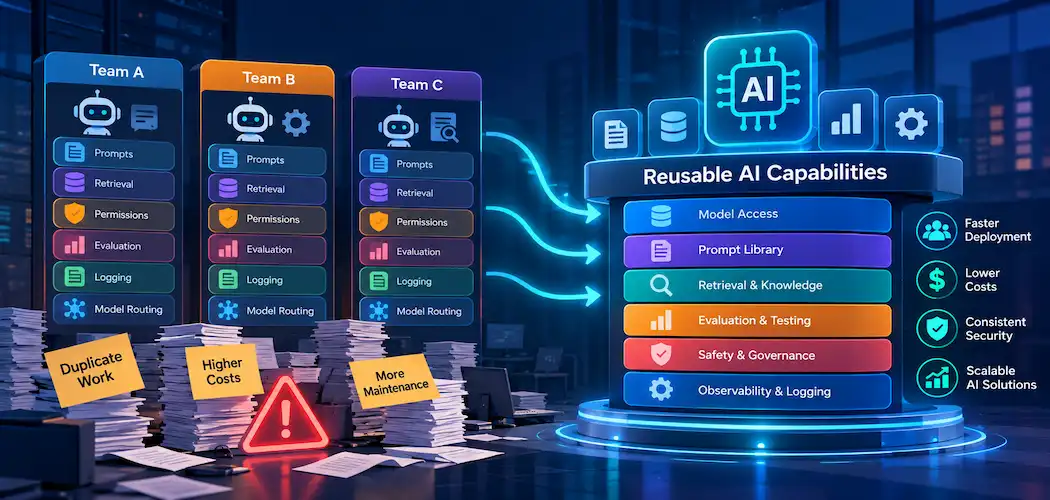
The fifth Gen AI pilot is where an enterprise should get suspicious.
If another team is rebuilding retrieval, permissions, prompt logic, evaluation, logging, and model routing from scratch, the company is no longer learning through experimentation. It is paying the same engineering bill again.
This is the hidden cost of pilot sprawl. Each proof of concept looks different at the surface, yet much of the plumbing repeats.
AWS Prescriptive Guidance now describes reusable components, standardized patterns, and automated workflows as markers of a more advanced generative AI operating environment. Gartner’s 2025 survey of 360 IT application leaders found that 75% were piloting, deploying, or had already deployed some form of AI agents, while only 13% strongly agreed that they had the governance structures required to manage them.
The next enterprise problem is therefore finding value beyond more experiments. It is extracting reusable AI capabilities from the experiments that already taught the organization something — the maturity leap that defines how Enterprise AI solutions move from isolated pilots into governed, scalable operating models.
Why Does Gen AI Experiment Sprawl Become Expensive?
Experiment sprawl is easy to underestimate because duplication is distributed.
One team creates a RAG assistant for policy questions. Another builds retrieval for sales knowledge. A third creates a document-review agent. Each team chooses its own prompt format, chunking rules, evaluation method, access pattern, logging convention, and fallback behavior.
The problem appears six months later. Security has three implementations to review. Platform teams have three observability patterns to support. A model change requires three regression efforts. An access-control fix must be reproduced in several places.
I call this the AI reinvention tax: engineering and governance effort spent solving a problem the organization has already solved somewhere else.
The objective of reusable AI capabilities is to turn repeated implementation work into shared building blocks with clear interfaces, owners, controls, and evidence of quality.
Reuse works only when the shared element is genuinely common.
What Should Enterprises Turn Into Reusable AI Components?
The right reuse boundary sits below the business workflow and above raw infrastructure.
A claims assistant and a procurement assistant should not share the same business instructions. They may share identity handling, model access, retrieval infrastructure, evaluation tooling, tracing, and policy enforcement.
A useful rule is to standardize the mechanics that should behave consistently while leaving business judgment close to the domain.
| Component | Good candidate for reuse | What should stay use-case specific |
| Model access | Gateways, routing, quotas, credentials | Quality threshold for the task |
| Prompting | Versioning, templates, variable handling | Domain instructions and examples |
| Retrieval | Ingestion, indexing, permission checks, citations | Source authority and retrieval rules |
| Evaluation | Test runners, graders, reporting, regression gates | Rubrics and business acceptance criteria |
| Safety | Common policy checks and logging | Risk thresholds for the workflow |
| Observability | Traces, latency, token and failure telemetry | Business outcome measures |
These are the Gen AI platform components worth standardizing because differences in their implementation usually create operational burden rather than business differentiation.
This is also where enterprise AI enablement becomes concrete. Internal teams need approved ways to build, test, govern, and operate AI without reconstructing the foundation for each project.
Why Prompt Libraries Need More Than a Folder of Good Prompts
Prompt libraries sound simple: save proven prompts and let teams reuse them.
That approach degrades quickly. A prompt that worked with one model version, source structure, output schema, or tool set may behave differently after any of those conditions change.
A reusable prompt should behave more like a software artifact.
I would package it as a prompt contract containing:
- the task it is approved to perform
- expected input fields
- required context
- output schema
- model assumptions
- test cases
- known failure conditions
- owner and version history
Profound’s 2026 introduction of Skills provides a useful commercial example of the broader idea. Its Skills are reusable instruction sets that can be created once and applied across content workflows, reducing the need for each user to teach the system the same standards repeatedly.
The deeper lesson is consistency. Reusable AI capabilities should capture instructions together with the conditions that make those instructions dependable.
What Makes a RAG Pipeline Reusable?
RAG is frequently rebuilt because teams treat retrieval as a use-case feature. Much of it is infrastructure.
Most enterprise retrieval flows contain the same sequence: source approval, ingestion, parsing, chunking, metadata enrichment, access preservation, indexing, retrieval, source attribution, refresh, deletion, and monitoring.
That sequence is an obvious candidate for reusable RAG pipelines.
The reusable part should provide the mechanics. The domain supplies the policy.
For example, a common pipeline can enforce document-level permissions and retain source lineage. Legal decides which contract repository is authoritative. HR defines which policy version takes precedence. Finance sets the freshness requirement for reporting material.
A useful architecture separates three layers:
- Retrieval mechanics: connectors, parsing, indexing, search, filters, and citations.
- Domain configuration: approved sources, metadata rules, freshness, authority, and exclusions.
- Use-case behavior: how retrieved evidence is used in the final task.
Reusable RAG pipelines also need deletion and permission propagation built in. A shared pipeline that retrieves well but cannot reliably remove obsolete or restricted information creates a shared risk.
Why Evaluation Should Become a Shared Service
Evaluation is another area where local experimentation creates waste.
A support assistant, coding assistant, and document reviewer need different rubrics. They do not need three separate systems for storing test cases, running graders, comparing model versions, recording results, and enforcing release gates.
AWS guidance describes the evaluation system itself as a product that should be designed, versioned, and validated. OpenAI’s evaluation tooling similarly separates evaluation structure, data sources, criteria, graders, and runs, allowing the same machinery to be applied across model configurations.
This is exactly the kind of work that should become reusable AI capabilities.
The shared service can provide:
- versioned evaluation datasets
- deterministic and model-based graders
- human-review workflows
- model comparison
- regression runs
- release thresholds
- result history
Business teams still define what “good” means. The platform makes it repeatable.
One metric worth tracking is evaluation reuse rate: the percentage of production AI applications using the approved evaluation service rather than a locally built test process. Low reuse usually signals that the shared service is hard to adopt, too generic, or missing a required control.
How Should Governance Be Built Into Shared AI Components?
Central governance teams cannot manually inspect each prompt, retrieval call, tool invocation, and model response.
The better approach is to put enforceable controls into the shared path.
A model gateway can apply approved-provider rules. The retrieval layer can preserve identity and access restrictions. A prompt registry can require an owner and version. The evaluation service can block releases below an agreed threshold. Observability can record which model, prompt, source set, and tool sequence produced an output.
Gartner’s agent research is useful here because it shows how quickly adoption can outrun governance. Reusable controls reduce the number of places where governance has to be implemented correctly.
This is one of the strongest arguments for Gen AI platform components. A control fixed once in a shared component can protect many applications that depend on it.
Governance then becomes part of the build path instead of a review added after development.
Why Internal AI Enablement Needs a Product
Shared components create value only when teams can use them without becoming experts in the platform.
Documentation alone is insufficient.
Good enterprise AI enablement should give teams a short route from idea to approved implementation. That can include starter repositories, reference applications, component catalogs, architecture patterns, example test suites, security defaults, cost guidance, and office hours for unusual cases.
Teams also need clear ownership, change communication, compatibility rules, and a route for defects.
A useful measure is time to first governed prototype: how long a competent product team needs to produce a working AI use case using approved shared services.
If the answer is several weeks because access, documentation, or integration is difficult, teams will keep creating local alternatives.
How Do Enterprises Decide What to Standardize Next?
Do not begin by designing a complete enterprise AI platform. Let repeated work reveal the next shared capability.
I use a simple extraction test after each serious experiment:
| Question | What it reveals |
| Did another team already build this? | Duplication |
| Will three or more use cases need it? | Reuse potential |
| Should this behavior be consistent everywhere? | Governance value |
| Is the interface stable enough to share? | Technical readiness |
| Can one team own it as a service? | Operating viability |
A component that passes all five deserves platform investment.
This creates a healthier sequence: experiment, observe repetition, extract the common part, harden it, publish it, and measure reuse.
Premature standardization can freeze an immature pattern. Waiting too long creates duplicate implementations that become expensive to replace.
Reuse Is How Experiments Become Institutional Knowledge
The real output of an AI pilot should be larger than the application it produced.
A useful experiment teaches the organization something about prompts, retrieval, evaluation, permissions, models, user behavior, cost, or workflow design. If that learning remains buried inside one repository and one project team, the next group pays to rediscover it.
Reusable AI capabilities turn those lessons into infrastructure the organization can apply again.
The more useful question after each successful pilot is: what did we build here that no other team should have to build again?
That question changes the economics of the portfolio. It reduces the AI reinvention tax, gives governance a consistent enforcement point, and lets domain teams spend more effort on the part that is actually unique: the business problem.
The goal is a growing set of reusable AI capabilities that make the next well-chosen use case easier to build, easier to govern, and easier to operate than the last.