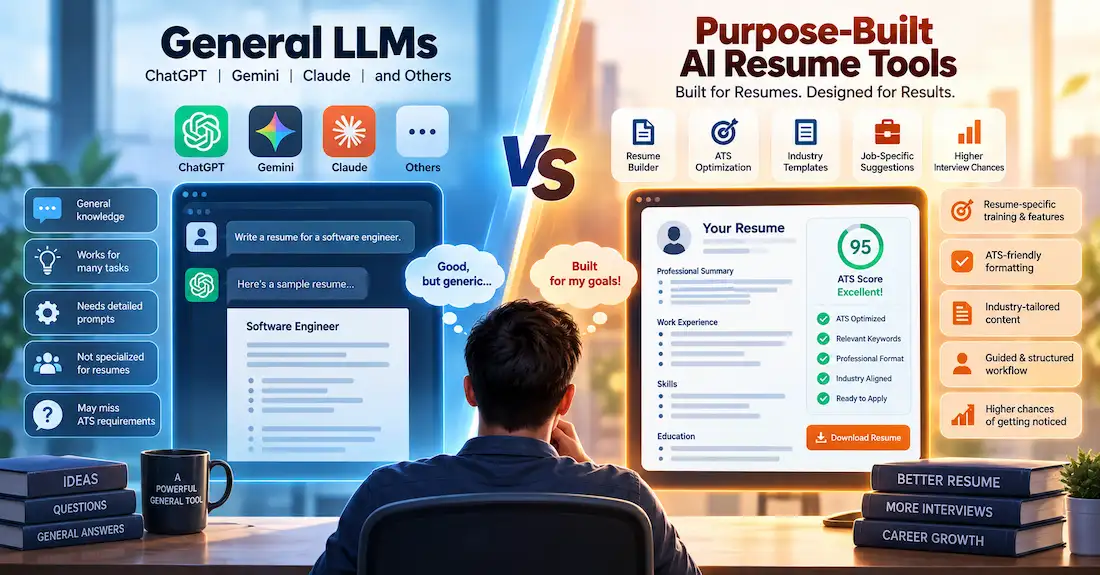
Career changers often reach for ChatGPT or Claude to quickly generate a resume tailored to a new field. These tools are free, fast, and surprisingly capable. But a resume written by a general-purpose language model can differ dramatically from one built by a tool designed specifically for hiring. We tested four AI resume tools with identical input—a teacher transitioning to product management—and the results reveal why the tool you choose matters.
The Problem With General-Purpose LLMs
ChatGPT-6 Astra: Full but Bloated
ChatGPT-6 Astra generated a complete, professional resume with rich vocabulary and strong alignment to the target job description. Every section was well-written. The problem: it generated 15+ bullet points across three job titles, with extensive detail on every achievement.
A hiring manager spends seconds scanning a resume. ChatGPT’s output required aggressive editing—cutting roughly 40% of the content to meet the typical one-page expectation for early-career candidates. The tool treated “comprehensive” as “better,” when actually “concise” is what passes through ATS systems and lands in front of a human recruiter.
Verdict: Useful for inspiration, but plan to spend 45+ minutes editing.
Claude: Clever But Dangerously Wrong
Claude took a more creative approach. It generated a solid resume and added a “Key Transferable Mappings for Recruiters” table—a markdown comparison of job requirements against the candidate’s experience.
The logic is sound. A hiring manager needs to see exactly how teaching experience maps to product management. But a recruiter opening a resume and finding a formatted table will either laugh or move to the next candidate. Resumes are plain-text documents optimized for ATS parsing and human scanning; they are not the place for creative formatting.
Additionally, Claude’s bullet on the department-wide improvement in exam pass rates—from 71% to 84%—read as a personal achievement without the necessary context that this was a department-wide result. A hiring manager might interpret it as individual impact, which is misleading.
Verdict: Creative thinking, poor execution. The table needs to be deleted entirely.
Why Purpose-Built Tools Handle This Differently
HIX AI: Simplicity as a Feature
HIX AI’s AI resume builder generated a six-bullet resume with clean, ATS-standard formatting. Every bullet point aligned with the target job description, using language from the posting itself: adoption, stakeholder, onboarding, outcome metrics. The tool made no attempt to be comprehensive—it prioritized relevance.
When it came to the department-wide exam improvement, HIX framed it carefully: “contributed to a department whose state biology exam pass rate increased from 71% to 84% during the six-year tenure (department-wide result).” This is factual, protective of the candidate’s credibility, and still impressive.
The output required almost no editing. A candidate could export it, review it for accuracy, and submit it within 10 minutes.
Verdict: Minimal changes needed. Ready to use.
Manus: Innovation With a Formatting Trap
Manus, another purpose-built resume tool, also attempted to bridge the gap between teaching and product management. Like Claude, it included a structured comparison table—but formatted differently, as a two-column “Product Responsibility | Evidence” layout rather than a markdown table.
The thinking is clever. The execution is still wrong. A resume should never contain a formatted table. Period. Even if the table is logically sound and visually clean, it signals to an ATS parser and a recruiter that the candidate either does not understand resume conventions or is trying too hard to be creative. Both interpretations hurt the application.
Manus also handled the 71%-to-84% improvement well—”This was a department-wide result rather than an individual attribution”—showing that purpose-built tools generally have better guardrails for attribution. But the table error undermines that advantage.
Verdict: Good thinking, wrong format. The table must be removed.
The Lesson: Tool Design Matters, But Human Review Matters More
The difference between general LLMs and purpose-built resume tools is not that one is “better”—it is that they optimize for different things.
General LLMs optimize for comprehensiveness and creativity. They generate full, detailed, impressive-sounding resumes because that is what language models are trained to do: produce complete, confident outputs. This is useful for brainstorming, but it requires heavy editing for a real application.
Purpose-built resume tools optimize for ATS compliance and hiring conventions. They generate shorter, simpler, less creative outputs—because a resume is not the place for creativity. This saves editing time, but it does not guarantee perfection.
Yet both categories of tools can fail in similar ways: Claude and Manus both tried to add a table, even though tables have no place in a resume. This is a reminder that no AI tool should be trusted to output a final resume without human review.
Before you submit, ask yourself three questions about every bullet point:
- Is this true? Can you explain this achievement in an interview without hesitation?
- Is this clear? Does a recruiter understand what you did, without needing to read between the lines?
- Is this appropriate? Does this belong on a resume, or is it an artifact of how the AI thinks?
If you use ChatGPT or Claude, expect to spend 45+ minutes editing. If you use HIX AI, expect to spend 10-15 minutes. If you use Manus, expect to spend 20+ minutes removing formatting that should never have been there. But in all cases, you are the final editor. The tool is just a starting point.
The fastest path to a strong resume is not the tool that generates the most impressive output. It is the tool whose output is closest to what you actually need to submit—and then taking 10 minutes to make sure every word is true.