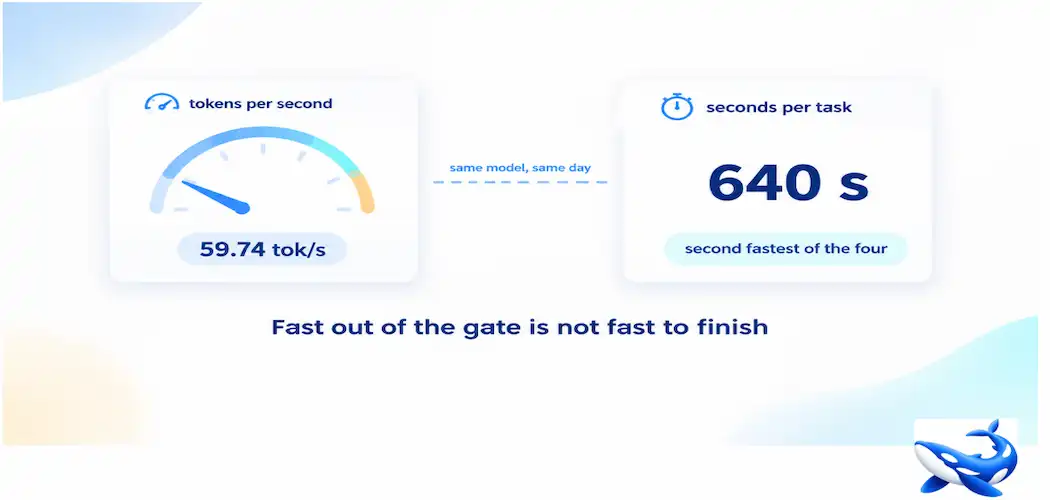
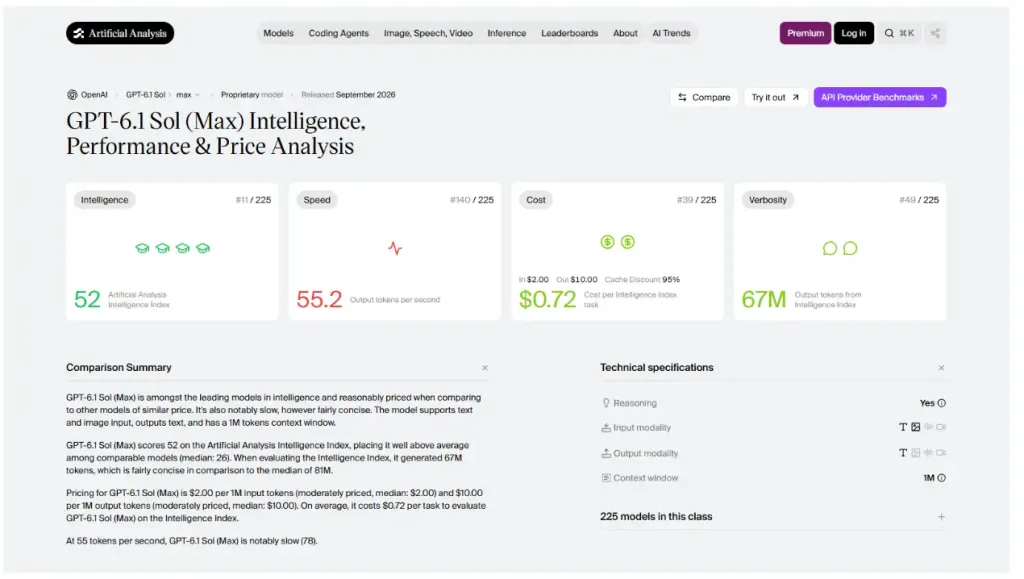
Latency on a reasoning model is two numbers wearing one word, and the GPT-6.1 Sol figures make the split unusually clear. Artificial Analysis, read on 2026-10-07 with the model running at its Max reasoning setting, records it streaming at 59.74 tokens a second and finishing a task in 640.46 seconds. The sibling it sits under, GPT-6 Astra, streams *faster* — 62.09 — and finishes the same kind of task in 433 seconds. A 4% difference in streaming speed sits inside a 48% difference in how long somebody waits. OpenAI’s GPT-6.1 Sol is carried here at list rate, so the only honest way to know your own number is to measure it on the traffic you actually send.
A cheaper model that is slower to finish is not the direction most people expect the ladder to run.
What “speed” means twice over
A served response is produced token by token, and the rate at which those tokens arrive is a property of the serving stack: hardware, batching, how busy the endpoint is. Call it the stream rate. It predicts one thing precisely — how long the last token takes to arrive once generation has started, for a known output length. A 1,000-token answer at 59.74 tokens a second takes about 17 seconds to stream. That is a real and useful number for an interface that types out an answer.
The per-task time is a different measurement, and it is the one a user experiences. It starts at the request, not at the first token, and it ends when the model stops. Between those two points sits everything the model chose to generate before it produced anything you wanted to read — and on a reasoning model that can dwarf the answer itself.
For a non-reasoning model the two numbers track each other closely, because output length is roughly the length of the answer and the answer is roughly what you asked for. For a reasoning model at a high effort setting, they come apart, and the size of the gap is set by a decision the model makes, not by the datacentre.
The whole 48%, accounted for
Here is the arithmetic that settles it, using only the two published figures.
Divide per-task time by stream rate and you get output tokens per task — roughly, since the division folds prefill and queueing into the same bucket. Do it for both OpenAI models on the same harness and the same day:
| (Artificial Analysis, 2026-10-07) | GPT-6.1 Sol | GPT-6 Astra |
| stream rate | 59.74 tok/s | 62.09 tok/s |
| seconds per task | 640.46 s | 433.35 s |
| implied output tokens per task | ≈ 38,000 | ≈ 27,000 |
The approximate token count is not a measurement — nobody published one — but the approximation is identical on both rows, so the *comparison* survives even if the absolute figures do not. GPT-6.1 Sol is generating on the order of 42% more tokens per task than GPT-6 Astra.
Now put the three ratios side by side. Tokens per task: up 42%. Stream rate: down 4%. Per-task time: up 48%. Those numbers close, and they close because they have to — time is tokens divided by rate, so the identity is arithmetic rather than evidence.
That is precisely what makes it useful. The identity closing almost exactly is a proof that the entire latency gap between these two models is token volume. Serving speed contributes about four points of a forty-eight-point difference. If GPT-6.1 Sol streamed exactly as fast as Astra, it would still take roughly 617 seconds per task instead of 640.
So when a benchmark page tells you one model is slower than another, on a reasoning harness it is usually telling you that model *talked more*, not that it was served worse. Those are different problems with different fixes: one is a setting, the other is a capacity question.
Wait times you can actually act on
Two things follow, and they pull in opposite directions.
The first is that a stream rate is the wrong headline for interactive work that runs long. If your interface waits for the whole answer before doing anything — a batch job, a pipeline stage, an agent step that cannot start until the previous one finishes — then per-task time is your latency, and it is governed by output volume rather than by the endpoint’s throughput. Lowering the reasoning setting is the lever, and it is a bigger lever than choosing a different provider.
The second is that latency and cost are not the same trade. On this harness GPT-6.1 Sol costs $0.7242 per task against Astra’s $3.26. Astra finishes 207 seconds sooner. Buying those 207 seconds by moving to the flagship costs $2.53 per task, which works out at roughly $44 an hour of saved waiting — a rate that makes sense for a human waiting on a single answer and very little sense for a thousand parallel batch calls, where throughput is what you actually buy.
That distinction decides the choice more often than a benchmark does. Interactive, sequential, low-volume work should pay for speed. Parallel, high-volume work should pay for tokens and accept the wait.
Reading a speed number without being misled
Three rules, in the order they will save you from a bad decision.
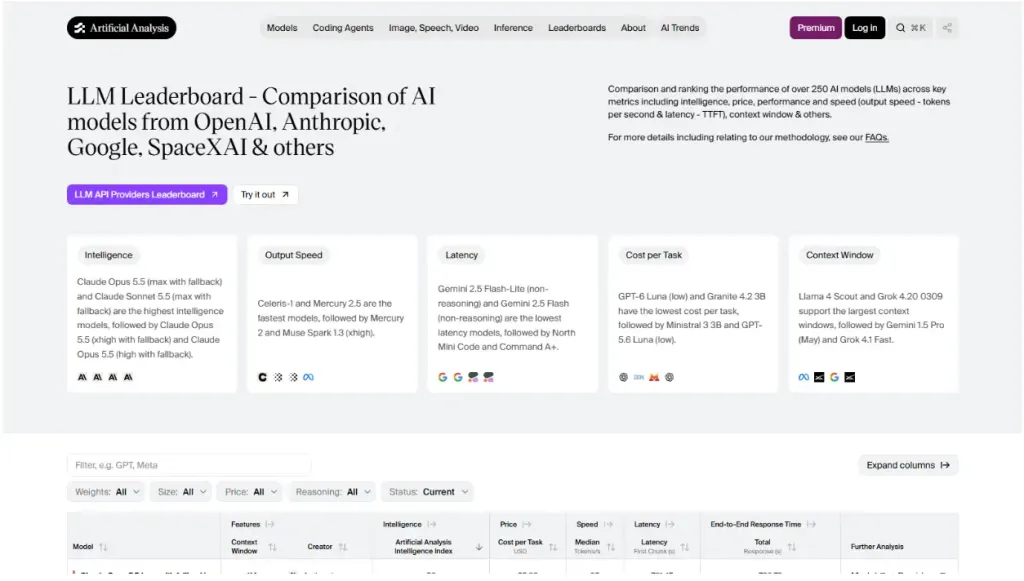
Check the effort setting before the number. A reasoning model at low effort and the same model at max are not the same product, and their latency differs by more than most cross-vendor comparisons. The Sol and Astra figures above are both Max; Grok 4.7, in the same comparison set, is measured at Xhigh — a lower rung. Stacking those three in one table without saying so is comparing three different configurations.
Ask which number you need. If a person is watching a response appear, the stream rate governs their experience for the part they can see. If a job has to finish before the next one starts, per-task time governs it. Very few published comparisons say which of the two they are reporting, and most readers assume it is the one they care about.
Treat every figure as dated. These readings are from 2026-10-07. Serving speed in particular moves with load and with provider capacity, and a number captured in a quiet week is not a promise about a busy one. Re-measure on your own endpoint rather than adopting someone else’s chart.
The takeaway
GPT-6.1 Sol streams at 59.74 tokens a second and takes 640 seconds per task on the independent harness, both at the Max reasoning setting and both read 2026-10-07. Its own flagship streams slightly faster and finishes 48% sooner — and that 48% is almost entirely a token-volume difference, not a serving difference. Sol is the chattier of the two by about 42%.
Which means the speed you get is mostly a setting you chose. If latency is the constraint, lower the effort rung and cap the output tokens before you go shopping for a faster endpoint; if throughput is the constraint, the wait is not the cost that matters, and the per-task price is.
OrcaRouter carries OpenAI’s GPT-6.1 Sol on the same key as the rest of the OpenAI line, so measuring your own stream rate and your own per-task time is a config change rather than a procurement cycle.