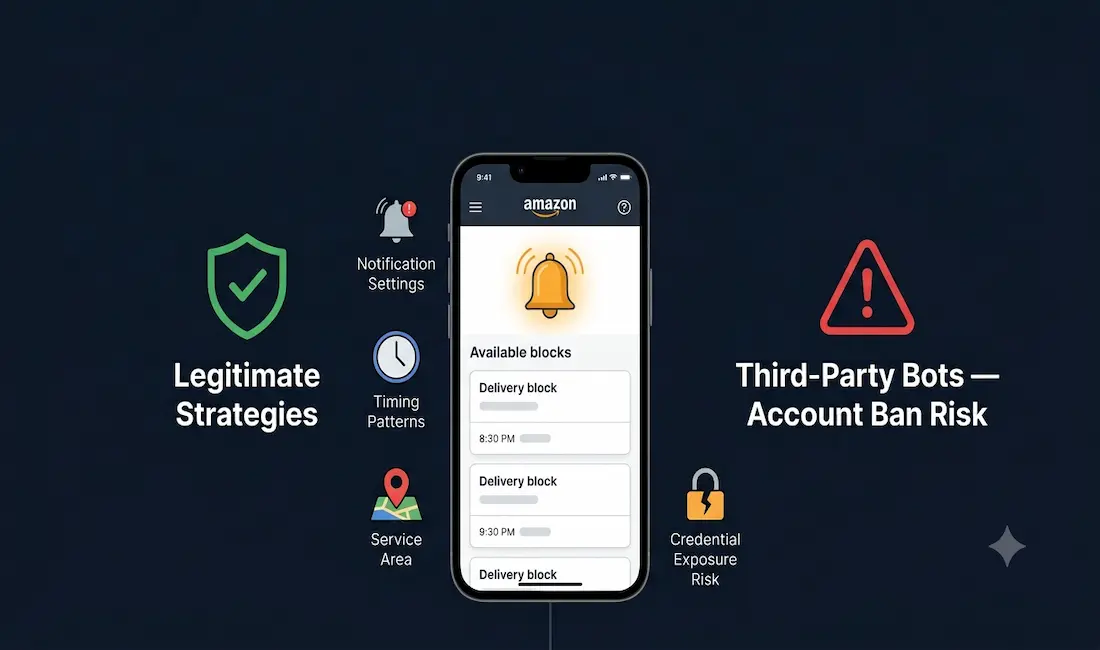
Amazon Flex drivers are frequently tempted by third-party “bot” apps and auto-tapper tools that claim to automatically grab delivery blocks the moment they are released. Before considering any of these tools, it is important to understand a critical fact: using third-party bots or automation software with Amazon Flex is a direct violation of Amazon’s Terms of Service, and can result in permanent deactivation of your Flex account with no appeal. Beyond the ban risk, many of these third-party apps require you to enter your actual Amazon account credentials into an unverified, unofficial third-party service, a genuine security risk that can expose your Amazon account, payment information, and personal data well beyond just your Flex driving privileges.
This guide covers legitimate, ToS-compliant strategies that experienced Flex drivers actually use to increase their block volume, without risking a ban or exposing your account credentials to a third-party app.
Why Third-Party Flex Bots Are a Bad Idea
Before covering what actually works, it is worth being direct about why block-grabbing bots and auto-tappers are not a viable strategy, regardless of what marketing claims you may see for these tools:
Account termination risk. Amazon actively monitors for automated, non-human interaction patterns with the Flex app. Accounts detected using bots, auto-clickers, or automated refresh tools are subject to permanent deactivation, and Amazon Flex does not typically offer an appeals process for ToS violations of this kind. The income you are trying to protect is exactly what you lose if your account is banned.
Credential and account security risk. Many block-grabbing tools require you to log into your actual Amazon account through their app or service in order to function, since they need account-level access to monitor and claim blocks automatically. This means trusting your Amazon credentials, and by extension your payment methods and personal information tied to that account, to a third-party service with no accountability to Amazon and no way for you to verify how your data is stored or used.
No verifiable track record. Claims made by these tools about driver earnings or success rates are typically unverifiable marketing copy, not independently audited results. There is no reliable way to confirm these figures are accurate.
Legitimate Strategies to Get More Blocks
1. Optimize Your Notification Settings
Ensure Amazon Flex app notifications are fully enabled at the operating system level, not just within the app itself. On iPhone, go to Settings, then Notifications, then Amazon Flex, and confirm Allow Notifications is on with Lock Screen, Notification Center, and Banners all enabled. A missed notification because of a disabled system-level setting is one of the most common, entirely avoidable reasons drivers lose out on blocks to other drivers checking manually.
2. Understand Block Release Timing Patterns
Amazon typically releases new blocks in predictable windows tied to warehouse operating hours, though exact timing varies by region and warehouse. Many experienced drivers track the specific release patterns for their local warehouse over a week or two, noting the times blocks tend to appear, and plan to have the app open during those windows rather than relying on random checking throughout the day.
3. Expand Your Service Area
If your Flex app is configured for a single warehouse or delivery zone, consider whether Amazon’s app settings in your region allow you to view or accept blocks across multiple nearby warehouses. A broader service area increases the total pool of blocks you are eligible to see and accept, without requiring any automation.
4. Keep the App Open and Ready During Peak Windows
Manually refreshing the app yourself, rather than through any automated tool, during known high-release windows (early morning and evening are common peak block-release times in many markets) remains the single most reliable, ToS-compliant way to catch new blocks as they appear. Keeping your phone charged, connected to reliable Wi-Fi or cellular data, and the app updated to its latest version all reduce the chance of missing a block due to a technical delay on your end.
5. Build a Consistent, Reliable Driver Profile
Amazon Flex driver standing, including your completion rate and on-time performance, can influence the blocks and opportunities made visible to you over time. Consistently completing accepted blocks on time, maintaining a strong customer rating, and avoiding cancellations builds a track record that works in your favor within Amazon’s own system, rather than around it.
6. Coordinate Informally with Other Drivers
Some local Flex driver communities, through legitimate channels like public social media groups or local forums, share general observations about block timing patterns and warehouse activity for their specific region. This kind of informal, human-driven information sharing is different from an automated bot and does not violate Amazon’s terms, since it involves no unauthorized software interacting with your account.
What to Do If You’re Considering a Third-Party Tool
If you are evaluating a paid “Flex bot” or auto-tapper service, ask yourself two questions before proceeding: does this tool require me to enter my real Amazon account credentials into a service that is not Amazon, and does this tool automate interactions with the Flex app rather than simply notifying me so I can act manually? If the answer to either question is yes, the tool very likely violates Amazon’s Terms of Service and puts your account, and potentially your broader Amazon account and associated payment information, at risk. A tool that only sends you a notification without taking any automated action inside the app occupies more of a gray area, but drivers should still weigh this against the explicit terms Amazon has published and the total absence of any official Amazon endorsement for any third-party Flex tool.
Conclusion
The most reliable way to get more Amazon Flex blocks is also the safest: optimize your notification settings, understand your local warehouse’s release patterns, keep the app ready during peak windows, and build a strong driver standing over time. Third-party bots and auto-tappers carry a real risk of permanent account deactivation and expose your Amazon credentials to unverified third-party services, risks that are rarely worth the marginal convenience these tools claim to offer. Working within Amazon’s actual system protects both your income and your account long-term.
Frequently Asked Questions
Is it against Amazon’s rules to use a bot to grab Flex blocks?
Yes. Amazon Flex’s Terms of Service explicitly prohibit the use of third-party software, bots, auto-clickers, or any automated tool to interact with the Flex app on your behalf. Drivers found to be using these tools risk permanent deactivation of their Flex account, and Amazon does not typically offer a meaningful appeals process for this specific type of violation. The convenience these tools offer is not worth the risk of losing your ability to drive for Flex entirely.
Are Amazon Flex block-grabbing apps safe to use?
No, they carry meaningful risk beyond just the account ban itself. Many of these tools require you to log into your actual Amazon account through their app or service, meaning you are trusting your real Amazon credentials, and by extension your stored payment methods and personal account information, to an unverified third party with no accountability to Amazon and no transparent security practices you can independently verify. This credential exposure risk exists regardless of whether the tool’s automation itself gets detected.
How can I legitimately increase the number of blocks I get on Amazon Flex?
Focus on fully enabling app notifications at the operating system level, learning your local warehouse’s typical block release timing through your own observation over a week or two, keeping the app open and ready during those peak windows, and maintaining a strong completion rate and customer rating within the app. Expanding your available service area to include multiple nearby warehouses, where your region’s app settings allow it, also increases the total pool of blocks you can see and accept, all without any automation or third-party tool.
Can Amazon detect if I’m using a Flex bot?
Amazon actively monitors for automated and non-human interaction patterns with the Flex app, and has a clear financial incentive to detect and remove tools that give some drivers an unfair advantage over others competing for the same limited pool of blocks. While no detection system catches every instance immediately, drivers should assume that any bot or auto-clicker carries an ongoing, indefinite risk of detection for as long as it remains in use, not just a one-time risk at the moment of first use.
What should I do if I’m not getting enough blocks through legitimate means?
Start by reviewing your notification settings to confirm nothing is being missed at the operating system level, then spend a week manually tracking when new blocks actually appear for your specific warehouse to identify your personal peak windows. If your region supports it, check whether you can expand your visible service area to additional nearby warehouses within the official Flex app settings. If block availability remains consistently low despite these steps, this may reflect genuine local market saturation, which no ToS-compliant strategy can fully overcome, and is worth weighing honestly against the account-security and ban risk of any third-party tool before considering one.