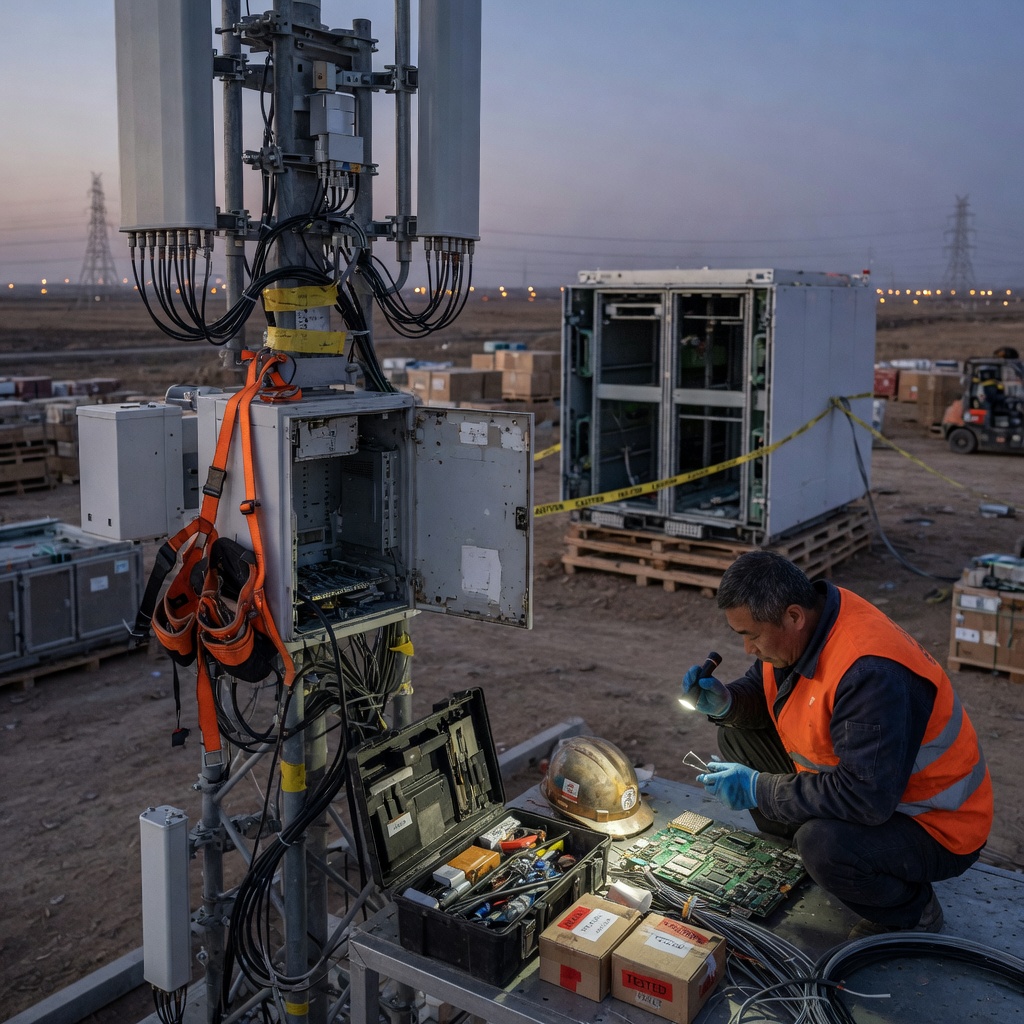
Huawei shipped 1.14 million 5G base stations globally before US sanctions forced a complete silicon redesign of its carrier-grade portfolio. That number — drawn from the company’s own 2025 annual report filings — captures the paradox at the center of any serious discussion about the Chinese networking giant. It is simultaneously the most sanctioned technology company on earth and the largest telecom equipment manufacturer by revenue, outpacing both Ericsson and Nokia combined since 2021.
For network engineers holding CCNA, CCNP, or CCIE certifications, the question is no longer whether Huawei equipment will appear in their topology — it already has, across 170 countries — but how to integrate, troubleshoot, and secure it alongside Cisco, Juniper, and Palo Alto Networks gear in increasingly fragmented enterprise environments.
The Sanctions Reality: What Engineers Actually Face in the Field
The US Entity List restrictions, first imposed in May 2019 and tightened through 2025, cut Huawei off from TSMC-fabricated silicon and Google Mobile Services. The immediate effect was a forced architecture shift. Huawei’s Kirin smartphone SoCs disappeared from the consumer market. More relevant to infrastructure engineers: the company redesigned its entire carrier router line — the NetEngine series — around in-house developed chips fabricated by SMIC on older process nodes.
A network architect working on a multi-vendor BGP peering deployment in Southeast Asia described the practical consequence: “The NE40E routers we received in 2024 use a different forwarding engine than the 2021 models. Same CLI syntax, same VRP version numbering, but the QoS buffer allocation behaves differently under congestion.” That discrepancy — identical configuration surface, divergent silicon behavior — is precisely the kind of detail that appears nowhere in vendor documentation but dominates troubleshooting sessions.
Huawei’s response has been to double down on software portability. The VRP (Versatile Routing Platform) operating system now runs across four distinct silicon generations, from legacy HiSilicon chips to the newer Kunpeng-based forwarding engines. For engineers, this means a single display version output no longer tells the full story — the hardware revision field buried in display device manufacture-info has become essential reading before any QoS or MPLS TE policy change.
VRP closer look: Commands That Differ From IOS and Junos
Huawei’s CLI borrows heavily from Cisco IOS syntax — a deliberate choice to reduce retraining friction — but diverges in ways that cause production outages when engineers assume one-to-one parity. The most dangerous false friend is VLAN configuration.
On a Cisco Catalyst switch, assigning an access port to VLAN 100 looks like this:
switchport mode access

switchport access vlan 100
On a Huawei CloudEngine switch running VRP, the equivalent is:
port link-type access

port default vlan 100
The syntax difference is minor. The behavioral difference is not. Huawei switches do not create the VLAN automatically when assigned to a port. If VLAN 100 does not exist in the VLAN database, the port assignment silently fails — no error, no syslog message, just a non-functional link. The fix requires explicitly running vlan 100 in global configuration mode first. Network engineers who learned on IOS routinely miss this until the first packet drop investigation.
STP configuration introduces another trap. Cisco’s default spanning-tree mode is PVST+ (Per-VLAN Spanning Tree). Huawei defaults to MSTP (Multiple Spanning Tree Protocol). Connecting a Cisco switch and a Huawei switch without explicitly aligning the STP mode produces a loop-free topology on paper and a broadcast storm in practice, because the two switches interpret BPDUs differently. The remediation command on Huawei — stp mode stp or stp mode rstp — must appear in every inter-vendor deployment checklist.
For engineers pursuing CCIE or Huawei’s equivalent HCIE certification, these interop edge cases represent the difference between lab knowledge and production competence. The certification tracks now explicitly test multi-vendor STP, OSPF, and BGP scenarios — a recognition that pure-play environments are increasingly rare outside of greenfield hyperscaler deployments.
The SD-WAN Battlefield: Huawei vs. Fortinet vs. Cisco
Enterprise SD-WAN procurement in 2026 has consolidated around three platforms: Cisco Catalyst SD-WAN (formerly Viptela), Fortinet Secure SD-WAN, and Huawei CloudCampus SD-WAN. Each approaches the same problem — application-aware path selection across MPLS, broadband, and 5G underlays — with fundamentally different architectures.
Huawei’s differentiator is its integrated WAN optimization stack. Where Cisco relies on AppNav and Fortinet depends on SSL inspection at the edge, Huawei embeds a full TCP proxy and caching engine directly into the CPE’s forwarding plane. In a 2026 test conducted by a European Tier 2 carrier evaluating SD-WAN vendors for a 2,000-site retail deployment, Huawei’s solution reduced SaaS application latency by 42% over lossy satellite links compared to Fortinet’s equivalent configuration. The mechanism: Huawei’s CPE intercepts TCP sessions at the branch, acknowledges packets locally, and maintains a separate optimized TCP connection across the WAN.
The trade-off is visibility. Splitting TCP sessions means the data center firewall — whether Palo Alto Networks or Check Point — sees only the optimized stream, not the original client-server exchange. Security teams accustomed to full packet inspection lose forensic granularity. The architectural decision, then, is whether WAN performance or security telemetry takes priority — and that decision depends entirely on the specific application mix and compliance requirements of the organization.
MPLS, Segment Routing, and the VRF Migration Problem
Huawei’s carrier routing portfolio supports the full IETF Segment Routing stack — SR-MPLS and SRv6 — with one implementation detail that trips up engineers migrating from Juniper MX or Cisco ASR platforms. Huawei’s VRF-aware BGP configuration requires an explicit route-distinguisher and route-target import/export statement under the VPN instance, even when using route-target auto-derivation.
On a Juniper MX running Junos:
set routing-instances CUSTOMER-A instance-type vrf

set routing-instances CUSTOMER-A route-distinguisher 65001:100

set routing-instances CUSTOMER-A vrf-target target:65001:100
The equivalent Huawei NE40E configuration under VRP:
ip vpn-instance CUSTOMER-A

route-distinguisher 65001:100

vpn-target 65001:100 export-extcommunity

vpn-target 65001:100 import-extcommunity
The syntax is close enough to create false confidence. The operational difference emerges when engineers attempt to use Huawei’s display ip routing-table vpn-instance command and find that routes learned via MP-BGP appear only if the route-target import statement matches exactly — Juniper’s auto-export behavior has no Huawei equivalent. The result: routes that exist in the BGP table but never populate the VRF routing table, diagnosed only after comparing display bgp vpnv4 all routing-table output against the VRF-specific table.
For GRE tunnel configurations — still widely used in legacy MPLS interconnects — Huawei requires the tunnel source to be a loopback interface, not a physical interface, when tunnel protection groups are configured. This constraint is documented but buried in the “Restrictions and Guidelines” section of the feature guide. Engineers who specify a physical interface as the GRE source find that the tunnel establishes successfully but fails over silently when the primary path drops.
The Certification Calculus: HCIE vs. CCIE Career Value
The labor market for network engineers now prices multi-vendor competency at a measurable premium. According to compensation data from a 2026 global IT salary survey covering 12,000 network professionals, engineers holding both CCIE and HCIE certifications command median base salaries 23% higher than single-vendor CCIE holders in the same geographic markets.
The reason is structural. Service providers in Africa, the Middle East, Southeast Asia, and Latin America have standardized on Huawei for radio access and aggregation networks while maintaining Cisco or Juniper cores. Enterprises in the same regions often run Huawei campus switches and Aruba wireless controllers. An engineer who can configure OSPF on a Huawei CX600 and redistribute routes into a Cisco ISR running EIGRP — and troubleshoot the inevitable metric mismatches — solves a business problem that single-vendor specialists cannot address.
HCIE certification tracks now mirror CCIE in structure: a written qualification exam followed by an eight-hour practical lab. The HCIE-Routing & Switching lab includes mandatory multi-vendor interop sections where candidates must peer a Huawei NE40E with an emulated Cisco IOS-XR route reflector using BGP communities for traffic engineering. Passing requires demonstrating not just VRP syntax mastery but the architectural understanding of why route policies behave differently across implementations.
Supply Chain Realities: What Procurement Teams Need From Engineering
Huawei’s equipment lead times, as of mid-2026, average 8 to 14 weeks for enterprise switching and 16 to 22 weeks for carrier-grade routing platforms — roughly double the pre-sanctions baseline. The bottleneck is not final assembly but silicon allocation from SMIC’s 7nm and 14nm fabrication lines, which serve multiple Huawei product divisions competing for limited wafer starts.
This constraint changes the engineering-planning relationship. Network architects can no longer specify Huawei equipment with the assumption of just-in-time delivery. A 500-switch campus refresh planned for Q3 requires purchase orders by Q1, with the specific bill of materials validated against Huawei’s current silicon availability matrix — a document that procurement teams rarely see but that engineering must request and review.
The matrix itself is a sobering artifact of the sanctions era. Certain CloudEngine models ship with one of three different ASIC revisions depending on the fabrication run. All three revisions run the same VRP version and support the same feature set on paper. In practice, the older ASIC revision — still shipping for some SKUs — imposes a 30% lower ACL scale limit. An engineer who designs a security policy requiring 8,000 ACL entries on a switch that supports only 5,000 entries in silicon discovers the gap during commissioning, not during design, unless the hardware revision is checked against the silicon matrix before ordering.
Security Posture: The Trust Architecture Question
No discussion of Huawei in enterprise infrastructure can avoid the security question. The technical reality is more detailed than the political rhetoric. Independent security audits of Huawei’s VRP source code — conducted under NDAs by the UK’s Huawei Cyber Security Evaluation Centre (HCSEC) through 2025 and by Germany’s BSI through early 2026 — have identified no backdoors. The audits did find systemic software engineering weaknesses: hardcoded credentials in legacy modules, insufficient input validation in protocol parsers, and inconsistent memory safety practices across code contributed by different development teams.
These findings mirror vulnerabilities found in Cisco IOS, Juniper Junos, and Arista EOS over the same period. The difference is one of trust architecture. US and European vendors participate in coordinated vulnerability disclosure programs and publish CVEs through MITRE. Huawei’s vulnerability disclosure process remains opaque, with patches sometimes appearing in VRP maintenance releases without corresponding CVE assignments — a practice that complicates risk assessment for security teams operating under regulatory compliance frameworks like PCI DSS or NIS2.
The pragmatic engineering response, adopted by financial institutions and government networks that deploy Huawei equipment, is a zero-trust overlay. Huawei switches and routers are treated as untrusted transport — all control plane traffic encrypted via IPsec, all management access mediated through a separate out-of-band network, and all configuration changes validated against a policy engine running on non-Huawei infrastructure. This architecture adds operational complexity but removes the trust dependency entirely.
The broader industry trajectory points toward this model becoming standard practice for all vendors, not just Huawei. Supply chain attacks like the 2020 SolarWinds incident demonstrated that vendor trust is a fragile security control regardless of corporate nationality. Engineers who build networks assuming any single vendor could be compromised — and architect segmentation, monitoring, and policy enforcement accordingly — produce infrastructure that is more resilient against the full spectrum of threats, from state actors to ransomware operators.