Mobile product teams across industries are facing pressure to add AI-driven features to their apps. Recommendation engines, chat-based support, predictive personalization, voice interfaces, and computer vision are no longer experimental add-ons; they are fast becoming standard expectations for modern digital products.
But adding AI is not just a product decision, it’s an operational one. Once the decision to integrate AI is made, the bigger question becomes: who should build it?
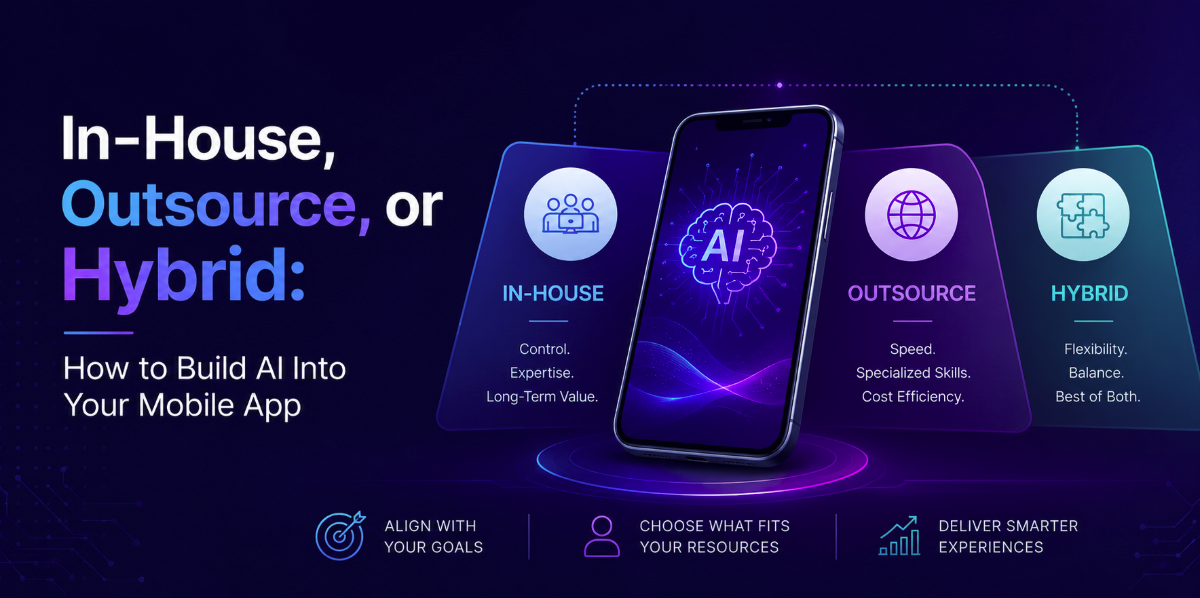
Most companies typically choose between three paths: building an internal AI team, partnering with specialized AI development companies, or adopting a hybrid model that combines both. Each path comes with its own trade-offs in cost, speed, control, and long-term scalability.
The right choice depends less on following industry trends and more on understanding what the business actually needs to achieve—and what it can realistically support.
Why AI Projects Don’t Follow the Usual Playbook
Most teams already have a steady process for building regular features: design, build, test, ship, and then improve over time. AI doesn’t follow that same pattern. A model can work well when it launches, but its accuracy can drop later as user behavior changes. That means someone has to keep checking on it and retraining it, which is an ongoing cost, not a one-time task. The skills needed are also harder to find.
Things like data engineering, model evaluation, and MLOps are not skills most mobile app developers already have. On top of that, choices such as which AI provider to use or where user data is stored can affect both costs and legal compliance down the road. If a company gets the staffing wrong here, it’s not just a delay. It can lead to higher cloud bills or leave the business relying on one engineer, who is the only person who really understands how the model works.
The Case for an In-House AI Team
Building AI in-house makes the most sense when AI is not just a feature, but the actual product. A fintech app built around fraud detection is one example. A healthtech app built around diagnosis is another. In these cases, an internal team holds onto important knowledge. The people who built the model know its weak points. They also know where the training data came from. This kind of knowledge is hard to pass on to a new vendor every time a contract ends. Internal teams also stay closer to the product’s strategy, since they understand the priorities behind it firsthand.
But there are real downsides too. Building a skilled AI team from the ground up takes time and money. Good engineers are hard to find, and hiring usually takes longer than most schedules allow. It’s also hard to keep a small, specialized team busy when a company only needs deep AI work once in a while.
The Case for Outsourcing
Outsourcing solves many of these problems, but brings different ones. An outside team already has experience solving similar problems for other clients. Since they work on multiple projects, they often stay more current with new tools and methods than an internal team would. Outsourcing also makes costs easier to predict, since the work has a clear scope and a fixed budget. It’s usually faster too. A good outside team can often start within a few weeks, while hiring internally can take months.
Still, there are risks worth knowing about. If the contract doesn’t require proper documentation, important knowledge can get lost. Data security also needs attention, since AI projects often involve sensitive information passing through outside systems. And relying on an outside team for too long, without a plan to eventually bring the work in-house, can become expensive over time. None of this means outsourcing is a bad choice. It just means the partner should be chosen carefully, with the right protections in place from the start.
The Hybrid Model
Many companies land somewhere in the middle. In this setup, the core team, the people who manage the product, design, and daily engineering, stays in-house. A specialized AI partner is brought in only for the parts that need deep expertise, like choosing the right model or building a specific feature, such as natural language search. This way, the right people work on the right parts of the project. It also helps the internal team build new skills over time, since junior engineers can learn directly from the outside specialists.
The downside is that this setup takes more coordination. Without a clear agreement on who owns the code and who’s responsible after launch, work can get duplicated, or important tasks can fall through the cracks.
Factors That Should Drive the Decision
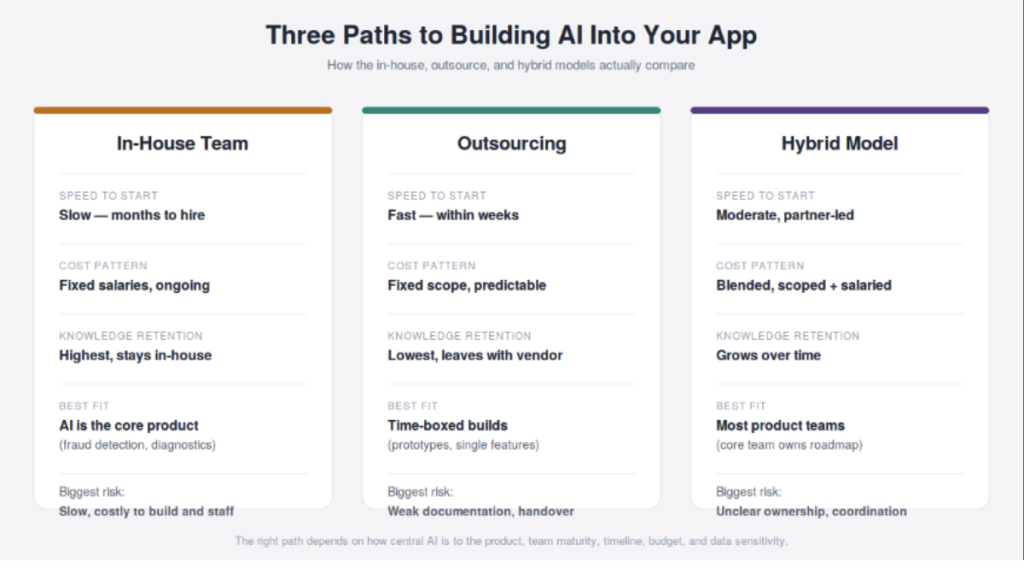
Instead of picking a model based on preference, it helps to ask a few simple questions. How important is AI to the core product? If the business depends on a unique algorithm, building that skill in-house usually makes sense over time. How experienced is the internal engineering team already? What does the timeline actually allow?
A quick six-week prototype leaves little room for hiring, while a multi-year project usually does. What can the budget support, since a fixed-cost outside project is often easier to plan for than hiring full-time staff? And how sensitive is the data involved? Industries like healthcare and finance often need tighter control over where information is stored and processed.
Choosing the Right Partner
If a company decides to bring in outside help, choosing the right partner matters just as much as the decision itself. It’s worth looking at past projects that are genuinely similar in scope, checking references, and confirming the team has real experience with the specific problem at hand, not just general app development. Comparing detailed profiles and past project history of established mobile app development companies is a useful way to build a shortlist before making a final decision. It also helps to ask a few direct questions early on, such as who owns the trained model and code once the project ends, and who is responsible for monitoring the model after it goes live.
Bringing It Together
There’s no single right answer to the in-house, outsource, or hybrid question, and any approach that claims there is should be questioned. The right choice depends on how important AI is to the product, how experienced the internal team already is, what the timeline and budget allow, and how sensitive the data is. What matters most is making this decision on purpose, based on these factors, instead of simply following whatever approach is currently popular. Companies that take staffing as seriously as they take the technology itself tend to build AI features that hold up well after launch. In the end, that matters more than any single decision about how the work got done.