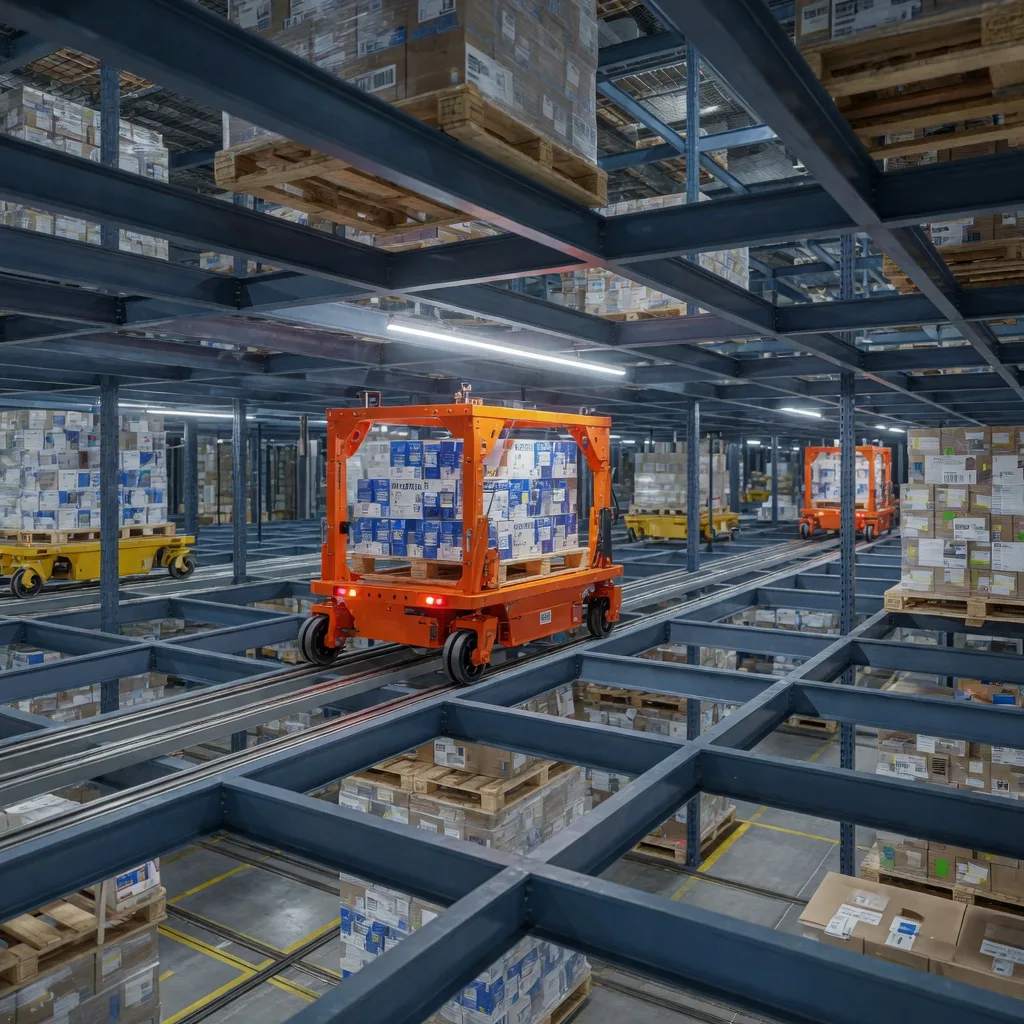
The four-way pallet shuttle represents a fundamental shift in how warehouses manage inventory and optimize storage space. This complete guide explores the technology, capabilities, and practical applications of this new automation solution.
What is a Four-Way Pallet Shuttle?
A four-way pallet shuttle is an autonomous robotic system designed to move palletized goods in all directions—forward, backward, left, and right—within a warehouse environment. Unlike traditional automated storage and retrieval systems (ASRS) that follow fixed pathways, four-way pallet shuttles offer omnidirectional movement capabilities that maximize flexibility and storage density.
The core advantage of four-way movement lies in its ability to navigate tight warehouse aisles without repositioning. This eliminates wasted motion and dramatically reduces cycle times in high-density storage operations. The system integrates smoothly with lift mechanisms to change storage layers, creating a complete automated solution for multi-level warehouse environments.
Atomix Robotics has engineered one of the market’s leading four-way pallet shuttle systems, incorporating advanced autonomous navigation, intelligent path planning, and industrial-grade safety features.
Key Technical Specifications
Load Capacity and Weight Efficiency
A four-way pallet shuttle’s practical utility depends on its load-carrying capacity relative to its own weight. Modern systems like Atomix’s shuttle carry 1,500 kg payloads while maintaining a deadweight of only 330 kg. This 4.5:1 load-to-weight ratio demonstrates engineering excellence and directly impacts operational efficiency.
Higher payload capacity means fewer trips are required to move inventory, reducing energy consumption per unit moved and accelerating throughput. This specification is particularly important for facilities handling standard euro pallets or heavier bulk items.
Speed and Performance
Four-way pallet shuttles operate at different speeds depending on load status:
Unloaded Speed: 1.5 m/s (5.4 km/h)
Loaded Speed: 1.2 m/s (4.3 km/h)
Unloaded Acceleration: 2.0 m/s²
Loaded Acceleration: 0.3 m/s²
These specifications ensure the system maintains productive throughput while protecting cargo integrity. The acceleration rates are calibrated to prevent damage to sensitive goods while keeping operational productivity high.
Battery Life and Energy Efficiency
Battery technology determines operational availability in warehouse environments. A four-way pallet shuttle with 8-hour average battery life can typically cover a full shift without requiring mid-shift charging. Some systems claim 30% higher efficiency compared to alternative solutions, meaning lower energy consumption per pallet moved and reduced operational costs.
Environmental Operating Range
Real-world warehouse conditions vary dramatically. Modern four-way pallet shuttles operate across diverse environments:
Temperature Range: -25°C to 45°C
Cold Storage Capability: Proven operation in frozen goods facilities
Dustproof Design: Compatible with outdoor or heavily contaminated environments
Reliability Metric: MTBF (Mean Time Between Failures) ≥2,000 hours
The ability to operate in cold storage environments (-25°C) opens significant market opportunities in pharmaceutical, food processing, and biotech logistics where temperature control is critical.
Design Innovation: Form and Function
Space-Efficient Architecture
At just 125mm in width, a four-way pallet shuttle is specifically engineered for dense storage environments. This slim profile enables:
Narrower aisle designs (reduction of 20-30% in aisle width)
Higher storage density per square meter of warehouse floor
Existing infrastructure compatibility (works with current racking systems)
Flexible reconfiguration (can adapt to changing warehouse layouts)
The width constraint is strategic—wide systems require broader aisles, consuming cubic space that could store inventory. A 125mm-wide shuttle maximizes usable storage while maintaining safe operational clearances.
Mechanical Versus Electronic Design
Four-way pallet shuttles typically employ either mechanical or electronic lift systems. Mechanical designs offer distinct advantages:
Reduced failure points compared to complex electronic systems
Easier maintenance with straightforward troubleshooting
Lower total cost of ownership over system lifetime
Predictable upkeep costs without surprise electronic component failures
This design philosophy prioritizes reliability and maintainability over advanced electronics, a practical choice for warehouse operations where downtime directly impacts revenue.
Safety Integration
Modern four-way pallet shuttles incorporate multiple safety layers:
Autonomous obstacle avoidance with real-time sensors
Omni-directional alarms (sound and light warnings)
Thermal runaway protection (battery safety threshold ≥500°C)
Fail-safe mechanisms for emergency stops
These safety features address both personnel protection and cargo integrity, essential requirements in shared warehouse environments.
Intelligent Automation Technology
Pathfinding Algorithms
The difference between adequate and strong four-way pallet shuttle performance lies in software optimization. Advanced pathfinding algorithms consider:
Current warehouse congestion patterns
Energy consumption optimization
Task sequencing and prioritization
Collision avoidance calculations
Real-time facility conditions
Systems employing best-in-class pathfinding report 30% efficiency improvements without hardware modifications, purely through software optimization.
Multi-Layer Integration
A four-way pallet shuttle’s ability to work with lift systems transforms storage strategy. The system can:
Navigate multiple storage tiers independently
Execute complex retrieval sequences across layers
Optimize inventory rotation patterns
Support mixed picking and storage operations
This integration capability means a single shuttle can service a warehouse with 8+ meter storage heights, previously requiring multiple dedicated ASRS systems.
Practical Applications and Use Cases
High-Density Storage Operations
Four-way pallet shuttles excel in storage-focused operations where space optimization drives profitability. These systems are ideal for:
Bulk storage facilities
Distribution center overflow management
Seasonal inventory consolidation
Long-term product warehousing
Cold Chain Logistics
The proven operation in -25°C environments makes four-way pallet shuttles essential for:
Frozen food warehouses
Pharmaceutical storage facilities
Biotech inventory management
Specialty chemical warehousing
E-Commerce Fulfillment
Rapid order fulfillment demands fast retrieval cycles. Four-way pallet shuttles support:
High-velocity picking operations
Order batching and consolidation
Returns processing and restocking
Cross-docking operations
Mixed-Mode Warehousing
Many facilities manage multiple inventory types simultaneously. Four-way pallet shuttles accommodate:
Storage mix (different SKU types in same facility)
Handling mix (pallets and cases in unified system)
Picking mix (bulk and piece-pick integration)
Performance Metrics and Reliability
Mean Time Between Failures (MTBF)
An MTBF rating of ≥2,000 hours represents excellent reliability for warehouse equipment. In practical terms:
2,000 hours equals approximately 250 working days (assuming 8-hour shifts)
Annual uptime: 95%+ availability
Maintenance frequency: Scheduled maintenance typically every 3-6 months
This reliability metric demonstrates that four-way pallet shuttle systems are engineered for continuous operation in demanding warehouse environments.
Efficiency Gains
The claimed 30% efficiency improvement translates to measurable business benefits:
Lower energy consumption per pallet moved
Faster cycle times due to optimized pathfinding
Reduced labor requirements through automation
Improved inventory accuracy through consistent handling
Integration with Warehouse Management Systems
Four-way pallet shuttles don’t operate in isolation. Modern systems integrate with:
WMS (Warehouse Management Systems) for task optimization
MES (Manufacturing Execution Systems) for production coordination
Real-time inventory tracking for accurate stock visibility
Analytics platforms for performance monitoring
This integration capability means four-way pallet shuttle data feeds directly into decision-making systems, enabling data-driven warehouse optimization.
Enterprise-Grade Certification
Industry-leading four-way pallet shuttle systems carry CE Full Directive Certification from recognized bodies like SGS. This certification confirms:
Compliance with European machinery safety standards
Electromagnetic compatibility with industrial environments
Functional safety for intended applications
Environmental and material safety standards
CE certification isn’t merely regulatory compliance—it represents validation that the system meets stringent international safety and performance standards.
Cost-Benefit Analysis
Capital Investment
Initial system cost varies based on configuration, but typical four-way pallet shuttle installations require:
Equipment purchase and installation
Warehouse infrastructure modifications (often minimal)
Software integration and training
6-12 month payback periods for many implementations
Operational Savings
Long-term benefits include:
Labor reduction: 30-50% fewer warehouse staff required
Space optimization: 20-30% usable storage increase
Energy efficiency: 30% operational cost reduction
Inventory accuracy: Fewer counting errors and discrepancies
Future Trends in Pallet Shuttle Technology
The four-way pallet shuttle market continues evolving:
AI-powered optimization: Machine learning improves pathfinding over time
Modular systems: Easier integration with existing infrastructure
Sustainability focus: Battery technology improvements reducing environmental impact
Mobile applications: Real-time monitoring and control via smartphones
Predictive maintenance: IoT sensors identifying maintenance needs before failures occur
Selecting a Four-Way Pallet Shuttle System
Key evaluation criteria include:
Load capacity requirements for your specific inventory
Environmental conditions (temperature, humidity, dust levels)
Integration capabilities with existing WMS and systems
Vendor support and global service networks
Scalability for future expansion
Total cost of ownership including maintenance and training
Conclusion
Four-way pallet shuttle systems represent mature, proven technology for warehouse automation. The combination of omnidirectional movement, intelligent pathfinding, high reliability, and easy integration makes them ideal for operations seeking to optimize storage density while improving operational efficiency.
Organizations using four-way pallet shuttle solutions typically realize benefits within 12-18 months, including significant labor savings, improved inventory accuracy, and increased storage capacity. As warehouse automation continues advancing, four-way pallet shuttles remain central to modern logistics strategy.
Whether you operate a high-density storage facility, cold chain warehouse, or e-commerce fulfillment center, four-way pallet shuttle technology offers measurable competitive advantage in today’s demanding logistics landscape.