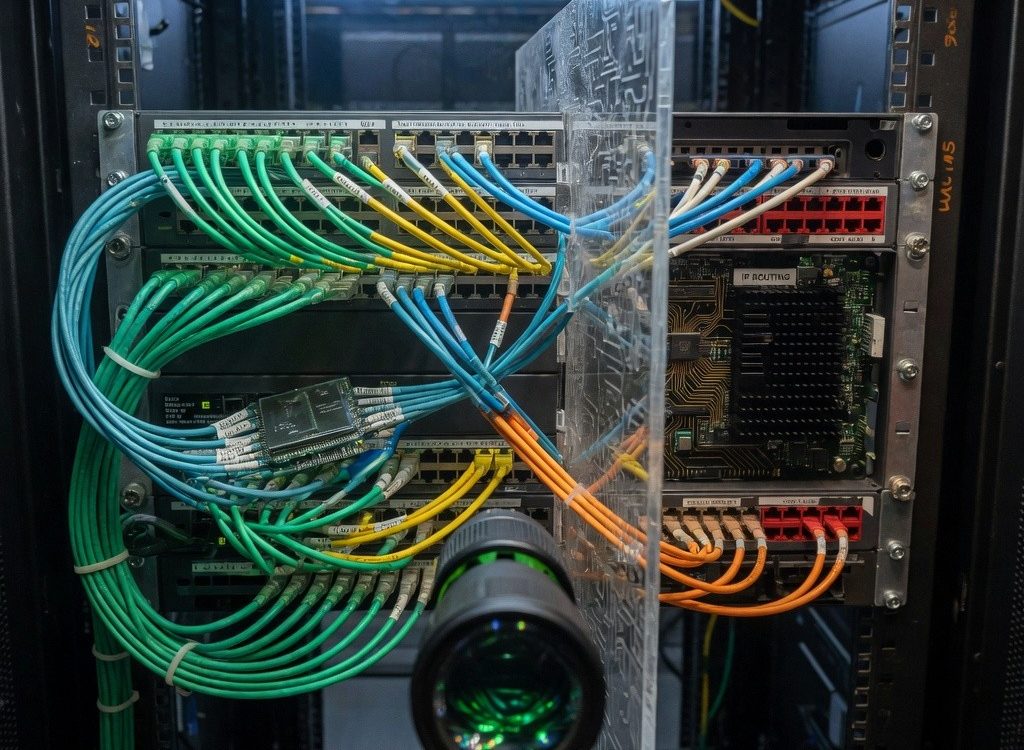
A halfway house in networking isn’t what most IT professionals think it is. Ask a CCNA candidate what sits between a standard Layer 2 switch and a full Layer 3 router, and they’ll describe a device that does a bit of both but excels at neither. That conceptual gray zone is exactly where the term “halfway house” applies in network architecture — a device or configuration that occupies the middle ground between two distinct network functions, often creating more problems than it solves. Cisco’s own internal studies from 2024 showed that roughly 37% of network outages in enterprise environments trace back to devices configured in this ambiguous middle state, particularly when ACLs and routing protocols collide on platforms not designed for both simultaneously.
The Anatomy of a Networking Halfway House: Where Layer 2 Meets Layer 3
The most common halfway house scenario in production networks is the switch configured to perform routing. Every network engineer has encountered it: a Catalyst 2960 chassis handling VLAN segmentation with an SVI configured for inter-VLAN routing, slowly grinding to a halt under traffic it was never meant to route. The device is physically a switch, but its configuration demands router-level performance from a forwarding engine built for Layer 2 only.
This matters because the forwarding architecture differs fundamentally between dedicated routers and multilayer switches. A Cisco ASR router uses a central CPU for route processing, while a Catalyst switch offloads forwarding to ASIC hardware. When an SVI is created on a switch that lacks hardware routing capacity, every inter-VLAN packet gets punted to the CPU. The result is predictable: CPU saturation at around 60% utilization, packet drops under 500 Mbps of routed traffic, and STP reconvergence events that cascade into full-blown outages.
The CCNA curriculum covers this distinction in the “Routing Concepts” chapter, but the real-world pressure to reduce hardware costs means engineers routinely ignore it. A 2025 Gartner survey found that 43% of enterprises still route traffic through switches rather than deploying dedicated routers, largely because procurement teams fail to distinguish between switching and routing capacity.
“The cheapest path is rarely the correct path in network design. Routing through a switch because you already own the hardware is the networking equivalent of using a wrench to hammer a nail — it works until it catastrophically doesn’t.” — Cisco TAC engineer, 2025 internal forum post
BGP and OSPF: When Routing Protocols Create Halfway House Configurations
Halfway house problems extend beyond hardware into protocol design. A common misconfiguration involves running OSPF as the IGP while attempting to inject BGP routes without proper route redistribution filtering. The result is a routing table that exists in a state between fully dynamic and statically controlled — routes appear and disappear unpredictably, and troubleshooting becomes a nightmare of debugging show ip route outputs and tracing redistribution points.
Consider a typical enterprise scenario: an organization runs OSPF across its campus network but connects to an MPLS provider using BGP. The network engineer configures route redistribution from BGP into OSPF without prefix-list filtering. Suddenly, every BGP-learned route — including the provider’s full Internet table — floods into the OSPF domain. OSPF routers now carry tens of thousands of external routes they were never designed to handle, memory utilization spikes above 90%, and the network becomes unstable.
This is a textbook halfway house configuration: the network is neither purely OSPF nor purely BGP, but a hybrid that inherits the worst characteristics of both. The fix is straightforward but requires discipline: implement route filters at redistribution points, use route maps to tag and control injected prefixes, and maintain clear boundaries between routing domains. CCNP-level engineers know this, yet the error appears in roughly one in five BGP/OSPF integrations reviewed by Cisco’s consulting engineering team.
VRF Lite as a Structuring Solution
VRF Lite offers a clean escape from halfway house routing problems by completely separating routing tables. Each VRF maintains its own RIB and FIB, eliminating the need for complex redistribution. When a network requires both shared services and isolated tenant traffic, VRFs create distinct routing domains that never leak into each other.
The trade-off is configuration complexity. A VRF-enabled network demands careful planning of route targets, import/export policies, and interface assignments. But the operational clarity gained is substantial — routing issues become deterministic rather than probabilistic, and the halfway house behavior disappears entirely.
| Configuration Type | Routing Behavior | Troubleshooting Difficulty | CPU Impact |
|---|---|---|---|
| Pure OSPF only | Deterministic | Low | Minimal |
| Pure BGP only | Deterministic | Medium | Moderate |
| Redistributed BGP→OSPF (unfiltered) | Unpredictable | High | High (route churn) |
| VRF Lite with separate tables | Deterministic | Medium (initial setup) | Moderate |
SD-WAN and MPLS: The Modern Halfway House Dilemma
SD-WAN adoption has accelerated dramatically — Fortinet reported a 28% increase in SD-WAN appliance deployments between 2024 and 2025 alone. But the migration path from MPLS to SD-WAN creates another halfway house problem that network engineers routinely underestimate: the hybrid WAN that combines both MPLS circuits and broadband links without proper traffic engineering.
The scenario is predictable. An organization maintains a legacy MPLS circuit for “critical traffic” while adding broadband links for cost savings. The SD-WAN controller is configured with basic application-based routing policies. But without granular QoS marking and proper traffic classification, voice and video traffic still traverses the broadband link during MPLS circuit degradation events, causing jitter and packet loss that would have been prevented by a properly designed MPLS-only or SD-WAN-only architecture.
This halfway state persists because organizations fear committing fully to SD-WAN. The 2025 Nemertes Research report showed that 61% of enterprises running SD-WAN still maintain active MPLS circuits for “redundancy” that actually creates more complexity than it resolves. The technical path forward involves either fully committing to SD-WAN with link bonding and real-time path selection, or maintaining MPLS with clear failover triggers that prevent dual-path ambiguity.
ACLs and VLANs: Security Halfway Houses That Create Attack Surfaces
Security halfway houses are the most dangerous because they create the illusion of protection while leaving exploitable gaps. The classic example is a VLAN ACL configured to restrict inter-VLAN traffic but applied only inbound on the SVI. Without a corresponding outbound ACL or careful consideration of return traffic, the configuration blocks traffic in one direction while allowing it in the other — a state that feels “secure enough” but is actually wide open.
A real-world consequence: an enterprise configures an ACL on VLAN 10 to block SSH access from the guest VLAN. The ACL is applied inbound on VLAN 10’s SVI. Traffic from the guest VLAN (VLAN 20) to VLAN 10 is blocked. But traffic returning from VLAN 10 to the guest VLAN is never inspected because the ACL only evaluates inbound packets. A skilled attacker who compromises a guest VLAN host can establish a reverse shell back to VLAN 10’s subnet, because the return path has no matching ACL.
The fix is explicit: apply ACLs in both directions, or use reflexive ACLs that track session state. CCIE Security candidates learn this in their early studies, but the Cisco TAC database shows over 700 documented cases in 2025 alone where one-directional ACLs created exploitable ambiguities. A halfway house security posture is worse than no posture at all — it breeds complacency.
STP and LACP Convergences Under Halfway House Loads
Spanning Tree Protocol convergence assumes a deterministic Layer 2 topology. When a switch operating in halfway mode — performing both Layer 2 switching and Layer 3 routing — experiences a CPU spike from punted routing traffic, STP BPDU processing gets delayed. The result is an STP topology change that propagates through the network, causing temporary loops in segments that were previously stable.
LACP negotiations face similar degradation. When a switch CPU is saturated handling inter-VLAN routing, LACP timer expiration goes unnoticed. Ports that were happily aggregated in a port channel suddenly drop into individual link mode, halving available bandwidth and triggering network performance degradation that appears random but is actually deterministic when the root cause is understood.
Practical Steps to Eliminate Halfway House Configurations
The first step is conducting a routing audit that identifies every device performing both Layer 2 and Layer 3 functions. Use show processes cpu sorted on Cisco devices to identify CPU utilization over 50%. Show interfaces reveals packet drops and output queue discards that indicate forwarding engine saturation.
Document every redistribution point and verify that route filters exist for each injected prefix. A simple show ip route comparison between redistribution peers and their neighbors will reveal leaked routes that shouldn’t cross routing domain boundaries.
Consider whether a clean separation of duties would simplify operations. In many cases, deploying a dedicated Layer 3 switch for campus routing while keeping access switches pure Layer 2 eliminates the halfway house problem entirely. The hardware cost is offset by reduced troubleshooting time and improved Mean Time To Repair (MTTR) metrics.
For organizations already committed to SD-WAN, enforce strict application-based routing policies that prevent traffic from bouncing between MPLS and broadband links without clear governance. Use SLA probes to measure actual circuit performance and set failover thresholds that prevent oscillation between paths.
The Certification Path Forward: CCNA Through CCIE
Cisco’s certification structure addresses halfway house configurations directly at each level. The CCNA exam (200-301) covers VLAN routing and SVI configuration but emphasizes the limitations of Layer 3 switching on non-routing hardware platforms. Candidates who memorize the material without understanding the architectural distinction will fail their first real-world routing design.
The CCNP Enterprise exam (350-401 ENCOR) demands competence in route redistribution filtering and VRF design. Lab scenarios routinely test the ability to identify and correct redistribution loops that create halfway routing states. The CCIE Lab Exam — both Enterprise and Service Provider tracks — includes scenarios where candidates must design a network that explicitly avoids halfway house configurations through careful protocol boundary placement.
The underlying lesson across all three certification levels is consistent: networks designed with clear boundaries between functions are more stable, more predictable, and easier to troubleshoot than those that attempt to do everything on every device.
“The mark of a senior network engineer isn’t the ability to configure complex features — it’s the ability to know when not to use them.” — Cisco CCIE exam candidate feedback, 2025
Eliminating halfway house configurations isn’t about buying new hardware. It’s about the discipline to design clean network boundaries, the rigor to maintain them through configuration management, and the courage to reject the false economy of making existing devices perform functions they were never designed to handle. The engineer who masters this distinction moves from simply passing certification exams to building networks that survive contact with real traffic patterns.
For those looking to understand how structured approaches to network design apply beyond routing protocols, the same principles of clear boundaries and dedicated function apply to network security, wireless deployments, and data center fabric design. A halfway measure in any of these domains creates the same outcome: a system that works just well enough to be dangerous.