Sponsored Content Disclosure: This article is sponsored content published in connection with Gold Leaf MD. It contains a link to Gold Leaf MD. The information is for general informational purposes only and does not constitute legal or medical advice.
A change to Schedule III could matter in Maryland, but not in one simple way. The practical stakes are less about symbolism than about which federal rules actually change next.
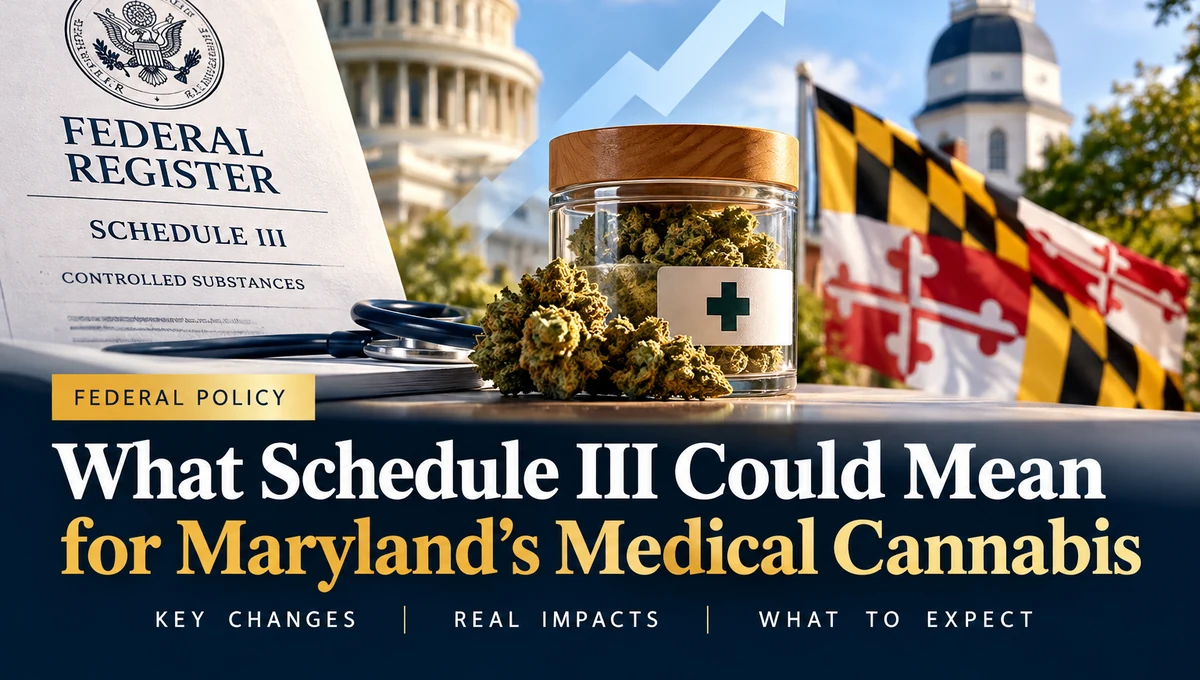
A 2026 Federal Register final rule already placed certain FDA-approved marijuana products and marijuana subject to state medical marijuana licenses in Schedule III, while a separate broader rescheduling proceeding remains focused on the proposed transfer of marijuana from Schedule I to Schedule III.
That leaves patients and dispensaries with a mixed outlook, not a clean reset. The key questions are narrower and more useful: taxes, banking, insurance, federal exposure, and whether Maryland’s state-run system changes at all.
Federal scheduling changes may ease some pressure, yet they would not automatically remake medical cannabis in Annapolis.
01 What Schedule III Would Actually Change Under Federal Drug Law
At the federal level, the clearest proposed change would be cannabis moving from the Drug Enforcement Administration’s most restrictive Schedule I category to the less restrictive Schedule III category. This shift matters because the legal baseline would change.
Cannabis would remain a controlled substance, but Schedule III would place it in a less restrictive federal category than Schedule I. The existing 2026 final rule also demonstrates that federal authorities can place certain medical marijuana products and state-licensed medical marijuana within Schedule III without creating full federal legalization.
Still, rescheduling is not the same as full legalization. It would not erase federal control or automatically rewrite every rule affecting patients, products, dispensing, or state programs. The practical takeaway is narrow but important.
Federal law could become less restrictive in kind, not irrelevant in practice. For patients and operators tied to medical cannabis in Annapolis, the key is watching for follow-on policy changes.
One scheduling decision would not settle the entire system.
02 Would Maryland’s Medical Cannabis Rules Change Automatically or Stay State-Run?
More likely, Maryland’s medical cannabis framework would remain state-run unless Maryland changes it. A federal move involving Schedule III would change the national baseline. It would not instantly rewrite state licensing, patient registration, product standards, or dispensing rules.
That distinction matters because Maryland’s program operates through its own laws and regulators. Patients in Annapolis should not assume new purchase rules, broader access, or different paperwork on day one.
The same caution applies to medical cannabis dispensary operators. Federal scheduling changes could encourage states to revisit parts of their systems over time. That pressure could matter most where state rules were built around older federal assumptions.
Still, pressure is not the same as automation. Any real shift inside Maryland would depend on state action, agency guidance, or both. The practical reading is simple: watch Maryland rulemaking as closely as federal developments.
For now, a broader federal scheduling change would trigger review, not flip the whole Maryland program overnight.
03 Why Rescheduling Matters Most for Dispensaries’ Taxes and 280E
Taxes are the place where rescheduling could matter most for dispensaries, if federal tax treatment changes with it. That is because tax rules hit the basic math of the business: payroll, rent, compliance work, security, and other operating costs.
A legal shift can sound dramatic, but a tax shift is what changes margins. That potential relief still should not be overstated. Lower tax pressure would not automatically mean lower prices for Maryland patients.
A medical cannabis dispensary might use any savings to stabilize cash flow, pay debt, add staff, improve inventory control, or absorb ongoing regulatory costs. In other words, the benefit could show up first on the business side, not at the register.
This is also where timing matters. Rescheduling alone would not guarantee instant tax relief in practice. The practical question is how federal tax rules are applied after any scheduling change. For Maryland operators, that makes tax guidance more important than the headline itself.
04 Could Maryland Cannabis Businesses Gain Easier Banking and Insurance Access?
Federal rescheduling would change the legal backdrop. However, Maryland operators should not view it as a promise of easier banking or wider insurance options. Those markets follow lender and insurer risk rules, underwriting, and compliance reviews.
They do not follow one headline change alone. Some institutions may see Schedule III as a reason to review their policies. Others may wait for clearer federal guidance, examiner signals, or evidence that compliance burdens have fallen.
This distinction matters because access problems are rarely all or nothing. A business might receive better terms, find more willing vendors, or face fewer workarounds. Yet fully mainstream services could remain out of reach.
Any effect, if it comes, would likely develop gradually. That makes the issue similar to taxes: follow-through matters more than the headline. For Maryland dispensaries, measured optimism is the most useful conclusion.
Rescheduling could open doors, but banks and insurers would still decide how, when, and whether to respond.
05 What Rescheduling Would Not Do for Interstate Sales, Shipping, or Travel
For now, the safer reading is narrow: rescheduling alone would not make interstate sales, shipping, or travel routine for Maryland patients or dispensaries. These questions involve more than cannabis changing schedules.
They also depend on specific federal rules that still apply to marijuana-related conduct. A Schedule III classification would not by itself create a national retail market or establish a general permission to move medical cannabis across state lines.
Those limits point in the same direction. A Schedule III move could change parts of the federal legal framework. Yet it would not automatically create a national market or a simple path for carrying products across state lines.
Timing adds another constraint. The broader proposed rescheduling proceeding has continued through formal administrative proceedings rather than producing an across-the-board federal legalization measure. For Maryland readers, the practical takeaway is clear: do not treat Schedule III as permission for cross-border movement under federal law.
06 Would Patients See Lower Prices, Better Access, or New Restrictions?
Price cuts and broader access would be possible, but neither would be automatic. A Schedule III change would alter one part of the legal setting. It would not change every cost or rule shaping Maryland’s medical cannabis market.
Retail prices could fall only if savings or new efficiencies reach patients. Businesses might instead use relief to cover compliance, staffing, inventory, or other operating needs. Access could improve through steadier operations or a smoother supply picture inside Maryland.
Yet that would not guarantee new products, looser purchase rules, or simpler cross-border options. Restrictions also could shift rather than simply fade. A less restrictive federal classification can invite closer review of how products are made, labeled, or handled.
That may help clarify regulatory expectations while adding new process burdens. The clearest takeaway is modest: patients and dispensaries should expect mixed effects. Gains likely would arrive unevenly and only after follow-on policy decisions.
07 Could Insurance Start Covering Medical Cannabis Under Schedule III?
Insurance coverage is the place to stay cautious. A move to Schedule III could make coverage easier to discuss, but it would not make payment automatic for Maryland medical cannabis patients. Health plans do not start covering a product simply because one federal classification changes.
Coverage usually turns on later decisions about benefit design, reimbursement rules, product status, and payer risk. That creates a real gap between legal change and practical payment. Even if rescheduling improves the federal framework, insurers could still wait for clearer guidance on what qualifies for coverage and how claims should be processed.
Some costs might become easier to discuss inside mainstream health systems before they become reimbursable. Those are not the same step. The most defensible conclusion is narrow. Schedule III could open the door to future coverage conversations, but patients and dispensaries should not expect insurers in Maryland to start paying for medical cannabis on rescheduling alone.
08 How Federal Law Exposure Would Change for Patients, Caregivers, and Operators
Exposure is the right lens for this part of the question. A Schedule III move could lower some federal pressure without clearing the field. That is because patients, caregivers, and operators do not face one rule set.
They face overlapping rules, policies, contracts, and risk reviews. In Maryland, that would likely leave a mixed picture after any broader rescheduling. Some activities could look less restrictive under one federal standard.
The same people could still face limits under another standard. That split matters most for operators with licenses, payroll, vendors, and compliance duties. It also matters for patients and caregivers who assume lower scheduling means broad protection.
A narrower reading is safer. Rescheduling could reduce certain forms of federal law exposure, yet it would not make exposure uniform or irrelevant. The practical takeaway is to treat any broader Schedule III change as partial relief, not a full legal shield, until later rules and enforcement positions make the boundary clearer.
09 Would Research, Labeling, and FDA Oversight Shift in Practice?
Readers should expect the biggest changes here to arrive slowly, if they arrive at all. A Schedule III shift would change an important federal classification. It would not, by itself, answer every practical question about research, labeling, or oversight.
Those subjects usually depend on later agency action, technical standards, and compliance expectations. In Maryland, that means patients and medical cannabis dispensaries could hear a major federal headline while daily operations stay familiar for a while.
Research may become easier to discuss in mainstream channels before study pathways actually feel simple. Labeling may draw closer scrutiny without producing one immediate national label rule. Federal oversight could also become more visible in some parts of the market while state oversight still handles the day-to-day program.
That mix matters. It suggests federal legitimacy and operational clarity may develop at different speeds. The most useful conclusion is narrow: treat rescheduling as a possible starting point for regulatory change, not as proof that research rules, labels, or federal review would instantly reset.
Schedule III Would Be a Change, Not a Full Reset
Maryland patients and dispensaries should view Schedule III as partial relief, not a full reset. The change could ease some federal pressure. Over time, it could improve the tax picture for operators and support broader regulatory legitimacy.
It could also support future policy review. Still, Maryland’s program would remain state-run unless Maryland changes it. Rescheduling alone would not guarantee lower prices, insurance coverage, easier banking, interstate sales, or immediate new access.
The main limit is simple: one federal classification change cannot automatically rewrite the many rules, payment systems, and risk decisions surrounding medical cannabis in Annapolis. The clearest takeaway is measured expectation, not sweeping change.