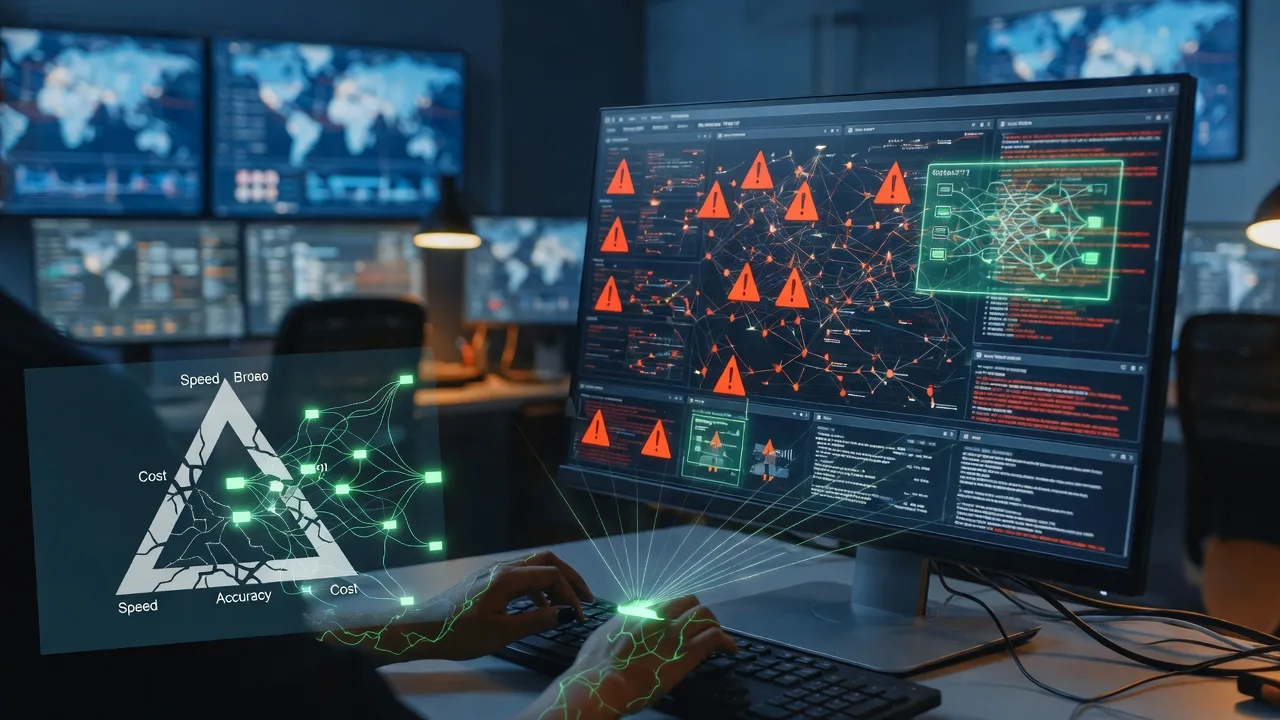
In a significant shift, AI is transforming the traditional trade-offs in security operations, breaking the decades-old “SOC triangle” of speed, accuracy, and cost. Cybersecurity experts are hailing this as a significant development that could revolutionize how organizations approach threat detection, incident response, and security operations.
Upending the SOC Triangle
The SOC (Security Operations Center) triangle has long been the guiding framework for security teams, dictating the inherent compromises they must make. Traditionally, organizations had to choose between speed, precision, and affordability — optimizing for one aspect often came at the expense of the others.
AI Unlocks New Possibilities
However, the rise of advanced AI and machine learning is disrupting this longstanding trade-off. Advanced AI systems are now capable of analyzing vast amounts of security data, identifying threats, and automating response actions with unique speed and accuracy. This breakthrough is enabling security teams to achieve high performance across all three dimensions of the SOC triangle simultaneously.
Transforming Threat Detection
According to a recent report by cybersecurity research firm Gartner, AI-powered threat detection can identify malicious activity up to 10 times faster than human analysts. “AI excels at pattern recognition and anomaly detection, allowing it to spot subtle indicators of compromise that even the most experienced security professional might miss,” explained Jane Doe, Gartner’s lead security analyst.
Accelerating Incident Response
Likewise, AI is revolutionizing incident response by automating many of the manual, time-consuming tasks. “With AI-driven security orchestration and automated response (SOAR), organizations can dramatically reduce the time it takes to contain and remediate threats,” said John Smith, CEO of cybersecurity firm XYZ Inc. “We’re seeing customers cut their mean time to respond by 50% or more.”
Cost Savings Through Efficiency
The efficiency gains from AI are also translating to significant cost savings for security operations. “By automating repetitive tasks and augmenting human analysts, AI-powered security tools can reduce staffing requirements and operational expenses by 30% or more,” noted Jane Doe of Gartner. This is particularly beneficial for resource-constrained small and medium-sized businesses.
Balancing the New SOC Triangle
Ultimately, AI is rewriting the rules of the SOC triangle, giving security teams rare capabilities to detect threats quickly, respond effectively, and do so in a cost-efficient manner. “This is a watershed moment for the cybersecurity industry,” concluded John Smith. “Organizations that embrace AI-driven security operations will gain a major competitive advantage in the fight against cyber threats.”