
If you’ve searched for a “P Bay proxy,” you already know what The Pirate Bay is and you’re probably looking for a way around a block — whether that’s your ISP, your school or workplace network, or a government-level restriction in your country. What most of that search traffic doesn’t find is a clear explanation of what’s actually happening on the other end of those proxy links, and why the security risks involved are a lot more serious than most people assume.
This isn’t a moral lecture about piracy. It’s a straightforward look at the technical and security reality of Pirate Bay proxy sites, aimed specifically at explaining what you’re exposing yourself to — because the people who run these proxies aren’t doing it for free, and understanding how they actually make money changes how risky this looks.
What a “P Bay proxy” actually is
The Pirate Bay is one of the world’s most well-known torrent index sites — it doesn’t host pirated files itself, but it indexes torrent links that let users download copyrighted movies, TV shows, music, software, and games without authorization. Because of that, the original site has been blocked at the ISP level in dozens of countries following court orders, and it’s been seized, relaunched, and re-blocked repeatedly over more than a decade.
A “proxy” in this context is a third-party site that mirrors The Pirate Bay’s content and sits at a different web address, letting visitors reach the same torrent listings without directly connecting to the blocked domain. There isn’t one official proxy — there are hundreds of them, run by unrelated, often anonymous operators, with no consistent ownership, security standard, or accountability from one to the next.
That last point is the whole problem.
Why these sites are a genuine cybersecurity risk, not just a legal one
Nobody is vetting these proxy operators. The original Pirate Bay site, whatever you think of its purpose, has been run by a relatively consistent set of people for years. A proxy mirror, by contrast, can be spun up by literally anyone — including people whose actual goal is to profit off of visitors, not to provide free access to a blocked site. Because proxy sites trade on a well-known brand name to attract traffic, they’re a natural target for exactly the kind of bad actor who wants a constant stream of visitors clicking on things without asking many questions.
Malicious advertising is the primary business model. Legitimate ad networks generally won’t work with sites built around indexing pirated content, so many proxy sites rely on lower-tier ad networks that are far more tolerant of malicious or deceptive ads — fake “your download is ready” buttons, fake virus warnings urging you to install “cleanup” software, and pop-unders that open new tabs without any click at all. Security researchers have documented this pattern across torrent-adjacent sites for years: the ad inventory itself becomes the attack vector, regardless of whether the file you were looking for even exists.
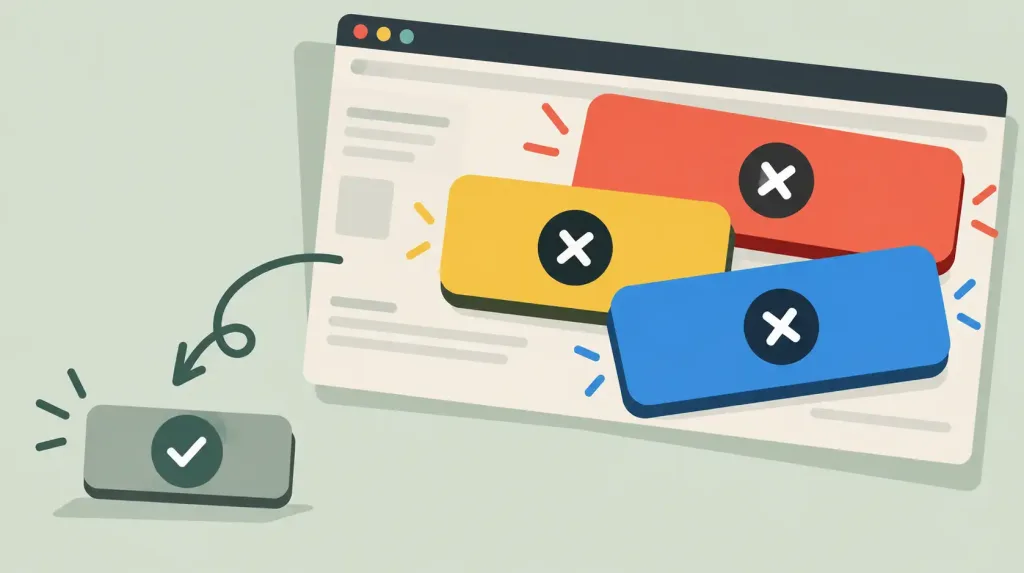
Fake download buttons are a specific, well-documented trick. On many torrent and proxy sites, the actual magnet link or torrent file is a small, often hard-to-spot element on the page, while several large, brightly colored “Download” buttons scattered around it are actually ads. Clicking one of these can trigger a drive-by download, redirect you through a chain of increasingly sketchy sites, or prompt a fake browser update that’s actually malware.
Some proxies exist purely to harvest traffic and data, with no real content behind them. Because “Pirate Bay proxy” is a high-volume search term, some sites are built specifically to rank for it and capture visitors, without providing any genuine functionality — instead pushing visitors through survey scams, fake antivirus software, browser extension installs that hijack search settings, or phishing pages disguised as login screens.
Cryptojacking scripts have shown up repeatedly on torrent-adjacent sites. This is a specific, documented pattern: a site embeds JavaScript that uses a visitor’s CPU to mine cryptocurrency for the site operator while the page is open, without consent or disclosure. It doesn’t steal your data, but it can noticeably slow down your device and increase power consumption, and it’s a good indicator of the kind of site you’re dealing with.
Browser hijacking and unwanted extensions are common outcomes. A number of proxy sites push “install this extension to continue” prompts that, once installed, redirect your searches, inject additional ads into every site you visit, or track your browsing activity for resale to data brokers — a much broader and more persistent compromise than anything related to the file you were originally trying to find.
Why the risk is higher precisely because you’re trying to bypass something
There’s a specific dynamic worth understanding here: when you’re actively trying to get around a block, you’re often more willing to click through security warnings, dismiss antivirus alerts, or install something you’d normally hesitate over, because your attention is on reaching the content rather than evaluating the site itself. Threat actors who build these proxy pages understand this and design around it — the entire user journey is optimized to get you clicking quickly, which is exactly the mental state that makes people bypass their own better judgment about suspicious downloads and prompts.
The legal exposure is real too, and separate from the security risk
Using a proxy to reach The Pirate Bay doesn’t change what happens once you’re there: downloading copyrighted material without authorization is still copyright infringement in most jurisdictions, and a proxy doesn’t anonymize your connection — it only routes around a domain-level block. Your ISP can typically still see that you’re using BitTorrent traffic (the protocol itself is visible even when the specific site isn’t), and rights-holder organizations in several countries actively monitor torrent swarms and send infringement notices or, in some jurisdictions, pursue legal action against individual IP addresses. A proxy addresses the “the site won’t load” problem; it does nothing about the “am I exposed” problem.
Why this matters more for the 18–24 age group specifically
This age group is disproportionately represented in both torrent-site traffic and in survey/study data on privacy-related cybercrime victimization, for a few consistent reasons: heavier use of torrent and streaming-proxy sites generally, higher rates of using shared or personal devices without enterprise-grade security software, and — often — less financial cushion to absorb the cost of a compromised bank card, a ransomware demand, or the time cost of cleaning a hijacked device. Younger users are also more likely to be juggling multiple devices (phone, laptop, sometimes a shared family or roommate computer), which means a single bad click can have a wider blast radius than it might for someone using one well-secured device.
What actually reduces this risk (short of avoiding these sites entirely)
If you’re going to be anywhere near this part of the internet, a few practical habits meaningfully cut your exposure:
- Use a dedicated, up-to-date ad blocker. Malicious ads are the single most common attack vector on these sites, and a good ad blocker removes most of that surface entirely.
- Never install a browser extension or “player update” prompted by the site itself. Legitimate video players and browsers update themselves — a page telling you that you need to install something to proceed is a red flag on virtually any site, but especially here.
- Keep antivirus/anti-malware software active and updated, and don’t dismiss its warnings reflexively just because you’re trying to reach a page quickly.
- Never enter login credentials, payment details, or personal information on a proxy site, even if it looks like a familiar login page — credential-phishing pages are a known pattern on sites that already trade in this kind of low-accountability traffic.
- Understand that a proxy is not a VPN. A proxy just changes which address you’re hitting to reach mirrored content; it doesn’t encrypt your traffic or hide your torrenting activity from your ISP. Conflating the two is one of the most common misunderstandings in this space.
The legitimate alternatives actually solve the underlying problem
For most of what people are looking for when they land on a torrent proxy, there’s now a legal option that’s genuinely competitive on convenience:
- Streaming services (Netflix, various regional and library-linked platforms) cover a large share of mainstream film and TV demand for a monthly cost that’s often lower than the realistic cost of a compromised device or a legal notice.
- Public library digital lending (through apps like Libby/OverDrive, or equivalent services in many countries) provides free, completely legal access to a large range of ebooks, audiobooks, and in some regions, films and music.
- Bandcamp and artist-direct platforms let you pay musicians directly, often for less than a single streaming month’s subscription cost, for permanent downloads.
- itch.io and similar platforms offer a large catalog of games, including many free and pay-what-you-want titles, directly from developers.
- Free, ad-supported legal streaming platforms (such as Tubi, Pluto TV, and similar services depending on your region) cover a genuine amount of film and TV content at zero cost, with none of the malware risk profile of a torrent proxy.
None of these fully replicate the exact catalog a torrent index offers, but the security and legal trade-off is worth being honest about: the “free” content on a proxy site often comes with a real cost in security risk that the alternatives simply don’t carry.
Frequently asked questions
Is using a Pirate Bay proxy illegal?
Accessing a proxy site itself generally isn’t illegal in most places, but downloading copyrighted material through it typically is, regardless of which domain you used to get there.
Does a proxy hide my identity or torrenting activity?
No. A proxy only routes around a domain-level block; it doesn’t encrypt your connection or hide your torrent traffic from your ISP the way a VPN does.
Why are there so many different Pirate Bay proxy sites?
Because the original site gets blocked repeatedly across different countries, third-party operators — with no consistent ownership or accountability — set up mirror sites to keep traffic flowing, often profiting from ad revenue in the process.
What’s the most common way people get infected through these sites?
Malicious or deceptive advertising — particularly fake “Download” buttons and fake software-update prompts — is the most consistently documented infection vector on torrent-adjacent sites.
Is a VPN enough to make this safe?
A VPN can mask your IP address from your ISP and from rights-holder monitoring, which addresses part of the legal exposure, but it does nothing to protect you from malicious ads, fake download buttons, or phishing pages on the proxy site itself. VPN and antivirus/ad-blocking protection address two different risk categories.
The bottom line
A “P Bay proxy” isn’t a single trustworthy tool — it’s an unregulated category of mirror sites run by unknown operators, many of whom profit specifically from the kind of traffic that clicks quickly and doesn’t ask questions. The legal risk is real, but the more immediate and more commonly realized risk is technical: malicious ads, fake downloads, browser hijacking, and credential phishing, all concentrated on exactly the kind of site engineered to make you drop your guard. Understanding that trade-off — and knowing that legitimate alternatives have closed most of the convenience gap — is worth more than any specific proxy link ever was.