A call arrives from an unfamiliar +353 number. You don’t answer. It rings twice more, then stops. If you’ve been in this situation recently, you’re not alone — and the stakes are higher than most people realise.
According to the Banking & Payments Federation of Ireland’s FraudSMART initiative, 52% of Irish adults receive scam calls at least once a month. Provisional Garda data from 2025 shows fraud offences rose 137% year-on-year, with deception offences up 273%. Whether the unknown number is a Wangiri one-ring scam, a spoofed Dublin landline, or a vishing attempt impersonating Revenue or An Garda Síochána, you need a reliable way to check before you call back.
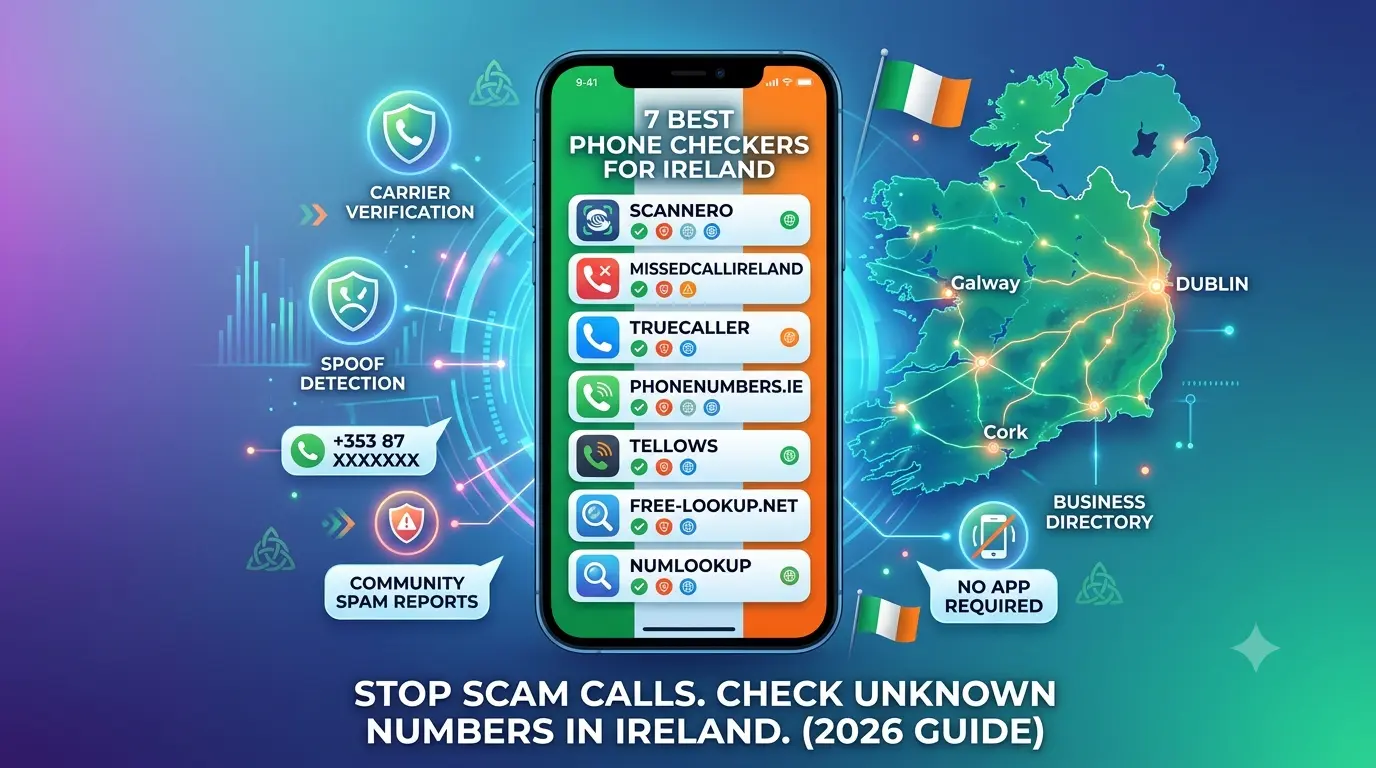
A dedicated phone number checker Ireland gives you that ability. This guide covers the 7 best tools for reverse phone lookup in Ireland in 2026 — including which ones handle spoofed numbers, which are genuinely free, and which give you the most useful data before you decide whether to pick up.
Why Identifying Unknown Irish Callers Matters in 2026
Ireland’s phone infrastructure creates lookup challenges that generic global tools aren’t built to handle. Mobile numbers can be ported between carriers with no external indication, prepaid SIMs remain available with minimal registration requirements, and VoIP numbers beginning with 076 are increasingly used by both legitimate businesses and fraudsters trying to appear local.
Caller ID spoofing is particularly widespread. Fraudsters manipulate the displayed number to appear as a trusted Irish or international number — including Revenue Commissioners, banks, and government lines. The Commission for Communications Regulation (ComReg) has begun using network-level interventions, but user-level verification tools remain the most immediate defence available.
The specific threats Irish users face include:
- Wangiri scams — one-ring calls from international numbers designed to prompt a callback to a premium-rate line
- Revenue and An Garda Síochána impersonation calls
- Spoofed bank numbers requesting verification of account details
- VoIP-based telemarketing with false Irish prefixes
- International vishing campaigns targeting Irish mobile users
What to Look for in a Phone Number Checker for Ireland
Not all reverse lookup tools are built equally for the Irish market. Before choosing one, check for:
- Ireland-specific database coverage — a tool indexing primarily US numbers gives minimal value for +353 lookups
- Carrier identification — knowing whether a number is Vodafone, Eir, Three, or a VoIP provider is a fast red flag check for spoofed calls
- Spoofed number detection — the ability to flag whether a number’s displayed carrier matches its actual allocation
- No-app requirement — web-based tools let you check a number without installing anything or granting permissions
- Community spam reports — crowd-sourced ratings from other Irish users who have already received calls from the same number
The 7 Best Phone Number Checker Tools for Ireland
Here are the seven most effective tools for Irish phone number lookup in 2026, ranked by depth of Ireland-specific coverage and practical utility.
1. Scannero — Reverse Lookup with Carrier Verification
You’ve just received a missed call from a number you don’t recognise. It could be a legitimate business, a spam centre, or a spoofed line impersonating a local number. Before calling back, you need carrier and ownership data — not just a community vote. Scannero handles this without requiring you to download anything.
Scannero is a web-based reverse phone lookup platform that cross-references any entered number against its database to surface available ownership details and carrier information. For Irish users, its most useful feature is its dedicated Ireland lookup section, which maps Irish number prefixes by carrier and region — allowing you to immediately check whether a number’s claimed origin matches its actual network allocation. A +353 1 number showing as registered to a VoIP provider rather than a landline carrier, for example, is a clear indicator worth investigating further.
Key features:
- Reverse phone lookup for Irish mobile and landline numbers including +353 prefixes
- Carrier identification: cross-references numbers against known Irish network allocations (Eir, Vodafone, Three, VoIP providers)
- Spoofed number detection: flags mismatches between displayed caller ID and actual carrier registration
- No app download required — fully web-based, results in seconds
- Dedicated Ireland section with Irish number prefix breakdowns by region and network
- Scam call database with user-submitted reports for known Irish spam numbers
Pricing: Scannero operates on a paid-per-search model at a low cost per lookup, with no subscription required for basic access. A free preview of number type and country data is available before purchase.
Pros:
- Handles spoofed and international numbers that target Irish users — exactly the category most likely to be involved in fraud
- No installation or account creation required, active in under two minutes
- Ireland-specific prefix data that most global tools do not include
- Carrier verification adds a layer that community-report-only tools cannot provide
Cons:
- Full ownership details require payment; not a completely free option
- Coverage depth depends on the number’s history in the database
Who it’s best for: Irish users who receive calls from unknown, spoofed, or international numbers and need carrier-level data, not just community votes. Particularly useful for anyone targeted by Revenue or bank impersonation scams.
Unlike most reverse lookup tools that rely solely on crowd-sourced reports, Scannero combines database cross-referencing with carrier-level verification — a distinction that matters when the number in question has never been reported but the caller ID looks suspicious. Visit scannero.com/who-called-me/ireland/ to check an Irish number directly.
2. MissedCallIreland.com — Ireland-Only Free Lookup
For anyone asking who called me Ireland after a missed call from a domestic number, MissedCallIreland.com is the natural first stop. It is a reverse phone number lookup service built exclusively for the Republic of Ireland, free to use, with a database of over 900,000 numbers.
Key features:
- Community-submitted caller reports from Irish users
- Search any +353 number and view comments, ratings, and scam flags
- Particularly strong for telemarketing numbers and recurring nuisance callers
Pricing: Free.
Pros:
- Entirely Ireland-specific — no noise from global data irrelevant to Irish users
- Strong community database for commonly reported scam lines
- No account required
Cons:
- Relies entirely on community reports — new or rarely reported numbers return no data
- No carrier identification or technical verification capability
Best for: Anyone wanting a free, Ireland-specific first check on a missed call from a known domestic number.
3. Truecaller — Global Spam Database
Truecaller’s value for Irish users lies in its global scale. The platform flagged 68 billion spam and fraud calls in 2025, meaning international vishing campaigns that also target Irish residents are frequently already flagged in its database before local tools have registered the number.
Key features:
- Global caller ID and spam tagging across hundreds of millions of users
- Real-time spam classification with manual number search
- Block list and call screening built into the app
Pricing: Free with a premium tier (Truecaller Premium) at approximately €2.50/month, which adds ad-free experience, who viewed your profile, and faster spam detection updates.
Pros:
- Strongest coverage for international numbers that target Irish users cross-border
- Real-time caller ID for incoming calls when the app is installed
- Established database with genuine scale behind spam classifications
Cons:
- Requires app installation and account creation — not a web-based lookup
- Less useful for identifying Irish-specific numbers that haven’t been reported internationally
Best for: Irish users who want real-time caller ID screening and receive a high volume of international spam calls.
4. PhoneNumbers.ie — Irish Business Directory Lookup
PhoneNumbers.ie is a telephone directory search service built specifically for the Irish market, covering both mobile and fixed-line numbers. It is most effective for identifying calls from Irish businesses, tradespeople, and registered entities — particularly landline numbers with established directory listings.
Key features:
- Searchable Irish telephone directory for mobile and landline numbers
- Business name and address data where available
- Reverse lookup by number for directory-listed contacts
Pricing: Free.
Pros:
- The most complete Irish business directory tool available
- No account or app required
- Covers both mobile and fixed-line +353 numbers
Cons:
- Limited to directory-listed numbers — unlisted mobiles and prepaid SIMs return no results
- No spam reporting or community flagging system
Best for: Users who receive calls from Irish businesses or landlines and want to verify the company name before calling back.
5. Tellows — Community Spam Rating
Tellows is a European community-powered spam rating platform with dedicated coverage for Irish numbers. Users rate callers and submit reports, creating a crowd-sourced database of known nuisance, spam, and scam numbers across Ireland and the wider European market.
Key features:
- Community ratings and detailed caller reports for Irish numbers
- Spam score system from 1 (safe) to 9 (dangerous)
- Search by number, area code, or caller type
Pricing: Free for basic lookups. Tellows Pro subscription available at approximately €2.99/month, adding ad-free browsing and extended call history data.
Pros:
- Strong European coverage — useful for cross-border calls originating from EU countries that target Irish users
- Detailed community comments often include specific scam scripts and warning details
- Area code search helps identify general caller patterns
Cons:
- Coverage is thinner for Irish numbers than for UK, German, or French numbers where user base is larger
- Spam scores are only as reliable as the volume of reports per number
Best for: Irish users who want to check whether a number has a documented history of complaints, particularly for calls originating from European numbers.
6. Free-Lookup.net — Secondary Free Check
Free-Lookup.net is a global reverse phone lookup tool with a dedicated Ireland section. It functions as a lightweight secondary check — useful when a number returns no results on Ireland-specific tools but you still want to verify basic details before deciding to call back.
Key features:
- Free reverse lookup for Irish +353 numbers
- Global database with basic owner type information
- Country and number format verification
Pricing: Free.
Pros:
- No registration or account required
- Works across mobile, landline, and VoIP number types
- Quick results for numbers that have appeared in global databases
Cons:
- Data depth is limited compared to dedicated Irish tools — often returns country and carrier type only
- No community report system or spam flagging
Best for: A quick secondary check when an Irish number returns no results on MissedCallIreland.com or PhoneNumbers.ie.
7. NumLookup — Technical Number Verification
NumLookup focuses on technical carrier-level data rather than community reports. For Irish users dealing with suspected spoofed numbers or wanting to verify line type before engaging, it provides HLR (Home Location Register) lookup data — the same type of technical verification used by telecoms professionals.
Key features:
- Carrier and network operator identification for Irish numbers
- Line type determination: mobile, landline, or VoIP
- HLR lookup to verify whether a number is currently active and roaming
Pricing: Free tier allows a limited number of lookups per day. Paid plans start at approximately $9.95/month for higher volume access.
Pros:
- Carrier-level technical data not available on community-report tools
- Identifies VoIP numbers disguised as mobile or landline — a common spoofing technique
- No account required for free-tier checks
Cons:
- No community spam reports or ownership data — purely technical output
- Free tier is limited; heavy users will need a paid plan
Best for: Technically minded users, developers, or anyone who wants to verify whether a number is a genuine mobile, landline, or VoIP line before taking any action.
Comparison: Phone Number Checker Tools for Ireland at a Glance
| Feature / Criteria | Scannero | MissedCallIreland | Truecaller | PhoneNumbers.ie | Tellows | Free-Lookup.net | NumLookup |
|---|---|---|---|---|---|---|---|
| Ireland-specific database | Yes | Yes | Partial | Yes | Partial | Partial | No |
| Carrier identification | Yes | No | No | No | No | Partial | Yes |
| Spoofed number detection | Yes | No | No | No | No | No | Partial |
| Free tier available | Partial | Yes | Yes | Yes | Yes | Yes | Yes |
| No app required | Yes | Yes | No | Yes | Yes | Yes | Yes |
| Community spam reports | Yes | Yes | Yes | No | Yes | No | No |
How to Find Out Who Called You in Ireland: Step-by-Step
When an unknown Irish number calls, work through these steps in order:
- Search the number on MissedCallIreland.com. Enter the full number including the 00353 or +353 prefix. If the number has been reported by other Irish users, you’ll see community comments and a caller category within seconds.
- Cross-check on Scannero’s Ireland lookup if MissedCallIreland returns no results or if the number looks suspicious. Scannero’s carrier verification tells you whether the number matches its claimed network allocation — a key check for spoofed calls.
- Run the number through Tellows if it appears to be international or from a European country code. Tellows’ European database is stronger for non-Irish numbers that target Irish residents.
- Check PhoneNumbers.ie if the call appears to be from an Irish landline or business number. Directory data will confirm whether it belongs to a registered entity.
- If the number remains unidentified and the call seems suspicious, report it to ComReg via comreg.ie. ComReg accepts reports of nuisance calls and unsolicited contacts through the National Directory Database portal, and reporting contributes to Ireland’s national spam call database.