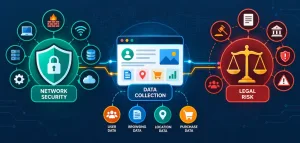
Cybersecurity is usually discussed as a defensive problem. Companies install firewalls, monitor networks, require multifactor authentication, train employees to recognize phishing attempts, and build incident-response plans to protect sensitive information.
But there’s another side to cybersecurity that gets far less attention. Sometimes an incident becomes a criminal investigation. When that happens, the question shifts. It’s no longer just “How did someone get in?” It becomes “Who did it?” and “Did someone commit a crime?”
For IT professionals, business owners, employees, and anyone responsible for digital infrastructure, understanding that shift matters more every year.
Cybersecurity and Criminal Law Are Becoming More Connected
Modern criminal investigations routinely involve technology. Computers and smartphones hold enormous amounts of information about their users. Servers keep logs. Cloud platforms record account activity. Businesses run surveillance systems. Applications store communications. Network infrastructure creates records showing when and how systems were accessed.
That means the same information cybersecurity professionals use to investigate an incident can become evidence in a criminal case.
Take an unauthorized login to a company network. An IT department might initially treat it as a routine security event. Investigators examine IP addresses, authentication logs, user accounts, timestamps, device information, and file-access histories to reconstruct what happened.
If the evidence suggests someone intentionally accessed the system without authorization, stole information, altered records, or used compromised credentials, the situation can eventually involve law enforcement. That’s the point where digital forensics and criminal law start to overlap.
The Digital Trail Can Be Extensive
Modern investigations are defined by how much information computers automatically generate. Depending on the system involved, investigators may encounter:
- Login and authentication records
- IP addresses
- VPN connections
- Email records
- Cloud account activity
- File access histories
- Browser information
- USB device activity
- Security camera footage
- Text messages and other communications
- Smartphone location information
- Electronic payment records
Individually, one record might reveal very little. Together, digital records can build a detailed timeline.
Suppose investigators are examining the unauthorized download of confidential company files. Server logs might show when an account accessed the files. Authentication records might identify the device or connection used. Surveillance footage could show who was physically present. Messages or emails might add context. Digital investigations often work exactly this way: combining many small pieces into a fuller picture.
An IP Address Is Evidence, Not Necessarily Identity
Technical evidence doesn’t always prove what investigators initially think it proves. An IP address is a good example. Investigators may tie particular online activity to an IP address, then try to determine who controlled that internet connection. That’s useful evidence, but identifying a connection isn’t the same as identifying the person at the keyboard.
Multiple people can share a network. Devices get shared too. Credentials get compromised. VPNs, remote-access tools, proxies, and malware all complicate attribution.
The same caution applies to user accounts. Evidence that an account performed an action doesn’t automatically establish who was controlling that account at the time. In criminal cases, that distinction can be everything.
Insider Threats Create Particularly Complicated Investigations
Not every cybersecurity investigation involves an unknown hacker on the other side of the world. Some involve employees, contractors, or former employees who legitimately had access to a system in the first place.
These cases get complicated fast, because authorized access and unauthorized conduct can sit right next to each other. An employee may have permission to access a database as part of the job. A dispute might later arise over whether that person accessed information for an improper purpose, downloaded more than was permitted, or kept using credentials after authorization ended.
Technically, the logs might clearly show an account accessed particular files. Legally, the harder question is whether that access was actually criminal. Technical evidence tells investigators what a system recorded. Criminal law determines what conduct those records legally establish. Those are two different questions, and it’s easy to conflate them.
Deleted Data Can Still Become Evidence
Deleting digital information doesn’t necessarily make it disappear. Copies can exist in multiple places. Emails can remain on servers or recipients’ devices. Cloud systems may keep independent records. Backups can preserve earlier versions of files. Security logs can survive even after user-facing information is gone.
Forensic specialists may also be able to recover certain information from devices, depending on how the data was stored and what happened after deletion.
This matters even more once someone knows an investigation is underway. Deleting files, destroying devices, altering records, or trying to conceal potentially relevant evidence can create its own legal problems. From both an incident-response and legal standpoint, preserving information is almost always safer than trying to “clean up” a system afterward.
Logs Can Protect the Accused, Too
Digital evidence is usually described as something law enforcement uses to prove wrongdoing. But the same records can sometimes prove an accusation wrong.
Imagine an employee accused of accessing confidential company information at 11:30 p.m. Server records might initially show the employee’s credentials were used. But additional evidence could reveal the login came from an unfamiliar device, after the employee’s password had already been compromised.
Or suppose someone is accused of sending threatening messages through an online account. Authentication records, device information, or account-access history could all become relevant to figuring out who actually controlled that account.
Digital evidence doesn’t inherently favor the prosecution or the defense. Its significance depends entirely on what the records actually show.
Context Matters in Digital Communications
Text messages, emails, and online conversations can become important evidence too, but individual messages are remarkably easy to misread once separated from the conversation around them.
Take a message that says: “Make sure it’s gone before tomorrow.”
Without context, that sounds suspicious. But imagine the messages before it show two coworkers discussing removing an outdated file from a public website. The meaning changes completely.
Screenshots create a similar problem, since they often show only a small slice of a larger conversation. When digital communications become evidence, investigators and attorneys may need to examine the full conversation: timestamps, participants, surrounding messages, and other context. A technically authentic message can still mislead when it’s presented without any of that.
Smartphones Have Become Evidence Repositories
Cybersecurity investigations increasingly extend well beyond traditional computers. A smartphone can hold communications, photos, account information, app data, location history, browser activity, and access to cloud services. That makes it extraordinarily valuable to investigators.
It also makes it one of the most private things a person owns. The U.S. Supreme Court has recognized the unique privacy implications of modern cellphones, and constitutional protections shape when and how law enforcement can search digital devices. Questions about search warrants, consent, and the scope of a search can end up mattering as much as whatever’s actually on the device.
Cloud Computing Has Changed Where Evidence Lives
There was a time when investigating a computer meant examining the physical machine in front of you. Cloud computing changed that. Important information can now be spread across multiple services, companies, devices, and jurisdictions. A laptop might hold relatively little locally while still providing access to enormous amounts of data stored remotely.
That raises real technical and legal questions. Where is the information actually stored? Who controls it? What records does the service provider keep, and for how long? What legal process is required to obtain them? As more of everyday life moves to cloud-based services, these questions will only matter more in criminal investigations.
AI Creates a New Evidence Problem
Artificial intelligence adds a different kind of complication: authenticity. Photographs, video, audio, and written communications have traditionally carried an unspoken assumption that a real person created them. Generative AI is challenging that assumption. Realistic synthetic voices, images, video, and text can now be produced with fairly accessible tools.
As AI-generated content keeps improving, criminal investigations will increasingly have to ask whether a piece of digital evidence is genuine, altered, or entirely synthetic. Metadata, source information, forensic analysis, account records, and chain-of-custody procedures may all become more important as a result.
Deepfake technology doesn’t make all digital evidence unreliable. But it does mean “there’s a video” may no longer settle the question of authenticity on its own.
Cybersecurity Professionals May Become Important Witnesses
An overlooked consequence of these investigations: IT professionals themselves can become witnesses. A network administrator who spots unusual activity may later be asked to explain what happened. A forensic examiner may need to describe how evidence was collected. A security engineer might be asked how authentication systems work, or whether particular activity looked unusual.
That makes documentation genuinely important. Anyone responding to a serious incident should carefully record what they observed, what actions they took, when they took them, and how evidence was preserved. Months or years later, those details can matter a great deal.
Technical Evidence Still Has to Satisfy Legal Standards
Computers produce enormous quantities of information, but more data doesn’t automatically mean stronger evidence. Technical records still have to be interpreted. Investigators need to establish that evidence is authentic and connected to the person accused of wrongdoing. Courts have to determine whether evidence was lawfully obtained. Attorneys may dispute what particular logs or communications actually show.
For criminal defense lawyers, understanding these distinctions has become increasingly important. At Hunt Law, a Tampa criminal defense firm, cases involving electronic communications, smartphones, online activity, surveillance footage, and other digital records illustrate how closely technology and criminal law can intersect.
A computer can accurately record that something happened. Determining who caused it, why, and whether it was actually a crime is a separate question entirely.
What Businesses Should Do When an Incident May Involve Criminal Conduct
When a serious cybersecurity event happens, the immediate priority is understandably stopping the damage. But organizations should also think about preserving evidence. Overwriting logs, reformatting machines, deleting accounts, or making undocumented changes can destroy information that later turns out to matter.
A thoughtful incident response usually includes preserving relevant logs, documenting the actions IT personnel take, keeping copies of important communications, identifying affected devices, and bringing in qualified cybersecurity and legal professionals when appropriate. The goal isn’t just to restore operations. It’s to understand what happened while preserving reliable evidence of the event.
The Future of Criminal Investigations Is Digital
Cybersecurity professionals and criminal attorneys increasingly work in overlapping territory. A network intrusion can become a criminal investigation. A server log can become courtroom evidence. A smartphone can establish a timeline, or dismantle one. An authentication record can point investigators toward a suspect, or reveal that an account was compromised all along.
As technology becomes more deeply woven into everyday life, criminal investigations will keep getting more technical. That makes one principle worth holding onto: digital evidence shouldn’t be treated as infallible just because it came from a computer.
Computers record information. Networks generate logs. Devices preserve enormous amounts of data. But people still have to determine what that information actually means. And when someone’s freedom may depend on the answer, the line between technical evidence and legal proof matters enormously.