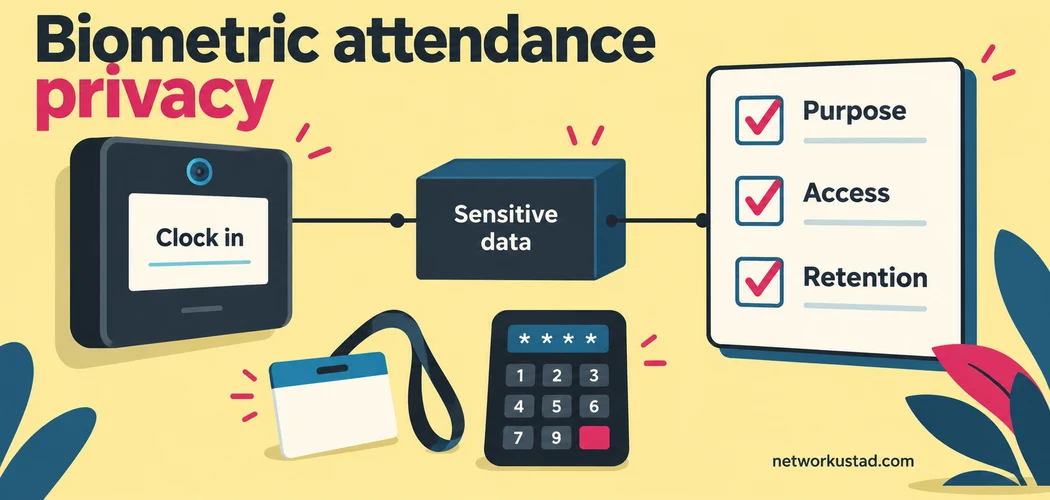
An attendance system should help an employer keep accurate records without collecting more personal information than the task justifies. Facial recognition may be one option, but convenience does not settle questions about necessity, security or employee treatment. A successful clock-in is an operational event, not proof that every privacy obligation has been met.
A review of biometric attendance privacy starts with understanding the proposed system. What does it capture? Where does processing happen? Who can access the results? What happens when recognition fails or someone cannot use the device? These questions matter before a contract is signed, not only after an incident.
This guide offers a practical evaluation method for employers and employees. It is not a product endorsement or a jurisdiction-specific legal opinion. The examples describe questions to investigate, rather than guaranteed capabilities of any particular attendance platform.
Start biometric attendance privacy with the problem you need to solve
Define the attendance problem before choosing a technology. A workplace may have missing clock-outs, incorrect schedules, shared credentials or confusing payroll corrections. These are different problems. A new camera-based terminal will not necessarily resolve poor instructions, an unreliable connection or a disagreement about which time should be recorded.
Review your own records and procedures. Identify how often exceptions occur, how much time staff spend resolving them and which problems genuinely require stronger identity verification. Keep suspected misconduct separate from honest mistakes. Treating every discrepancy as theft can damage trust and obscure the causes of inaccurate records.
A 2017 report used the estimate “Buddy punching costs businesses an estimated $373 million annually in the US alone.” Treat that as a dated industry estimate, not a current national measurement or a forecast of your organisation’s savings. Establish a local baseline before evaluating a proposed control.
Understand what verification actually establishes
Biometric matching compares captured characteristics with stored reference information. A verification process may compare a person with the record associated with a claimed identity. An identification process may search a collection of enrolled people. Ask which approach the proposed configuration uses and how that changes its operation.
A match is not a guarantee of identity under every condition. Systems can incorrectly accept a comparison or reject a legitimate employee. Their behavior depends on the method, configuration, input quality and operating environment. Ask the supplier to explain error measures in terms relevant to your deployment.
Attendance verification also has a limited purpose. Establishing who interacted with a terminal does not establish every hour worked, whether a break was interrupted or whether an assignment continued away from that device. Keep the identity check connected to a complete timekeeping process rather than treating it as the whole process.
Treat templates as sensitive information
One recurring biometric attendance privacy mistake is assuming that a numerical template is harmless because it is not an ordinary photograph. A template may represent features extracted from an image, but its format alone does not establish confidentiality or eliminate the consequences of misuse.
Research has demonstrated face reconstruction from some facial embeddings. That does not prove a vulnerability in the specific product you are evaluating, nor does it mean every protected template can be inverted in the same way. It does show why a universal promise that biometric templates cannot reveal useful information is unjustified.
Encryption is another separate question. Ask whether information is encrypted in transit and at rest, how keys are managed and which services can decrypt it. Do not assume that extracting a template automatically encrypts it. Likewise, strong encryption cannot compensate for an administrator account with inappropriate access or a poorly controlled export feature.
A primary concern with biometrics is data security. Ask what information the proposed system creates, where it is stored and how access is controlled. Evaluate the actual architecture and evidence rather than relying on a general assurance.
Map information for a biometric attendance privacy review
Before approving collection, list the information associated with enrollment, matching and attendance administration. The system might handle source images, templates, timestamps, employee identifiers, location information, device logs or support records. Do not assume that every product stores all of these, or that a supplier advertising templates stores no images.
Ask where each category is processed and retained. Include terminals, mobile devices, cloud services, integrations, backups and support tools. Determine which organization operates each component and which parties can access it. A statement that processing occurs on a device may answer one question while leaving cloud synchronization or technical support unresolved.
Biometric attendance privacy also depends on purpose boundaries. Decide whether information collected for timekeeping may be used for another function, such as access control or analytics. Require an explicit review before expanding the purpose. One initial enrollment should not quietly become permission for every later use.
Evaluate liveness detection as a control with limits
Liveness detection, often discussed alongside presentation-attack detection, attempts to distinguish an acceptable live presentation from certain spoofing attempts. The supported method and tested attack conditions vary. A supplier should explain what it has evaluated, what remains outside the assessment and how the feature is configured.
Ask whether performance evidence applies to the same device, software version and environment you intend to use. Lighting, positioning and the capture process can affect recognition. NIST’s face-recognition evaluations identify image quality as an important contributor to false negatives. A marketing label such as AI-powered does not describe an error rate or prove reliable operation in your workplace.
NIST’s digital-identity guidance also explains that biometric characteristics are not secrets. That guidance has a specific authentication scope; it is not a universal approval or prohibition of workplace time clocks. Use it to sharpen your questions, rather than claiming a device is NIST-certified merely because it uses similar terminology.
Separate vendor descriptions from verified findings
When evaluating facial recognition time and attendance, request evidence for the specific configuration and working environment. Ask how failed matches, spoofing attempts and ordinary attendance corrections are handled.
For a meaningful biometric attendance privacy review, request documentation for the configuration being considered. Ask which information is retained, which security responsibilities fall to the customer and how the vendor responds to an incident. Record answers in a form that can be reviewed later, especially where an assurance influences the purchase decision.
Distinguish an independent assessment from a supplier statement. A test report can be useful, but its scope, date and exclusions matter. A demonstration can show a workflow, but it does not prove how the system behaves across all employees, environments or attack conditions. Treat unresolved questions as gaps to investigate.
Check biometric attendance privacy requirements before collection
Biometric attendance privacy requirements depend on jurisdiction, the organizations involved and the information and activities at issue. Do not treat a general consent form as a nationwide compliance solution. Relevant obligations may concern collection, notice, consent or authorization, security, disclosure, retention and destruction.
Illinois BIPA is an important example of a statute with specific biometric obligations, including a written-release requirement before covered collection and rules concerning retention and destruction. Whether it applies to a particular deployment requires an assessment of the facts and current law. Its requirements should not be copied into an article as though they automatically describe every workplace worldwide.
Ask qualified counsel to review the proposed process before enrollment. Include the employee notice, purpose, data handling, vendor arrangements and any alternative method. Also distinguish a privacy assessment from wage-and-hour obligations: satisfying one set of requirements does not establish that the other has been addressed.
Explain the process to employees clearly
An employee notice should make the actual process understandable. Describe what the organization intends to collect, why it considers the collection appropriate, where the information goes, who can access it and how questions can be raised. Have the notice reviewed against the applicable requirements rather than assuming this general list is legally complete.
Avoid reassurance that exceeds the evidence. Saying that records are numerical does not explain access controls, and saying that a system is touchless does not explain retention. If a point remains uncertain, resolve it before telling employees that their information cannot be misused.
A practical biometric attendance privacy discussion also asks how employees who cannot use the proposed method will record time. Explain the alternative and escalation route without forcing someone to disclose unnecessary personal details to a supervisor or a public queue at the terminal. Appropriate arrangements depend on the workplace and applicable obligations.
Provide a usable non-biometric option
Compare the proposed system with alternatives such as an assigned badge, a PIN-based process or a supervised correction workflow. These options have their own limitations. A badge may be shared, a PIN may be disclosed, and manual administration requires oversight. The point is to compare the actual risks rather than assume one method is always best.
Consider whether a less intrusive option addresses the documented problem sufficiently. If stronger identity verification is justified for a particular task, explain why and define its scope. A decision that is reasonable for one site may not automatically be appropriate for every employee or location.
The U.S. Department of Labor’s recordkeeping guidance allows different timekeeping methods where the relevant records are complete and accurate. It does not prescribe facial recognition as a general requirement. Review the applicable rules for your workers and build the process around accurate records, including exceptions.
Test failed matches and payroll corrections
Biometric attendance privacy is connected to fair operational handling. If an employee cannot clock in, the organization needs a prompt way to record the event, review what happened and correct the time record. A failed match should trigger a defined process, not an automatic conclusion that no work occurred.
Test ordinary exceptions in an authorized pilot. Consider a forgotten credential, a terminal outage, poor capture conditions and a delayed synchronization. Ask who can correct a record, what evidence is retained and how the employee sees the result. Limit testing to approved accounts and data.
Keep original events distinguishable from later amendments. Record who made a correction, its reason and when it occurred. This can help resolve disputes and identify recurring faults. A technically accurate identity match is not enough if an integration then attaches the event to the wrong employee or payroll period.
Set access, retention and deletion responsibilities
Limit access according to an identified role and task. A manager who reviews attendance exceptions may not need access to enrollment material, while a support worker may need only a limited diagnostic record. Identify privileged accounts and the process for approving exports or changes.
For biometric attendance privacy, retention should be defined for each information category. Enrollment records, attendance logs, support attachments and backups may have different purposes and obligations. Establish the applicable requirements rather than inventing one period that supposedly works for everything.
Ask how deletion is carried out and documented, including when an employee leaves or the organization changes suppliers. Check dependencies and any lawful preservation requirement before removal. Deleting a visible user account should not be assumed to remove every associated record from every component. Require a clear explanation of what the action does and what remains.
Pilot biometric attendance privacy controls before expanding
Start with a documented objective, an approved participant group and agreed evaluation criteria. Measure both successful interactions and exceptions. Record how often staff need assistance, whether a queue forms, how corrections are handled and how much administration the process requires. These observations are proposed evaluation activities, not promises of performance.
A biometric attendance privacy pilot should include a review of employee communication and data handling, not only recognition speed. Confirm that staff understand the process and can use the alternative where appropriate. Investigate patterns of failure rather than treating repeated retries as normal without explanation.
At the end, decide whether to proceed, modify the design or stop. Include recurring costs, support responsibilities, unresolved legal questions and supplier exit arrangements. Avoid calculating savings from an old national estimate when the pilot can provide evidence about the organization’s own situation.
Assemble the evidence for an attendance decision
Document the information an attendance supplier collects and how each category is used. Include a purpose, storage location, access rule and responsible owner. Ask for clarification where the proposed data flow remains incomplete.
Check technical interfaces and ordinary staff procedures together. An integration may transfer records correctly while leaving employees without a clear way to question or correct an entry.
The practical next step is to assemble the proposed system’s data inventory, supplier answers, employee process and legal review. A decision supported by those records is more defensible than a choice based on guarantees that no product can establish simply through marketing language.
Frequently asked questions
Does using a template remove biometric attendance privacy concerns?
No. The relevant questions include what the template represents, how it is protected, who can access it and what consequences misuse could create. A numerical format is not, by itself, a security guarantee or a reason to ignore applicable biometric obligations.
Can liveness detection prevent every attack?
No blanket claim is justified. Ask which attacks were tested, which configuration was assessed and what residual risks remain. Combine the feature with appropriate system security, access controls, monitoring and a defined response process rather than treating it as an invulnerable barrier.
Is written consent always enough?
No. Applicable law may require specific notices, authorization, safeguards or other measures, and different jurisdictions take different approaches. Consent alone should not be represented as establishing compliance. Obtain advice based on the actual location, employment context and deployment.
How should an employer respond to a missed clock-in?
Use a documented correction procedure that can establish the relevant facts and maintain accurate records. Distinguish a device or matching problem from misconduct. Seek appropriate payroll or legal guidance where there is uncertainty about the treatment of working time.