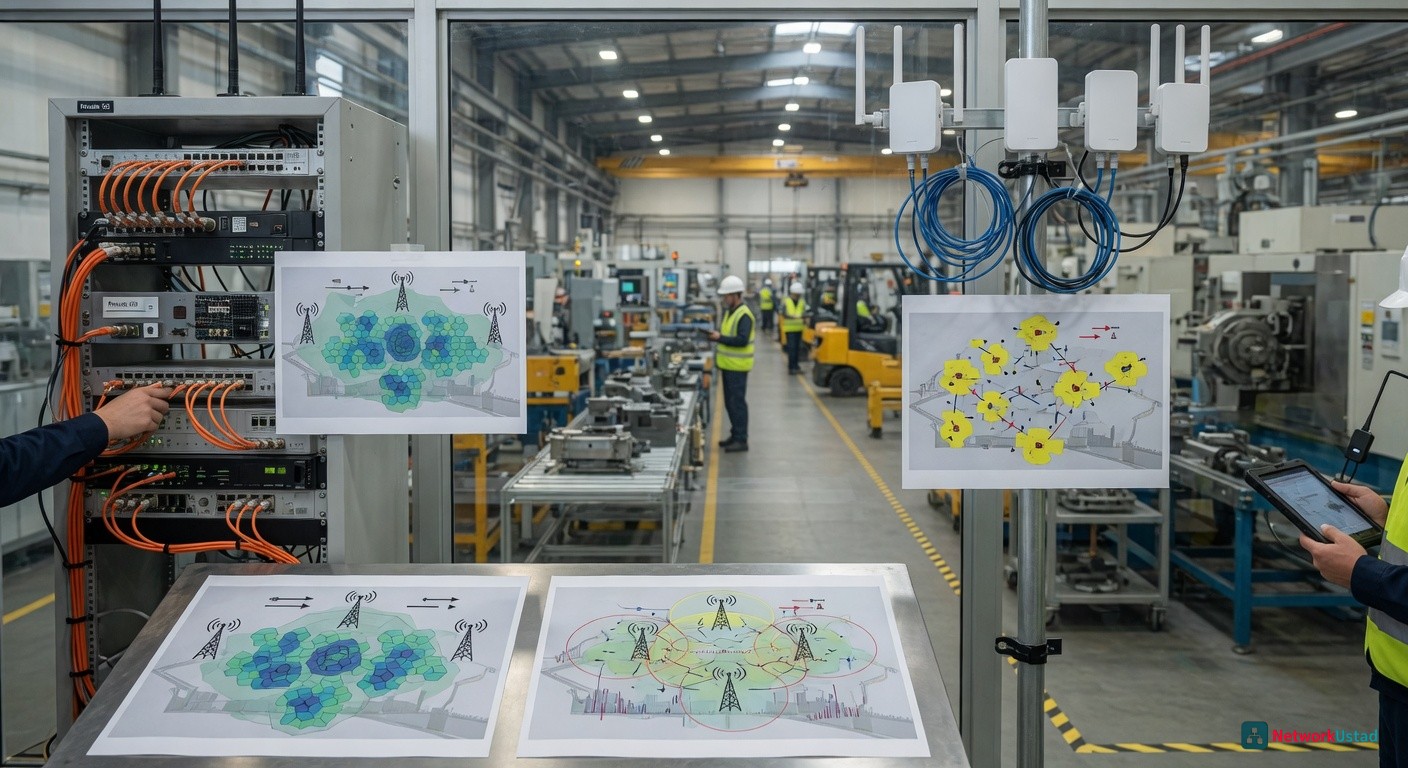
A modern mine, refinery, or factory floor now runs on data. Autonomous haul trucks, fixed sensors, video analytics, and handheld devices all compete for the same airwaves. Connectivity has shifted from a convenience to a production input.
Most traditional setups struggle to keep up. Large footprints, metal structures, dust, and moving equipment break the assumptions behind office Wi-Fi. So two technologies now dominate the conversation: private LTE/5G and industrial Wi-Fi. Each solves part of the problem, and plenty of sites run both.
This guide weighs them across the factors planners actually argue about. Coverage, mobility, reliability, security, cost, and scalability.
Understanding Private LTE/5G Networks
Picture a cellular network you own and run yourself. That is private LTE or 5G. It uses the same standards as the public mobile network, but ownership and control stay in-house.
Under the hood, a site runs a small core network, one or more radios, and a pool of SIM cards. Devices authenticate through those SIMs. Traffic then stays on-site instead of crossing a carrier’s public network.
The real enabler is spectrum. Some deployments use shared or licensed bands such as CBRS in the US. Others lease spectrum from a carrier. Either way, a dedicated band buys predictable performance with little outside interference.
Where does it pay off? Wide-area, mission-critical work. Think autonomous vehicles in a pit, remote-controlled cranes, sensors across a tank farm, or push-to-talk voice over a large yard. A handful of towers can blanket several square kilometers.
How Industrial Wi-Fi Networks Work
Wi-Fi takes the opposite approach. It runs on unlicensed spectrum through access points wired back to switches. Each access point covers a modest radius, and you expand coverage by adding more of them.
Speed, cost, and familiarity are the draw. Inside a warehouse, control room, or single building, Wi-Fi delivers high throughput cheaply. Hardware is commodity-priced. Most IT teams already know how to run it.
Walk any distribution center and the typical jobs appear. Barcode scanners, tablets on a production line, cameras watching the floor. For dense coverage of a contained space, the price is tough to beat.
The trade-off shows up at scale. Cover a wide outdoor site, and you need many access points, careful channel planning, and solid backhaul to every one.
Coverage and Mobility in Large Industrial Sites
Coverage is where the two diverge most sharply. One private cellular cell reaches far beyond a single Wi-Fi access point. Fewer radios cover more ground, which simplifies large outdoor sites.
Then there is movement. Cellular was built for devices roaming between towers, so handoffs stay quick and rarely drop a session. Wi-Fi roaming can stall instead. A half-second gap is enough to interrupt a video feed or a control link.
That gap matters most for anything mobile. A haul truck crossing a mine needs a connection that follows it. So does a vehicle on a long pipeline road. Cellular handles that motion better.
Indoors, the balance tips back. Wi-Fi often wins inside a building, where short range and high throughput suit dense device counts. Cellular keeps the edge outdoors and across rugged terrain.
Reliability and Network Performance
For control systems, latency draws the line between usable and frustrating. Private 5G can reach single-digit milliseconds, which suits remote operation and machine control. Wi-Fi latency is usually fine for data, though it wobbles under load.
Interference is the bigger threat on the Wi-Fi side. Unlicensed spectrum is shared with every device nearby. A neighboring network or a faulty radio can degrade performance with no warning.
Private cellular sidesteps much of that. Dedicated spectrum and scheduled airtime keep congestion predictable, even as device counts climb. The network allocates capacity rather than letting devices fight for it.
Now raise the stakes. Safety systems, remote machine control, and process telemetry all need high uptime and steady performance. That demand is why heavy industry leans on private LTE/5G for core operations.
Security and Network Control
Authentication marks the clearest contrast. LTE and 5G tie identity to a SIM, so only provisioned SIMs join the network. That is far harder to spoof than a shared Wi-Fi password.
Control flows from that foundation. Administrators enable or revoke a SIM centrally, then apply policy per device or per group. Network slicing and segmentation isolate traffic, so a sensor cannot reach a control system it should never touch.
Privacy improves too. When traffic stays on private infrastructure, sensitive operational data never crosses a public network.
Unmanaged Wi-Fi runs the opposite risk. Rogue access points, weak credentials, and open guest networks all create openings. Wi-Fi can be locked down well, yet staying secure takes constant discipline.
Cost, Deployment Complexity, and Scalability
On price, Wi-Fi pulls ahead for many projects. Access points are inexpensive, and the skills to run them are common. For a contained site, Wi-Fi is the practical default.
Private cellular asks for more upfront. It needs a core network, radios, SIM provisioning, and often spectrum through a license or lease. Specialized skills add to the bill.
Maintenance flips the math on large sites. Blanketing a wide area with Wi-Fi means many access points to power, mount, and maintain. A few cellular radios may cost less to run over time.
Growth is where cellular shines. Adding devices is mostly a provisioning task. Capacity stays predictable as the count rises.
Hybrid Connectivity Models for Remote Operations
In practice, few sites pick one technology and stop. The workable answer is layered. Private cellular handles wide-area coverage and mobility, Wi-Fi covers dense indoor zones, and satellite reaches everything past the fence line.
Satellite earns its place the moment a site sits far from fiber. A remote mine or a construction camp still needs a path back to headquarters. Low-earth-orbit services now deliver usable speeds for exactly that. With portable satellite connectivity, crews can stand up the link within hours of arriving.
Redundancy ties the layers together. If a fiber backhaul fails, satellite failover keeps the site online. When indoor Wi-Fi saturates, cellular absorbs the overflow. Each layer quietly covers a weakness in the others.
Conclusion
No single network fits every industrial environment. The right call follows the operational requirement.
Choose private LTE/5G when mobility, security, and wide-area coverage drive the project. It fits moving equipment and mission-critical control. Lean on Wi-Fi when the work is dense, indoor, and cost-sensitive.
The trend points to hybrid. Sites that combine cellular, Wi-Fi, and satellite keep coverage, performance, and resilience intact across the whole footprint. Map the network to the work, and the technology question tends to answer itself.