BMW iX xDrive50 Review: Strong EV Performance, High Price
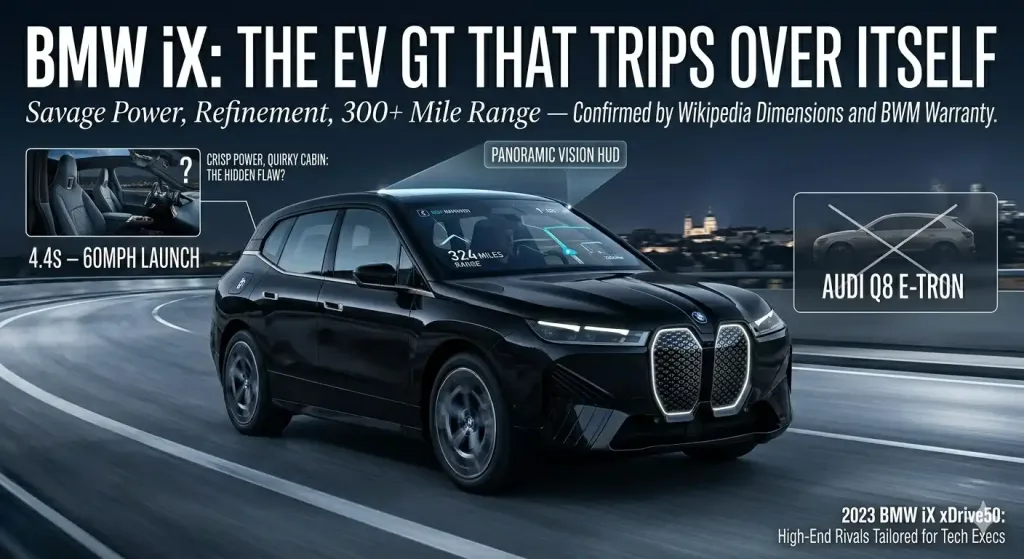
The BMW iX xDrive50 was BMW's mid-tier electric SUV from 2022 through 2025 — a 516 hp, dual-motor all-wheel-drive grand tourer with a 105 kWh battery, 324 miles of EPA-rated range, and 0–60 in 4.4 seconds. It delivered one of the most refined highway EV experiences available at its $87,945 starting price, backed by BMW's signature driving dynamics and an 8-year/100,000-mile battery warranty. Its weaknesses were real — an iDrive learning curve, aggressive Sport-mode regen braking, and a high loaded price — but for high-mileage luxury buyers, it was one of the strongest cases for a non-Tesla EV. As a used purchase in 2026, it remains a compelling option; as a new purchase, the xDrive60 successor is the one to buy.
⚠️ Important Notice
The BMW iX xDrive50 was discontinued after the 2025 model year. For 2026, BMW replaced it with the iX xDrive60 — which brings 536 hp (up from 516), a larger 113.4 kWh battery, and up to 364 miles of range. If you are researching a used or certified pre-owned xDrive50, this review covers everything you need to know. If you are buying new in 2026, scroll to the xDrive60 Upgrade Section at the bottom of this article.
Performance Analysis
The BMW iX xDrive50’s dual-motor setup delivers 516 hp and 564 lb-ft of torque through BMW’s xDrive all-wheel-drive system. The official 0–60 figure of 4.4 seconds translates accurately in real-world driving — the instant torque delivery produces a surge that feels disproportionate to the SUV’s nearly 5,700-pound kerb weight. In an Edmunds real-world range test, the xDrive50 achieved 377 miles from a full charge in mixed 60/40 city-highway conditions at 73°F — exceeding its 324-mile EPA rating by approximately 16%, making it one of the stronger real-world overachievers in the segment at the time.
At 75 mph highway cruise with air conditioning active, real-world consumption sits around 28–32 kWh per 100 miles depending on conditions, speed, and wheel size. The 105 kWh battery pack supports up to 195 kW DC fast charging, reaching 80% from 10% in approximately 35 minutes at a compatible CCS station. AC home charging via the BMW Wallbox (Level 2, 11 kW) delivers a full charge from empty in roughly 10 hours.
The adaptive air suspension — standard on the xDrive50 — was broadly regarded as the best balance of ride comfort and dynamic response in its competitive set. Compared to the Audi e-tron S (496 hp, ~285 miles EPA), the iX xDrive50 led on range and matched or exceeded it in handling dynamics. Against the Rivian R1S, the iX won on highway refinement and interior quality; the Rivian countered with superior towing and off-road capability.
Regenerative braking in Sport mode is the most commonly cited dynamic complaint — it is aggressive enough to unsettle rear passengers in stop-and-go traffic. BMW’s adaptive regen mode or manual reduction resolves this in most cases, but buyers who spend significant time in urban traffic should test this specifically before purchasing.
Design and Build Quality
The iX xDrive50 introduced the Iconic Kidney Grille in its most dramatic form — a large, body-coloured closed panel that replaced the traditional BMW grille opening entirely, housing cameras, radar, and sensors behind it under the ShyTech philosophy. Reactions divided sharply on its styling, and that division persisted throughout the model’s four-year run. The illuminated version, with its white-light proximity outline, was more universally appreciated for both its aesthetic and practical parking utility.
Inside, the cabin set a new bar for BMW interior quality at the time of launch. Open-pore wood trim with embedded touch-sensitive surfaces, Merino leather or vegan SensaTec upholstery options, and the floating Curved Display created a genuinely distinctive space. Wind noise at 80 mph was measurably lower than most competitors. The wireless charging pad ran cooler than Tesla Model Y equivalents. Build quality was consistently described as flagship-grade — doors sealed vault-like, panel gaps were tight, and materials felt premium throughout.
Two ergonomic criticisms persisted across the model’s life: the flat-spoke steering wheel reduced sightlines to the upper instrument panel for taller drivers, and the slanted Curved Display required a slight head-tilt to access climate controls while in motion. Both were design choices BMW defended rather than revised.
Rear passenger headroom was adequate for occupants up to approximately six feet. Above that, the panoramic roof’s encroachment into the roofline created noticeable tightness — a consistent criticism from taller reviewers and worth verifying in person for families with tall members.
Software and User Experience
BMW OS 8 on the xDrive50 received several OTA updates during its production life that improved navigation, charging network integration, and energy management. The system supports wireless CarPlay and Android Auto. The BMW Intelligent Personal Assistant handles natural-language commands for navigation, media, and climate reasonably well, though it lacked the conversational breadth of later large language model-based assistants.
The iDrive touchscreen replaced the physical rotary controller for most interactions, a change that divided longtime BMW owners. Climate and seat heating functions required more screen navigation than in competitors with dedicated physical controls. Voice commands offset this for common tasks once the assistant’s vocabulary was learned. Overall, the software experience was functional and feature-rich but demanded more initial investment from the driver than rival systems.
Battery Life
The 105 kWh battery pack in the xDrive50 delivered 324 miles of EPA-rated range — a figure that real-world testing consistently matched or exceeded under moderate conditions. Edmunds’ mixed-cycle test returned 377 miles; highway-only testing at 75 mph produced results closer to 290–310 miles depending on temperature and load. Cold-weather performance was managed through a heat pump system, though sub-zero temperatures reduced range more noticeably than in vehicles with 800V architecture and more sophisticated thermal management.
The 8-year / 100,000-mile battery warranty covered defects in materials and workmanship. BMW noted that battery capacity naturally decreases over time and with use — standard industry language — but no widespread premature degradation issues were documented across the xDrive50’s production run. For used buyers in 2026, checking remaining battery health via a BMW dealer diagnostic is advisable before purchase.
Value for Money and Competition
The xDrive50 launched at $83,200 in 2022 and reached $87,945 at its 2025 final model year — a pricing trajectory that kept it competitive against the Audi Q8 e-tron ($76,500–$88,000), Tesla Model X Long Range (approximately $79,990), and below the Rivian R1S Adventure ($78,000+). Loaded configurations regularly exceeded $100,000.
As a used purchase in 2026, certified pre-owned xDrive50 examples represent strong value. BMW’s CPO programme extends warranty coverage, and the 8-year battery warranty transfers with the vehicle (pro-rated from original sale date). Buyers can expect used xDrive50 pricing in the $55,000–$75,000 range depending on mileage, year, and specification — meaningfully below the cost of a new xDrive60 at $88,500.
The most relevant used comparison in 2026 is the xDrive50 CPO versus the new xDrive45 at $75,150. The xDrive45 offers 402 hp and 312 miles range — less performance than the xDrive50, but new with full warranty. Buyers who prioritise driving performance and are comfortable with used purchases will find the CPO xDrive50 a compelling value proposition.
2026 Update: xDrive60 — What Changed and Is It Worth Upgrading?
> Buying new in 2026? The xDrive50 is no longer available. Here is what the xDrive60 successor brings.
BMW replaced the xDrive50 with the iX xDrive60 for the 2026 model year. The naming shift was part of a broader lineup restructure that also added a new entry-level xDrive45 ($75,150) and renamed the M60 to M70. Here is what changed:
Power: 516 hp → 536 hp (+20 hp). Torque unchanged at 564 lb-ft. Real-world difference is minimal but the powertrain software is meaningfully more efficient.
Battery: 105 kWh → 113.4 kWh (112.8 kWh usable). Paired with new silicon carbide inverters and revised energy management software.
Range: 324 miles EPA → 318–364 miles EPA (wheel-size dependent). The 20-inch wheel configuration achieves the 364-mile figure; 21-inch wheels return 318 miles. GreenCars’ road test reported a dash estimate of 379 miles at full charge on 21-inch rollers.
Charging: 195 kW DC retained. Charge time improved slightly — 10–80% in approximately 28 minutes (vs. ~35 minutes on the xDrive50).
Exterior: Redesigned vertical LED headlights, updated kidney grille structure, new front fascia. 13 exterior colours and wheel options up to 23 inches.
Interior: New M Multi-function seats with extended thigh support and improved side bolstering — a direct response to criticisms of the pre-facelift model. BMW Curved Display retained.
Charging Network: Access to 180,000+ charge points including Tesla Superchargers via BMW ChargingNetwork and My BMW App — the single biggest practical improvement over the xDrive50 era.
Price: $88,500 MSRP ($89,675 with destination) — approximately $600 more than the xDrive50’s last MSRP for meaningfully more battery, range, and network access.
Verdict on upgrading: If you already own an xDrive50, the delta is not large enough to justify trading in. If you are buying new, the xDrive60 is the correct choice — the range improvement, faster charge time, and Tesla Supercharger access alone justify the marginal price increase over the outgoing model.
Verdict
The BMW iX xDrive50 was one of the best luxury electric SUVs available during its 2022–2025 production run — a genuinely driver-focused alternative to Tesla’s minimalism and Audi’s conservative approach. Its combination of 516 hp, 324 miles of real-world-validated range, adaptive air suspension, and an 8-year battery warranty made it a compelling choice for high-mileage affluent buyers who wanted BMW’s driving character in an electric package.
As a used or certified pre-owned purchase in 2026, it remains worth serious consideration. Battery warranties transfer, real-world range held up well across the production run, and CPO pricing in the $55,000–$75,000 range makes it meaningfully more accessible than when new. For anyone considering the used market, a BMW dealer battery diagnostic and full CPO inspection are advisable steps before committing.
For new car buyers in 2026, the xDrive60 successor is the right choice — same driving character, more range, faster charging, Tesla Supercharger access, and improved seats for a marginal price premium. Check current new BMW iX xDrive60 pricing and inventory at BMW USA, or search certified pre-owned xDrive50 inventory through your local BMW dealer.
Rating: 4.0 / 5 — A landmark luxury EV that aged well; strong used value in 2026, superseded by the xDrive60 for new buyers.
Frequently Asked Questions
Is the BMW iX xDrive50 still available to buy new?
What is the real-world range of the BMW iX xDrive50?
What replaced the BMW iX xDrive50?
How does the BMW iX xDrive50 compare to the Tesla Model X?
Is the BMW iX xDrive50 battery warranty transferable?
Where can I find a used BMW iX xDrive50?
+Pros
- 516 hp and 4.4-second 0–60 deliver genuine sports-car urgency from an SUV
- Real-world range consistently met or exceeded EPA 324-mile estimate in testing
- Adaptive air suspension set the segment benchmark for ride-and-handling balance
- 8-year / 100,000-mile battery warranty transfers to used buyers (pro-rated)
- Panoramic electrochromic roof and ShyTech interior design remain class-distinctive
- Strong CPO used value proposition in 2026 at $55,000–$75,000
−Cons
- Discontinued — new units unavailable; used/CPO only from 2026 onward
- iDrive interface steeper to learn than Tesla or Rivian equivalents
- Slanted Curved Display requires head-tilt to access climate controls while driving
- Sport-mode regenerative braking is abrupt enough to catch rear passengers off guard
- Rear headroom tight for passengers over 6 feet with panoramic roof fitted
- Loaded pricing exceeded $100,000 — expensive relative to longer-range competitors