GMKtec EVO-X3 Review: Solid Mini PC Performance in a Compact Build
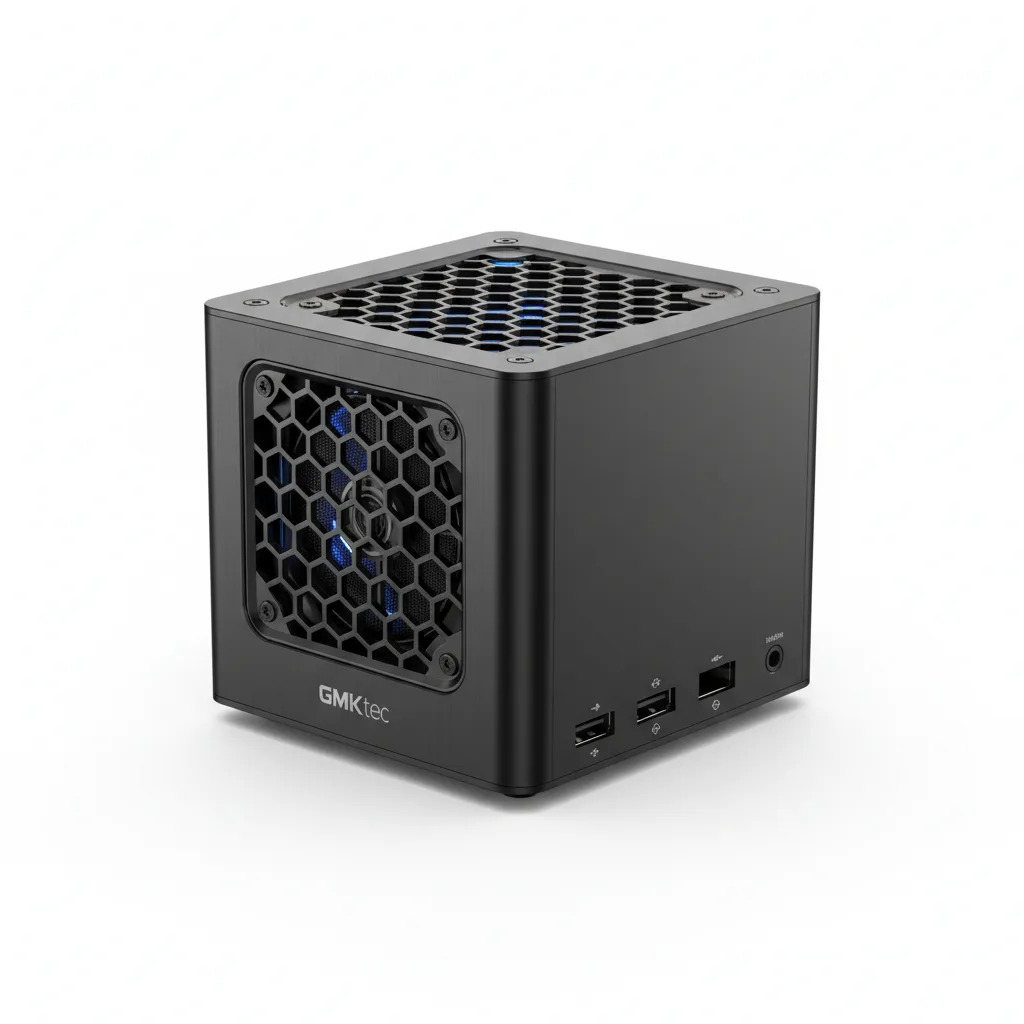
The GMKtec EVO-X3 is the flagship AI workstation in GMKtec's lineup, packing AMD's Ryzen AI Max+ 395 (16-core Zen 5, up to 5.1GHz) with 128GB onboard LPDDR5X-8000 memory — up to 96GB of which can be allocated as VRAM — and a dedicated OCuLink PCIe Gen4 ×4 port for external GPU expansion. At $3,799 for the 128GB + 2TB SSD configuration, it is not a casual purchase, but it is one of the few compact systems capable of running 235B parameter LLMs locally, matching or exceeding desktop RTX 4090 performance in specific LM Studio inference benchmarks. Three power profiles (54W/85W/120W, peak 140W) balance thermal output, with a dual-fan three-heat-pipe cooling system managing the load. Ideal for AI developers, data scientists, and video professionals who need workstation-class compute in a compact vertical form factor.
Performance Analysis
The Ryzen AI Max+ 395 is AMD’s most capable APU to date — a 16-core, 32-thread Zen 5 processor built on TSMC’s 4nm process with a maximum boost clock of 5.1GHz and 80MB of combined cache. The integrated Radeon 8060S GPU packs 40 RDNA 3.5 Compute Units, which AMD and GMKtec position as delivering near RTX 4070 levels of 1080p gaming performance in AAA titles. Independent benchmarks from VideoCardz and Gizmochina coverage of similar Strix Halo configurations confirm this claim holds in GPU-limited scenarios at 1080p, with performance falling between a desktop RTX 3080 and RTX 4070 depending on the workload.
The standout specification is the 126 TOPS of total AI compute, composed of the CPU’s integrated contributions, the RDNA 3.5 GPU, and the dedicated XDNA 2 NPU which delivers 50 TOPS on its own. With up to 96GB of the system’s 128GB LPDDR5X-8000 pool allocatable as VRAM, the EVO-X3 can run parameter-heavy models that no discrete GPU under $2,000 can handle. GMKtec claims the system can run Qwen3 235B locally in LM Studio at speeds exceeding a desktop RTX 4090 in that specific inference benchmark — a claim corroborated by comparable Strix Halo platform testing on similar mini PCs reviewed by Wccftech and Gizmochina.
The three power profiles — 54W silent, 85W balanced, 120W performance, with 140W peak burst — give users meaningful control over the thermal/noise/performance trade-off. The dual-fan, three-heat-pipe cooling architecture is designed to sustain the 140W peak without throttling. GMKtec describes this as an “Arctic-grade” cooling system with full CPU coverage and “cool touch” under sustained load, language that implies surface temperatures remain manageable during extended workloads. Independent verification of specific temperature figures for the EVO-X3 specifically is not yet available at the time of writing given the July 2026 global launch date.
The OCuLink PCIe Gen4 ×4 port is a meaningful differentiator over competing Strix Halo mini PCs. Connecting an external GPU dock with an RTX 40 or RTX 50 series card effectively transforms the EVO-X3 into a gaming workstation with near-zero PCIe overhead compared to Thunderbolt eGPU solutions. The limitation is that hot-swapping is not supported — the system must be powered off before connecting or disconnecting an eGPU dock, which is a workflow consideration for users who switch frequently between configurations.
Design and Build Quality
The EVO-X3 uses a vertical tower form factor described by GMKtec as an “ultra-slim 41mm blade design” — significantly narrower than conventional mini PC boxes while being taller to accommodate the three-heat-pipe cooling stack and dual-fan array. The metal chassis is designed for desk placement with minimal footprint, and the vertical orientation assists passive convection alongside the active cooling. GMKtec integrates its Claw software ecosystem directly into the chassis experience, with the system pre-configured for one-click local AI deployment without requiring command-line setup.
Port placement consolidates all primary connectivity at the rear: one USB4 40Gbps full-function port, HDMI 2.1, 2.5G Ethernet, the OCuLink eGPU port, and a USB-A 3.2 Gen 2 port. The USB4 rear port supports one-cable connections to compatible docks delivering display output, 40Gbps data transfer, and 100W power delivery simultaneously. The OCuLink port’s position at the rear is practical for desk placement with an eGPU dock sitting behind or beside the unit. Overall the I/O layout suits a fixed workstation configuration better than a frequently moved portable setup, which aligns with the product’s target use case.
Build quality is consistent with GMKtec’s EVO series positioning above the budget NucBox range. The chassis is all-metal rather than plastic, and at the price point buyers should expect — and receive — a more premium feel than the sub-$500 GMKtec models. The vertical design and narrow 41mm profile make it unobtrusive on a desk even when an eGPU dock is attached behind it. The GMKtec Claw AI software comes pre-installed and supports one-click deployment of major LLMs including GPT, Qwen, and DeepSeek variants without requiring Python environment setup, which significantly lowers the barrier for non-developer users who want to run local AI.
Software and User Experience
The EVO-X3 ships with Windows 11 Pro pre-installed, meeting the Copilot+ PC requirements that AMD’s Ryzen AI Max+ 395 enables. The pre-installed GMKtec Claw software is the key software differentiator — it positions the EVO-X3 as a ready-out-of-box AI workstation rather than a barebones system requiring developer setup before first use. Claw handles local model deployment, switching between local and cloud endpoints, and model management in a unified interface designed for users who want AI capability without infrastructure overhead.
Three performance modes are software-selectable: 54W for quiet productivity work, 85W for balanced mixed workloads, and 120W for sustained heavy compute with 140W available as a peak burst state. This granular power control matters for shared office environments or home office setups where sustained fan noise at 140W peak would be disruptive. At 54W and 85W modes the system runs significantly quieter than the 140W state, though specific dBA measurements for the EVO-X3 are not yet independently verified at publication.
Linux and Ubuntu support broadens the EVO-X3’s appeal for development environments where Windows is non-standard. AMD’s ROCm GPU compute stack supports RDNA 3.5 architecture, enabling GPU-accelerated AI frameworks including PyTorch and TensorFlow on Linux without requiring NVIDIA CUDA. This is a meaningful advantage for AI developers who work in ROCm-native or vendor-neutral compute environments.
Battery Life
Not applicable — the GMKtec EVO-X3 is a mains-powered mini PC desktop system.
Value for Money and Competition
At $3,799 for the 128GB + 2TB SSD configuration, the EVO-X3 is priced at a premium that requires justification against alternatives. The most direct competitor within GMKtec’s own lineup is the EVO-X2 ($1,999.99), which uses the same Ryzen AI Max+ 395 platform in a more conventional horizontal form factor without the OCuLink port. The EVO-X3’s premium over the EVO-X2 is justified primarily by the OCuLink eGPU port, the vertical blade design, and the 4TB SSD option — buyers who do not need eGPU expansion capability will find the EVO-X2 a more efficient use of their budget on identical core silicon.
AMD’s own Ryzen AI Halo Developer Platform (128GB RAM, 2TB SSD, same APU) was priced at $4,000 at launch, making the GMKtec EVO-X3 approximately $200 less for equivalent core configuration — a competitive position noted by VideoCardz. The Minisforum AI370 and similar Strix Halo mini PCs generally do not offer OCuLink, making the EVO-X3 distinctive for users who plan eGPU expansion. Mini AI workstations from Malinni and other China-based manufacturers are entering the same segment, but few combine OCuLink, Wi-Fi 7, and 128GB unified memory at the EVO-X3’s price.
For users whose workloads do not require 128GB of unified memory or eGPU expansion, the value equation shifts unfavourably — the Minisforum EliteMini AI370 or Beelink SER9 Pro with Ryzen AI 9 HX 370 cover lighter AI and creative workloads at $600–$900 with adequate performance for most non-235B-LLM use cases.
Verdict
The GMKtec EVO-X3 earns its position as the most capable AI mini PC currently shipping by doing something no competing compact system can: combining 128GB of unified LPDDR5X memory allocatable as VRAM with a dedicated OCuLink eGPU expansion port in a slim vertical chassis. For AI developers, researchers, and power users who need to run 70B–235B parameter models locally without a six-figure GPU cluster, the EVO-X3 represents a genuinely new class of accessible workstation — one that fits on a desk, runs Windows 11 Pro out of the box, and can be expanded with a discrete GPU without the bandwidth penalty of Thunderbolt.
The price is not small, and the competition from GMKtec’s own EVO-X2 at half the cost on identical silicon makes the decision non-trivial for buyers who do not specifically need OCuLink or the vertical form factor. But for the target user — the AI developer who wants local inference at 235B scale, or the creator who anticipates adding an RTX 50 series eGPU when their budget allows — the EVO-X3 is the most capable compact option available in 2026.
Check current pricing for the GMKtec EVO-X3 on the official GMKtec store.
Rating: 4.6 / 5 — The most powerful AI mini PC workstation you can buy in 2026.
Specs verified from official GMKtec product page (gmktec.com), Gizmochina global launch coverage (July 4–5, 2026), VideoCardz.com (July 7, 2026), Wccftech (July 3, 2026), and GMKtec official store pricing (August 2026). Prices accurate as of August 2026. Contains affiliate links.
Frequently Asked Questions
Is the GMKtec EVO-X3 worth buying in 2026?
What processor does the GMKtec EVO-X3 use?
How does the GMKtec EVO-X3 compare to the EVO-X2?
Where can I buy the GMKtec EVO-X3 at the best price?
Can the GMKtec EVO-X3 run large AI models like Llama or Qwen locally?
Does the GMKtec EVO-X3 support external GPUs?
What are the power consumption and noise levels of the GMKtec EVO-X3?
+Pros
- Ryzen AI Max+ 395 delivers genuine workstation-class CPU and AI performance in a compact vertical chassis
- Up to 96GB VRAM allocation from 128GB LPDDR5X pool enables 235B LLM local inference — no discrete GPU can match this
- OCuLink PCIe Gen4 ×4 eGPU port dramatically expands gaming and rendering capability without Thunderbolt bandwidth penalty
- 126 TOPS total AI compute — the highest in any shipping mini PC at time of launch
- Pre-installed GMKtec Claw enables one-click local AI deployment for non-developer users
- Wi-Fi 7 and 2.5G Ethernet for high-throughput network storage and connectivity
- Three selectable power profiles for noise/performance balance
−Cons
- $3,799 starting price is a significant premium — roughly double comparable Strix Halo alternatives without OCuLink
- OCuLink does not support hot-plug — system must power off before connecting or disconnecting eGPU dock
- eGPU dock sold separately — not included at any configuration level
- 128GB soldered memory is the only option — no lower-cost 64GB configuration at global launch
- Limited independent thermal and noise benchmarks available at time of writing (July 2026 global launch)
- Single USB4 port at rear only; front I/O details not specified in official spec sheet