HeyGears Reflex RS Turbo Review: Impressive Resin 3D Printer
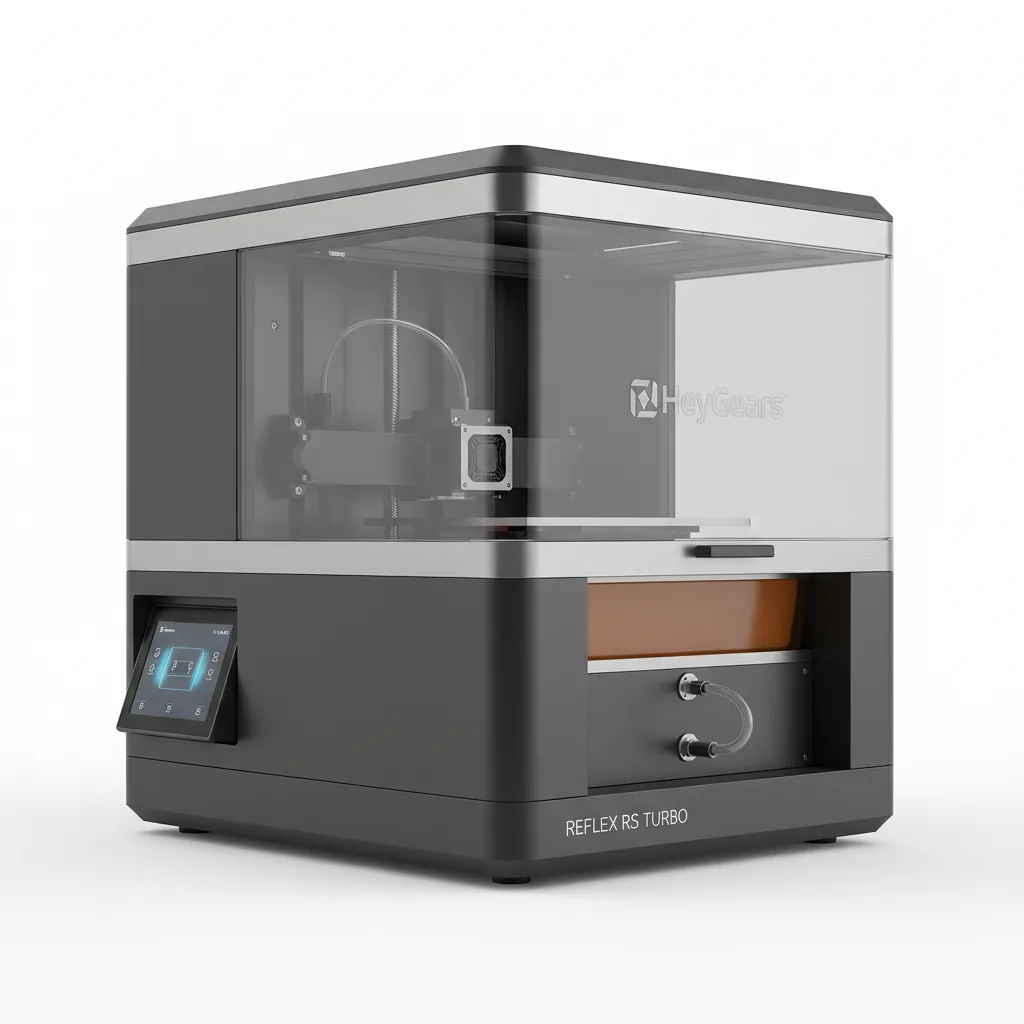
The HeyGears Reflex RS Turbo launched in June 2025 as an upgraded version of the original Reflex RS, and it has quickly established itself as one of the most automated and beginner-accessible premium resin printers available. Its 10.3-inch 8K Amber LCD with 566:1 contrast ratio and C5-grade Z-axis module delivering ±2μm accuracy produce print quality that rivals machines costing significantly more. At 4.5 seconds per layer — a 33% speed improvement over standard motion systems via Dynamic Motion Algorithm 3.0 — batch runs that previously took overnight now finish in hours. The regular price is $999 with frequent sales dropping it to $799 at the HeyGears store. The main caveats are ecosystem lock-in (best performance requires HeyGears proprietary resins), the fact that wash and cure stations are sold separately, and a price point that exceeds most entry-level MSLA competitors by a wide margin. For miniature artists, Etsy batch sellers, and engineering prototypers who want near-zero-calibration professional output, the RS Turbo is the strongest choice in its tier.
Performance Analysis
The RS Turbo’s performance story centers on three hardware advantages working together: the 8K Amber LCD, the C5-grade Z-axis, and Dynamic Motion Algorithm 3.0. The Amber screen’s 566:1 contrast ratio controls UV light transmission with high precision, ensuring only the intended pixels cure on each layer. This reduces light bleed — the stray UV exposure that softens fine edges and creates surface haze on lower-contrast panels — and is the primary reason the RS Turbo produces miniature details like sword hilts, facial features, and fabric folds with a sharpness that is difficult to achieve on conventional mono LCD machines without extensive exposure tuning.
The C5-grade Z-axis module delivers ±2μm motion accuracy — a specification more commonly found in industrial MSLA equipment than desktop consumer machines. In practical terms, this prevents the subtle banding, layer walk, and vertical drift that plague tall prints on competitors using lower-tolerance Z assemblies. 3DTechValley’s independent testing confirmed that overnight prints with the RS Turbo show no axis wander or compression creep, and engineering parts assembled after printing demonstrate clean hole-to-pin alignment within ±0.05mm tolerances — suitable for functional prototype testing. Dynamic Motion Algorithm 3.0 reads force sensor data at 80 times per second and continuously adjusts lift speed, acceleration, and motion profile in real time, pushing layer time down to 4.5 seconds with appropriate HeyGears resins. Compared to the standard Reflex RS (which lacks this algorithm), print times drop by up to 33% — independently confirmed by 3D Printing Industry.
The force sensor system doubles as a failure prevention mechanism. With 0.1N sensitivity, the sensor detects resin residue left by a detached print before the build platform descends into it, triggering an auto-pause. This alone eliminates one of the most frustrating failure modes in resin printing — the destroyed FEP film from an undetected floating print fragment. Combined with Blueprint Studio’s pre-print self-check (which verifies platform placement, resin level, and temperature before each run), real-world failure rates are substantially lower than on open-configuration machines.
Design and Build Quality
At 20 kg, the RS Turbo is a solidly substantial machine that stays planted during rapid lift cycles without vibrating or walking across the bench. The reinforced chassis and precision-fitted internal components minimize resonance — a meaningful factor when the Z-axis is moving at high speed during short 4.5-second layer cycles. The amber-tinted front panel cover protects the LCD from stray UV and gives the machine a clean, workshop-appropriate aesthetic that suits both home studios and professional environments. HeyGears was founded in 2015 and is headquartered in Guangzhou, China, with a U.S. presence in Irvine, California; the RS Turbo reflects a decade of hardware refinement rather than a first-generation product.
The resin vat slides out cleanly on a guided rail and seats precisely on reinstallation — essential for the NFC calibration system to read correctly. The build platform uses a durable surface coating that promotes adhesion and allows completed prints to flex off with a sharp tap rather than requiring a palette knife. The optional Heated & Pulsing Release Resin Tank upgrade replaces the standard vat and adds active temperature control (keeping resin at optimal viscosity for long batch runs) alongside pneumatic pulsing that reduces FEP peel force by approximately 50% per layer. This upgrade is most valuable for studios printing high-fill models overnight with high-viscosity engineering resins like PAH10.
Interface hardware is straightforward: a touchscreen panel for job control and settings, USB port and Wi-Fi for file transfer and remote management. Setup from unboxing to first print takes approximately 15 minutes following Blueprint Studio’s guided workflow — with no manual leveling required thanks to the Floating Screen auto-leveling system. The machine performs a self-check before every print, verifying platform placement, resin level, and temperature automatically. The amber LCD is rated for over one million printed layers — the highest rated lifespan in the Reflex product family — which meaningfully lowers total cost of ownership for high-volume users who would otherwise replace conventional screens every 500 to 700 hours.
Software and User Experience
Blueprint Studio runs on Windows and macOS and connects to the RS Turbo via USB or Wi-Fi for job transfer. The interface is organized around a workflow model — import, repair, support, slice, send — with each step executed sequentially and automatically for users who prefer hands-off operation, or accessible individually for those who want to override specific parameters. Experienced users can unlock adjustable print settings beyond the preset profiles, enabling compatibility with a wider range of third-party resins. HeyGears built-in technical assistance is accessible from within the software, reducing the need to navigate forums or support tickets for common troubleshooting scenarios.
User feedback from the HeyGears store and 3DTechValley’s community follows a consistent pattern: nearly zero failed prints after the first week, even for users switching from open-configuration machines that required daily calibration. One verified user quoted on the HeyGears sale page describes switching from another brand and reporting that the RS Turbo “has not only never failed but the quality of the prints is beyond my expectations.” Another reported moving to PAP10 resin on the RS Turbo for functional mold production, citing “excellent, repeatable results with very high dimensional accuracy.” This community track record aligns with the machine’s hardware specifications — the ±2μm Z-axis and force-sensor failure detection together address the two most common root causes of resin print failure.
HeyGears provides firmware updates, screen replacement guides, and Blueprint Studio documentation through its support center. The NFC-based screen calibration system stores exposure data on the screen assembly itself, so replacement screens are recognized automatically without recalibration — a practical advantage for studios running the machine at high duty cycles where screen replacement is a scheduled maintenance task rather than a crisis event.
Value for Money and Competition
The RS Turbo’s regular price of $999 (sale price $799 at store.heygears.com as of August 2026) sits above most consumer MSLA printers but well below the professional industrial segment. The full RS Turbo Combo with UltraCraft Wash and Cure runs from $1,807 on sale — the practical entry price for a complete print-wash-cure workflow without additional purchases. Against direct competitors, the positioning is clear.
The Elegoo Saturn 4 Ultra 16K ($699–$799) offers a larger 10-inch 16K panel with a 8.33 × 4.66 × 8.66-inch build volume and built-in tank heating at 30°C — a competitive machine that undercuts the RS Turbo on print area and resolution per dollar. It lacks the RS Turbo’s force sensor failure detection, C5-grade Z-axis tolerance, and Blueprint Studio’s one-click automation ecosystem, making it the better choice for users who want to tune parameters themselves and prioritize raw resolution. The Anycubic Photon Mono M7 Pro (~$600) delivers comparable resolution but without the failure prevention hardware or proprietary software integration. For users willing to manually configure profiles and tolerate higher failure rates in exchange for lower cost, it is a reasonable alternative.
Against the Formlabs Form 4 ($4,999), the RS Turbo loses on validated biocompatible and castable resin certifications, regulatory compliance documentation for dental and medical applications, and Formlabs’ global service network. For clinical and regulated professional workflows, the Form 4 is the appropriate tool despite its 6× higher price. For non-clinical professional use — miniature production, engineering prototyping, product design — the RS Turbo’s output quality and dimensional accuracy are difficult to distinguish from the Form 4 at a fraction of the cost. For broader context on choosing between resin 3D printers for different use cases, our technology reviews section covers related hardware decisions, and our guide to tech tools for small business includes considerations for studio and workshop equipment.
Verdict
The HeyGears Reflex RS Turbo is the most complete package in the sub-$1,000 resin 3D printer category for users who prioritize print consistency, failure prevention, and workflow automation over raw build volume or maximum resolution per dollar. Its C5-grade Z-axis and 8K Amber LCD produce dimensional accuracy and surface quality that compete with machines costing several times more, while Blueprint Studio’s one-click workflow genuinely removes the calibration burden that keeps capable makers away from resin printing. The 1,000,000-layer LCD lifespan and 0.1N force sensor combine to make this the most maintenance-resilient MSLA printer in its tier.
The caveats are real: HeyGears’ resin ecosystem produces the best results, which means per-litre material costs above generic alternatives; post-processing stations add to the total investment; and competitors like the Elegoo Saturn 4 Ultra offer larger build areas at lower prices for users who want to optimize differently. For commission artists, tabletop batch producers, product designers running fit-test prototypes, and engineers needing consistent ±0.05mm tolerances, the RS Turbo pays back its premium in reduced failure rates and reclaimed setup time within the first month of regular use.
Check the current price for the HeyGears Reflex RS Turbo at the official store or view on Amazon. The RS Turbo Combo (printer + UltraCraft Wash + Cure) starts at $1,807 and is the recommended starting point for anyone planning to print more than 20 hours per week.
Rating: 4.5 / 5 — The most automation-complete resin 3D printer under $1,000, with hardware precision to back up every workflow claim.
Sources: HeyGears Reflex RS Turbo Official Product Page | website, ENGtechnica — HeyGears Launches UltraCraft Reflex RS Turbo (June 2025) | website, 3D Printing Industry — Reflex RS Turbo Cuts Print Time by 33% | website, 3DTechValley — Reflex RS Turbo 3D Printer Review (December 2025) | website, VoxelMatters — HeyGears Reflex RS Turbo & Reflex 2 Series (November 2025) | website, Amazon — HeyGears Reflex RS Turbo Product Listing | website, HeyGears Store — Current Pricing and Bundles | website — August 2026.
Sources: HeyGears Reflex RS Turbo Official Product Page, HeyGears Store u2014 All 3D Printers and Pricing, ENGtechnica u2014 HeyGears Launches UltraCraft Reflex RS Turbo (June 9, 2025), 3D Printing Industry u2014 Reflex RS Turbo Cuts Print Time by 33%, 3DTechValley u2014 Reflex RS Turbo 3D Printer Review (December 2025), VoxelMatters u2014 HeyGears Reflex RS Turbo & Reflex 2 Series Coverage (November 2025), Amazon u2014 HeyGears Reflex RS Turbo Listing — August 2026
Frequently Asked Questions
Is the HeyGears Reflex RS Turbo worth buying in 2026?
What print resolution does the HeyGears Reflex RS Turbo achieve?
How does the HeyGears Reflex RS Turbo compare to the Elegoo Saturn 4 Ultra?
Where can I buy the HeyGears Reflex RS Turbo at the best price?
What resins are compatible with the HeyGears Reflex RS Turbo?
Does the HeyGears Reflex RS Turbo require manual leveling?
+Pros
- 10.3-inch 8K Amber LCD with 566:1 contrast — produces sharper edges and cleaner surfaces than conventional mono panels
- C5-grade Z-axis with ±2μm accuracy — industrial-level dimensional precision in a desktop form factor
- 4.5s/layer print speed via Dynamic Motion Algorithm 3.0 — 33% faster than standard MSLA motion systems
- Force sensor residue detection at 0.1N — auto-stops before a floating fragment destroys the FEP film
- Blueprint Studio one-click workflow eliminates manual calibration, exposure testing, and mesh repair steps
- Amber LCD rated for 1,000,000+ layers — lowest screen replacement frequency in its class
- Available at $799 on sale (regular $999) — well-positioned for professional-grade output
−Cons
- Best performance requires HeyGears proprietary resins — third-party materials work but lose adaptive profile benefits
- UltraCraft Wash and Cure stations sold separately — full workflow costs from $1,807 in the combo
- Heavier than most competitors at 20 kg — not easily repositioned in a workshop
- No display of supported file formats (STL/OBJ confirmed via Blueprint Studio import)
- Smaller build volume (222 × 122 × 228 mm) than some competitors at this price — Elegoo Saturn 4 Ultra offers more area per dollar