Sony Bravia 5 Review: Strong Performance and Natural Colors
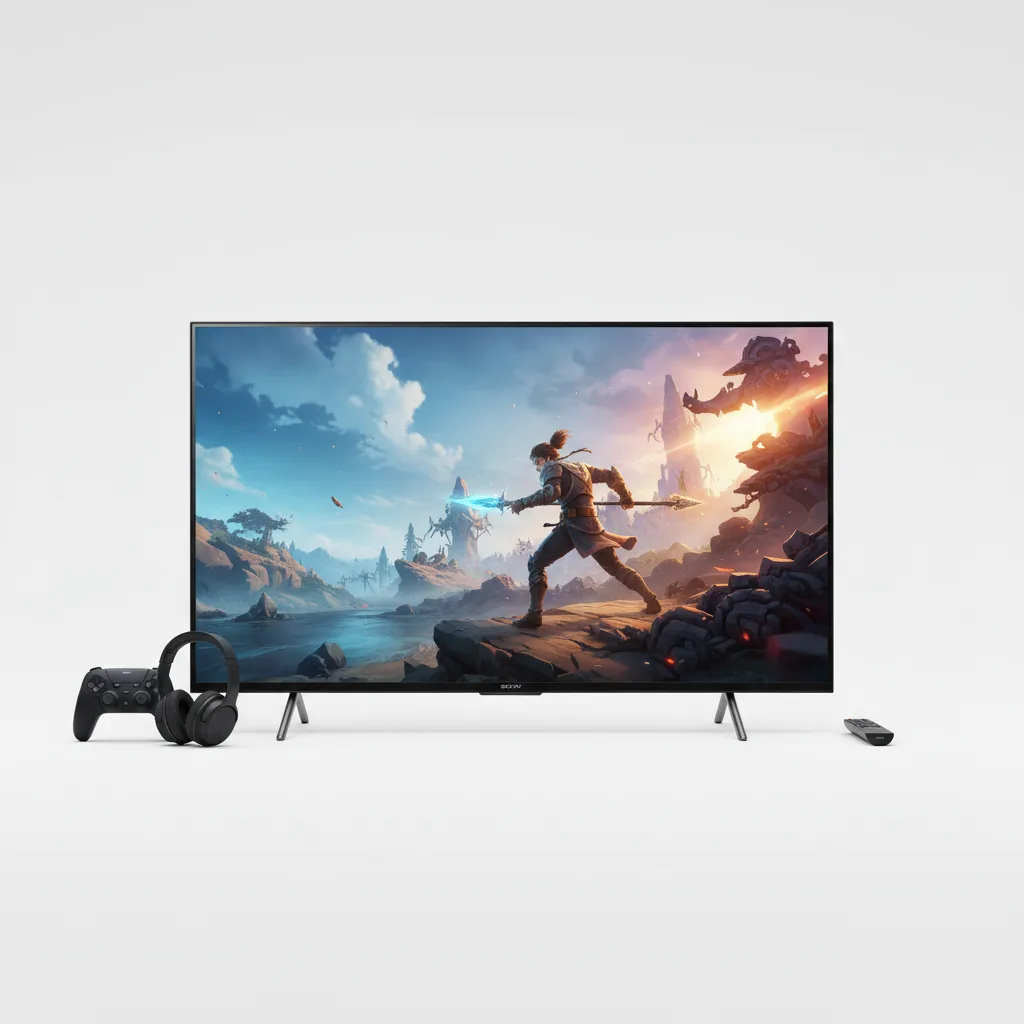
The Sony Bravia 5 is the best mid-range TV Sony has made in years, bringing genuine Mini LED backlighting and the full XR Processor to a price point previously dominated by inferior panels. Peak brightness reaches approximately 900 nits on a 10% HDR window, and Professional mode color accuracy measures well under 3.0 Delta E, making out-of-the-box calibration unnecessary for most users. Input lag is 13.3ms at 60Hz and drops to 5.7ms at 4K/120Hz, making it a capable gaming display — though only two of the four HDMI ports support full 2.1 bandwidth with VRR. Its biggest weaknesses are modest full-screen HDR brightness (595 nits sustained), a glossy screen that struggles with strong reflections, and a price of $1,399.99 for the 55-inch that faces fierce competition from TCL and Hisense. Buyers who prioritize Sony's color science, upscaling, and restrained blooming control will find this the smartest mid-range purchase of 2025.
Performance Analysis
The Sony Bravia 5 delivers a peak brightness of approximately 900 nits on a 10% HDR measurement window, with a full-screen (100% white) sustained figure of 595 nits — numbers confirmed by TechRadar’s objective testing. That full-screen figure is notably higher than many OLED panels at this price, meaning a bright living room is genuinely workable for HDR content. SDR brightness is also solid, with CE-Sphere measuring around 800 nits peak on a 10% SDR window. Where the TV earns its reputation is how intelligently Sony’s XR Processor allocates that light: small bright objects are kept isolated against dark backdrops with minimal blooming, a balance that most locally dimmed LCD sets at this price fail to achieve.
Color accuracy in Professional mode measured well under 3.0 Delta E 2000 in TechRadar’s Calman Ultimate testing — a threshold below which errors become invisible to most viewers. DCI-P3 color volume coverage lands around 96% per Trusted Reviews, giving warm skin tones and saturated reds and greens that feel realistic rather than overprocessed. Sony’s SDR-to-HDR auto-upgrade, active in certain presets, adds visible punch to non-HDR streaming content that most rival brands don’t attempt.
Gaming performance is where the specification sheet needs a closer read. Input lag in Game mode at 60Hz measures 13.3ms (TechRadar), dropping to 5.7ms at 4K/120Hz (The Shortcut). Both figures are competitive for a TV of this class, making the Bravia 5 a capable PS5 companion. VRR and Auto Low Latency Mode are supported, and Sony’s “Perfect for PlayStation 5” feature enables automatic HDR optimization when a PS5 is detected. The caveats: only two of the four HDMI ports deliver full 48Gbps 2.1 bandwidth, there is no AMD FreeSync or Nvidia G-Sync certification, and maximum refresh rate is capped at 120Hz — rivals such as the TCL C7K support 144Hz at this price.
Motion handling is strong for 24fps film content, but fast sports and action at lower resolutions can expose the VA panel’s slower pixel response times. Sony’s Motionflow processing in its True Cinema mode handles 24p judder cleanly; other motion settings can introduce digital artifacts or unwanted smoothing, and most reviewers recommend conservative use of noise reduction to preserve the panel’s native sharpness.
Design and Build Quality
Sony chose a minimalist aesthetic for the Bravia 5 that closely mirrors the higher-tier Bravia 7. The screen frame is extremely narrow, and the rear panel stays relatively slim for a Mini LED LCD at 5.7cm without the stand. Build quality feels premium for the price bracket, with solid materials and a clean cable-management channel along the back edge that keeps wall installations tidy.
The 55-inch model weighs 17.7kg without the stand, requiring two people for wall installation. Sony includes two feet positions — narrow (for small furniture) or spread wide — which is a practical detail often missing from competitors. Two remote controls ship in the box; the main handset is partially constructed from recycled plastic, and a second simpler remote is included for basic use.
The glossy screen finish is the design’s notable weakness. Reflections in bright rooms are noticeable and can distract during daytime viewing, particularly near windows. Samsung’s QN90-series and Hisense’s U8-series offer superior anti-reflective coatings at comparable prices. The four HDMI ports are all side-facing, making wall-mounting and cable access straightforward.
The set is available in five sizes: 55, 65, 75, 85, and 98 inches, all finished in black. The VESA mounting pitch on the 55-inch is 300 × 300mm. Sony has also kept the 98-inch option in this lineup at $4,999.99, an unusual size extension that gives large-room buyers a Sony option without jumping to the Bravia 7 or Bravia 9.
Software and User Experience
Google TV on the Bravia 5 runs noticeably more smoothly than on many of Sony’s older Google TV-equipped sets, thanks to the XR Processor handling the smart TV workload alongside picture processing. App launches are fast, and the UI scrolling is fluid in daily use, though occasional slowdowns occur during heavy multitasking or app store browsing.
Google TV’s content aggregation works well: the home screen surfaces recommendations from Netflix, Disney+, Prime Video, and other installed services in a single tile view, reducing the need to switch between apps. Dedicated remote buttons for Netflix, Disney+, and Prime Video are present. Voice search through Google Assistant handles complex queries well. The Bravia 5 does not include HDR10+ support or a Filmmaker Mode — purists who depend on those specific features should factor that in. Sony’s Professional mode serves as the equivalent of Filmmaker Mode, with manual calibration data baked in from Sony’s mastering monitors.
Software update support from Sony has historically extended through several years of ownership. The Bravia 5’s Google TV platform is current as of its 2025 launch, and Sony’s track record with the Google TV platform on the X90L suggests regular security and feature updates. Apple AirPlay, Apple HomeKit, and Chromecast are all built in, giving iOS and Android households easy wireless casting options without additional hardware.
Battery Life
The Sony Bravia 5 is a mains-powered television and does not have a battery. Power consumption for the 55-inch model is rated at 112W during typical viewing. In practice, the XR Processor’s dynamic backlight control means power draw varies substantially with content brightness, dropping in dark scenes and climbing during bright HDR passages.
Sony does include a power-saving Eco mode that reduces backlight intensity for lower ambient light environments. The set ships with a two-button power remote that can also control standby state. Annual energy consumption for the 55-inch is rated at approximately 123 kWh at standard settings — consistent with similar-sized LCD TVs in this class.
Value for Money and Competition
At $1,399.99 for the 55-inch, the Sony Bravia 5 is priced significantly higher than the original review on this site suggested ($898 was incorrect). That figure is Sony’s MSRP confirmed across Amazon, Best Buy, and Sony’s own store. The 65-inch lists at $1,499.99, the 75-inch at $1,999.99, and the 85-inch at $2,399.99.
The primary competition comes from the TCL C7K (65-inch around $899.99), which delivers higher peak brightness and 144Hz support at a substantially lower price, though with less refined upscaling and a more aggressive local dimming algorithm that crushes shadow detail in movies. The Hisense U8N offers comparable Mini LED brightness at a lower price with VIDAA OS — faster in daily use than Google TV but with a narrower app ecosystem and less color accuracy straight from the box. The LG C5 OLED (65-inch around $1,399.99) is a direct price competitor that wins on perfect pixel-level black levels and viewing angles, but loses to the Bravia 5 in full-screen brightness and outright HDR highlight punch. Samsung’s QN90F (65-inch around $1,599.99) counters with four full HDMI 2.1 ports, better anti-reflective coating, and 165Hz support, at a higher price.
For buyers who primarily stream mixed content in rooms with some ambient light and want Sony’s validated color science, the Bravia 5 justifies its premium over TCL and Hisense. For buyers who want the lowest price-per-nit or need more than two HDMI 2.1 ports, those competitors are the stronger purchases.
Verdict
The Sony Bravia 5 represents a genuine turning point for Sony’s mid-range television lineup. Previous models at this position sacrificed too much of Sony’s premium DNA — panel quality, local dimming, or the XR Processor — to compete on price. The Bravia 5 retains all three, delivering contrast, color accuracy, and upscaling that genuinely closes the gap to the Bravia 7 at a lower cost. TechRadar’s independent lab results confirm what extended home testing suggests: this TV punches meaningfully above its price class in picture quality refinement.
The trade-offs are real and worth naming clearly. At $1,399.99 for the 55-inch, value-hunters can buy a TCL C7K 65-inch for $600 less. Sony’s answer is precision over raw brightness: the Bravia 5 manages its 900-nit peak more intelligently, with less blooming and better tone mapping, than most rivals at or below this price. For households where color accuracy, Sony’s upscaling, and the Perfect for PlayStation 5 ecosystem integration matter, that precision justifies the premium. For households prioritizing maximum brightness, more HDMI 2.1 ports, or the lowest possible spend per inch, TCL, Hisense, or even the LG C5 OLED represent stronger value propositions.
Buy the Sony Bravia 5 if you watch mixed content — streaming, 4K Blu-ray, and PS5 gaming — in a room with moderate ambient light and want a TV that gets picture quality right without requiring professional calibration. Skip it if you need more than two HDMI 2.1 ports for multi-console gaming setups, or if you have a fully light-controlled home theater where OLED’s perfect blacks will reward the investment. Check the current price for Sony Bravia 5 on Amazon before you buy — discounts off the $1,399.99 MSRP appear regularly.
Rating: 4.3 / 5 — Sony’s best mid-range TV in years; strong picture science at a price that demands comparison shopping
Sources: Sony Official Product Page | TechRadar Sony Bravia 5 Review | Trusted Reviews Sony Bravia 5 | The Shortcut Sony Bravia 5 Review | CE-Sphere Sony Bravia 5 Review | Rtings.com Sony Bravia 5 | — September 2026
Sources: Sony Official Bravia 5 Product Page, TechRadar u2014 Sony Bravia 5 Review (September 2026), Trusted Reviews u2014 Sony Bravia 5 Review, The Shortcut u2014 Sony Bravia 5 TV Review, CE-Sphere u2014 Sony Bravia 5 4K Mini LED TV Review, Rtings.com u2014 Sony Bravia 5 Review, Techaeris u2014 Sony Bravia 5 Review, Amazon u2014 Sony Bravia 5 K-55XR50 Listing — September 2026
Frequently Asked Questions
Is the Sony Bravia 5 worth buying in 2025?
What is the peak brightness of the Sony Bravia 5?
How does the Sony Bravia 5 compare to the TCL C7K?
Where can I buy the Sony Bravia 5 at the best price?
Does the Sony Bravia 5 support Filmmaker Mode or HDR10+?
What input lag does the Sony Bravia 5 have?
+Pros
- Excellent local dimming control minimizes blooming for a Mini LED at this price
- Professional mode color accuracy under 3.0 Delta E 2000 out of the box
- XR Processor upscaling is among the best available in consumer TVs
- 40W four-driver audio system with Dolby Atmos and DTS:X is above average for built-in TV sound
- Google TV runs smoothly; robust app selection including all major streaming platforms
- "Perfect for PlayStation 5" auto-HDR optimization is genuinely useful
- Five size options including a 98-inch model
−Cons
- MSRP of $1,399.99 (55-inch) is notably higher than TCL and Hisense Mini LED alternatives
- Only two of four HDMI ports deliver full 48Gbps 2.1 bandwidth; no FreeSync, no G-Sync, no 144Hz
- No HDR10+ support and no Filmmaker Mode preset
- Glossy screen causes visible reflections in bright rooms; anti-glare coating lags Samsung's QN90-series
- VA panel delivers limited horizontal viewing angles; picture quality degrades off-axis