What Is a Sawtooth Greenhouse and How Does the Design Work?
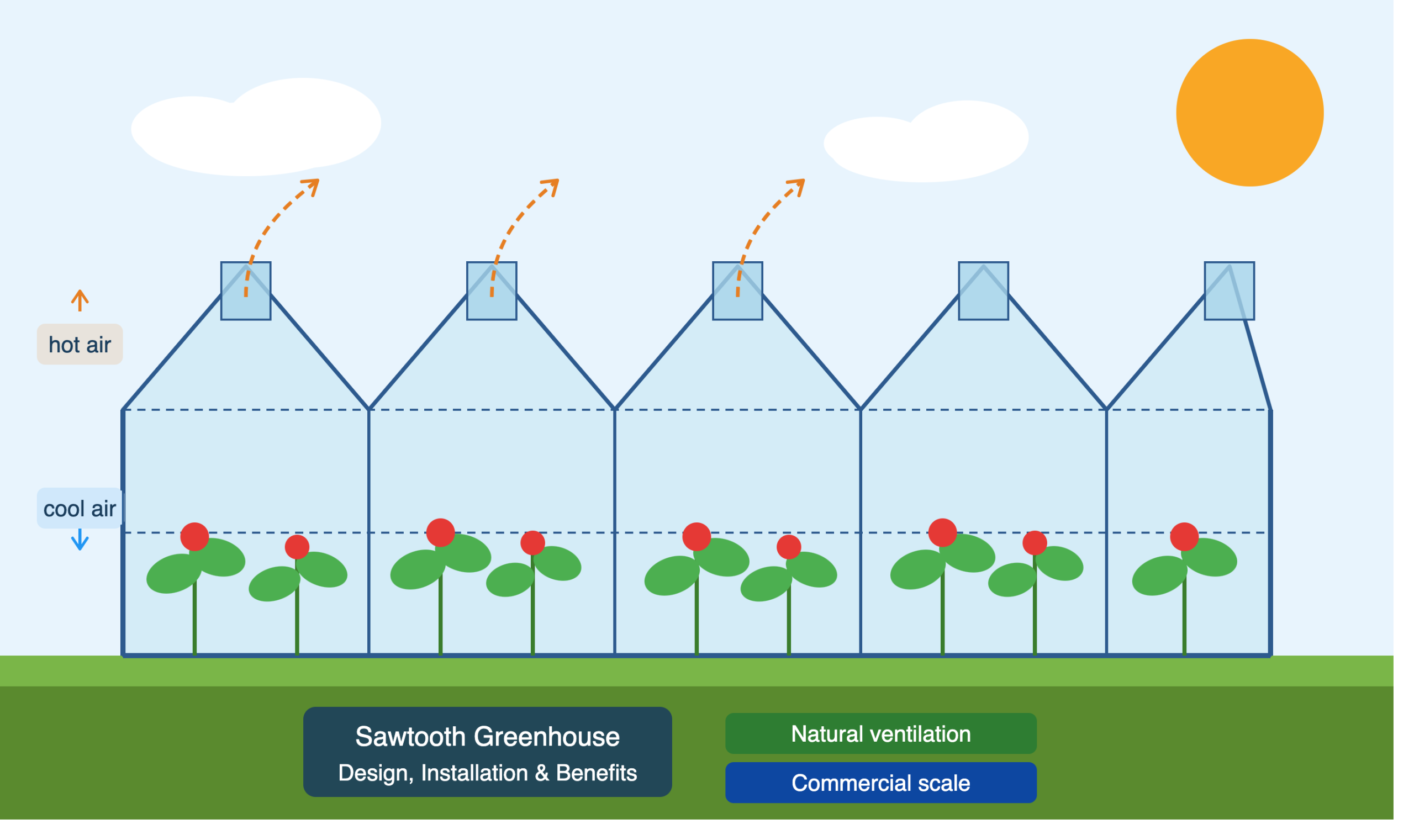
A sawtooth greenhouse is a multi-span agricultural structure named for the distinctive zigzag profile of its roof. Each “tooth” in the roofline consists of a sloped section — typically facing south to capture sunlight — and a near-vertical section fitted with ventilation openings. This alternating pattern repeats across the width of the structure, creating continuous natural airflow channels above the crop zone.
The ventilation principle is straightforward: hot air naturally rises and exits through the upper vertical openings, while cooler ambient air enters from side or lower openings. Because the system relies on convective airflow rather than mechanical fans, it operates without electricity during favorable weather conditions. According to industry analysis published by Aurlant, growers in tropical regions report energy savings of 50–70% on cooling costs compared to mechanically ventilated alternatives, though this figure varies significantly by climate, crop density, and operational management.
The structure is almost always built as a multi-span configuration — multiple sawtooth spans joined side by side — which allows large growing areas to be covered while maintaining the ventilation benefits of the roofline. Single-span versions exist for smaller operations, but the design’s key advantages in airflow uniformity and cost-per-square-meter efficiency become more pronounced at commercial scale.
The roof design also influences light distribution. The alternating angles scatter incoming sunlight more evenly across the growing area than a uniform pitched roof, reducing hotspots and shaded zones. For light-sensitive crops, this can produce more consistent growing conditions than tunnel greenhouses with symmetrical profiles. Sawtooth structures require careful engineering at roof transitions to prevent weather infiltration — a point noted by greenhouse engineering guides including CFGET’s commercial greenhouse review — and this detail separates quality installations from cut-rate ones.
Where Sawtooth Greenhouses Perform Well — and Where They Don’t
Understanding the limitations of this design is as important as understanding its strengths. Sawtooth greenhouses are not a universal solution, and specifying one for the wrong climate or crop situation produces poor results.
The design performs best in hot, humid, and subtropical or tropical regions. The passive ventilation system is effective when there is a meaningful temperature differential between inside and outside air, and when the outside air is cool enough to provide useful ventilation. In practice, this means sawtooth structures are well-suited to Southeast Asia, South Asia, parts of Africa, the Middle East, and warm regions of Latin America — environments where heat accumulation inside closed structures is the primary production challenge. China’s greenhouse industry has developed the sawtooth design extensively for domestic use precisely because large parts of the country experience these conditions seasonally.
The design has clear limitations in cold climates. The same vertical openings that enable airflow in summer become a significant heat retention problem in winter. In regions with cold winters, managing heat loss through the sawtooth vents requires either closing systems — which adds cost and complexity — or accepting higher heating costs. For northern European climates, Scandinavian growing regions, or temperate zones with long winters, high-tech glass venlo greenhouses with precise climate control typically outperform sawtooth designs in year-round energy efficiency.
The design also performs less well when mechanical cooling is still required. If summer temperatures are so extreme that passive ventilation alone cannot maintain acceptable growing temperatures, the cost advantage of avoiding fans largely disappears. In practice, many sawtooth installations in hotter climates combine the passive roof ventilation with evaporative cooling pads and supplemental fans for the hottest months — a hybrid approach that delivers better results than passive ventilation alone.
For comparison, tunnel greenhouses offer lower initial investment but require more mechanical ventilation support in hot climates. Venlo-type glass greenhouses provide the most precise climate control but at significantly higher capital cost and with higher heating requirements in cold weather. The sawtooth design occupies a middle ground: more effective natural ventilation than a tunnel greenhouse, lower capital cost than a high-spec glass structure, but with specific climate suitability requirements that need to match the installation site.
Structure, Materials, and Construction
The main structural components of a commercial sawtooth greenhouse are galvanized steel columns and purlins, roof trusses designed to create the sawtooth profile, gutter systems connecting spans, and the ventilation openings themselves — which may be fixed or motorized depending on the specification.
Galvanized steel is the standard structural material across commercial greenhouse construction, including sawtooth designs, because of its corrosion resistance and structural reliability over a 15–25 year service lifespan. The galvanization specification — typically expressed in grams per square meter of zinc coating — affects long-term durability and is worth verifying in any supplier quotation. Thicker coatings increase upfront cost but reduce maintenance and replacement frequency. Similar durability considerations apply to industrial equipment generally; the principle of prioritizing material quality over initial price to reduce lifecycle costs is relevant across sectors from conveyor belt systems to agricultural infrastructure.
Covering materials fall into two main categories. Greenhouse polyethylene film is the lower-cost option, typically replaced every 3–5 years depending on UV degradation rate and climate. Twin-wall or multi-wall polycarbonate panels cost significantly more upfront but offer better insulation, longer service life (10+ years), and better light diffusion. For tropical applications where insulation is less critical, film covering is often the practical choice. For mixed-climate applications or where light diffusion matters, polycarbonate is generally preferred.
The foundation and installation process involves concrete footings for the columns, frame assembly, covering installation, and then fitting of supplementary systems — irrigation, shading, and environmental monitoring equipment. The complexity of installation scales with the size of the structure and the specification of the systems included. A basic film-covered sawtooth at 3,000–5,000 square meters with manual ventilation is a significantly different project from a 20,000-square-meter installation with motorized ridge vents, evaporative cooling, automated irrigation, and climate control sensors.
Typical Costs and What Affects Them
Greenhouse pricing is highly context-dependent, and any quotation requires site-specific assessment. That said, general industry data provides useful reference points.
Basic single or double-film sawtooth structures sourced from Chinese manufacturers typically range from approximately $8–18 per square meter for the structural frame and covering alone, before site preparation, foundation, irrigation, and systems. More complex configurations with polycarbonate covering, motorized ventilation, and climate control equipment can reach $30–60 per square meter or higher depending on specification. These are indicative industry ranges — actual project costs depend heavily on site accessibility, local labor rates, freight and import costs, and the specific systems specified.
Operating costs are generally lower than mechanically cooled alternatives due to reduced electricity consumption for ventilation, and this is the primary economic argument for the design in appropriate climates. The payback period relative to a tunnel greenhouse or a fully mechanically controlled structure depends on the local energy cost, crop value, and the degree to which passive ventilation actually reduces mechanical cooling requirements at the specific site.
Before committing to a budget, buyers should request itemized quotations that separate structure, covering, foundation, systems, freight, installation, and commissioning — rather than a single all-in figure. The difference between quotations that include and exclude these elements can be substantial.
Practical Considerations When Choosing a Supplier
The global commercial greenhouse market was valued at approximately $46.7 billion in 2025 and is projected to reach $130.5 billion by 2035, growing at a compound annual growth rate of 10.8%, according to market analysis published by Market.us. China is the largest single greenhouse-producing country by area, operating over 4 million hectares of greenhouse structures according to data from the Chinese Academy of Agricultural Sciences, and Chinese manufacturers are the primary source of export-oriented sawtooth greenhouse packages globally.
Working with a China-based manufacturer can offer cost advantages on materials and structural components, but the selection process requires careful evaluation. The key factors are not materially different from evaluating any industrial equipment supplier:
- Engineering documentation: Can the supplier provide structural calculations for the specific wind and snow loads at your site? A supplier who quotes a standard structure without site-specific engineering is not providing an appropriate commercial greenhouse solution — this is particularly important in regions with typhoon, hurricane, or heavy snow risk.
- Material specifications: Request the galvanization standard, steel grade, and covering material specification in writing, not just a verbal description.
- References from comparable projects: A supplier with experience installing sawtooth greenhouses in climates similar to yours, at similar scale, can provide references. A supplier who cannot provide these is a higher-risk choice regardless of price.
- After-sale support: Greenhouse systems require ongoing maintenance and occasional part replacement. Confirm what spare parts availability and technical support look like after installation is complete.
- Installation capability: Determine whether the supplier is providing materials-only with installation guidance, or genuine on-site installation management. These are different service levels with different risk profiles.
Professional Sawtooth Greenhouse installation service providers typically offer integrated packages covering design, structural engineering, material supply, and installation support — which reduces the coordination burden on the buyer but requires verifying each component of the service as above.
Systems That Typically Accompany Sawtooth Greenhouses
A greenhouse structure alone does not create a productive growing environment. The systems installed alongside the structure determine the actual growing conditions and operational efficiency.
Irrigation systems range from basic drip irrigation to fully automated fertigation systems that deliver water and nutrients on programmable schedules. For commercial vegetable production, automated irrigation typically pays for itself in reduced labor and improved yield consistency within the first few growing seasons.
Shading systems — either external shade cloth or internal retractable screens — are important in high-light environments where direct sunlight intensity would damage crops or overheat the growing zone even with good ventilation. External shade is more effective at reducing heat gain; internal shade is more flexible and can be retracted when light levels drop.
Environmental monitoring in modern commercial greenhouses has moved significantly toward sensor-based systems that track temperature, humidity, CO2 levels, and light intensity at multiple points in the growing zone, feeding data to climate control equipment or alerting operators to conditions requiring intervention. The integration of IoT sensors and data logging into agricultural facilities mirrors the broader adoption of connected systems across industrial settings, where real-time monitoring has become standard practice for operational efficiency.
Evaporative cooling pads (also called pad-and-fan systems) are commonly added to sawtooth greenhouses in regions where passive ventilation alone is insufficient during peak summer temperatures. Water-saturated pads at one end of the structure and fans at the other create a cross-flow cooling effect that can reduce internal temperatures by 8–15°C depending on ambient humidity — most effective in dry climates, less effective in high-humidity environments.
Key Questions to Answer Before Starting a Sawtooth Greenhouse Project
Before engaging a supplier, the following questions should be answered at the site assessment stage:
- What are the maximum summer temperatures and minimum winter temperatures at the site, and what temperature range does the target crop require?
- What are the local wind load and snow load requirements under applicable building codes?
- Is the growing area large enough to justify a multi-span structure, or would a simpler single-span tunnel greenhouse be more appropriate?
- What crops are planned, and what are their specific light, temperature, and humidity requirements?
- Is year-round production planned, or is the structure intended for seasonal use?
- What irrigation water source and quality are available at the site?
- What are the local availability and cost of electricity, and how does this affect the economics of mechanical versus passive ventilation?
The answers to these questions determine whether a sawtooth greenhouse is the right structure for the project, what specification is appropriate, and what supplementary systems are necessary.
Conclusion
Sawtooth greenhouses are a well-established and effective commercial growing structure for the right applications — specifically, warm-climate commercial agriculture where natural ventilation is the primary design priority and capital cost efficiency matters. Their passive ventilation system is technically sound, their multi-span configuration scales well for large growing areas, and the energy savings versus mechanically cooled alternatives are real and meaningful in appropriate climates.
They are not the right choice for cold-climate year-round production, for projects where extreme summer heat requires supplemental mechanical cooling regardless, or for growers who prioritize the maximum climate precision that high-tech glass structures provide. Making an accurate assessment of whether the design matches the site climate, crop requirements, and project budget is the most important step in any greenhouse specification processFor growers who have completed that assessment and determined that a sawtooth greenhouse is the right fit, the practical focus should be on selecting a supplier who can demonstrate engineering competence, provide verifiable references, and supply material specifications in writing — rather than on price alone. The difference between a well-specified, properly installed greenhouse and a budget installation that underperforms or requires early repair is typically far larger than the initial price difference between the two.