
Every startup reaches a point where the question changes. It’s no longer “should we market?” It’s “how much should we spend, and on what?” Spend too early, and you burn cash before you know what works. Wait too long, and a competitor takes the market you found first. Neither is a good outcome for a young company.
The truth is that many startups don’t fail because they spent too little on marketing. They fail because they spent it before they were ready, or spent it in the wrong places. Scaling works best when you have proof that customers want what you sell and a clear idea of what it costs to win them. This article explains the signs that you’re ready to invest more, how to set a budget, which channels to scale first, and how to track results so you know when to push harder and when to pull back.
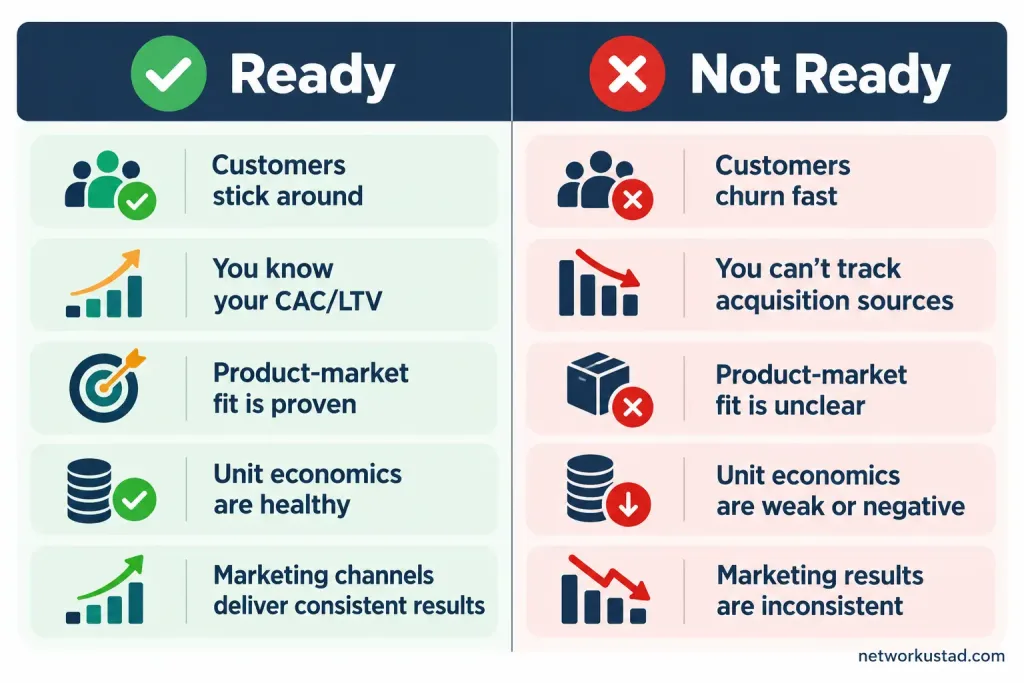
Signs You’re Ready to Invest More
You Have Product-Market Fit
Product-market fit means people want what you’re selling and would be upset if it went away. You’ll often feel it before you can measure it. Sales get easier. Customers refer others without being asked. Support requests shift from “how does this work” to “can it also do this.”
One simple test is to survey your users and ask how they’d feel if they could no longer use your product. If around 40 percent or more say “very disappointed,” that’s a strong sign.
Customers Stick Around
Getting people to sign up is one thing. Keeping them is another. If most customers leave within a month or two, more marketing just fills a leaky bucket. Look for steady or improving retention before you scale.
You Know Your Numbers
You should be able to answer a few basic questions. What does it cost to get a customer? How much is that customer worth over time? How long does it take to earn back what you spent? If you can’t answer these yet, work on that first.
You Found at Least One Channel That Works
You don’t need five working channels. You need one that brings in customers at a cost that makes sense. That’s the channel you scale first.
Signs You’re Not Ready Yet
Hold off on big spending if:
- Customers leave quickly after buying
- You’re still changing what the product does every few weeks
- You can’t track where your customers come from
- Your sales process isn’t ready to handle more leads
- You’re hoping marketing will fix a product problem
More traffic won’t help a product people don’t want. It just makes the problem more expensive.
Know the Metrics That Matter
Customer Acquisition Cost (CAC)
CAC is how much you spend to win one new customer. Add up your marketing and sales costs for a period, then divide by the number of new customers you got in that period.
Customer Lifetime Value (LTV)
LTV is how much money a customer brings in over the whole time they stay with you. For a subscription business, a simple version is average monthly revenue per customer multiplied by how many months they usually stay.
LTV to CAC Ratio
This compares what a customer is worth to what it cost to get them. A common target is about 3 to 1. That means a customer brings in three times what you spent to get them. Much lower, and you may be overspending. Much higher, and you may be growing too slowly and leaving room for competitors.
Payback Period
This is how long it takes to earn back what you spent to get a customer. Many startups aim for 12 months or less. A shorter payback means you can reinvest faster without running out of cash.
How to Set a Marketing Budget
There’s no perfect number. But these methods give you a starting point.
Percentage of Revenue
Many companies spend a set share of revenue on marketing. Growth-stage startups often spend more than established businesses, sometimes 15 to 25 percent or higher. It depends on your industry, margins, and how fast you want to grow.
Goal-Based Budgeting
Work backward from your target. If you want 200 new customers next quarter and your CAC is $150, you need about $30,000 in marketing and sales spend. This keeps your budget tied to real results.
The 70/20/10 Split
A simple way to split your budget:
- 70 percent on channels that already work
- 20 percent on channels that show early promise
- 10 percent on new experiments
This lets you grow what works while still testing new ideas.
Which Channels to Scale First
Double Down on What Already Works
Start with the channel that’s already bringing in customers at a good cost. Increase spend in steps and watch your CAC. At some point, costs start to rise as you reach less interested audiences. That’s your signal to add another channel.
Search and Content
SEO and content take time to build. But once they work, they keep bringing in leads without paying for every click. Good content also builds trust and answers the questions buyers have before they reach out.
Paid Ads
Paid search and paid social can scale fast. You can raise or lower spend almost overnight. The catch is that results stop when you stop paying, and ad costs on major platforms have risen over the past few years. Test small, find what works, then grow.
Email and Retention
It usually costs less to keep a customer than to find a new one. Email, onboarding sequences, and customer check-ins help people stay longer and buy more. This raises your LTV, which gives you more room to spend on getting new customers.
Referrals and Partnerships
Happy customers are one of your best sources of growth. A simple referral program can bring in new users at a low cost. Partnerships with companies that serve the same audience can also open doors quickly.
How Marketing Is Changing in 2026
The rules of the internet keep shifting, and that affects how startups should plan. A few changes stand out right now.
- AI search is growing. More people get answers from AI tools and AI summaries in search results. Clear, helpful content that answers real questions is more important than ever.
- Privacy limits tracking. Browser changes and privacy rules make it harder to track users across sites. First-party data, like email lists and customer accounts, is worth more.
- Ad costs keep rising on the biggest platforms, so wasted spend hurts more.
- Short video still performs on most social platforms, especially for reaching new audiences.
- Trust matters. Buyers check reviews, case studies, and real proof before they commit.
The takeaway is simple. Build assets you own, like your website, content, and email list, instead of relying only on rented attention.
Build In-House, Hire an Agency, or Both
When to Hire In-House
A full-time marketer makes sense when you need someone who knows your product deeply and can work closely with sales and product teams every day. It’s also a good fit once marketing becomes a core, ongoing part of the business.
When an Agency Makes Sense
An agency gives you a full team of skills without hiring each role. That’s useful when you need SEO, paid ads, design, and analytics but can’t afford specialists for all of them. It also helps when you need to move fast.
Local knowledge can help too. A startup based in South Florida might work with a digital marketing agency fort lauderdale businesses already trusted, especially if local customers are a big part of the plan. Wherever you look, ask for case studies, clear reporting, and pricing tied to real results.
Freelancers
Freelancers work well for specific projects, like a website rebuild, a content push, or ad setup. They cost less than an agency but need more management from you.
Many startups use a mix. An in-house lead sets the strategy, and outside help handles the work that needs special skills.
Scale in Steps, Not Leaps
Don’t double your budget overnight. Raise spend by 20 to 30 percent at a time and watch what happens for a few weeks. If CAC stays steady, keep going. If it jumps, pause and find out why.
Set clear rules for yourself, like:
- Keep scaling while CAC stays under a set number
- Pull back if payback stretches past a set limit
- Review results every month, not just every quarter
This keeps you from spending money faster than you can learn from it.
Common Mistakes When Scaling
- Spreading too thin. Trying every channel at once means none get enough attention.
- Ignoring retention. New customers don’t help much if old ones keep leaving.
- Chasing vanity metrics. Likes, followers, and traffic mean little without sales.
- Not tracking properly. If you can’t tell where customers come from, you can’t scale the right things.
- Cutting too fast. Some channels, like SEO, need months before they pay off.
- Copying competitors blindly. What works for them may not fit your audience or budget.
Final Thoughts
Scaling with marketing isn’t about spending more. It’s about spending more on what works. Wait until you have proof that customers want your product and stick around. Learn your CAC, LTV, and payback period. Set a budget tied to your goals. Grow your best channel first, then add others in steps. And keep checking the numbers. If you do that, marketing becomes a steady engine for growth instead of a guess.